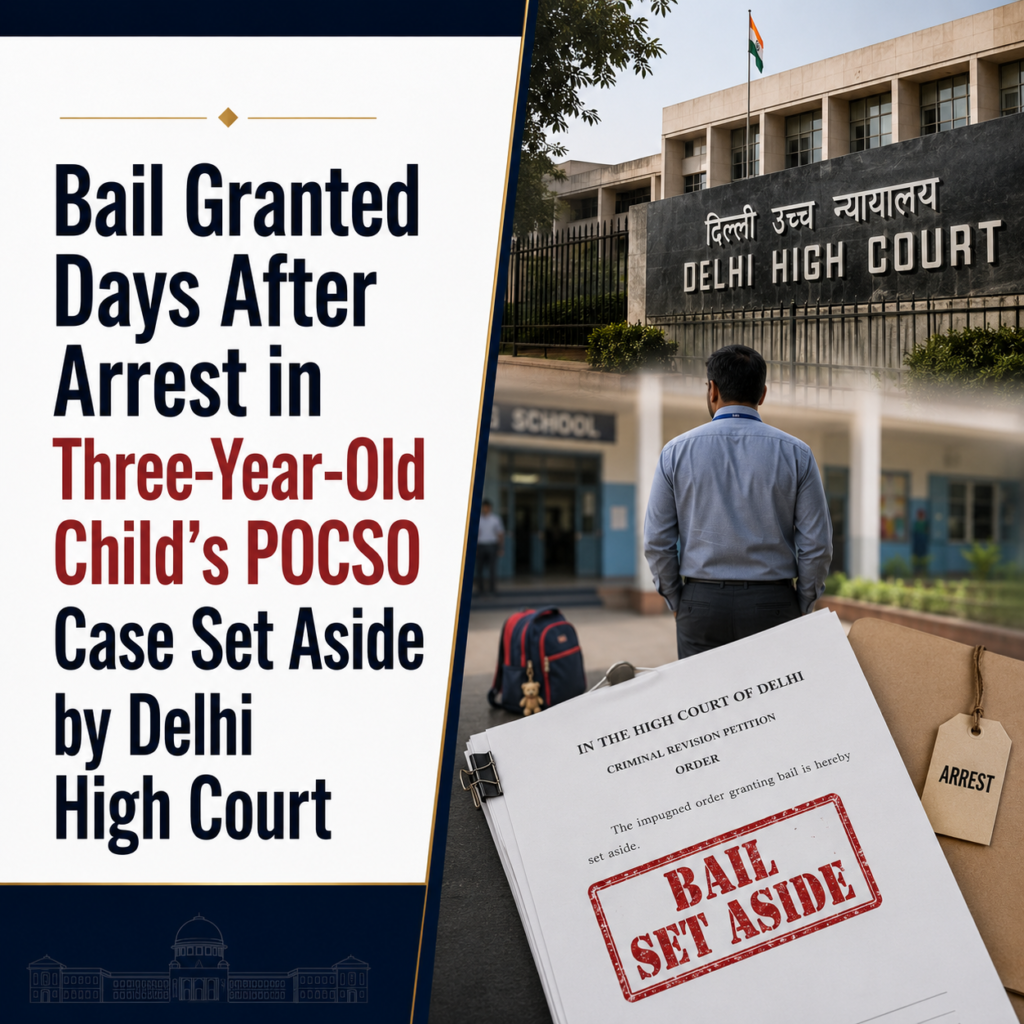
Bail Granted Days After Arrest in Three-Year-Old Child’s POCSO Case Set Aside by Delhi High Court

No Visible Injury Does Not Discredit Three-Year-Old Child’s Statement; Delhi High Court Cancels School Employee’s Bail
Facts
The case arose from FIR No. 104 of 2026 registered at Police Station Janakpuri, Delhi, for offences under Section 64(1) of the Bharatiya Nyaya Sanhita, 2023 and Section 6 of the Protection of Children from Sexual Offences Act, 2012.
The alleged victim was a three-year-old child who had recently joined a nursery school in Janakpuri. On 30 April 2026, after returning from school, the child complained of pain and disclosed to her mother that a man at school had taken her downstairs and touched her inappropriately.
The child later identified Lalit Kumar, a caretaker and Upper Division Clerk working at the school, as the person involved. She also identified the basement room where the incident allegedly occurred.
During investigation, the police seized CCTV-related material and forensic exhibits. One operational camera allegedly showed the accused moving towards the school passage between approximately 8:13 a.m. and 8:37 a.m. Several other CCTV cameras were found non-functional, and forensic examination of the DVR and other material was still pending.
The accused was arrested on 1 May 2026. However, on 7 May 2026, the Additional Sessions Judge granted him regular bail. The State and the child’s mother separately challenged that bail order before the Delhi High Court.
Issues
- Whether the Trial Court granted bail prematurely while the investigation was still at a crucial stage.
- Whether the Trial Court failed to adequately consider the statement and identification made by a three-year-old child.
- Whether the absence of visible injuries in the medical examination could justify granting bail at such an early stage.
- Whether the CCTV footage relied upon by the defence conclusively ruled out the accused’s involvement.
- Whether the seriousness of the alleged offence, the vulnerability of the child and the possibility of influencing witnesses were properly considered.
- Whether the High Court should interfere with and cancel bail already granted by the Trial Court.
Petitioner’s Arguments
The State and the child’s mother argued that the Trial Court had granted bail without properly considering the gravity of the allegations.
They submitted that:
- The allegation concerned a serious offence against a three-year-old child.
- The child had identified the accused and also pointed out the alleged place of occurrence.
- CCTV material placed the accused in the Junior Wing during the relevant morning period.
- Crucial forensic reports were still awaited.
- Several CCTV cameras at the school were non-functional, requiring further investigation.
- The accused had initially delayed cooperation when the police sought access to the school premises and CCTV system.
- The accused had worked at the school for more than 30 years and could potentially influence staff members who were material witnesses.
- The Trial Court had selectively relied upon the medical report and CCTV footage while overlooking incriminating circumstances.
- The Trial Court had effectively conducted a mini-trial at the bail stage.
The petitioners relied upon settled principles requiring courts to consider the seriousness of the offence, prima facie material, possibility of witness influence and the special protection required in POCSO cases.
Respondent’s Arguments
The accused denied the allegations and claimed false implication.
His counsel argued that:
- He was approximately 56 years old and had served the school for over three decades without any criminal antecedents.
- His duties were administrative and he had no direct responsibility for supervising children.
- CCTV footage showed that he left the Junior Wing at about 8:37 a.m. and entered the Senior Wing shortly thereafter.
- He remained in the Senior Wing for the rest of the relevant period.
- The medical examination did not reveal fresh injury, redness or visible marks.
- The prosecution’s medical and electronic material did not conclusively support the allegation.
- He had joined the investigation and there was no material to show that he would abscond or obstruct the investigation.
- Bail could not be refused merely because charges were serious, particularly when the court was not expected to conclusively assess evidence before trial.
The respondent relied upon Dharmander Singh alias Saheb v. State, where bail was granted in a POCSO case without undertaking a final assessment of the evidence.
Analysis of the Law
Scope of Interference With Bail
The High Court acknowledged that a higher court should ordinarily be slow to interfere with an order granting bail.
However, interference is justified where the bail court:
- Ignores material evidence;
- Fails to consider the gravity of the offence;
- Overlooks the vulnerability of the victim;
- Grants bail at a premature stage; or
- Applies legally irrelevant or incomplete reasoning.
Assessment at the Bail Stage
The Court clarified that a bail court should not conduct a detailed trial or record final findings on guilt.
At the same time, it must broadly consider:
- The nature of the accusation;
- The prima facie material;
- The age and vulnerability of the victim;
- The stage of investigation;
- The likelihood of influencing witnesses;
- The seriousness of the punishment; and
- The possibility of obstruction of justice.
Evidentiary Value of a Young Child’s Statement
The High Court placed significant emphasis on the victim’s age.
It held that a three-year-old child cannot be expected to narrate events with the same precision, sequence or understanding as an adult.
A child of such tender age may appear:
- Inconsistent;
- Incomplete;
- Inarticulate; or
- Unable to provide exact timings.
However, this does not mean that the disclosure is false.
The Court considered the child’s identification of the accused and the alleged place of occurrence to be material circumstances that could not be lightly ignored at the bail stage.
Absence of Injury Is Not Conclusive
The Court held that the absence of visible injuries in the medical examination did not automatically discredit the child’s version.
Medical evidence is relevant, but lack of injury is not by itself decisive, particularly where the allegations and surrounding circumstances are still under investigation.
The Court also observed that a preliminary forensic result regarding the tissue paper did not erase the child’s disclosure or identification.
CCTV Evidence
The Court found that the CCTV footage did not conclusively establish the accused’s innocence.
Although the footage showed him leaving the Junior Wing at around 8:37 a.m., it also established his presence there between approximately 8:13 a.m. and 8:37 a.m.
The Trial Court had treated his departure at 8:37 a.m. as a significant exculpatory circumstance without sufficiently examining whether the alleged incident could have occurred before that time.
Premature Grant of Bail
The accused was arrested on 1 May 2026 and granted bail on 7 May 2026, barely a week later.
The High Court held that this was too early because:
- The investigation was still active;
- Forensic reports were awaited;
- CCTV material required further examination;
- The role of other school staff was still being investigated; and
- Several factual issues had not yet crystallised.
Precedent Analysis
Prasanta Kumar Sarkar v. Ashis Chatterjee, (2010) 14 SCC 496
This case lays down the settled factors governing the grant of bail, including the nature of accusation, severity of punishment, prima facie evidence, possibility of witness influence and likelihood of the accused obstructing justice.
The petitioners relied upon it to argue that the Trial Court had not applied the correct legal parameters.
Ms. N v. State & Another, 2023:DHC:6253
The Delhi High Court had emphasised that, in POCSO cases, courts must keep in mind the protective object of the statute and the vulnerability of children.
The judgment highlighted additional considerations such as:
- The child’s age;
- The age difference between victim and accused;
- The nature of the alleged act;
- The relationship between the parties; and
- The likelihood of influence or intimidation.
The High Court found these considerations relevant to the present case.
Dharmander Singh alias Saheb v. State, 2020 SCC OnLine Del 1267
The respondent relied upon this decision to argue that bail may be granted even before framing of charge and that the court should not conclusively assess evidence at the bail stage.
The High Court distinguished it because, in that case:
- The prosecutrix was older and mature;
- There was a prior relationship with the accused;
- The investigation had been completed; and
- Evidence had already begun.
In the present case, the victim was only three years old and the investigation was still continuing.
X v. State of Uttar Pradesh and Another, 2026 SCC OnLine SC 43
The Supreme Court had set aside bail in a POCSO case where the High Court had relied heavily on lack of medical injury and failed to properly consider the gravity of the offence and the vulnerability of the child.
The Delhi High Court relied upon this precedent to hold that absence of medical injury could not be treated as sufficient justification for bail in the present case.
Court’s Reasoning
The High Court found that the Trial Court had missed the central issue: why would a three-year-old child make such a disclosure, identify the accused and point out the alleged place of occurrence?
The Court noted that only two male staff members were posted in the Junior Wing. This reduced the possibility of mistaken identification and was a factor the Trial Court should have considered.
The child’s inability to provide a perfectly sequenced account could not be used against her because of her tender age.
The High Court also held that the Trial Court had given excessive weight to:
- The absence of injuries in the medical report;
- The fact that the accused left the Junior Wing at 8:37 a.m.; and
- The absence of a present need for custodial interrogation.
At the same time, it had failed to sufficiently consider:
- The child’s disclosure;
- The identification of the accused;
- The identification of the place;
- The pending forensic investigation;
- The accused’s longstanding influence in the school; and
- The gravity of the allegations.
The High Court concluded that the bail order had been passed prematurely and without considering crucial material.
Conclusion
The Delhi High Court allowed both petitions filed by the State and the child’s mother.
It set aside the order dated 7 May 2026 by which the Additional Sessions Judge had granted regular bail to Lalit Kumar.
The accused was directed to surrender before the jurisdictional Additional Sessions Judge, POCSO Court, on 1 July 2026 at 2:00 p.m.
The Court clarified that its observations were limited to the question of bail and were not final findings on the guilt or innocence of the accused.
Case Details
Case: State v. Lalit Kumar; XXXX v. State of NCT of Delhi & Another
Court: High Court of Delhi at New Delhi
Case Number: CRL.M.C. 3956/2026 and CRL.M.C. 3966/2026
Judge: Hon’ble Mr. Justice Vinod Kumar
Date: 29 June 2026
Result: Bail granted by the Sessions Court cancelled; accused directed to surrender before the POCSO Court on 1 July 2026.
Bail Granted Days After Arrest in Three-Year-Old Child’s POCSO Case Set Aside by Delhi High Court
No Visible Injury Does Not Discredit Three-Year-Old Child’s Statement; Delhi High Court Cancels School Employee’s Bail
Facts
The case arose from FIR No. 104 of 2026 registered at Police Station Janakpuri, Delhi, for offences under Section 64(1) of the Bharatiya Nyaya Sanhita, 2023 and Section 6 of the Protection of Children from Sexual Offences Act, 2012.
The alleged victim was a three-year-old child who had recently joined a nursery school in Janakpuri. On 30 April 2026, after returning from school, the child complained of pain and disclosed to her mother that a man at school had taken her downstairs and touched her inappropriately.
The child later identified Lalit Kumar, a caretaker and Upper Division Clerk working at the school, as the person involved. She also identified the basement room where the incident allegedly occurred.
During investigation, the police seized CCTV-related material and forensic exhibits. One operational camera allegedly showed the accused moving towards the school passage between approximately 8:13 a.m. and 8:37 a.m. Several other CCTV cameras were found non-functional, and forensic examination of the DVR and other material was still pending.
The accused was arrested on 1 May 2026. However, on 7 May 2026, the Additional Sessions Judge granted him regular bail. The State and the child’s mother separately challenged that bail order before the Delhi High Court.
Issues
- Whether the Trial Court granted bail prematurely while the investigation was still at a crucial stage.
- Whether the Trial Court failed to adequately consider the statement and identification made by a three-year-old child.
- Whether the absence of visible injuries in the medical examination could justify granting bail at such an early stage.
- Whether the CCTV footage relied upon by the defence conclusively ruled out the accused’s involvement.
- Whether the seriousness of the alleged offence, the vulnerability of the child and the possibility of influencing witnesses were properly considered.
- Whether the High Court should interfere with and cancel bail already granted by the Trial Court.
Petitioner’s Arguments
The State and the child’s mother argued that the Trial Court had granted bail without properly considering the gravity of the allegations.
They submitted that:
- The allegation concerned a serious offence against a three-year-old child.
- The child had identified the accused and also pointed out the alleged place of occurrence.
- CCTV material placed the accused in the Junior Wing during the relevant morning period.
- Crucial forensic reports were still awaited.
- Several CCTV cameras at the school were non-functional, requiring further investigation.
- The accused had initially delayed cooperation when the police sought access to the school premises and CCTV system.
- The accused had worked at the school for more than 30 years and could potentially influence staff members who were material witnesses.
- The Trial Court had selectively relied upon the medical report and CCTV footage while overlooking incriminating circumstances.
- The Trial Court had effectively conducted a mini-trial at the bail stage.
The petitioners relied upon settled principles requiring courts to consider the seriousness of the offence, prima facie material, possibility of witness influence and the special protection required in POCSO cases.
Respondent’s Arguments
The accused denied the allegations and claimed false implication.
His counsel argued that:
- He was approximately 56 years old and had served the school for over three decades without any criminal antecedents.
- His duties were administrative and he had no direct responsibility for supervising children.
- CCTV footage showed that he left the Junior Wing at about 8:37 a.m. and entered the Senior Wing shortly thereafter.
- He remained in the Senior Wing for the rest of the relevant period.
- The medical examination did not reveal fresh injury, redness or visible marks.
- The prosecution’s medical and electronic material did not conclusively support the allegation.
- He had joined the investigation and there was no material to show that he would abscond or obstruct the investigation.
- Bail could not be refused merely because charges were serious, particularly when the court was not expected to conclusively assess evidence before trial.
The respondent relied upon Dharmander Singh alias Saheb v. State, where bail was granted in a POCSO case without undertaking a final assessment of the evidence.
Analysis of the Law
Scope of Interference With Bail
The High Court acknowledged that a higher court should ordinarily be slow to interfere with an order granting bail.
However, interference is justified where the bail court:
- Ignores material evidence;
- Fails to consider the gravity of the offence;
- Overlooks the vulnerability of the victim;
- Grants bail at a premature stage; or
- Applies legally irrelevant or incomplete reasoning.
Assessment at the Bail Stage
The Court clarified that a bail court should not conduct a detailed trial or record final findings on guilt.
At the same time, it must broadly consider:
- The nature of the accusation;
- The prima facie material;
- The age and vulnerability of the victim;
- The stage of investigation;
- The likelihood of influencing witnesses;
- The seriousness of the punishment; and
- The possibility of obstruction of justice.
Evidentiary Value of a Young Child’s Statement
The High Court placed significant emphasis on the victim’s age.
It held that a three-year-old child cannot be expected to narrate events with the same precision, sequence or understanding as an adult.
A child of such tender age may appear:
- Inconsistent;
- Incomplete;
- Inarticulate; or
- Unable to provide exact timings.
However, this does not mean that the disclosure is false.
The Court considered the child’s identification of the accused and the alleged place of occurrence to be material circumstances that could not be lightly ignored at the bail stage.
Absence of Injury Is Not Conclusive
The Court held that the absence of visible injuries in the medical examination did not automatically discredit the child’s version.
Medical evidence is relevant, but lack of injury is not by itself decisive, particularly where the allegations and surrounding circumstances are still under investigation.
The Court also observed that a preliminary forensic result regarding the tissue paper did not erase the child’s disclosure or identification.
CCTV Evidence
The Court found that the CCTV footage did not conclusively establish the accused’s innocence.
Although the footage showed him leaving the Junior Wing at around 8:37 a.m., it also established his presence there between approximately 8:13 a.m. and 8:37 a.m.
The Trial Court had treated his departure at 8:37 a.m. as a significant exculpatory circumstance without sufficiently examining whether the alleged incident could have occurred before that time.
Premature Grant of Bail
The accused was arrested on 1 May 2026 and granted bail on 7 May 2026, barely a week later.
The High Court held that this was too early because:
- The investigation was still active;
- Forensic reports were awaited;
- CCTV material required further examination;
- The role of other school staff was still being investigated; and
- Several factual issues had not yet crystallised.
Precedent Analysis
Prasanta Kumar Sarkar v. Ashis Chatterjee, (2010) 14 SCC 496
This case lays down the settled factors governing the grant of bail, including the nature of accusation, severity of punishment, prima facie evidence, possibility of witness influence and likelihood of the accused obstructing justice.
The petitioners relied upon it to argue that the Trial Court had not applied the correct legal parameters.
Ms. N v. State & Another, 2023:DHC:6253
The Delhi High Court had emphasised that, in POCSO cases, courts must keep in mind the protective object of the statute and the vulnerability of children.
The judgment highlighted additional considerations such as:
- The child’s age;
- The age difference between victim and accused;
- The nature of the alleged act;
- The relationship between the parties; and
- The likelihood of influence or intimidation.
The High Court found these considerations relevant to the present case.
Dharmander Singh alias Saheb v. State, 2020 SCC OnLine Del 1267
The respondent relied upon this decision to argue that bail may be granted even before framing of charge and that the court should not conclusively assess evidence at the bail stage.
The High Court distinguished it because, in that case:
- The prosecutrix was older and mature;
- There was a prior relationship with the accused;
- The investigation had been completed; and
- Evidence had already begun.
In the present case, the victim was only three years old and the investigation was still continuing.
X v. State of Uttar Pradesh and Another, 2026 SCC OnLine SC 43
The Supreme Court had set aside bail in a POCSO case where the High Court had relied heavily on lack of medical injury and failed to properly consider the gravity of the offence and the vulnerability of the child.
The Delhi High Court relied upon this precedent to hold that absence of medical injury could not be treated as sufficient justification for bail in the present case.
Court’s Reasoning
The High Court found that the Trial Court had missed the central issue: why would a three-year-old child make such a disclosure, identify the accused and point out the alleged place of occurrence?
The Court noted that only two male staff members were posted in the Junior Wing. This reduced the possibility of mistaken identification and was a factor the Trial Court should have considered.
The child’s inability to provide a perfectly sequenced account could not be used against her because of her tender age.
The High Court also held that the Trial Court had given excessive weight to:
- The absence of injuries in the medical report;
- The fact that the accused left the Junior Wing at 8:37 a.m.; and
- The absence of a present need for custodial interrogation.
At the same time, it had failed to sufficiently consider:
- The child’s disclosure;
- The identification of the accused;
- The identification of the place;
- The pending forensic investigation;
- The accused’s longstanding influence in the school; and
- The gravity of the allegations.
The High Court concluded that the bail order had been passed prematurely and without considering crucial material.
Conclusion
The Delhi High Court allowed both petitions filed by the State and the child’s mother.
It set aside the order dated 7 May 2026 by which the Additional Sessions Judge had granted regular bail to Lalit Kumar.
The accused was directed to surrender before the jurisdictional Additional Sessions Judge, POCSO Court, on 1 July 2026 at 2:00 p.m.
The Court clarified that its observations were limited to the question of bail and were not final findings on the guilt or innocence of the accused.
Case Details
Case: State v. Lalit Kumar; XXXX v. State of NCT of Delhi & Another
Court: High Court of Delhi at New Delhi
Case Number: CRL.M.C. 3956/2026 and CRL.M.C. 3966/2026
Judge: Hon’ble Mr. Justice Vinod Kumar
Date: 29 June 2026
Result: Bail granted by the Sessions Court cancelled; accused directed to surrender before the POCSO Court on 1 July 2026.