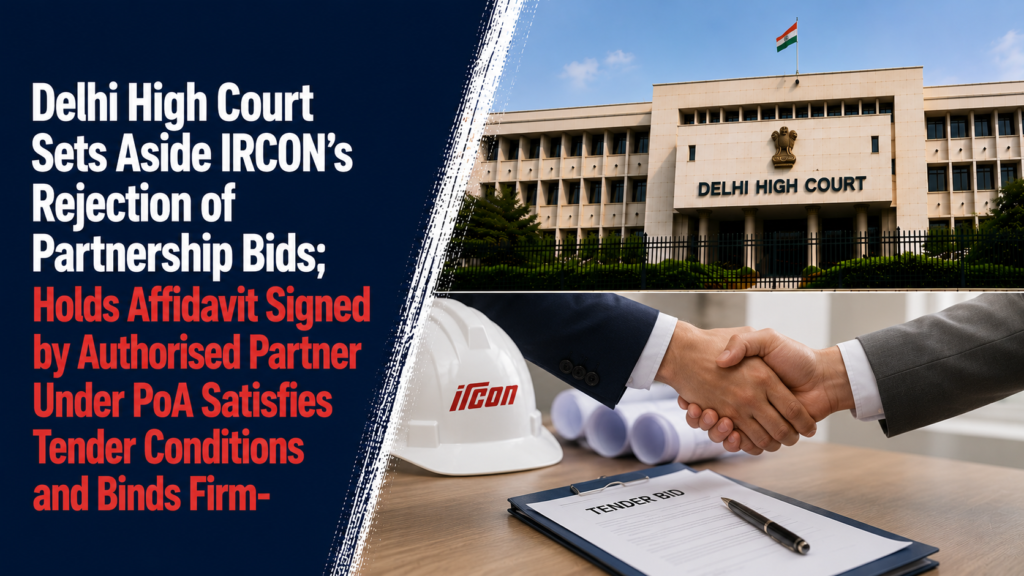
Delhi High Court Sets Aside IRCON’s Rejection of Partnership Bids; Holds Affidavit Signed by Authorised Partner Under PoA Satisfies Tender Conditions and Binds Firm

Delhi High Court Allows Writs Against IRCON Tender Disqualification; Says Substance of Partner Declarations Prevails Over Mechanical Signature Formality
Facts
Two writ petitions under Article 226 of the Constitution were filed by Rawani Construction and M/s Trishul Constructions, both partnership firms, challenging their disqualification by IRCON International Limited in a tender for construction of an MSME Technology Centre at Nagpur, Maharashtra.
The controversy arose from an affidavit required under Annexure IV of the Instructions to Tenderers.
Each petitioner submitted the affidavit through one partner who had been duly authorised by the remaining partners through a Power of Attorney.
IRCON rejected both bids on the ground that the affidavit was required to be signed by every partner individually, whereas it had been signed only by the authorised partner.
Rawani Construction’s authorised partner was Amit Rawani, while in Trishul Constructions the partners had authorised Manish Kumar Agrawal to execute the affidavit on their behalf.
The petitioners argued that the prescribed affidavit format itself expressly stated:
“Signed by the Authorized Representative of the Firm.”
They therefore contended that they had complied exactly with the tender format supplied by IRCON.
Issues
The principal issue before the Delhi High Court was:
Whether an affidavit submitted by a partnership bidder under Annexure IV, signed and sworn by one duly authorised partner acting under a Power of Attorney from all partners, complied with the tender conditions.
The Court also considered:
- Whether Clause 7 of the Essential Qualifying Criteria required every partner to personally sign the affidavit;
- Whether that requirement conflicted with Annexure IV, which expressly permitted signature by the authorised representative of the firm;
- Whether such inconsistency in the tender documents could be used against the bidders;
- Whether one partner authorised under a PoA could validly depose to the required declarations on behalf of the other partners;
- Whether a single affidavit signed by multiple partners would even conform to the legal character of an affidavit;
- Whether the alleged deficiency affected the substance or responsiveness of the bids;
- Whether requiring signatures from all partners would confer any competitive or substantive advantage; and
- Whether the petitioners’ technical disqualification was arbitrary and liable to be interfered with under Article 226.
Petitioners’ Arguments
The petitioners argued that they had followed the exact format prescribed in Annexure IV.
That format expressly provided that the affidavit was to be:
“Signed by the Authorized Representative of the Firm.”
Further, Annexure IV cross-referenced Clause 26(b) of the ITT, Clause 4 of the EQC and Clause 10.2 of the ITT. None of those provisions required the affidavit to be individually signed by every partner.
The petitioners contrasted this with the Integrity Pact, where the tender expressly required signatures of all partners of a partnership firm.
They argued that this difference demonstrated that where IRCON intended all partners to sign, it had said so expressly.
They further submitted that:
- the authorised partner held a valid PoA executed by all partners;
- the affidavit therefore legally bound the firm and all partners;
- none of the partners suffered from blacklisting, insolvency or other disqualifications referred to in the affidavit;
- there was no misrepresentation;
- the alleged deficiency was at best curable; and
- rejection of the bid was arbitrary and hyper-technical.
The petitioners relied upon Royal BNILLP (JV) v. Union of India.
Respondent’s Arguments
IRCON defended the disqualification by relying principally upon Clause 7 of the Essential Qualifying Criteria.
It argued that this provision expressly required the Annexure IV affidavit to be signed by all partners of a partnership firm.
IRCON submitted that the affidavit contained personal declarations concerning each partner, including whether any partner:
- had been declared a non-performer;
- was debarred or blacklisted;
- was undergoing CIRP, liquidation or restructuring; or
- had defaulted in contractual obligations.
Therefore, each partner was allegedly required to personally make the declaration.
IRCON further argued that:
- the PoA was general in nature and did not specifically authorise the substantive declarations;
- the words “Signed by the Authorized Representative of the Firm” were merely a generic footer;
- the specific requirement under Clause 7 of the EQC prevailed over the affidavit format; and
- courts should ordinarily defer to a tendering authority’s interpretation unless arbitrary, perverse or mala fide.
It relied upon Kalinga Commercial Corporation Ltd. v. Steel Authority of India and Amit Kumar v. Union of India.
Analysis of the Law
1. Tender Documents Were Internally Inconsistent
The Court found that Annexure IV did not refer to Clause 7 of the EQC at all.
Instead, it referred to Clause 26(b), Clause 4 of the EQC and Clause 10.2 of the ITT.
None of those provisions required every partner to sign the affidavit.
More importantly, the actual affidavit format expressly stated that it should be signed by the “Authorized Representative of the Firm.”
The Court therefore found an apparent contradiction between Annexure IV and Clause 7 of Annexure V.
It held that this inconsistency arose from the manner in which IRCON itself had drafted the tender documents.
Accordingly, the resulting ambiguity could not fairly be attributed to the petitioners, who had acted according to the prescribed format.
2. No Misrepresentation by the Petitioners
There was no dispute that all partners of the petitioners actually satisfied the declarations contained in the affidavit.
None was blacklisted, undergoing CIRP or suffering from any other stated disqualification.
The authorised partner’s declaration on behalf of all partners was therefore factually correct.
The Court expressly found that there had been no misrepresentation by the petitioners.
3. One Affidavit Is Normally Sworn by One Deponent
The Court found IRCON’s interpretation problematic even as a matter of basic affidavit law.
An affidavit is, by its nature, a sworn declaration by a deponent, accompanied by verification and administration of an oath by a Notary.
The Court held that IRCON’s contention that all partners should simultaneously execute and swear one common affidavit was inconsistent with the legal character of an affidavit.
If IRCON genuinely intended separate personal declarations from each partner, the tender ought to have required each partner to execute a separate affidavit.
4. Authorised Partner Can Swear Affidavit for Others
The Court held that the law permits one person to swear an affidavit on behalf of another where that person is properly authorised and deposes on instructions.
Here, all partners had authorised one partner through a valid PoA to execute the tender documents and make the declarations.
The Court therefore held that execution of the affidavit by the authorised partner on behalf of himself and the remaining partners was legally valid and fulfilled the purpose of the tender condition.
5. IRCON’s Own Sample Demonstrated the Problem
IRCON placed before the Court an affidavit filed by another bidder whose bid had been treated as responsive.
That affidavit bore signatures of five partners on the same document.
The Court examined the document reproduced on page 14 of the judgment and found that the contents had not been separately verified by the purported deponents and the Notary’s affirmation stamp did not even identify a specific deponent.
The Court held that such a document could not properly be characterised as an affidavit.
Rather than supporting IRCON, the sample demonstrated that its insistence upon all partners signing one affidavit resulted in “paper compliance” that was neither meaningful nor legally proper.
6. IRCON Was Insisting on Mechanical Compliance
The Court was also critical of the manner in which Annexure IV had been drafted for different types of bidders.
It noted that the contents were primarily directed towards partnership firms and their partners, yet the same format was apparently being mechanically used for corporate bidders without requiring declarations from every director or shareholder.
The Court observed that the format did not appear to have been adequately thought through for companies, LLPs or other bidder structures.
The substantive object of the condition was merely to ensure that the bidder and its constituents did not suffer from the stipulated disqualifications.
That substantive objective was fully satisfied through the authorised partner’s affidavit.
7. Partnership Law Supported the Petitioners
The Court relied upon Chapter IV of the Indian Partnership Act, 1932.
A partner is an agent of the firm, and acts undertaken by an authorised partner in the ordinary course bind the firm and the other partners.
This reinforced the reasonableness of the petitioners’ understanding that their authorised partner could execute Annexure IV for and on behalf of the partnership.
8. Even Assuming IRCON’s Interpretation, There Was Substantial Compliance
The Court went further and held that even if IRCON’s interpretation were assumed to be correct, the underlying purpose of the condition had been fulfilled.
All partners had executed the PoA.
The authorised representative then gave a binding sworn declaration on their behalf.
Obtaining additional signatures would:
- not alter the bid;
- not improve the petitioner’s eligibility;
- not confer an unfair advantage; and
- not prejudice competing bidders.
Thus, the disqualification elevated a matter of form above substance.
Precedent Analysis
Royal BNILLP (JV) v. Union of India, 2023 SCC OnLine Gau 5472
The petitioners relied upon this Gauhati High Court decision to support their contention that deficiencies of a technical or curable nature should not result in rejection where the substantive tender requirement has otherwise been fulfilled.
Kalinga Commercial Corporation Ltd. v. Steel Authority of India, 2023 SCC OnLine Del 3458
IRCON relied upon this judgment for judicial restraint in tender matters.
The Delhi High Court distinguished it.
Kalinga Commercial Corporation concerned non-compliance with an express financial eligibility criterion involving net worth.
In the present case, the petitioners’ substantive eligibility was not disputed; the controversy concerned only the manner in which the affidavit had been executed under conflicting tender instructions.
Amit Kumar v. Union of India, 2019 SCC OnLine Del 12333
IRCON also relied upon Amit Kumar.
The Court distinguished that judgment because the bidder there had completely failed to furnish a mandatory undertaking.
Here, by contrast, the petitioners had actually submitted the required affidavit in the prescribed format. The only controversy was whether all partners or the authorised representative had to sign it.
Thus, neither precedent justified rejection of the petitioners’ bids.
Court’s Reasoning
The High Court found the petitioners’ interpretation of the tender documents both reasonable and legally sustainable.
Annexure IV itself directed signature by the authorised representative.
The provisions expressly cross-referenced in Annexure IV did not require all partners to sign.
The contradictory requirement appeared only in Clause 7 of another annexure that was not cross-referenced in the affidavit format.
The ambiguity therefore arose from IRCON’s own drafting.
Further, the affidavit had been sworn by a partner validly authorised through a PoA executed by all partners. The declaration was factually correct and legally binding on the firm.
The Court also considered the very notion of five or more persons jointly “swearing” a single affidavit to be inconsistent with affidavit law, unless each were separately administered an oath and made a proper verification.
The sample relied upon by IRCON itself illustrated how its approach had resulted only in mechanical signatures rather than a legally proper common affidavit.
The Court therefore concluded that rejection of the petitioners’ bids solely because all partners had not signed Annexure IV was unsustainable.
Conclusion
The Delhi High Court allowed both writ petitions.
In Rawani Construction’s case, it:
- set aside IRCON’s decision dated 10 July 2026 disqualifying the bid for non-signature of Annexure IV by all partners;
- directed IRCON to process and evaluate the technical bid;
- directed that, if technically eligible, the financial bid must also be considered; and
- permitted IRCON, if it wished, to separately seek an individual affidavit from each partner.
The Court also clarified that in other similar tenders, IRCON cannot disqualify the petitioners on the same ground.
The same relief was granted to Trishul Constructions, whose disqualification dated 10 July 2026 was likewise set aside, with directions to process its technical bid and, if eligible, consider its financial bid.
Finally, the Court advised IRCON to re-examine and redraft Annexure IV and its execution instructions so that the requirements are clear for partnership firms, joint ventures and corporate entities.
Case Details
Case: Rawani Construction & Anr. v. IRCON International Limited & Anr. with M/s Trishul Constructions v. M/s IRCON International Limited
Court: High Court of Delhi at New Delhi
Case Number: W.P.(C) 9493/2026 & W.P.(C) 9544/2026; CNR Nos. DLHC010301392026 & DLHC010304872026
Judges: Justice V. Kameswar Rao and Justice Manmeet Pritam Singh Arora
Reserved On: 31 July 2026
Date: 12 August 2026
Result: Both writ petitions allowed; disqualifications set aside; IRCON directed to process technical bids and, if eligible, consider financial bids; similar disqualification barred in other tenders on the same ground.