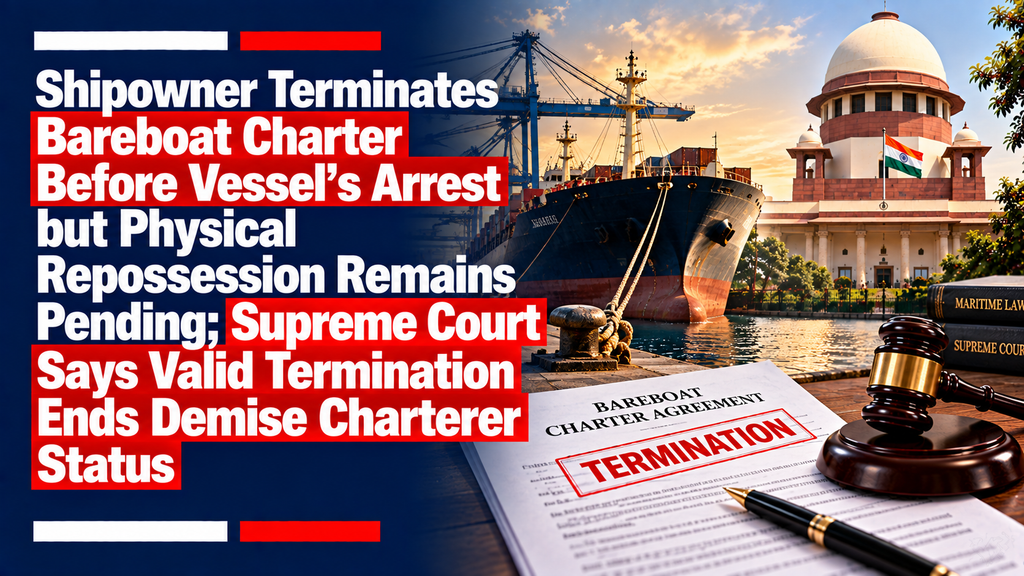
Shipowner Terminates Bareboat Charter Before Vessel’s Arrest but Physical Repossession Remains Pending; Supreme Court Says Valid Termination Ends Demise Charterer Status

Vessel Arrested for Charterer’s Maritime Debt Despite Earlier Termination of Charter; Supreme Court Sets Aside Arrest and Restores Shipowner’s Rights
Facts
The dispute concerned the vessel M.V. Nereus Progress, owned by the appellant, and its continued arrest pursuant to the admiralty jurisdiction of the Madras High Court. The respondent, Om Freight Forwarders Ltd., was not a creditor of the appellant shipowner; rather, it was a creditor of Nereides Marine Services, which had been the demise charterer of M.V. Nereus Progress. OWNERS AND PARTIES
On 3 October 2024, the appellant gave M.V. Nereus Progress to Nereides under a bareboat charter executed on the BIMCO BARECON 2017 form. Separately, Om Freight had given its own vessel, M.V. Bharadwaj, to Nereides under another bareboat charter. OWNERS AND PARTIES
Nereides repeatedly defaulted in payment of hire to the appellant. After several demands, the appellant issued an Anti-Technicality Notice on 6 November 2025 granting three banking days to cure the default. When payment was still not made, the appellant terminated the charter on 13 November 2025 and issued a repossession notice on 19 November 2025. OWNERS AND PARTIES
Meanwhile, Nereides had also defaulted on amounts payable to Om Freight under the separate charter of M.V. Bharadwaj. Om Freight therefore instituted an admiralty suit and sought the arrest of M.V. Nereus Progress as a sister ship, contending that Nereides continued to be its demise charterer.
Before the appellant could physically repossess M.V. Nereus Progress at Tuticorin, Om Freight obtained an ex parte arrest order on 4 December 2025. OWNERS AND PARTIES
The Single Judge and subsequently the Division Bench of the Madras High Court refused to vacate the arrest, reasoning that termination of a demise charter ordinarily does not become effective until the owner physically repossesses the vessel. OWNERS AND PARTIES
The shipowner approached the Supreme Court.
Issues
The Supreme Court formulated two principal questions:
- Whether the appellant had validly terminated the bareboat charter through its notice dated 13 November 2025; and
- Even if the charter was validly terminated, whether Nereides nevertheless continued to remain the demise charterer until physical repossession of the vessel by the owner. OWNERS AND PARTIES
The second question was crucial because Section 5(1)(b) read with Section 5(2) of the Admiralty Act permitted the sister-ship arrest only if the statutory conditions concerning the demise charterer’s status continued to exist at the time of arrest.
Appellant’s Arguments
The shipowner argued that the High Court proceeded on the erroneous premise that Nereides remained the demise charterer merely because physical repossession had not been completed.
It contended that Section 5(1)(b) required the relevant party not only to have been the demise charterer when the maritime claim arose, but also to remain the demise charterer or owner when the arrest was effected. Nereides had ceased to satisfy that requirement because the charter had already been terminated on 13 November 2025, three weeks before the arrest. OWNERS AND PARTIES
Most importantly, Clause 32 of the contract expressly provided that after termination and pending physical repossession, the charterer would hold the vessel merely as a “gratuitous bailee” for the owner. Therefore, physical possession and legal status as demise charterer were distinct questions.
Respondent’s Arguments
Om Freight argued that Nereides continued to exercise effective control over and commercially employ the vessel and therefore remained its demise charterer notwithstanding the termination notice.
It maintained that physical redelivery and repossession were necessary to terminate the bareboat charter. It also argued that whether Nereides was actually a demise charterer or merely a gratuitous bailee was a mixed question of fact that should be decided at trial rather than in proceedings seeking recall of the arrest. OWNERS AND PARTIES
Analysis of the Law
The Supreme Court first examined whether the termination itself was valid.
Nereides owed USD 696,500 in arrears. Multiple demands had been made, followed by the contractual three-day cure period. No payment was made. Nereides itself acknowledged receipt of the termination notice and sought additional time, stating that otherwise it would accept the owner’s decision and arrange an orderly handover. OWNERS AND PARTIES
The Court emphasized that commercial contracts must ordinarily be given effect according to their terms and commercial purpose. Courts should enforce the bargain struck by the parties rather than rewrite it.
It accordingly held that the 13 November 2025 termination was proper and valid. OWNERS AND PARTIES
Precedent Analysis
The Court identified two competing lines of foreign authority.
The Singapore High Court in The Chem Orchid and the Sri Lankan Court of Appeal in Navi-Bunkering Corp. had taken the view that demise-charterer status generally continues until physical possession is returned to the owner.
By contrast, the Federal Court of Australia in The Hako Fortress and the Hong Kong Court in M.V. Trident Dawn treated contractual termination and physical repossession as separate events: the charter could terminate upon a valid notice even though physical repossession occurred later. OWNERS AND PARTIES
The Supreme Court noted that the precise issue had apparently not previously been authoritatively settled by an Indian court. Instead of mechanically adopting either foreign approach, it held that the answer must turn upon the language of the particular charterparty and the surrounding facts. OWNERS AND PARTIES OWNERS AND PARTIES
Court’s Reasoning
The decisive provision was Clause 32 of BIMCO BARECON 2017.
It expressly stated that following early termination, the owner could repossess the vessel and that:
“Pending physical repossession… the Charterers shall hold the Vessel as gratuitous Bailee only…”
OWNERS AND PARTIES
The Supreme Court held that the language made the contractual structure clear: repossession was a consequence of an already completed termination, not a condition precedent to termination.
A demise charterer possesses and operates the vessel essentially as owner for the duration of the charter. A gratuitous bailee, by contrast, possesses another’s property without an independent right to use or commercially employ it. Nereides could not simultaneously occupy both legal statuses. OWNERS AND PARTIES
Accordingly:
Clause 31 = termination of the charter.
Clause 32 = mechanism for subsequent physical repossession.
The Court held that termination took effect upon service of the valid notice. At that moment, Nereides’ legal status changed from demise charterer to gratuitous bailee. Physical repossession merely completed the practical transfer of control. OWNERS AND PARTIES
The Court also highlighted the commercial consequences of the contrary interpretation. If physical repossession were mandatory before termination became effective, a defaulting charterer could frustrate the owner’s contractual termination right simply by delaying or obstructing delivery of the vessel. The owner’s contractual right would effectively become “hostage to the very default that occasioned its exercise.” OWNERS AND PARTIES
Admiralty Arrest
Section 5(1)(b) required Nereides to continue to be the demise charterer or owner of the vessel when the arrest was effected. Section 5(2), permitting sister-ship arrest, remained subject to those jurisdictional conditions. OWNERS AND PARTIES
Here, the charter had validly ended on 13 November 2025, whereas the vessel was arrested only on 4 December 2025.
Nereides therefore no longer possessed the requisite status when the arrest occurred. The statutory foundation for arrest consequently failed. OWNERS AND PARTIES
Conclusion
The Supreme Court allowed the shipowner’s appeal and set aside the Madras High Court judgment.
It held that:
- the 13 November 2025 termination was valid;
- a valid termination notice under Clause 31 was sufficient to end the demise charter;
- physical repossession was not a condition precedent and merely completed the practical transfer of control;
- Nereides thereafter held M.V. Nereus Progress only as a gratuitous bailee;
- Nereides had ceased to be the demise charterer well before the 4 December 2025 arrest; and
- consequently, the arrest of M.V. Nereus Progress was vacated. OWNERS AND PARTIES
Case Details
Case: Owners and Parties Interested in M.V. Nereus Progress v. Om Freight Forwarders Ltd.
Court: Supreme Court of India
Citation: 2026 INSC 1055
Case: Civil Appeal arising out of SLP (C) No. 23834 of 2026
Bench: Chief Justice Surya Kant, Justice Joymalya Bagchi and Justice V. Mohana
Date: 25 September 2026
Result: Appeal allowed; Madras High Court judgment set aside; arrest of M.V. Nereus Progress vacated.