Employer Leaves With Worker to Collect Business Payments and Is Later Found Murdered; Delhi High Court Upholds Worker’s Life Sentence on Circumstantial Evidence

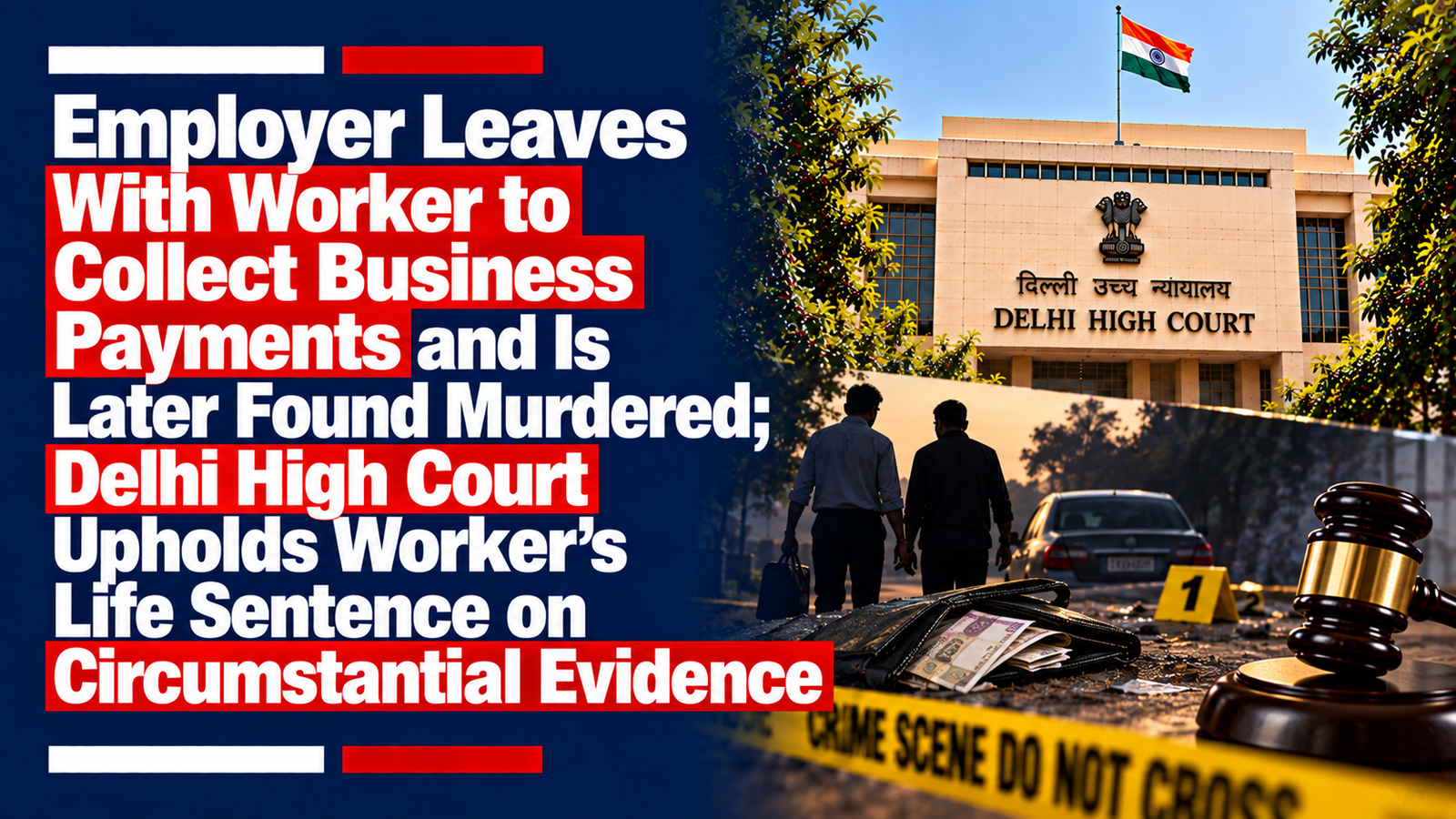
Unidentified Body Found and Buried in Bulandshahar Is Later Linked to Missing Delhi Businessman; Delhi High Court Upholds Employee’s Murder Conviction
Facts
According to the prosecution, Hasmat Ali worked with Mohd. Hanif, who was engaged in a jacket-related business. Hanif’s wife reported that Hasmat had taken her husband from Delhi on the pretext of going to Jaipur for business and collecting payments. Hanif never returned. A missing report was eventually lodged and an FIR under Section 364 IPC followed. HASMAT ALI
Hasmat was arrested on 9 January 2000. In his disclosure statement, he allegedly stated that Hanif had been murdered and that his body had been thrown in the Bulandshahar area of Uttar Pradesh.
When Delhi Police reached Bulandshahar, they discovered that an unidentified body had already been recovered on 2 January 2000, post-mortem had been conducted, and the body had been buried as unclaimed. Hanif’s son subsequently identified his father through photographs and clothes preserved by the police. HASMAT ALI
The Trial Court convicted Hasmat under Section 302 IPC and sentenced him to life imprisonment with a fine of ₹500. Co-accused Mohd. Iqbal was acquitted by giving him the benefit of doubt. HASMAT ALI
Hasmat challenged his conviction before the Delhi High Court.
Issues
The principal issue was whether a murder conviction could safely be sustained when the prosecution case was based entirely on circumstantial evidence.
The Court examined whether the prosecution had established a complete chain through:
- identification of the deceased;
- last-seen evidence;
- proximity between the last-seen circumstance and the time of death;
- Hasmat’s relationship with and employment under the deceased;
- motive concerning business collections;
- Hasmat’s disclosure and knowledge concerning the unidentified body;
- his subsequent conduct; and
- his failure to explain what happened after he left with the deceased.
Appellant’s Arguments
Hasmat argued that the prosecution’s circumstantial chain was incomplete.
A major challenge concerned the identity of the body. Hanif’s family described him as having a beard, whereas the recovered body was clean-shaven. The body had initially remained unidentified and had been buried as unclaimed.
He also relied upon discrepancies regarding whether Hanif disappeared on 31 December 1999 or 1 January 2000 and the delay of about eight or nine days in lodging the missing report. HASMAT ALI
The defence further argued that the prosecution’s alleged manner of murder did not correspond with the medical evidence. The disclosure allegedly referred to strangulation with a lungi, but the post-mortem attributed death to coma resulting from ante-mortem injuries, particularly a fatal head injury. The alleged lungi was never recovered. HASMAT ALI
It was also argued that:
- the alleged motive of misappropriating business collections was unproved;
- the alleged extra-judicial confession had already been rejected by the Trial Court;
- last-seen evidence by itself was insufficient;
- the STD booth owner from where Hasmat allegedly called the family was never examined; and
- pointing out the location of the body had little value because Bulandshahar Police had already discovered it. HASMAT ALI
Respondent’s Arguments
The State argued that the circumstances, when considered cumulatively, pointed only towards Hasmat.
It relied particularly upon the wife and sons of the deceased as well as independent Dhaba owner Mukut Lal, who supported the last-seen circumstance.
The State further argued that Delhi Police did not know before Hasmat’s disclosure that an unidentified body had already been recovered in Bulandshahar. Therefore, his knowledge of the body and its location was an important admissible discovery.
According to the State, the identification of the body, motive, last-seen evidence, disclosure and Hasmat’s subsequent conduct collectively formed a complete chain.
Analysis of the Law
Last Seen Cannot Alone Sustain Conviction
The High Court recognized that the last-seen theory is an important circumstance but ordinarily cannot by itself form the sole basis of conviction.
Relying upon Nizam v. State of Rajasthan, the Court held that last-seen evidence must be considered together with the circumstances preceding and following the point when the accused and deceased were last seen together. HASMAT ALI
Here, several witnesses stated that Hanif left with Hasmat. Importantly, the prosecution did not rely exclusively upon family members; an independent Dhaba owner testified that the two had eaten at his establishment and thereafter left together. HASMAT ALI
Medical Evidence Corroborated the Timeline
The post-mortem indicated that the injuries were approximately one-and-a-half days old. Since the examination occurred on 3 January 2000, the injuries were consistent with having been inflicted during the night of 1/2 January.
That substantially corresponded with the prosecution evidence that Hanif was last seen with Hasmat on 1 January.
The Court therefore found sufficient temporal proximity between last seen alive and the probable time of death. HASMAT ALI
Section 106 Evidence Act
The High Court emphasized that Section 106 does not relieve the prosecution of its initial burden.
Only after the prosecution establishes foundational facts can the accused’s failure to explain facts particularly within his knowledge become an additional circumstance.
Here, once the prosecution established that Hasmat took Hanif with him and Hanif was last seen alive in his company, Hasmat was expected to explain when and how they separated. His bare denial under Section 313 CrPC supplied no such explanation. HASMAT ALI
Body Already Recovered — Disclosure Still Relevant
This was one of the judgment’s significant evidentiary findings.
Hasmat argued that his alleged disclosure regarding the body’s location had no value because Bulandshahar Police had already recovered the body before his disclosure.
The High Court rejected that argument.
It reasoned that the importance of the disclosure was not the physical recovery of the body itself. Until Delhi Police arrived following Hasmat’s disclosure, the body recovered by Bulandshahar Police remained unidentified.
The significant discovery was the connection between that unidentified body and Mohd. Hanif, together with Hasmat’s knowledge of the location where it had been found. The Court held this relevant under Section 27 of the Evidence Act. HASMAT ALI
Precedent Analysis
The Court relied upon Charandas Swami v. State of Gujarat, where the Supreme Court held that prior recovery of an unidentified body does not necessarily destroy the evidentiary value of an accused’s subsequent disclosure if that disclosure reveals information exclusively within his knowledge and connects the recovered body with the crime. HASMAT ALI
On last-seen evidence, the Court relied upon Nizam v. State of Rajasthan to reiterate that last seen must operate as part of the larger circumstantial chain rather than as an isolated basis for conviction. HASMAT ALI
For Section 106, the Court referred to Ganeshlal v. State of Maharashtra, emphasizing that once foundational facts are established, failure to explain circumstances exclusively within the accused’s knowledge may operate as an additional link. HASMAT ALI
Court’s Reasoning
The High Court found that the recovered body was sufficiently established to be that of Mohd. Hanif.
Although Hanif was normally bearded and the recovered body was clean-shaven, a witness had noticed fresh blade marks on the face. The Court considered this a plausible explanation for the discrepancy and observed that shaving the beard could have been intended to make identification difficult.
More importantly, Hanif’s son identified not merely the photographs but also his father’s preserved clothes. HASMAT ALI
The medical evidence independently established a homicidal death. The discrepancy between the disclosure statement referring to strangulation and the post-mortem showing fatal blunt-force injuries did not undermine the fact of murder; the Court noted that the disclosure version could itself have been misleading. HASMAT ALI
The Court further found Hasmat’s employment with Hanif proved through several witnesses despite the absence of documentary employment records. HASMAT ALI
Ultimately, the High Court held that the circumstances had to be assessed cumulatively rather than in isolation. The last-seen evidence, medical timeline, identification of the body, Hasmat’s knowledge disclosed to police, motive and his unexplained conduct constituted a complete chain pointing towards his guilt.
The Court also held that non-examination of the STD booth owner did not destroy the case because the alleged telephone calls were merely supportive circumstances, not the foundation of the conviction.
Conclusion
The Delhi High Court held that the Trial Court had properly appreciated the circumstantial evidence and that the prosecution had established Hasmat Ali’s guilt beyond reasonable doubt.
It found no perversity or illegality in the conviction and held that the life sentence was proportionate to the offence.
Accordingly, Hasmat Ali’s appeal was dismissed and his conviction and life sentence under Section 302 IPC were upheld.
Since the appellant was before the Court, he was directed to surrender before the Jail Superintendent within two weeks to serve the remaining sentence, failing which steps were to be taken to secure him into custody.
Case Details
Case: Hasmat Ali v. State NCT of Delhi
Court: Delhi High Court
Case No.: CRL.A. 72/2005
CNR: DLHC010513472005
Judges: Justice Navin Chawla and Justice Ravinder Dudeja
Reserved: 17 August 2026
Pronounced: 25 September 2026 HASMAT ALI
Result: Appeal dismissed; murder conviction and life imprisonment upheld; appellant directed to surrender within two weeks.