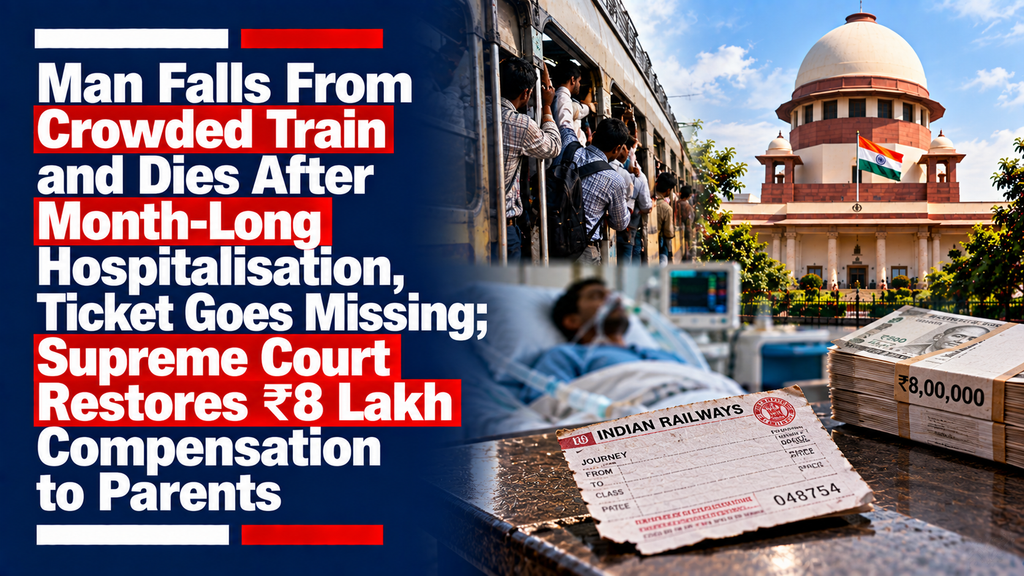
Man Falls From Crowded Train and Dies After Month-Long Hospitalisation, Ticket Goes Missing; Supreme Court Restores ₹8 Lakh Compensation to Parents

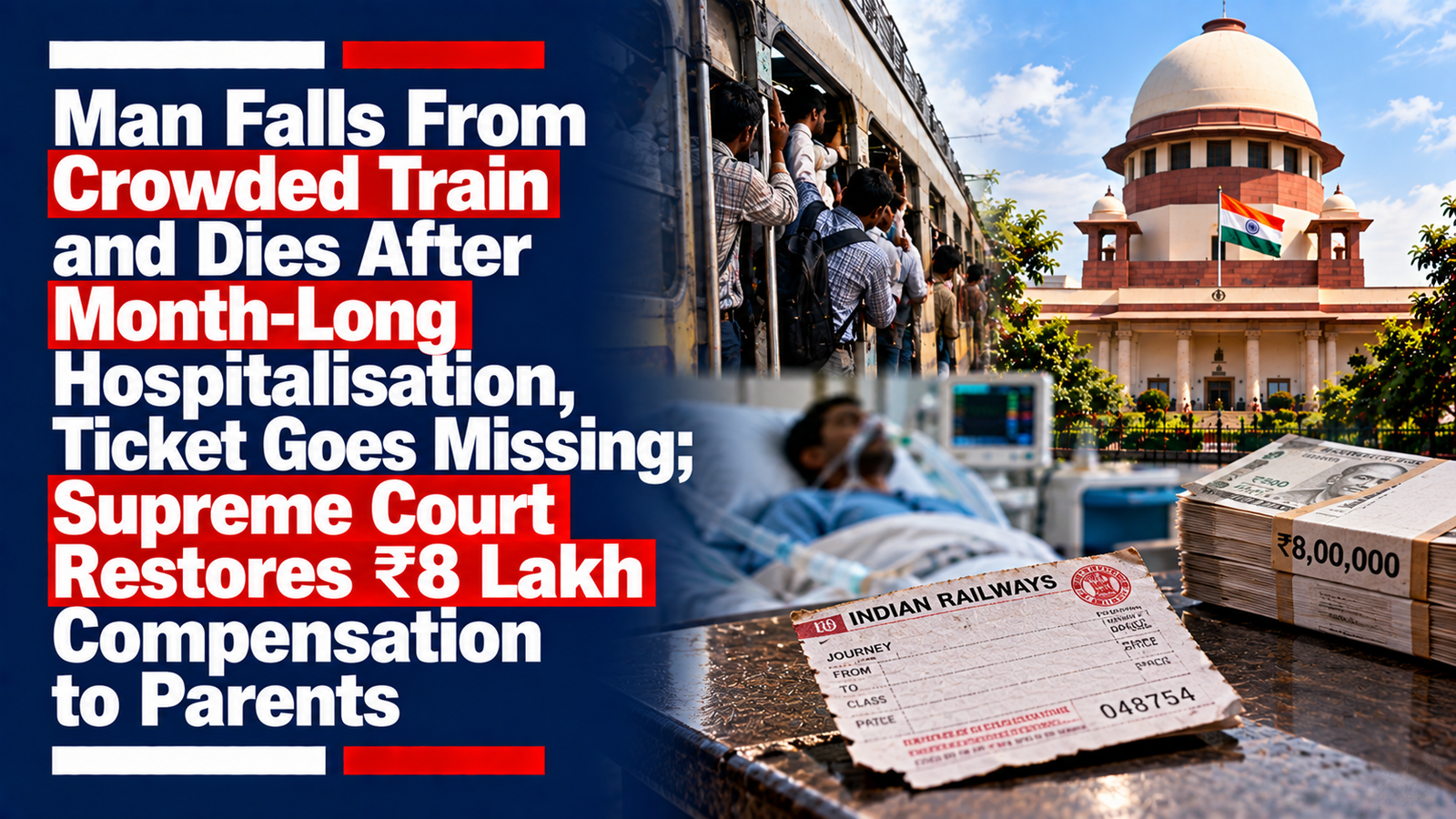
Father Says Son Bought Railway Ticket Before Fatal Fall but Ticket Was Lost; Supreme Court Says Initial Burden Stood Discharged
Facts
Maheshbhai was travelling to Surat via Ahmedabad on 27 September 2017 in the general compartment of a train. According to the claim, a sudden jerk and jolt amid heavy rush caused him to lose balance and fall from the train between Sabarmati and Ahmedabad railway stations. He suffered multiple grievous injuries, remained hospitalised and ultimately died on 31 October 2017. SUKHABHAI NANJIBHAI
His parents, Sukhabhai Nanjibhai Makwana and another, approached the Railway Claims Tribunal. On 17 June 2022, the Tribunal held that Maheshbhai was a victim of an “untoward incident” and awarded ₹8 lakh with 9% interest per annum from the date of the incident until the date of the award. SUKHABHAI NANJIBHAI
The Gujarat High Court reversed the award on 15 July 2025, principally holding that there was insufficient evidence proving that Maheshbhai had actually fallen from a train and noting the absence of a railway ticket and specific travel details.
The parents approached the Supreme Court.
Issues
The principal questions were:
- Whether Maheshbhai could be treated as a bona fide passenger despite the railway ticket not being recovered;
- Whether his accidental fall constituted an “untoward incident” under Section 123(c)(2) of the Railways Act, 1989;
- Who bore the burden of proving whether the deceased was an authorised passenger;
- Whether the Railways could rely upon an investigation report prepared approximately seven months after the incident; and
- Whether the Tribunal’s ₹8 lakh compensation award ought to be restored.
Appellants’ Arguments
The parents argued that Maheshbhai was travelling with a valid railway ticket which was subsequently lost. Once this fact was stated on oath, the burden shifted to the Railways to establish that he was an unauthorised passenger.
They emphasized that neither the absence of an eyewitness nor the failure to recover the physical ticket was sufficient to reject the claim.
They also attacked the Railways’ investigation report because it was prepared only on 17 May 2018, nearly seven months after the accident, contrary to the requirement for prompt investigation under the Railway Passengers (Manner of Investigation of Untoward Incidents) Rules, 2003. SUKHABHAI NANJIBHAI
Respondent’s Arguments
The Union of India contended that the deceased’s train details had not been disclosed, no eyewitness had been examined and no railway ticket was recovered.
The Railways further relied upon evidence concerning train movement at the relevant time and argued that the injuries should be treated as “self-inflicted injury”, thereby attracting the exception to compensation under Section 124-A. SUKHABHAI NANJIBHAI
Analysis of the Law
The Supreme Court disagreed with the High Court and held that the Tribunal had correctly awarded compensation.
The Court found it significant that Maheshbhai’s father had stated on oath that his son habitually purchased tickets and had purchased a ticket for this journey, but that it was lost. The Railways’ own witnesses admitted that they had not searched the victim’s pockets for the ticket. SUKHABHAI NANJIBHAI
The Court applied Union of India v. Rina Devi, under which mere absence of a ticket does not automatically establish that the injured or deceased person was not a bona fide passenger.
The claimant bears an initial burden, but that burden may be discharged through an affidavit setting out the relevant facts. Once this is done, the evidentiary burden shifts to the Railways, and the issue must be determined from the surrounding circumstances. SUKHABHAI NANJIBHAI
Precedent Analysis
Union of India v. Rina Devi
This was the central authority. The Supreme Court reiterated that non-recovery of a railway ticket is not by itself sufficient to defeat a compensation claim.
The claimant may discharge the initial burden by sworn evidence. The Railways must thereafter rebut that evidence.
Union of India v. Prabhakaran Vijaya Kumar
The Court relied upon this judgment for the principle of strict liability under Section 124-A of the Railways Act. Once the statutory requirements of an untoward incident involving a bona fide passenger are established, compensation is not dependent upon proving negligence. SUKHABHAI NANJIBHAI
Kalandi Charan Sahoo v. General Manager, South-East Central Railways
The Court relied upon this precedent while considering the delayed railway investigation. Failure to conduct the statutory inquiry promptly was treated as a circumstance operating against the Railways.
Court’s Reasoning
The Supreme Court considered the circumstances realistically.
Maheshbhai suffered grievous injuries on 27 September 2017, remained under medical treatment for more than a month, and died on 31 October 2017. In those circumstances, the Court observed that it was quite unlikely that the railway ticket would have been preserved throughout the period of hospitalisation. SUKHABHAI NANJIBHAI
The parents had specifically pleaded that not only the railway ticket but also the deceased’s handkerchief, wristwatch, comb and ₹800–₹900 in cash were lost.
His father’s sworn testimony discharged the initial burden. The Railways then failed to rebut it, particularly when its own witnesses admitted that they had never checked the injured man’s pockets.
On a preponderance of probabilities, the Court held that Maheshbhai was a bona fide passenger and that non-recovery of the ticket could not defeat the compensation claim. SUKHABHAI NANJIBHAI
Seven-Month-Delayed Railway Investigation
The Court separately criticized the timing of the Railway investigation.
The claim application was filed on 12 January 2018, and only thereafter did the railway authorities initiate communications for preparation of the statutory investigation report. The report was eventually prepared on 17 May 2018 — approximately seven months after the incident.
There was no satisfactory explanation for this delay.
The Supreme Court held that the Railways could not take advantage of its own delay in carrying out the statutory investigation and therefore declined to rely upon the belated report. SUKHABHAI NANJIBHAI
Conclusion
The Supreme Court held that the Gujarat High Court had placed undue emphasis on the missing railway ticket and had wrongly interfered with the Railway Claims Tribunal’s findings.
The Court accordingly:
- allowed the parents’ appeal;
- set aside the Gujarat High Court judgment dated 15 July 2025;
- restored the Railway Claims Tribunal’s award dated 17 June 2022;
- restored compensation of ₹8 lakh with the interest awarded by the Tribunal; and
- directed the Railways to satisfy the award within 30 days. SUKHABHAI NANJIBHAI
Case Details
Case: Sukhabhai Nanjibhai Makwana & Another v. Union of India
Court: Supreme Court of India
Citation: 2026 INSC 1056
Case No.: Civil Appeal No. 12951 of 2026
Judges: Justice Ujjal Bhuyan and Justice Atul S. Chandurkar
Date: 25 September 2026
Result: Appeal allowed; Gujarat High Court judgment set aside; Railway Claims Tribunal’s ₹8 lakh compensation award restored and directed to be satisfied within 30 days.