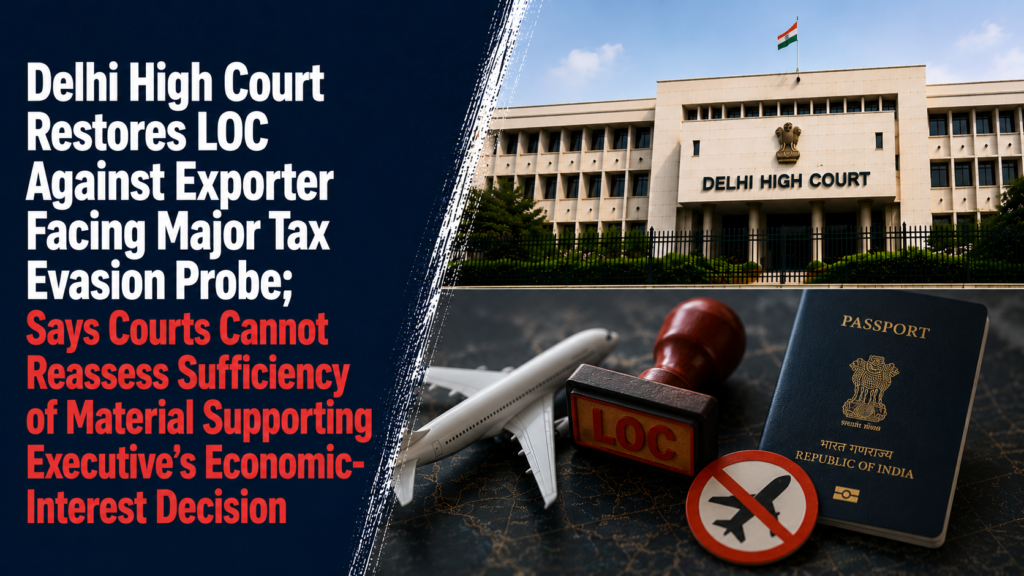
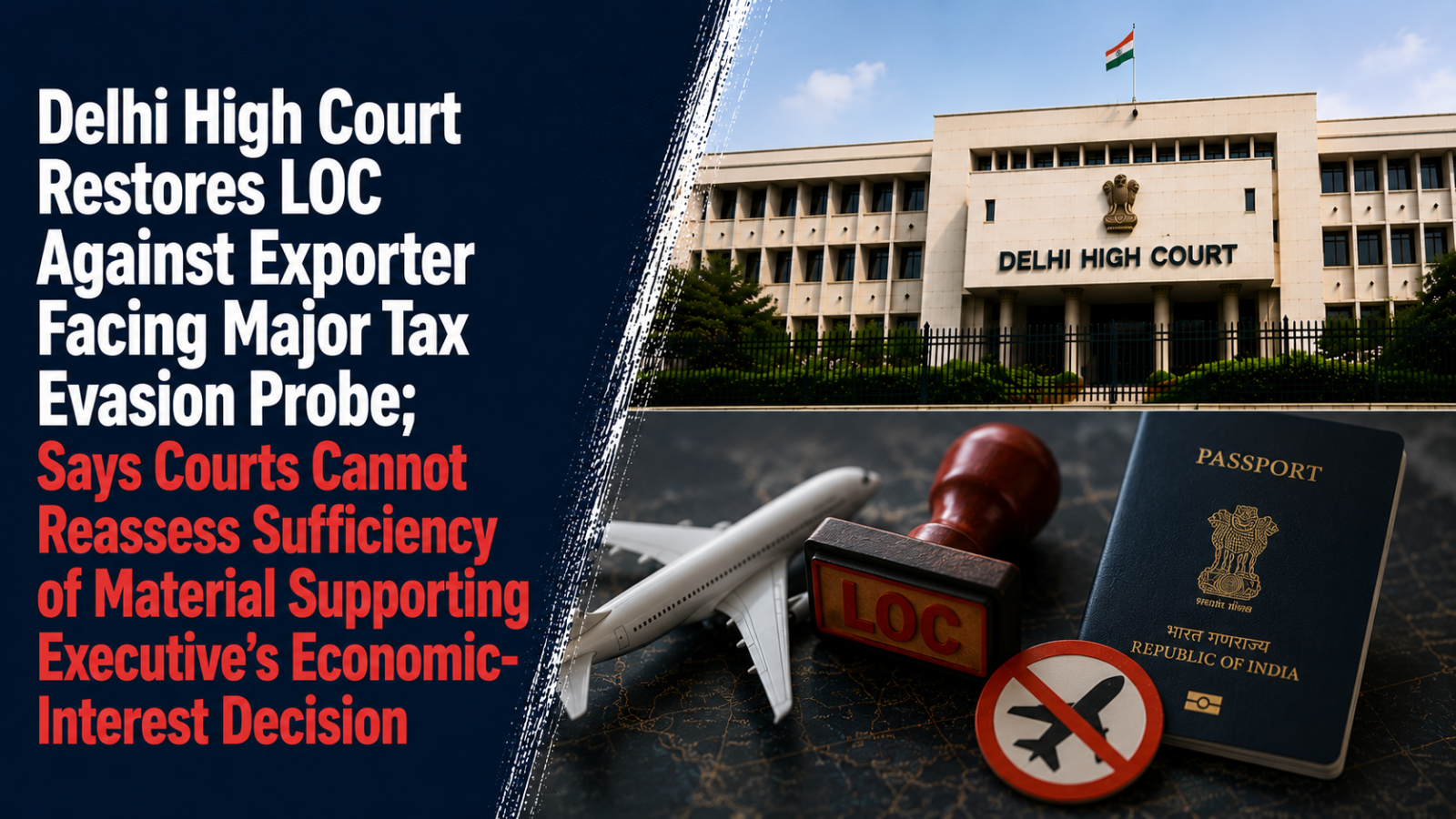
Delhi High Court Restores LOC Against Exporter Facing Major Tax Evasion Probe; Says Courts Cannot Reassess Sufficiency of Material Supporting Executive’s Economic-Interest Decision

Delhi High Court Restrains Bank of Maharashtra From Enforcing Security Over Dwarka Property Claimed by SBI; Arbitration Must Commence Within Three Weeks
Facts
The dispute arose from a Cash Credit Facility of ₹4.5 crore sanctioned by State Bank of India to Respondent No. 2 on 19 September 2023. Respondent Nos. 2 to 4 executed the relevant loan and guarantee documents, and Property No. 63, Block A, Sector 8, Dwarka, New Delhi was stated to have been mortgaged in SBI’s favour.
Upon default, the loan account was classified as an NPA on 29 May 2025. SBI initiated proceedings under the SARFAESI Act and also filed an Original Application before DRT-I, New Delhi.
SBI later discovered that Bank of Maharashtra was also asserting a security interest over the same property and had issued an auction notice proposing sale of the property on 15 January 2026.
Because both banks claimed rights over the same mortgaged asset, SBI invoked Section 11 of the SARFAESI Act and approached the Delhi High Court under Section 9 of the Arbitration and Conciliation Act, 1996 seeking interim protection against possession, alienation and auction pending determination of the rival claims.
On 23 December 2025, the Court had already granted interim protection restraining Bank of Maharashtra from taking possession of or auctioning the property.
The present judgment considered whether that interim protection should continue and on what terms.
Issues
The principal issues before the High Court were:
- Whether SBI was entitled to continuation of interim protection under Section 9 of the Arbitration Act;
- Whether Bank of Maharashtra should be restrained from taking possession of or auctioning the Dwarka property while the competing security interests remained unresolved;
- Whether the risk of auction would render SBI’s claim ineffective or leave it remediless;
- Whether the balance of convenience and irreparable injury justified preservation of the property;
- Whether SBI was required to promptly commence arbitration under Section 11 of the SARFAESI Act; and
- How long the Section 9 protection should continue after constitution of the Arbitral Tribunal.
Petitioner’s Arguments
SBI contended that the property had been mortgaged to it by Respondent Nos. 2 to 4 as security for the ₹4.5 crore credit facility.
It further asserted that the original title deeds were in its possession and that approximately ₹5 crore was outstanding from the borrowers.
According to SBI, permitting Bank of Maharashtra to proceed with possession and auction would effectively destroy or seriously prejudice SBI’s asserted security interest before the rival claims could be adjudicated.
SBI relied upon Section 11 of the SARFAESI Act as the basis for arbitration between the competing secured creditors and invoked Section 9 of the Arbitration Act for interim protection.
Respondents’ Arguments
The judgment records the appearance of Bank of Maharashtra and the other respondents but does not set out any elaborate counter-argument on merits.
Respondent No. 3’s counsel stated that Respondent No. 3 had died in 2011, though this assertion was disputed by Respondent No. 4.
The principal controversy before the Court therefore remained the preservation of the subject property until arbitration could determine the respective claims of SBI and Bank of Maharashtra.
Analysis of the Law
Interim Protection Was Necessary to Preserve the Subject Matter
The High Court had already observed in its earlier order that if Bank of Maharashtra were permitted to proceed with auction, SBI could be left remediless, since the very property claimed as security by SBI would pass out of the dispute.
The Court further found that the balance of convenience lay in favour of SBI and that failure to grant protection would expose it to irreparable loss incapable of adequate monetary compensation.
Accordingly, preservation of the property pending adjudication was considered necessary.
Section 9 Relief Was Tied to Prompt Commencement of Arbitration
The Court did not permit the interim injunction to operate indefinitely without initiation of the substantive arbitral process.
Instead, it made the protection conditional upon SBI taking steps to commence arbitration under Section 11 of the SARFAESI Act within three weeks from the date of judgment.
This ensured that Section 9 relief remained ancillary to the substantive dispute-resolution mechanism rather than becoming an end in itself.
Arbitral Tribunal to Take Over Interim Relief Jurisdiction
Once the tribunal is constituted, the parties have been granted liberty to move an application under Section 17 of the Arbitration and Conciliation Act.
The Court directed that its interim protection would continue only until the Arbitral Tribunal considers the application for interim relief.
Thus, judicial protection under Section 9 operates as a bridge until the tribunal is in a position to exercise its own interim jurisdiction.
Precedent Analysis
The five-page judgment does not cite or analyse any external judicial precedents.
Its reasoning is based directly upon:
- the competing security claims over the same property;
- SBI’s loan and mortgage documents;
- the fact that SARFAESI and DRT proceedings had already been commenced;
- the impending auction proposed by Bank of Maharashtra;
- the principles of prima facie case, balance of convenience and irreparable injury; and
- the statutory mechanism under Section 11 of the SARFAESI Act read with Sections 9 and 17 of the Arbitration and Conciliation Act.
Accordingly, the judgment is principally significant as an application of interim-protection principles to a secured-creditor priority dispute between two banks.
Court’s Reasoning
The Court considered the commercial nature of the dispute and emphasised the need for expeditious adjudication.
The property constituted the very subject matter over which SBI and Bank of Maharashtra asserted competing security interests.
If one bank were allowed to take possession and auction it before those rights were determined, the arbitration could be rendered practically ineffective.
The Court therefore converted the earlier ad interim restraint into an absolute interim injunction, but simultaneously required SBI to promptly initiate arbitration.
This balanced preservation of the property with the need to move the dispute swiftly to the designated arbitral forum.
Once the tribunal is constituted, further interim relief is to be considered under Section 17 rather than indefinitely remaining before the High Court.
Conclusion
The Delhi High Court made its interim order dated 23 December 2025 absolute.
Accordingly, Bank of Maharashtra remains restrained from:
- taking possession of Property No. 63, Block A, Sector 8, Dwarka, New Delhi; and
- auctioning the property.
The protection is subject to SBI commencing arbitration within three weeks under Section 11 of the SARFAESI Act.
After constitution of the tribunal, the parties may seek interim measures under Section 17 of the Arbitration Act, and the High Court’s protection will continue until the tribunal considers that prayer.
The petition and pending applications were accordingly disposed of.
Case Details
Case: State Bank of India v. Bank of Maharashtra & Ors.
Court: High Court of Delhi at New Delhi
Case Number: O.M.P.(I) (COMM.) 535/2025 & I.A. 4871/2026; CNR No. DLHC011062212025
Judge: Justice Om Prakash Shukla
Date: 12 August 2026
Result: Interim injunction restraining Bank of Maharashtra from possession and auction of the Dwarka property made absolute; SBI directed to commence arbitration within three weeks; protection to continue until the Arbitral Tribunal considers interim relief.
bd372f2a-2e6f-47a7-bccd-9149c7dbb559.pdf
15 Title Options
- Delhi High Court Restores Look Out Circular Against Businessman in Tax Probe; Says Courts Cannot Reassess Sufficiency of Material Behind Executive Decision
- Delhi High Court Upholds LOC Against Garment Exporter Facing Major Tax Evasion Allegations; Sets Aside Single Judge’s Order Permitting Unrestricted Foreign Travel
- Delhi High Court Revives LOC Against Vikas Chaudhary in Tax Investigation; Holds Courts Cannot Substitute Their View for Authorities on Economic Interests
- Delhi High Court Restores Travel Restriction in Alleged ₹1,153 Crore Bogus Purchase Probe; Says LOC Can Stand Without Registered Criminal Case
- Delhi High Court Upholds LOC Amid Tax Evasion and Undisclosed Dubai Asset Allegations; Says Sufficiency of Investigative Material Is Primarily for Authorities
- Delhi High Court Allows Income Tax Department’s Appeal and Restores LOC; Says Judicial Review Cannot Turn Court Into ‘Super-Executive Authority’
- Delhi High Court Restores LOC Against Exporter Accused of Bogus Purchases and Undisclosed Dubai Investments; Finds Authorities Had Substantial Investigative Material
- Delhi High Court Upholds Look Out Circular in Economic Offence Probe; Says Courts Must Exercise Restraint Before Second-Guessing Authorities’ Assessment of Evidence
- Delhi High Court Reverses Quashing of LOC Against Vikas Chaudhary; Finds Tax Department’s Decision Based on Relevant and Substantial Material
- Delhi High Court Says Right to Travel Does Not Permit Courts to Reweigh Evidence Behind LOC; Restores Circular in Major Tax Investigation
- Delhi High Court Restores LOC Over Alleged Tax Evasion and Foreign Assets; Holds Executive Best Placed to Assess Threat to India’s Economic Interests
- Delhi High Court Upholds LOC Despite No Criminal Case Against Exporter; Says 2017 Guidelines Permit Travel Restriction to Protect India’s Economic Interests
- Delhi High Court Allows Income Tax Appeal in Vikas Chaudhary Case; Holds LOC Cannot Be Quashed Merely Because Court Finds Evidence Insufficient
- Delhi High Court Restores LOC in Alleged Bogus Purchase and Dubai Investment Probe; Says Judicial Review Examines Legality, Not Sufficiency of Evidence
- Delhi High Court Upholds Travel Ban Amid Alleged Large-Scale Tax Evasion; Finds LOC Was Not Based on Irrelevant, Inadmissible or Insubstantial Material
Recommended Title — 25 Words
Delhi High Court Restores LOC Against Exporter Facing Major Tax Evasion Probe; Says Courts Cannot Reassess Sufficiency of Material Supporting Executive’s Economic-Interest Decision
The Division Bench held that judicial review of an LOC remains available, but courts cannot sit in appeal over the authority’s subjective satisfaction or independently reassess whether the material was sufficient, except where it is essentially speculative or non-existent.
Judgment Summary
Facts
The Income Tax Department filed a Letters Patent Appeal against a Single Judge’s judgment dated 12 January 2022, which had quashed a Look Out Circular (LOC) dated 25 February 2019 issued against businessman and garment exporter Vikas Chaudhary at the Department’s instance.
Chaudhary was a director of Nautilus Metal Crafts Pvt. Ltd. and Aastha Apparels Pvt. Ltd., companies engaged in garment exports to several countries. Following a warrant under Section 132(1) of the Income Tax Act, his premises were searched in February 2019, documents and goods were seized, and his and his wife’s statements were recorded. A subsequent search of their locker resulted in seizure of jewellery valued at approximately ₹1 crore.
The LOC was thereafter issued on 25 February 2019, preventing Chaudhary from leaving India. The Income Tax authorities relied upon suspected undisclosed foreign assets and interests in foreign entities, with possible consequences under the Income Tax Act, Black Money Act and PMLA.
Two assessment orders dated 5 July 2021 assessed additional undisclosed income of approximately ₹21.4 crore.
The Department, however, alleged a much wider financial network. It referred to reassessment material indicating approximately ₹1,153 crore in bogus purchases, unexplained transactions and digital evidence allegedly concerning acquisition of a 10% interest in a Dubai company for approximately ₹30 crore.
The Single Judge quashed the LOC, principally finding that the Department’s material remained inconclusive despite the LOC having operated for almost three years and that no prosecution under the Income Tax Act, PMLA or Black Money Act had meanwhile been initiated.
The Income Tax Department challenged that decision before the Division Bench.
Issues
The Division Bench substantially reduced the controversy to two principal questions:
- What is the permissible scope of judicial review over an executive decision to issue a Look Out Circular?
- Applying that standard, was the Single Judge justified in interfering with and quashing the LOC issued against Vikas Chaudhary?
The case consequently required the Court to determine whether a constitutional court can independently assess the sufficiency or magnitude of the material relied upon by the originating authority when it concludes that a person’s departure would be detrimental to India’s economic interests.
Appellant’s Arguments — Income Tax Department
The Income Tax Department argued that the Single Judge had exceeded the permissible limits of judicial review by effectively reassessing whether the evidence available with the authorities was sufficient to justify the LOC.
It contended that the Department had substantial material concerning the respondent’s alleged economic activities, including:
- reassessment findings concerning approximately ₹1,153 crore of bogus purchases by companies allegedly connected with him;
- unexplained cash transactions resulting in an additional tax demand of approximately ₹22 crore;
- digital material concerning alleged acquisition of a 10% interest in Centurion International Limited, Dubai, valued at approximately ₹30 crore; and
- continuing investigations and references to authorities in Dubai concerning alleged undisclosed foreign interests.
The Department argued that the absence of a registered FIR did not invalidate the LOC because the 2017 Office Memorandum widened the circumstances in which an LOC could be issued, including cases where departure was considered detrimental to the economic interests of India.
It further argued that economic offences need not necessarily commence through registration of an FIR and that investigations under the Black Money Act remained ongoing.
The Department maintained that permitting Chaudhary to travel abroad could potentially enable him to interfere with evidence, particularly evidence situated in Dubai.
Respondent’s Arguments — Vikas Chaudhary
Chaudhary supported the Single Judge’s decision and argued that the LOC represented an unjustified and prolonged restriction on his right to travel.
He stressed that he had cooperated extensively with the investigation, appearing 19 times during investigation and participating in assessment proceedings more than 40 times.
He argued that the allegations concerning undisclosed Dubai assets were founded principally upon an unsigned draft agreement and WhatsApp conversations which were not conclusive.
He also relied upon certificates and other documents from Dubai authorities to contend that neither he nor his family owned the foreign assets alleged by the Department.
Chaudhary further contended that:
- no criminal complaint or prosecution had been initiated against him despite the passage of several years;
- the ₹1,500 crore tax evasion allegation was inconsistent with assessment orders quantifying additional income at ₹21.4 crore;
- the LOC had originally been issued under the 2010 Office Memorandum and had expired by efflux of time;
- subsequent Office Memoranda could not retrospectively revive it; and
- continued restriction on his travel disproportionately interfered with his liberty and international garment-export business.
Accordingly, he sought dismissal of the Department’s appeal and continuation of the Single Judge’s order quashing the LOC.
Analysis of the Law
1. LOC Decisions Are Subject to Judicial Review
The Division Bench rejected any absolute proposition that the executive’s decision to issue an LOC is immune from judicial scrutiny.
Constitutional courts remain empowered—and obligated—to protect fundamental rights where executive action crosses constitutional or statutory limits.
At the same time, judicial review is not an appellate jurisdiction over executive decisions. The Court emphasised that the judiciary and executive are co-equal constitutional actors, and judicial review examines whether executive action remains within legally permissible boundaries rather than whether the Court itself would have reached the same conclusion.
2. Greater Judicial Restraint Applies in Economic and Fiscal Matters
The Court placed particular emphasis upon restraint where the executive decision concerns the economic or fiscal interests of the country.
It held that courts should ordinarily defer to executive expertise in determining where national economic interests lie, provided constitutional boundaries have not been crossed.
The judiciary cannot substitute its own subjective satisfaction for that of the competent executive authority merely because another view of the material is possible.
3. Court Cannot Reassess Sufficiency of Material Supporting an LOC
This was the central ratio of the judgment.
The Division Bench held that although judicial review of an LOC is available, its scope does not ordinarily extend to independently assessing the quantity, quality or sufficiency of the material relied upon by the originating authority.
Interference may be justified where:
- there is practically no material;
- the material is merely speculative or “moonshine”;
- irrelevant considerations form the basis of the decision;
- the decision is manifestly arbitrary; or
- the action is shockingly disproportionate to the material available.
But where relevant and substantive material exists, the Court cannot substitute its assessment for the authority’s conclusion.
4. Court Cannot Act as a “Super-Executive Authority”
The Division Bench accepted that an LOC significantly restricts a citizen’s freedom to travel abroad and is therefore a serious measure.
However, the seriousness of that restriction does not authorise the Court to undertake a merits-based reappraisal of the investigative material.
The Court expressly held that the sufficiency of material fundamentally remains within the province of the authority issuing the LOC, and the Court cannot assume the role of a “super-executive authority.”
5. “Detrimental to Economic Interests of India” Is Deliberately Broad
The Court analysed the 2017 amendment to the MHA guidelines and found that the residuary power for issuance of LOCs had been consciously widened.
It permits departure to be restrained where, based upon inputs received, the competent authority considers the departure detrimental to:
- sovereignty;
- security;
- integrity of India;
- bilateral relations;
- strategic interests;
- economic interests of India; or
- larger public interest.
The relevant satisfaction is that of the authority issuing the LOC, not the Court reviewing it.
6. Fundamental Right to Travel Remains Important
The Court did not reject the proposition that an LOC interferes with personal liberty.
It acknowledged that restricting foreign travel is a drastic step.
However, the constitutional protection of liberty must coexist with legitimate governmental action concerning serious economic offences and national economic interests.
Thus, judicial review remains available as a safeguard against arbitrary action, but does not permit a court to reweigh investigative evidence merely because a fundamental right is affected.
Precedent Analysis
Kalpana Mehta v. Union of India, (2018) 7 SCC 1
The Constitution Bench decision was relied upon to explain the constitutional function of judicial review.
It recognises the broad responsibility of constitutional courts to protect fundamental rights while simultaneously requiring judicial restraint and respect for institutional boundaries.
Union Territory of Ladakh v. Jammu & Kashmir National Conference, (2024) 18 SCC 643
The Court noted that the Supreme Court had described the principles in Kalpana Mehta as a “talisman of sorts” governing judicial review.
State of M.P. v. Nandlal Jaiswal, (1986) 4 SCC 566
Relying upon R.K. Garg v. Union of India, this decision reinforces the principle that courts grant considerable latitude to executive action in complex economic matters and interfere only where the action is plainly arbitrary, irrational, discriminatory or mala fide.
Akola Municipal Corporation v. Zishan Hussain Azhar Hussain, 2025 SCC OnLine SC 2729
The Supreme Court reiterated that courts should be particularly circumspect in reviewing economic and fiscal policy and should not substitute their judgment for that of the competent executive or expert authority unless illegality is demonstrated.
Kirloskar Ferrous Industries Ltd. v. Union of India, (2025) 1 SCC 695
This authority was relied upon to explain that judicial review concerns legality of the decision-making process, rather than a comprehensive re-evaluation of the merits or wisdom of economic policy decisions.
Vivek Narayan Sharma v. Union of India, (2023) 3 SCC 1
The demonetisation decision reinforced the limited nature of judicial review over economic and fiscal regulatory decisions. Courts should ordinarily intervene only where executive action is arbitrary or violates constitutional or statutory provisions.
Radhika Agarwal v. Union of India
The Division Bench relied materially upon the Supreme Court’s discussion concerning judicial review of executive action in economic offences.
The principle extracted was that courts must exercise particular caution and should not examine the sufficiency of investigative material, except where there is effectively no material or serious illegality in the decision-making process.
Sumer Singh Salkan v. Assistant Director, 2010 SCC OnLine Del 2699
This decision formed part of the LOC jurisprudence considered by the parties. The Income Tax Department relied upon it in support of limitations on judicial interference with executive LOC decisions.
Brij Bhushan Kathuria v. Union of India, 2021 SCC OnLine Del 1260
The Single Judge had relied upon this authority while holding that an LOC should not routinely be issued merely upon suspicion of foreign accounts or investments. The Division Bench, however, adopted a more deferential approach to the originating authority’s assessment.
Court’s Reasoning
The Division Bench found that the Single Judge had effectively gone beyond permissible judicial review by independently evaluating whether the Department possessed sufficient evidence to conclude that Chaudhary’s departure could prejudice India’s economic interests.
The correct inquiry was narrower: whether the Department’s decision was founded upon relevant material capable of supporting its satisfaction.
The Court examined the official file produced in sealed cover and found that it supported the assertions contained in the Department’s counter-affidavit.
The material included allegations concerning large-scale bogus purchases, over-invoicing, export incentives, undisclosed transactions, alleged foreign investment and continuing investigation with Dubai authorities.
Without expressing any view on whether those allegations would ultimately be proved, the Court held that the material could not be characterised as irrelevant, inadmissible or insubstantial.
Therefore, the Single Judge was not justified in substituting her assessment of the sufficiency of that material for the subjective satisfaction reached by the competent authorities.
The Division Bench carefully clarified that it was not deciding whether the allegations against Chaudhary were true. Their eventual outcome remained a matter for the ongoing investigations.
Its conclusion was limited to holding that the material available was sufficient to take the LOC decision outside the narrow grounds upon which judicial review could legitimately interfere.
Conclusion
The Delhi High Court allowed the Income Tax Department’s appeal.
It held that although issuance of an LOC is amenable to judicial review, a court cannot ordinarily sit in appeal over the originating authority’s subjective satisfaction or independently determine whether the available material was quantitatively or qualitatively sufficient.
On examining the record, including the official file, the Division Bench found that the LOC against Vikas Chaudhary was based upon material that could not be regarded as irrelevant, inadmissible or insubstantial. It therefore held that no case for quashing the LOC had been made out.
Accordingly:
- the Single Judge’s judgment dated 12 January 2022 was quashed and set aside;
- Vikas Chaudhary’s WP(C) 5374/2021 was dismissed; and
- the Income Tax Department’s LPA 78/2022 was allowed, with no order as to costs.
Case Details
Case: Income Tax Department v. Vikas Chaudhary & Ors.
Court: High Court of Delhi at New Delhi, Division Bench
Case Number: LPA 78/2022, CM APPLs. 5852/2022 & 31407/2025; CNR No. DLHC010053972022
Judges: Justice C. Hari Shankar and Justice Om Prakash Shukla
Reserved On: 6 May 2026
Date: 12 August 2026
Result: Appeal allowed; Single Judge’s judgment quashing the LOC set aside; writ petition dismissed; LOC against Vikas Chaudhary consequently restored; no order as to costs.