Delhi High Court Protects SBI’s Mortgage Over Dwarka Property; Restrains Bank of Maharashtra From Possession or Auction Pending Arbitration Under Section 11 SARFAESI

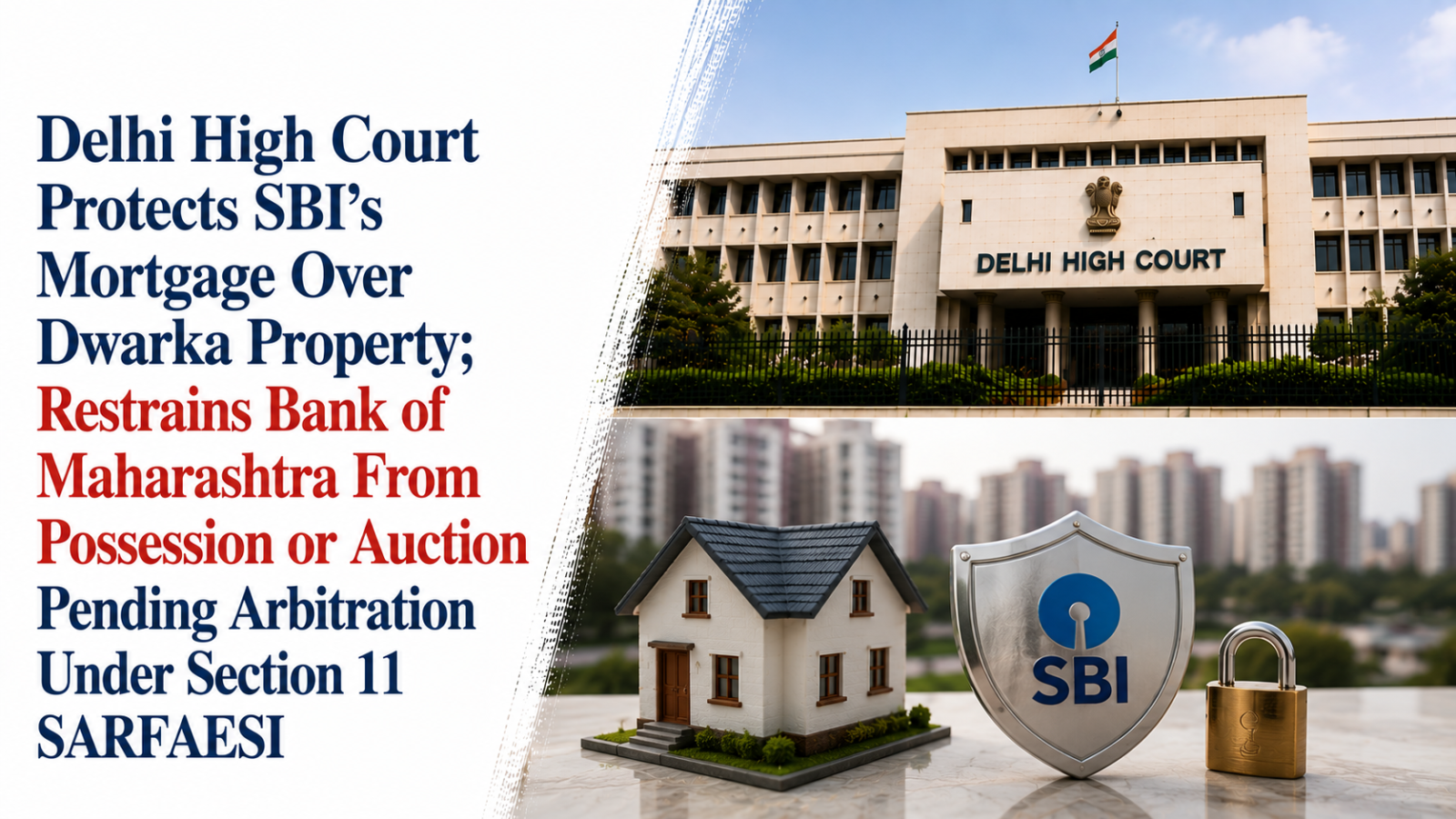
Delhi High Court Restrains Bank of Maharashtra From Enforcing Security Over Dwarka Property Claimed by SBI; Arbitration Must Commence Within Three Weeks
Facts
The dispute arose from a Cash Credit Facility of ₹4.5 crore sanctioned by State Bank of India to Respondent No. 2 on 19 September 2023. Respondent Nos. 2 to 4 executed the relevant loan and guarantee documents, and Property No. 63, Block A, Sector 8, Dwarka, New Delhi was stated to have been mortgaged in SBI’s favour.
Upon default, the loan account was classified as an NPA on 29 May 2025. SBI initiated proceedings under the SARFAESI Act and also filed an Original Application before DRT-I, New Delhi.
SBI later discovered that Bank of Maharashtra was also asserting a security interest over the same property and had issued an auction notice proposing sale of the property on 15 January 2026.
Because both banks claimed rights over the same mortgaged asset, SBI invoked Section 11 of the SARFAESI Act and approached the Delhi High Court under Section 9 of the Arbitration and Conciliation Act, 1996 seeking interim protection against possession, alienation and auction pending determination of the rival claims.
On 23 December 2025, the Court had already granted interim protection restraining Bank of Maharashtra from taking possession of or auctioning the property.
The present judgment considered whether that interim protection should continue and on what terms.
Issues
The principal issues before the High Court were:
- Whether SBI was entitled to continuation of interim protection under Section 9 of the Arbitration Act;
- Whether Bank of Maharashtra should be restrained from taking possession of or auctioning the Dwarka property while the competing security interests remained unresolved;
- Whether the risk of auction would render SBI’s claim ineffective or leave it remediless;
- Whether the balance of convenience and irreparable injury justified preservation of the property;
- Whether SBI was required to promptly commence arbitration under Section 11 of the SARFAESI Act; and
- How long the Section 9 protection should continue after constitution of the Arbitral Tribunal.
Petitioner’s Arguments
SBI contended that the property had been mortgaged to it by Respondent Nos. 2 to 4 as security for the ₹4.5 crore credit facility.
It further asserted that the original title deeds were in its possession and that approximately ₹5 crore was outstanding from the borrowers.
According to SBI, permitting Bank of Maharashtra to proceed with possession and auction would effectively destroy or seriously prejudice SBI’s asserted security interest before the rival claims could be adjudicated.
SBI relied upon Section 11 of the SARFAESI Act as the basis for arbitration between the competing secured creditors and invoked Section 9 of the Arbitration Act for interim protection.
Respondents’ Arguments
The judgment records the appearance of Bank of Maharashtra and the other respondents but does not set out any elaborate counter-argument on merits.
Respondent No. 3’s counsel stated that Respondent No. 3 had died in 2011, though this assertion was disputed by Respondent No. 4.
The principal controversy before the Court therefore remained the preservation of the subject property until arbitration could determine the respective claims of SBI and Bank of Maharashtra.
Analysis of the Law
Interim Protection Was Necessary to Preserve the Subject Matter
The High Court had already observed in its earlier order that if Bank of Maharashtra were permitted to proceed with auction, SBI could be left remediless, since the very property claimed as security by SBI would pass out of the dispute.
The Court further found that the balance of convenience lay in favour of SBI and that failure to grant protection would expose it to irreparable loss incapable of adequate monetary compensation.
Accordingly, preservation of the property pending adjudication was considered necessary.
Section 9 Relief Was Tied to Prompt Commencement of Arbitration
The Court did not permit the interim injunction to operate indefinitely without initiation of the substantive arbitral process.
Instead, it made the protection conditional upon SBI taking steps to commence arbitration under Section 11 of the SARFAESI Act within three weeks from the date of judgment.
This ensured that Section 9 relief remained ancillary to the substantive dispute-resolution mechanism rather than becoming an end in itself.
Arbitral Tribunal to Take Over Interim Relief Jurisdiction
Once the tribunal is constituted, the parties have been granted liberty to move an application under Section 17 of the Arbitration and Conciliation Act.
The Court directed that its interim protection would continue only until the Arbitral Tribunal considers the application for interim relief.
Thus, judicial protection under Section 9 operates as a bridge until the tribunal is in a position to exercise its own interim jurisdiction.
Precedent Analysis
The five-page judgment does not cite or analyse any external judicial precedents.
Its reasoning is based directly upon:
- the competing security claims over the same property;
- SBI’s loan and mortgage documents;
- the fact that SARFAESI and DRT proceedings had already been commenced;
- the impending auction proposed by Bank of Maharashtra;
- the principles of prima facie case, balance of convenience and irreparable injury; and
- the statutory mechanism under Section 11 of the SARFAESI Act read with Sections 9 and 17 of the Arbitration and Conciliation Act.
Accordingly, the judgment is principally significant as an application of interim-protection principles to a secured-creditor priority dispute between two banks.
Court’s Reasoning
The Court considered the commercial nature of the dispute and emphasised the need for expeditious adjudication.
The property constituted the very subject matter over which SBI and Bank of Maharashtra asserted competing security interests.
If one bank were allowed to take possession and auction it before those rights were determined, the arbitration could be rendered practically ineffective.
The Court therefore converted the earlier ad interim restraint into an absolute interim injunction, but simultaneously required SBI to promptly initiate arbitration.
This balanced preservation of the property with the need to move the dispute swiftly to the designated arbitral forum.
Once the tribunal is constituted, further interim relief is to be considered under Section 17 rather than indefinitely remaining before the High Court.
Conclusion
The Delhi High Court made its interim order dated 23 December 2025 absolute.
Accordingly, Bank of Maharashtra remains restrained from:
- taking possession of Property No. 63, Block A, Sector 8, Dwarka, New Delhi; and
- auctioning the property.
The protection is subject to SBI commencing arbitration within three weeks under Section 11 of the SARFAESI Act.
After constitution of the tribunal, the parties may seek interim measures under Section 17 of the Arbitration Act, and the High Court’s protection will continue until the tribunal considers that prayer.
The petition and pending applications were accordingly disposed of.
Case Details
Case: State Bank of India v. Bank of Maharashtra & Ors.
Court: High Court of Delhi at New Delhi
Case Number: O.M.P.(I) (COMM.) 535/2025 & I.A. 4871/2026; CNR No. DLHC011062212025
Judge: Justice Om Prakash Shukla
Date: 12 August 2026
Result: Interim injunction restraining Bank of Maharashtra from possession and auction of the Dwarka property made absolute; SBI directed to commence arbitration within three weeks; protection to continue until the Arbitral Tribunal considers interim relief