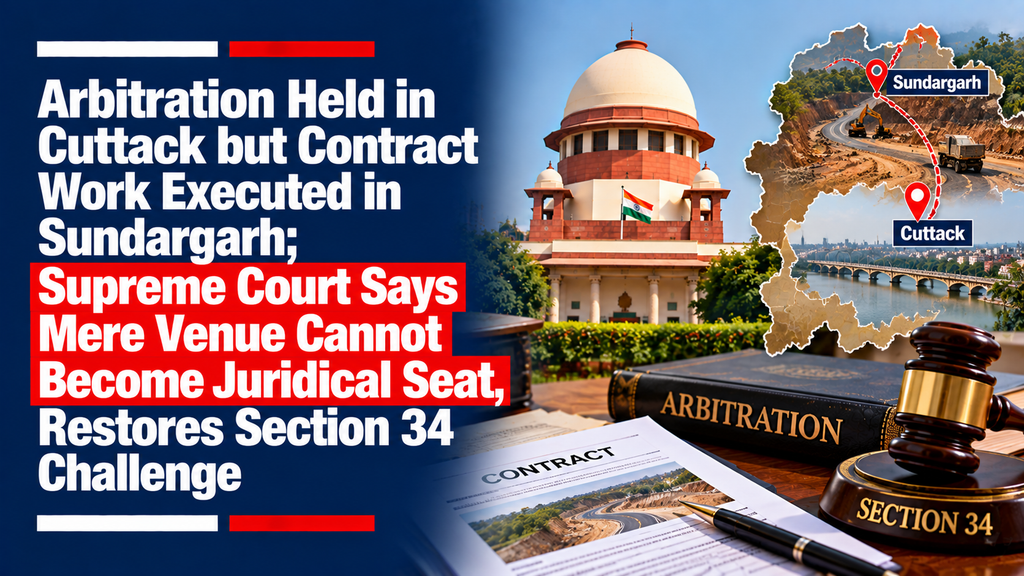
Arbitration Held in Cuttack but Contract Work Executed in Sundargarh; Supreme Court Says Mere Venue Cannot Become Juridical Seat, Restores Section 34 Challenge

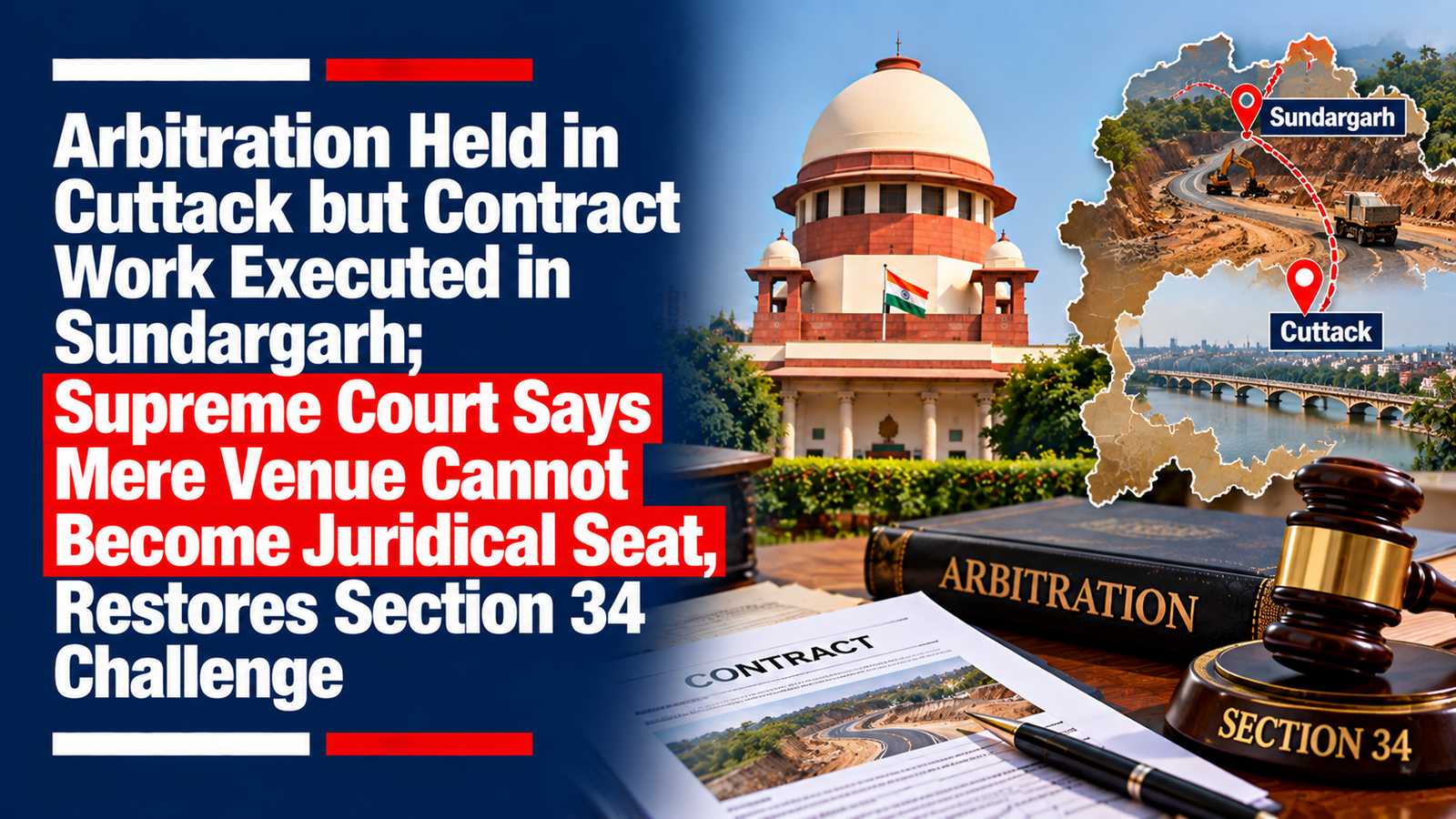
Can Place Where Arbitrator Holds Hearings Automatically Become Arbitration Seat? Supreme Court Says No, Restores Section 34 Petition
Facts
The dispute arose from a 2012 tender issued by Mahanadi Coalfields Limited (MCL) for hiring heavy earth-moving machinery and carrying out excavation, transportation, dumping and allied work at the Kulda Open Cast Project in Sundargarh, Odisha. M/s GSCO Infrastructure Pvt. Ltd. was the successful bidder. Significantly, the contract contained no arbitration clause.
After disputes arose regarding contractual claims, GSCO approached the Orissa High Court. By a common order dated 25 March 2019, the High Court, recording the parties’ mutual consent, appointed a retired Judge as sole arbitrator under Section 11(6) of the Arbitration and Conciliation Act, 1996.
The arbitration proceedings were conducted at Cuttack, and on 25 October 2021 the arbitrator passed a common award in favour of GSCO.
MCL challenged the award by filing three petitions under Section 34 before the District Judge, Sundargarh on 8 December 2021.
GSCO objected that Sundargarh lacked territorial jurisdiction because Cuttack was allegedly the seat of arbitration and also claimed that the Section 34 petitions were time-barred.
The District Judge rejected these preliminary objections. However, the Orissa High Court reversed that decision and held that the Section 34 petitions were both without jurisdiction and barred by limitation. MCL therefore approached the Supreme Court.
Issues
The Supreme Court considered two principal questions:
First, whether Cuttack became the juridical “seat” of arbitration merely because the arbitration hearings were conducted there and the arbitrator had been appointed by the Orissa High Court sitting at Cuttack.
Second, whether MCL’s Section 34 petitions filed before the District Judge, Sundargarh were barred by limitation.
Appellants’ Arguments
MCL argued that the arbitral award was dated 25 October 2021, while the Section 34 petitions were filed on 8 December 2021—well within the statutory three-month limitation period.
On jurisdiction, MCL pointed out that the entire work was executed at Sundargarh and that the contractual terms expressly provided for disputes to be taken before courts where the work was executed.
Clause 40 specifically stated that disputes arising from the tender and subsequent contract would be subject to the jurisdiction of the District Court where the work was to be executed.
Since the work was admittedly executed in Sundargarh, MCL argued that the District Judge there was the competent court.
Respondent’s Arguments
GSCO had contended before the courts below that Cuttack was the seat of arbitration because the arbitrator had been appointed by the Orissa High Court at Cuttack and the arbitral proceedings themselves were conducted there.
It also relied upon Section 42 of the Arbitration Act to argue that because the earlier proceedings for appointment of the arbitrator were initiated before the High Court at Cuttack, subsequent proceedings under Part I—including the Section 34 challenge—could only be pursued there.
However, before the Supreme Court, GSCO’s senior counsel fairly conceded that the High Court’s finding on limitation was erroneous.
Analysis of the Law
1. Seat and Venue of Arbitration Are Legally Distinct
This is the central proposition of the judgment.
The Supreme Court reiterated that the “seat” of arbitration determines the courts exercising supervisory jurisdiction over the arbitration.
The “venue”, by contrast, merely identifies the physical location where arbitral hearings take place.
Therefore:
The mere fact that arbitration hearings physically take place in a city does not, by itself, make that city the juridical seat of arbitration.
Here, neither the High Court’s order appointing the arbitrator nor any agreement between the parties designated Cuttack as the seat.
The hearings were held there merely for the arbitrator’s convenience.
2. Appointment of Arbitrator by a High Court Does Not Make Its Physical Location the Seat
The High Court had reasoned that because it appointed the arbitrator while sitting at Cuttack, Cuttack acquired supervisory jurisdiction.
The Supreme Court rejected this reasoning.
A High Court exercises jurisdiction over the entire State, not merely the district or city in which its principal seat is physically situated.
Thus, appointment of an arbitrator by the Orissa High Court at Cuttack did not automatically confer exclusive jurisdiction upon the District or Commercial Courts at Cuttack.
3. Contractual Jurisdiction Clause Pointed Directly to Sundargarh
The contractual terms materially strengthened MCL’s case.
Clause 12 provided that disputes could be taken before the District Court/High Court having jurisdiction where the work was executed.
Clause 40 was even clearer: disputes arising from the tender and subsequent contract were subject to the jurisdiction of the District Court where the subject work was to be executed.
It was undisputed that the work was executed in Sundargarh.
At the relevant time, no Commercial Court had been assigned to Sundargarh. Therefore, the Section 34 petitions could properly be presented before the District Judge, Sundargarh.
4. Section 42 Could Not Convert Cuttack Into the Arbitration Seat
The High Court had relied upon Section 42 because the earlier application leading to appointment of the arbitrator had been made before the Orissa High Court.
The Supreme Court’s reasoning effectively rejected the proposition that this circumstance could confer exclusive supervisory jurisdiction upon courts at Cuttack.
The Orissa High Court’s territorial jurisdiction extends throughout Odisha. Its physical seat at Cuttack cannot be equated with a contractual or juridically determined seat of arbitration.
5. Section 34 Petition Was Clearly Within Limitation
The limitation issue was straightforward.
The award was dated 25 October 2021.
MCL filed its Section 34 petitions on 8 December 2021.
Thus, the petitions were filed roughly six weeks after the award and plainly within the three-month period prescribed by Section 34(3). The respondent itself conceded before the Supreme Court that the High Court’s contrary finding was erroneous.
Precedent Analysis
The Court considered the leading arbitration authorities:
- Bharat Aluminium Co. v. Kaiser Aluminium Technical Services Inc. (BALCO)
- Indus Mobile Distribution Pvt. Ltd. v. Datawind Innovations Pvt. Ltd.
- BGS SGS Soma JV v. NHPC Ltd.
These authorities establish the significance of the juridical seat and its connection with supervisory court jurisdiction.
However, the Supreme Court held that they did not assist GSCO because there was no seat expressly designated or agreed upon by the parties in the present case. Cuttack was merely the location where the arbitrator conducted proceedings for administrative convenience.
The judgment therefore does not dilute the established seat-centric approach to arbitration jurisdiction. Rather, it stresses that before applying that doctrine, there must first be a legally sustainable basis for identifying a particular location as the seat rather than merely the venue.
Court’s Reasoning
The Supreme Court identified two fundamental errors in the High Court judgment.
First, it was incorrect to infer that Cuttack was the juridical seat simply because the hearings took place there. Neither the appointment order nor the parties’ agreement designated Cuttack as the seat.
Second, it was equally incorrect to conclude that because the Orissa High Court appointed the arbitrator while sitting at Cuttack, only courts physically situated in Cuttack could exercise jurisdiction over the subsequent Section 34 proceedings.
The Supreme Court clarified that a State High Court exercises jurisdiction throughout the State. Consequently, District Courts and Commercial Courts within that territorial jurisdiction may entertain Section 34 proceedings where otherwise competent, unless the parties have agreed upon a contrary jurisdictional arrangement or a particular seat has been specifically determined.
On the facts, Sundargarh had the strongest jurisdictional connection: the contract was performed there, the cause of action arose there, and the contractual jurisdiction clauses expressly pointed there.
Conclusion
The Supreme Court allowed Mahanadi Coalfields’ appeal and set aside the Orissa High Court judgment.
It held that the Section 34 petitions filed before the District Judge, Sundargarh were maintainable and were not barred by limitation.
The three Section 34 proceedings were restored to the District Judge, Sundargarh, with a direction that they be decided expeditiously in accordance with law.
The key proposition is:
Mere conduct of arbitral hearings at a particular place does not automatically make that place the juridical seat. Venue is the physical location of hearings; seat determines supervisory court jurisdiction.
Case: Mahanadi Coalfields Ltd. & Ors. v. M/s GSCO (Gurmeet Singh and Company) Infrastructure Pvt. Ltd.
Court: Supreme Court of India
Citation: 2026 INSC 1038
Case: Civil Appeal arising out of SLP (C) No. 21375 of 2025
Judges: Justice Sanjay Kumar and Justice Sanjeev Sachdeva
Date: 23 September 2026
Result: Appeal allowed; High Court judgment set aside; Section 34 petitions restored before District Judge, Sundargarh for decision on merits.