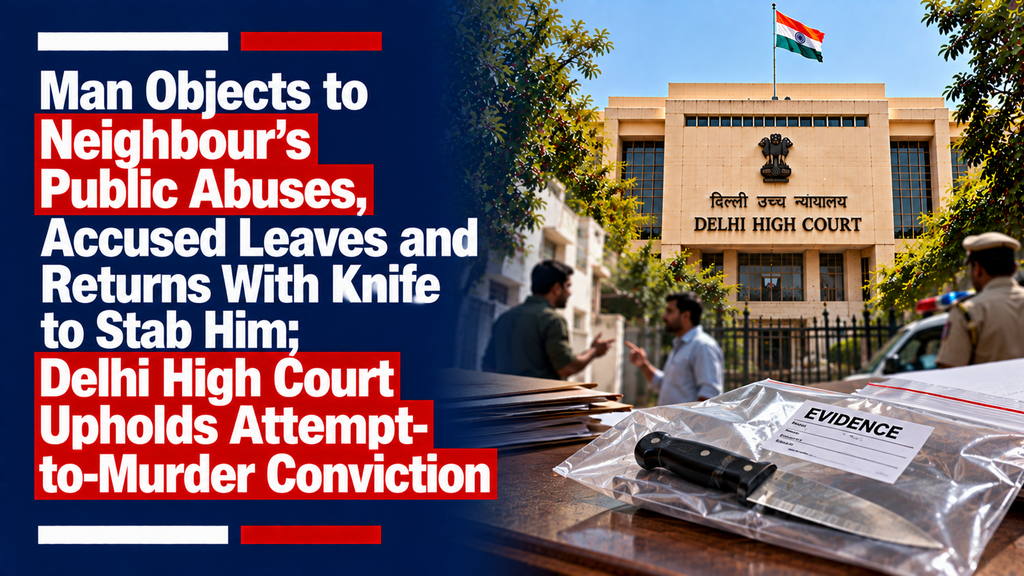
Man Objects to Neighbour’s Public Abuses, Accused Leaves and Returns With Knife to Stab Him; Delhi High Court Upholds Attempt-to-Murder Conviction

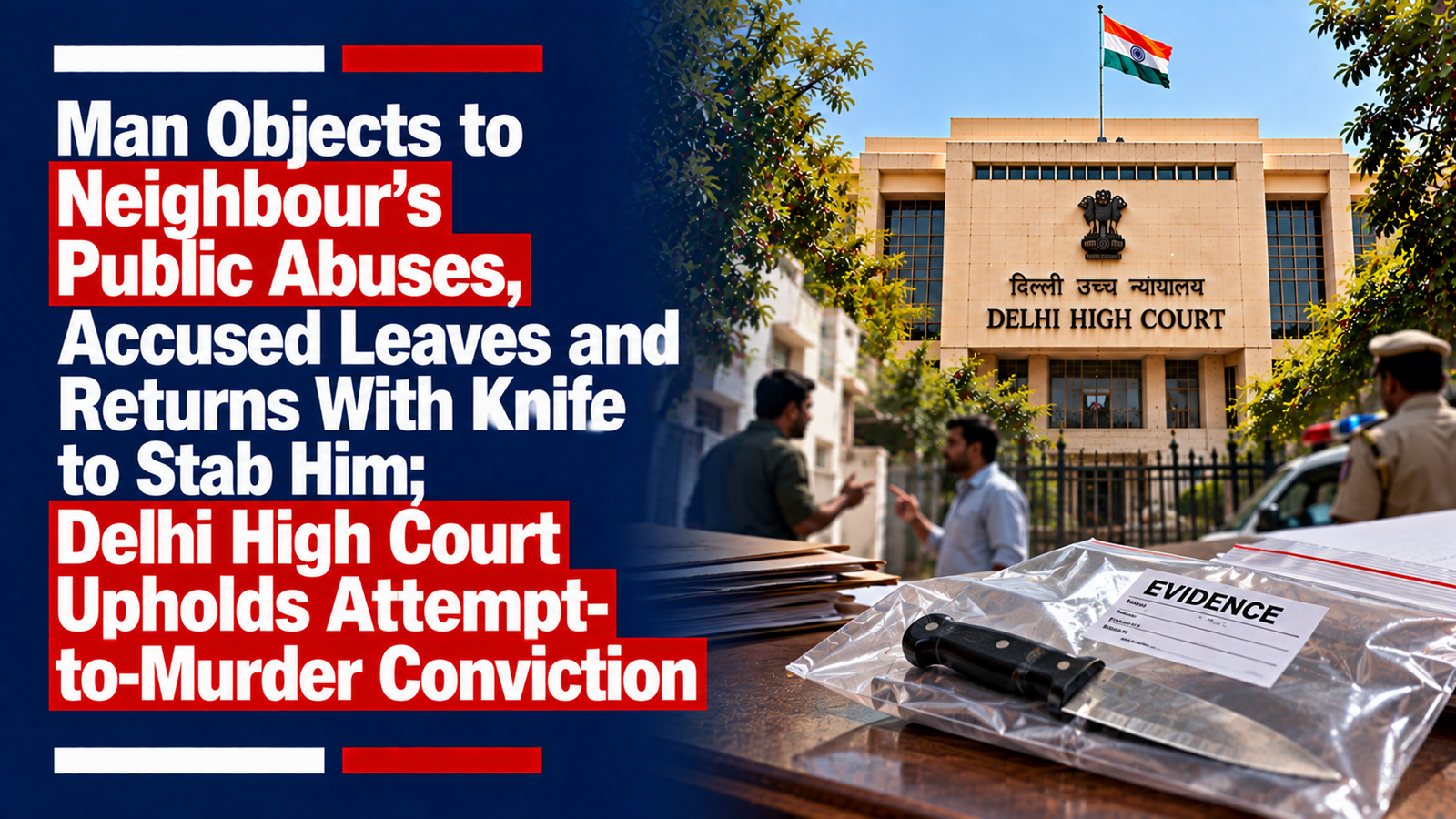
Accused Targets Chest and Abdomen With Knife After Brief Argument; Delhi High Court Says Nature and Location of Injuries Establish Murderous Intent
Facts
The appellant, Vikrant @ Ashu, challenged his conviction under Section 307 IPC for attempt to murder. The Trial Court had sentenced him to seven years’ rigorous imprisonment and a fine of ₹50,000.
The incident occurred at about 10:30 p.m. on 9 April 2021 at Shahbad Dairy, Delhi.
According to the prosecution, Vikrant was passing through a residential street while hurling abuses. The injured, Ravi, objected, telling him that women and families lived in the area and asking him not to use such language.
Vikrant allegedly responded by asking who Ravi was to question him and said that he would “show him.”
He then left the spot.
Approximately five minutes later, he allegedly returned carrying a knife and repeatedly attacked Ravi, causing stab injuries to his left flank involving the chest and abdomen and his left arm.
Medical Evidence
The MLC recorded:
- a 6 cm × 2 cm lacerated wound over the left flank involving the chest and abdomen;
- wounds measuring approximately 2 cm × 1 cm and 3 cm × 2 cm over the left arm.
The medical opinion categorised the injuries as “dangerous.”
Trial Court Proceedings
Vikrant was charged under Sections 307 and 174A IPC.
The prosecution examined 16 witnesses. Vikrant denied the allegations and claimed that Ravi was a habitual offender who had harassed the wife of his relative and that he had consequently been falsely implicated.
The Trial Court convicted him under Section 307 IPC but acquitted him of the Section 174A IPC charge.
For the attempt-to-murder offence, he was sentenced to seven years’ rigorous imprisonment with a ₹50,000 fine, with three months’ simple imprisonment in default.
Appellant’s Arguments
The principal defence was that the ingredients of Section 307 IPC were not established.
Vikrant argued that:
- there was no previous enmity with Ravi;
- there was no premeditation or preparation;
- the incident arose suddenly after Ravi confronted him;
- his conduct was impulsive rather than accompanied by an intention to kill; and
- at the highest, the offence could fall under Section 324 IPC for voluntarily causing hurt with a dangerous weapon.
State’s Arguments
The prosecution emphasised one crucial circumstance:
Vikrant did not immediately attack Ravi during the argument.
Instead, he left the scene, obtained a knife and returned after several minutes.
According to the State, this intervening period clearly distinguished the incident from a purely sudden or spontaneous assault.
The prosecution also relied upon the fact that Vikrant allegedly made repeated stabbing attempts and targeted vital parts of Ravi’s body, resulting in dangerous injuries.
Analysis of the Law
What Must Be Proved Under Section 307 IPC?
The High Court explained that Section 307 focuses principally upon the intention or knowledge accompanying the act, rather than merely its ultimate consequence.
The prosecution must establish an act done with such intention or knowledge that, had death resulted, the act would have amounted to murder.
It is therefore unnecessary that the injury actually caused should itself inevitably result in death.
The relevant inquiry concerns the accused’s state of mind when committing the act.
Intention Can Be Inferred From Circumstances
Since intention is a mental state, direct evidence will rarely be available.
The Court held that it may be inferred from circumstances such as:
- the weapon used;
- preparations made;
- words spoken by the accused;
- persistence of the assault;
- body part targeted;
- nature and seriousness of injuries; and
- surrounding circumstances.
Even in an initially unpremeditated incident, the requisite intention may arise contemporaneously with the physical act or immediately before it.
Therefore, absence of a long-standing plan or previous enmity does not automatically exclude Section 307 IPC.
Leaving to Fetch a Knife Was Crucial
This was the central factual circumstance relied upon by the High Court.
The evidence consistently showed that after Ravi objected to Vikrant’s abusive language:
Vikrant threatened him → left the scene → procured a knife → returned → attacked Ravi.
The Court held that this intervening conduct was relevant in determining intention.
It specifically found that leaving the scene to obtain a weapon and returning to attack negated the defence that the stabbing was merely instantaneous or committed on the spur of the moment.
No Prior Enmity Was Not Enough to Reduce the Offence
Vikrant stressed that there was no previous animosity between him and Ravi.
The High Court held that this circumstance alone could not override the manner in which the attack occurred.
The accused had returned armed with a knife, attempted multiple stabbings and targeted areas including the chest and abdomen.
The medical evidence characterised the injuries as dangerous.
Taken together, these circumstances sufficiently demonstrated the intention contemplated by Section 307 IPC.
False Implication Defence Rejected
Vikrant also claimed that Ravi had been falsely implicating him because of an earlier dispute involving allegedly indecent comments made by Ravi towards the wife of DW1.
The High Court treated this defence as an afterthought.
Most importantly, this allegation had not even been put to Ravi, his brother or his sister during their cross-examination.
The Court therefore rejected the theory of retaliatory false implication.
Defence Witness’s Presence Was Doubtful
The Court also doubted DW1’s claim concerning events on the night of the incident.
DW1 admitted that his regular duty hours were 4:00 p.m. until 8:00 a.m. the next morning.
The stabbing occurred at approximately 10:30 p.m., and DW1 did not claim to have been on leave.
The High Court therefore found his version regarding his presence at the relevant time highly doubtful.
Precedent Analysis
Om Parkash v. State of Punjab
The Supreme Court explained that Section 307 requires an act accompanied by the intention or knowledge necessary for murder. The immediate consequence of the act need not actually be death.
Sreedharan v. State of Kerala
Intention and knowledge may be inferred from circumstances including the weapon used, preparation, persistence of assault, nature of injuries and their location.
The precedent also recognises that in an unpremeditated offence, intention may arise only an instant before the physical act.
Parsuram Pandey v. State of Bihar
For Section 307, the critical consideration is intention or knowledge rather than the actual consequence.
Relevant indicators include the nature of the weapon, body part where injury was inflicted, nature of the injury and circumstances surrounding the incident.
The Court also referred to Bipin Bihari v. State of Madhya Pradesh and Anjani Kumar Chaudhary v. State of Bihar on the same principles.
Court’s Reasoning
The High Court found that the prosecution had satisfactorily established:
Vikrant’s presence at the scene; his attack upon Ravi; the resulting injuries; and the requisite intention for Section 307 IPC.
The decisive circumstances were that Vikrant:
- was confronted over his abusive language;
- threatened Ravi;
- left the scene;
- returned approximately five minutes later armed with a knife;
- repeatedly attempted to stab him;
- targeted vital parts including the chest and abdomen; and
- caused injuries medically classified as dangerous.
The Court therefore refused to convert the conviction from Section 307 to Section 324 IPC.
Why Seven Years Was Reduced to Six
On sentence, Section 307 IPC permitted imprisonment extending to ten years and, where hurt is caused, potentially imprisonment for life.
The Court noted that Vikrant had several criminal antecedents, including another case involving an alleged Section 307 offence.
His conduct in custody was also stated to be unsatisfactory, with involvement in multiple incidents while in jail.
Nevertheless, considering the overall facts and circumstances, the High Court considered six years’ rigorous imprisonment appropriate instead of seven years.
The judgment does not elaborate a separate detailed mitigating analysis explaining the precise one-year reduction.
Conclusion
The Delhi High Court partly allowed the appeal only on sentence.
Vikrant’s conviction under Section 307 IPC for attempt to murder was affirmed.
However, his sentence was reduced from:
7 years’ rigorous imprisonment → 6 years’ rigorous imprisonment.
The conviction itself remained undisturbed.
Case: Vikrant @ Ashu v. State Govt. of NCT of Delhi
Court: Delhi High Court
Case No.: CRL.A. 980/2025
Judge: Justice Chandrasekharan Sudha
Reserved: 16 September 2026
Pronounced: 23 September 2026
Result: Section 307 IPC conviction upheld; seven-year rigorous imprisonment reduced to six years.