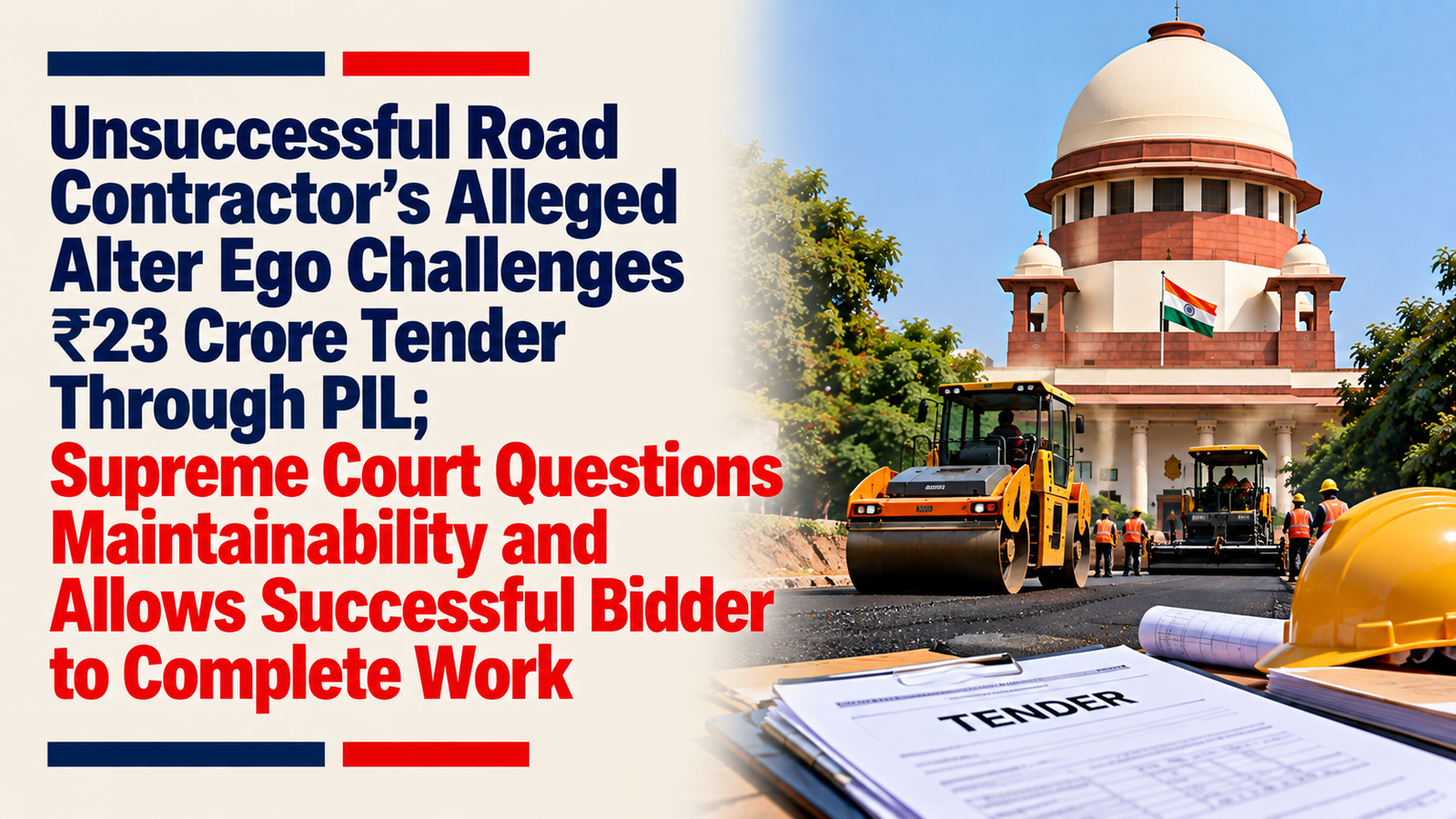
Unsuccessful Road Contractor’s Alleged Alter Ego Challenges ₹23 Crore Tender Through PIL; Supreme Court Questions Maintainability and Allows Successful Bidder to Complete Work

Facts
The dispute concerned a contract for upgrading the Matiana–Mahori to Chhaila road in Himachal Pradesh, covering approximately 25.650 kilometres under PMGSY Package No. HP-09-694. The value of the work was approximately ₹23 crore.
The Himachal Pradesh High Court had entertained a PIL challenging the tender process. By its judgment dated 24 December 2024, it quashed the award of work made in favour of contractor O.P. Mehta and directed the authorities to re-tender the remaining work within one month.
The controversy essentially involved a comparison between two competing bidders and whether the successful contractor fulfilled the tender eligibility conditions.
O.P. Mehta and the State of Himachal Pradesh challenged the High Court’s decision before the Supreme Court. The proceedings were registered as O.P. Mehta v. Mohinder Kalta & Ors., Civil Appeal Nos. 12968 and 12969 of 2026.
Issues
The principal question identified by the Supreme Court was:
Can the validity of a tender, requiring adjudication of the comparative claims and eligibility of competing bidders, ordinarily be challenged through a Public Interest Litigation?
The Court specifically expressed reservations because the PIL predominantly involved an inter se comparative assessment between two tenderers.
Appellant’s Case
The successful contractor challenged the High Court’s interference with the tender award.
During the Supreme Court proceedings, he filed an affidavit stating that approximately three kilometres of road construction, together with retaining and breast walls, had already been completed.
More significantly, he offered to complete the remaining work at the same rates at which the contract had originally been awarded on 15 March 2024, while assuring the Court that the quality of construction would not be compromised.
PIL Petitioner’s Case / High Court Concerns
The High Court had identified several concerns regarding the tender process.
These included contradictory stands by the authorities regarding whether a complaint made by the unsuccessful bidder, M/s PK Construction Pvt. Ltd., had actually been received and whether it had subsequently been withdrawn.
Questions were also raised regarding whether O.P. Mehta’s previous experience was gained as a sub-contractor or prime contractor; whether he was permitted to operate under two different names; whether conditions governing sub-contracts had been fulfilled; and whether the nature of experience reflected in his certificate corresponded with the work actually executed.
Analysis of the Law
The most significant aspect of the order is the Supreme Court’s approach to PIL jurisdiction in tender disputes.
The Court observed that tender litigation involving comparative assessment of rival bidders is fundamentally different from a genuine public-interest challenge involving large-scale misuse of public resources, corruption or another demonstrable public wrong.
Here, the grounds raised before the High Court predominantly required comparison of the eligibility and experience of two competing contractors.
The Court also considered the ₹23 crore value of the work and observed that it was not of such magnitude as would, by itself, enable the PIL petitioner to raise an argument concerning wastage of public resources.
Alleged Proxy Litigation Was Significant
A particularly important factual circumstance was that the Supreme Court described the PIL petitioner as the “alter ego of the unsuccessful bidder.”
The unsuccessful bidder had itself complained against the successful contractor but subsequently withdrew that complaint. Nevertheless, the tender process continued to be questioned through the PIL.
This circumstance reinforced the Court’s reservations about using the extraordinary jurisdiction of PIL to adjudicate what was substantially a commercial dispute between rival tenderers.
Court’s Reasoning
Rather than immediately directing a fresh tender, the Supreme Court took account of the practical position on the ground.
Three kilometres of construction had already been completed. The successful bidder was prepared to complete the remaining work at the 15 March 2024 contractual rates, despite the passage of more than two years.
The Court therefore granted the contractor three months to complete the entire allotted work at those original rates.
However, this permission was conditional.
The official respondents were required to verify the quality of the work. If the contractor failed to complete the work within three months, the authorities were directed to re-tender the work at the prevailing market rate.
Important Qualification
This is not yet a final judgment conclusively laying down that tender disputes can never be entertained through PIL.
The Supreme Court expressly stated that it had “reservations” regarding the maintainability of such a PIL in the circumstances of this case. The matter itself was deferred and directed to be listed again in the first week of December 2026 for the contractor to submit a compliance report.
Accordingly, the proposition should presently be reported as the Court questioning or expressing reservations about the use of PIL for comparative tender disputes, rather than finally holding all such PILs non-maintainable.
Conclusion
The Supreme Court effectively modified the High Court’s direction requiring immediate re-tendering.
It allowed O.P. Mehta three months to complete the entire road work at the rates prevailing under the original award dated 15 March 2024, subject to verification of construction quality.
If the work is not completed within that period, the authorities must re-tender it at the prevailing market rate. The matter will return before the Supreme Court in the first week of December 2026 for a compliance report.
Case: O.P. Mehta v. Mohinder Kalta & Ors.
Court: Supreme Court of India
Citation: 2026 INSC 1037
Case Nos.: Civil Appeal Nos. 12968 and 12969 of 2026
Judges: Justice Dipankar Datta and Justice Sheel Nagu
Date: 23 September 2026
Result: High Court’s immediate re-tender direction modified; successful contractor given three months to complete the work at original 2024 rates, failing which fresh tender must be issued at prevailing market rates; matter kept pending for compliance.