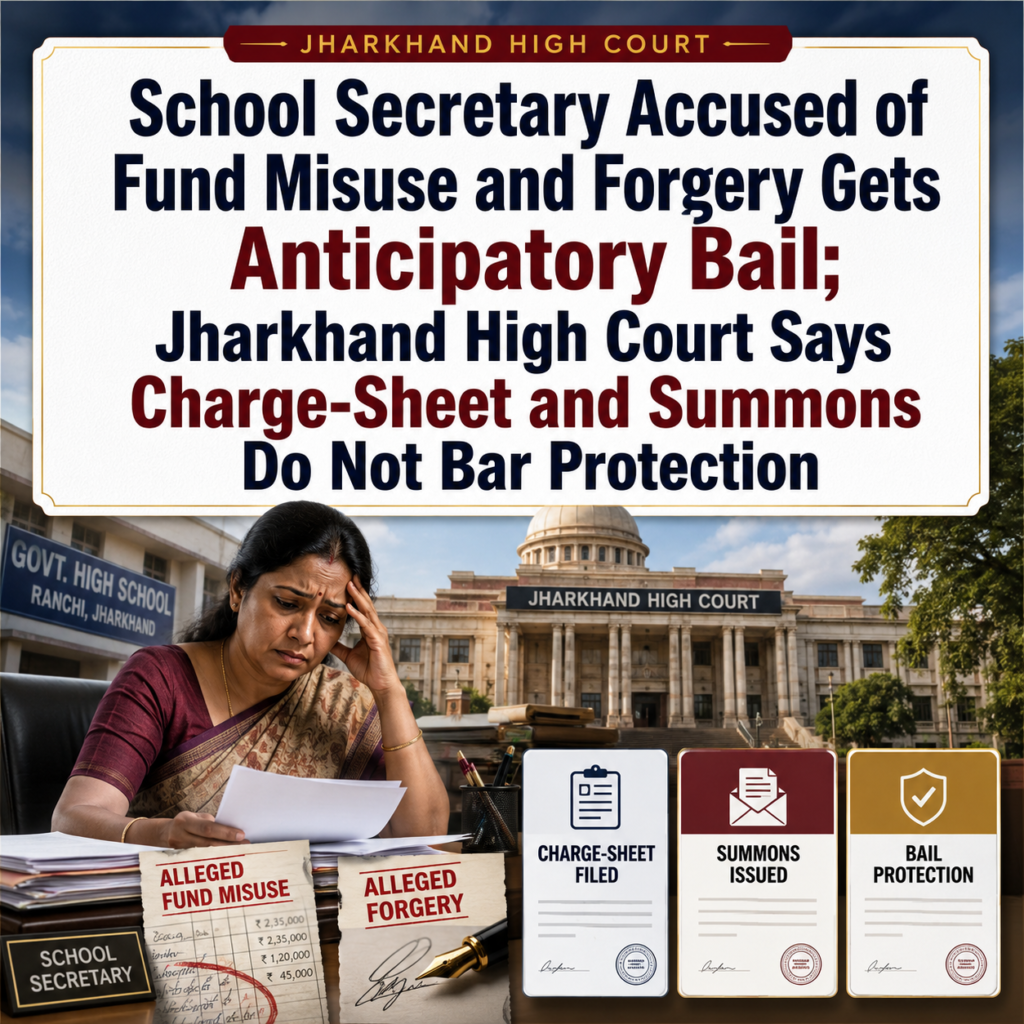
School Secretary Accused of Fund Misuse and Forgery Gets Anticipatory Bail; Jharkhand High Court Says Charge-Sheet and Summons Do Not Bar Protection

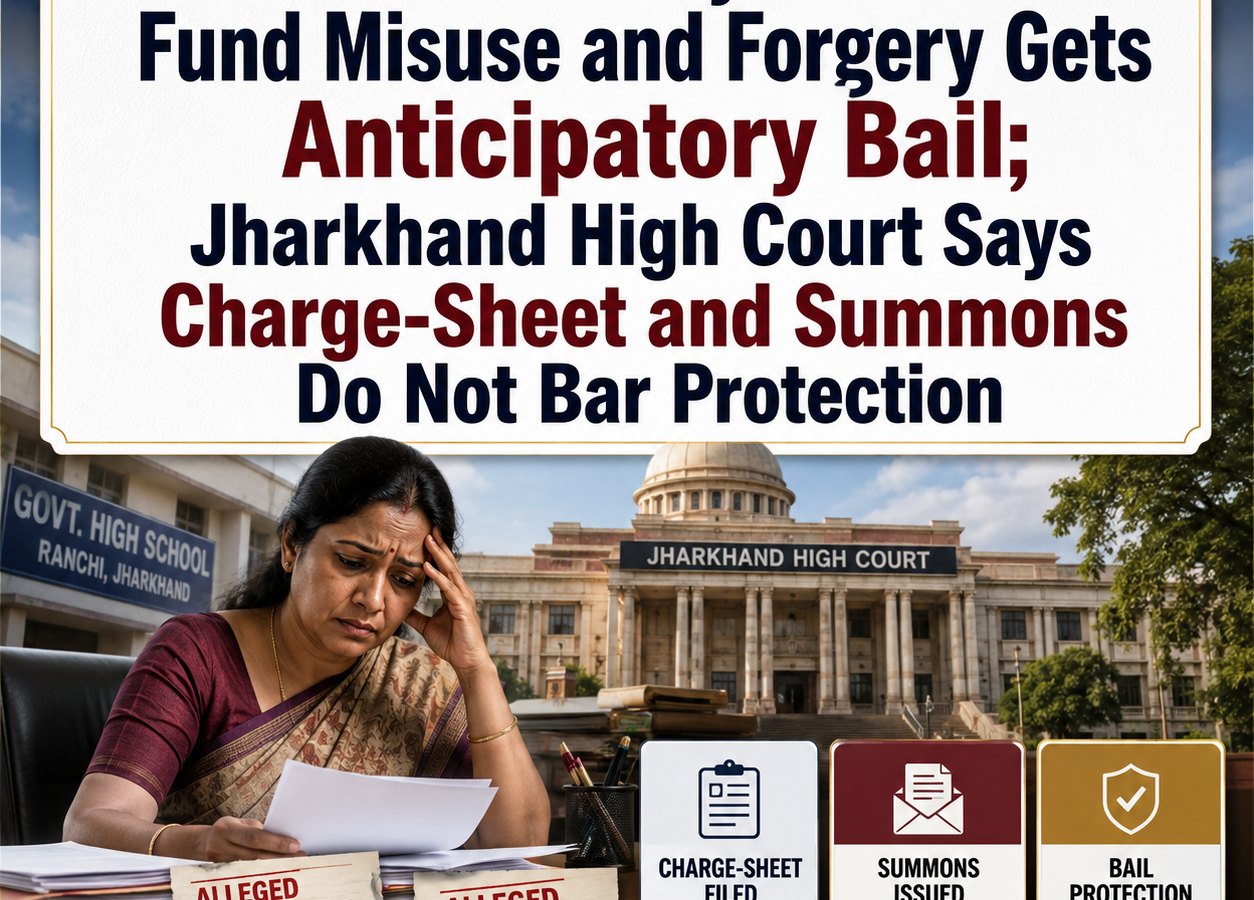
After 2017 School Fraud FIR and Filing of Charge-Sheet, Jharkhand High Court Grants Anticipatory Bail to Former Secretary
Facts
Abhay Kumar Mishra sought anticipatory bail in connection with Jagarnathpur Police Station Case No. 314 of 2017, registered for alleged offences of criminal breach of trust, cheating, forgery, theft and criminal conspiracy under Sections 406, 420, 467, 468, 379, 120-B and 34 of the Indian Penal Code.
The case concerned alleged financial and administrative irregularities in the management of a school. The petitioner had been elected Secretary of the school in 2015. The allegations included misuse of school funds, irregularities in the tender and construction of classrooms, alteration of the number of classrooms in official records, questionable cash deposits during demonetisation, and the alleged appointment of the petitioner’s wife as a trained teacher without the required qualifications.
The petitioner had earlier filed proceedings seeking quashing of the criminal case and had received interim protection. That protection was subsequently vacated. The police completed the investigation and filed the charge-sheet on 31 December 2023. The Magistrate took cognizance and issued summons against the petitioner.
Apprehending that he would be taken into custody upon appearing before the trial court, the petitioner approached the High Court for anticipatory bail.
Issues
- Whether an application for anticipatory bail remains maintainable after filing of the charge-sheet, taking of cognizance and issuance of summons.
- Whether the petitioner’s apprehension of arrest continued to exist even though the investigation had concluded.
- Whether the Supreme Court ruling concerning appearance of an accused in a private complaint case applied equally to a police case arising from an FIR and investigation.
- Whether the allegations concerning school funds, construction, appointment of the petitioner’s wife and alleged manipulation of records justified denial of anticipatory bail.
Petitioner’s Arguments
The petitioner submitted that the FIR had been registered in 2017 and that he had cooperated throughout the police investigation. Since the charge-sheet had already been filed, no further custodial interrogation was required.
He explained that he had not earlier filed an anticipatory bail application because he had interim protection in the quashing proceedings. After that protection was vacated, he faced a genuine apprehension of being taken into custody upon appearing before the Magistrate.
The petitioner contended that the criminal allegations arose from an internal dispute concerning the management and election of the school. According to him, the informant was neither associated with the concerned society nor connected with the school.
Regarding the school building, the petitioner argued that the construction had been duly sanctioned and completed. The reference to five classrooms instead of six was stated to be a typographical mistake that was subsequently corrected. The tender amount was also said to have been correctly shown as ₹54 lakh through a corrected advertisement.
The petitioner further submitted that:
- His wife had been appointed in 2009, whereas he became Secretary only in 2015.
- She had obtained a B.Ed. qualification from Bengaluru University.
- The school’s accounts were handled by a Chartered Accountant.
- A retired High Court judge appointed as Administrator of the school had not made any complaint against him.
- In another criminal case involving substantially similar allegations, he and other co-accused had already been granted anticipatory bail.
Respondent’s Arguments
State’s Arguments
The State submitted that the investigation had concluded, the charge-sheet had been filed and the petitioner was therefore required to appear before the trial court and face the proceedings.
Informant’s Arguments
The informant opposed anticipatory bail on the ground that cognizance had already been taken and summons had been issued. He argued that once summons were issued, the petitioner was required to appear before the Magistrate and could not maintain an anticipatory bail application.
Relying upon the Supreme Court’s decision in Om Prakash Chhawnika alias Om Prakash Chabnika alias Om Prakash Chawnika v. State of Jharkhand, the informant contended that the petitioner should appear before the trial court instead of seeking pre-arrest protection.
On the merits, the informant alleged that:
- The petitioner and the school’s Chartered Accountant had misappropriated school funds.
- The Income Tax Department had imposed a penalty of approximately ₹5.72 crore upon the school and frozen two bank accounts.
- Serious irregularities existed in the tender and payments made for construction of the school building.
- The figure relating to the number of classrooms had been altered from five to six.
- Approximately ₹2.32 crore had been deposited in cash during demonetisation and allegedly withdrawn on the same day.
- The petitioner’s wife had been drawing salary as a trained teacher despite allegedly lacking the required qualification.
- The certificates produced in support of her qualification were doubtful.
The informant further accused the petitioner of repeatedly approaching the High Court and avoiding appearance before the trial court despite issuance of summons.
Analysis of the Law
The High Court held that filing of a charge-sheet, taking of cognizance or issuance of summons does not, by itself, create a legal bar against entertaining an anticipatory bail application.
Section 438 of the Code of Criminal Procedure, corresponding to Section 482 of the Bharatiya Nagarik Suraksha Sanhita, 2023, is intended to protect personal liberty where a person has a reasonable apprehension of arrest. An application under this provision must therefore be considered on its merits and cannot be rejected solely because the investigation has concluded.
The Court distinguished between:
- A private complaint case, where the Magistrate proceeds on a complaint and may hold an inquiry under Section 202 CrPC; and
- A police case, where an FIR is investigated by the police and a charge-sheet is subsequently filed.
In the present matter, the petitioner had cooperated in the police investigation, had earlier enjoyed interim protection and faced a real possibility of being taken into custody upon appearing before the Magistrate. Therefore, his apprehension of arrest had not disappeared merely because the charge-sheet had been filed.
The Court also held that allegations relating to the school accounts, building construction, the petitioner’s wife’s appointment and the authenticity of documents involved disputed questions of fact. These matters were required to be adjudicated during trial and could not be conclusively determined while deciding anticipatory bail.
Precedent Analysis
Om Prakash Chhawnika v. State of Jharkhand
The informant relied upon this Supreme Court decision to argue that, after summons had been issued, the accused was required to appear before the trial court and could not seek anticipatory bail.
The High Court distinguished the decision because it arose from a private complaint case involving an inquiry under Section 202 CrPC. The Supreme Court had observed in that factual context that arrest was not necessary and that the accused should appear before the Magistrate.
The present case, however, arose from a police FIR followed by investigation and filing of a charge-sheet. Since the petitioner faced a genuine apprehension of custody upon appearance, the ruling did not bar consideration of his anticipatory bail application.
Ravindra Saxena v. State of Rajasthan, (2010) 1 SCC 684
The High Court relied principally upon this decision. The Supreme Court had held that anticipatory bail cannot be refused merely because the charge-sheet or challan has been filed.
The court must examine the facts and circumstances of the individual case and exercise its discretion on merits. Allegations of cheating or forgery, by themselves, do not justify rejection of anticipatory bail without examining the need for custody and the surrounding circumstances.
Gurbaksh Singh Sibbia v. State of Punjab, (1980) 2 SCC 565
The judgment in Ravindra Saxena referred to the principles laid down in Gurbaksh Singh Sibbia. The Supreme Court had cautioned against placing restrictions upon anticipatory bail that are not contained in the statutory provision itself.
The expression “if it thinks fit” gives the High Court and Court of Session broad judicial discretion to grant anticipatory bail where the facts justify protection of personal liberty.
Maneka Gandhi v. Union of India, (1978) 1 SCC 248
The Court referred to the principle that any procedure resulting in deprivation of personal liberty must be fair, just and reasonable under Article 21 of the Constitution.
The beneficial protection of anticipatory bail cannot therefore be defeated by technical objections that are not expressly recognised by the legislature.
Court’s Reasoning
The Court found that the petitioner had cooperated with the investigation and that the police had already filed the charge-sheet. His custody was therefore not shown to be necessary for completing the investigation.
The fact that cognizance had been taken and summons had been issued did not eliminate the petitioner’s apprehension that he could be remanded to custody upon appearing before the Magistrate.
The Court also considered that the allegations concerning construction of the school building and alteration of the number of classrooms were disputed. The building had already been completed, and the petitioner had produced an explanation regarding the corrected tender amount and the reference to six classrooms.
The Court observed that it was not clear, at the anticipatory bail stage, whether the Income Tax penalty had been imposed because of any act personally attributable to the petitioner.
Similarly, the petitioner’s wife had been appointed in 2009, whereas the petitioner became Secretary only in 2015. The questions concerning her qualifications, appointment and certificates were matters to be examined during trial.
The Court concluded that the informant’s allegations went to the merits of the prosecution case and could not, by themselves, justify rejection of anticipatory bail, particularly when the investigation was complete and the petitioner had cooperated.
Conclusion
The Jharkhand High Court granted anticipatory bail to the petitioner.
The petitioner was directed to surrender before the trial court within three weeks. In the event of his surrender or arrest, he was ordered to be released on bail upon furnishing:
- A bail bond of ₹25,000;
- Two sureties of the like amount each;
- An undertaking to cooperate with the trial; and
- Compliance with the conditions prescribed under Section 482(2) of the Bharatiya Nagarik Suraksha Sanhita, 2023.
The Court reaffirmed that a charge-sheet, cognizance order or summons does not automatically bar anticipatory bail. Where an accused continues to face a genuine apprehension of arrest, the application must be decided on its individual merits.
Case Details
Case: Abhay Kumar Mishra v. State of Jharkhand & Another
Court: High Court of Jharkhand at Ranchi
Case Number: A.B.A. No. 3354 of 2026
Neutral Citation: 2026:JHHC:18476
Judge: Hon’ble Mr. Justice Sanjay Kumar Dwivedi
Date: 24 June 2026
Result: Anticipatory bail granted; petitioner directed to surrender within three weeks and be released on bail on furnishing a bond of ₹25,000 with two sureties, subject to cooperation with the trial and statutory conditions.