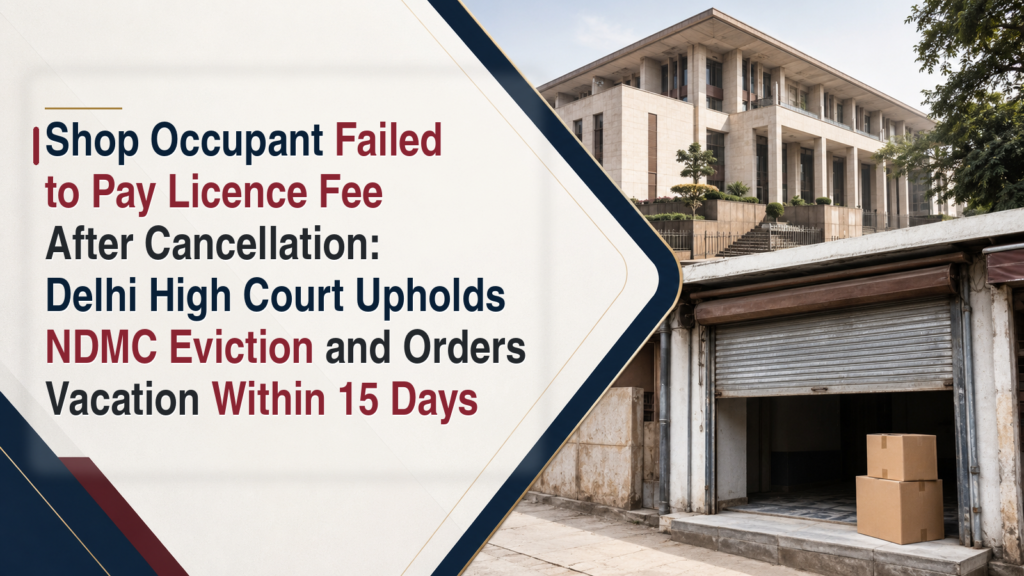
Shop Occupant Failed to Pay Licence Fee After Cancellation: Delhi High Court Upholds NDMC Eviction and Orders Vacation Within 15 Days

Non-Payment of Licence Fee Led to Cancellation of Palika Bhawan Shop: Delhi High Court Directs Occupant to Vacate in 15 Days
Facts
Ratinder Nath Abrol was allotted Shop No. G-19, Palika Bhawan, R.K. Puram, New Delhi, by the New Delhi Municipal Council through a licence agreement dated 18 August 1984. The shop was allotted for carrying on business.
The initial licence was for five years, with a monthly licence fee of ₹5,733. It was extended in 1989 for another five years, up to July 1994.
The licence was further renewed in 1994. A dispute subsequently arose over the enhancement of the licence fee. The petitioner claimed that New Delhi Municipal Council had wrongly applied an enhancement of 25% instead of the agreed 15%.
Following representations and meetings, the New Delhi Municipal Council issued a communication dated 14 February 2005. The petitioner was permitted to deposit the outstanding principal licence fee calculated without interest by 28 February 2005. If the principal dues were cleared, the question of interest would be reconsidered. Failure to clear them would result in cancellation of the licence.
The petitioner claimed that he deposited the required amount, including ₹1,88,540 through a cheque dated 21 February 2005. The record referred to payment of ₹2,48,540 in two instalments towards the principal amount up to January 2005.
According to the petitioner, even after the principal dues were paid, the Council continued charging interest on an amount arising from the allegedly incorrect licence-fee enhancement.
The New Delhi Municipal Council issued a show-cause notice on 9 October 2006 and cancelled the allotment in June 2007 for non-payment of dues. It treated the petitioner’s continued possession after cancellation as unauthorised occupation.
Eviction proceedings were instituted under Sections 5 and 7 of the Public Premises (Eviction of Unauthorised Occupants) Act, 1971. A notice under Section 4(1) was issued by the Estate Officer.
On 18 August 2020, the Estate Officer directed the petitioner to:
- Vacate the shop within 15 days;
- Pay an interim amount of ₹26,48,799 towards licence fees and damages calculated up to August 2017; and
- Pay the revised balance after correction of the statement of accounts in accordance with the earlier directions concerning interest.
The petitioner challenged this order under Section 9 of the Public Premises Act. On 23 March 2023, the Principal District and Sessions Judge dismissed the challenge insofar as it concerned eviction and recovery of ₹26,48,799.
For the period beginning September 2017, however, the matter was remanded to the Estate Officer for a fresh calculation based on the applicable licence fee, annual enhancement, prevailing market rent and other relevant factors.
The petitioner thereafter approached the Delhi High Court under Articles 226 and 227 of the Constitution.
During the writ proceedings, the High Court initially stayed the impugned order subject to a deposit of ₹12 lakh, which was made. The petitioner also tendered ₹2,30,194, which according to his calculations represented the balance licence fee payable. The Court ultimately examined whether these payments or the alleged procedural deficiencies justified interference with the eviction.
Issues
- Whether the petitioner received the mandatory notice under Section 4 of the Public Premises Act before the eviction order was passed.
- Whether the eviction proceedings violated the principles of natural justice.
- Whether the New Delhi Municipal Council could treat the petitioner as an unauthorised occupant after cancellation of the licence.
- Whether the alleged incorrect enhancement of licence fees from 15% to 25% invalidated the cancellation and eviction.
- Whether payment of earlier principal dues entitled the petitioner to continue occupying the shop.
- Whether the Estate Officer and appellate court properly considered the licence-fee dispute and payment records.
- Whether the High Court could reassess the evidence and calculations under its limited jurisdiction under Articles 226 and 227.
- Whether the eviction order and recovery of ₹26,48,799 required interference.
- How the amounts deposited during the High Court proceedings were to be treated.
Petitioner’s Arguments
The petitioner argued that the eviction proceedings violated natural justice because no valid notice under Section 4 of the Public Premises Act had been issued before proceedings under Sections 5 and 7 were initiated.
He contended that the New Delhi Municipal Council had already declared him an unauthorised occupant in its cancellation communication. According to him, this showed that the issue had been predetermined before the Estate Officer independently considered it.
The petitioner relied upon Bhagat Singh v. Delhi Development Authority to argue that service of a valid Section 4 notice is mandatory before an eviction order under Section 5 can be made.
He also relied upon Ganesh Bai v. Union of India, which emphasised that an Estate Officer must follow the statutory procedure prescribed by the Public Premises Act.
On the merits, the petitioner maintained that the Council had incorrectly enhanced the licence fee by 25% instead of 15%. He claimed that the competent authority subsequently recognised this error and permitted him to clear the corrected principal amount.
The petitioner asserted that he had complied with the 2005 direction and deposited the full principal amount. The unresolved dispute concerned interest and the Council’s failure to correct its statement of accounts.
He relied upon the ₹12 lakh deposited pursuant to the High Court’s interim order and the further amount of ₹2,30,194 tendered during the proceedings. According to his calculations, ₹2,30,194 was the only remaining principal licence fee due.
He therefore sought quashing of both the Estate Officer’s eviction order and the Principal District and Sessions Judge’s appellate order.
Respondent’s Arguments
The New Delhi Municipal Council argued that the procedure under the Public Premises Act had been duly followed.
It produced the notice issued by the Estate Officer under Section 4(1). It explained that a statutory show-cause notice naturally followed receipt of the Council’s eviction application and information regarding the petitioner’s unauthorised occupation.
The Council contended that the petitioner became an unauthorised occupant only after cancellation of the licence. The cancellation was communicated in June 2007 and was never separately challenged.
It argued that the petitioner had continued occupying the shop for approximately 13 years without a valid licence by the time the Estate Officer passed the eviction order.
The Council also submitted that the objection regarding non-compliance with Sections 4 and 5 had not been raised before the Estate Officer or in the statutory appeal. It allegedly did not even form part of the grounds initially pleaded in the writ petition.
Reliance was placed on Life Insurance Corporation of India v. Nandini J. Shah to oppose the introduction of a new procedural challenge at the writ stage.
The Council further relied on Sadhana Lodh v. National Insurance Co. Ltd. to argue that the High Court’s supervisory jurisdiction under Article 227 does not permit it to act as an appellate court or reweigh the evidence.
According to the Council’s provisional calculation, the total outstanding monthly licence fee was ₹41,70,799. After adjusting payments, it claimed that ₹31,11,437 remained due, excluding interest.
Analysis of the Law
Mandatory Notice Under Section 4
Section 4 of the Public Premises Act requires an Estate Officer who receives information about unauthorised occupation to issue a written notice calling upon the occupant to show cause against eviction.
The notice must specify the proposed grounds of eviction and give the occupant an opportunity to:
- File a response;
- Produce supporting evidence; and
- Seek a personal hearing.
An order under Section 5 can be passed only after considering the response, evidence and hearing, if requested.
The High Court found that the Estate Officer had issued a Section 4(1) notice after receiving the New Delhi Municipal Council’s eviction application. The petitioner participated in the proceedings through counsel and in person over several years. Therefore, the statutory requirement and principles of natural justice were satisfied.
Meaning of Unauthorised Occupation
Under Section 2(g) of the Public Premises Act, unauthorised occupation includes possession that was initially lawful but became unauthorised after the authority to occupy ceased.
The petitioner’s initial possession arose from a valid licence. Once the licence expired or was cancelled and was not renewed, his continued occupation became unauthorised.
Effect of Licence-Fee Dispute
A disagreement regarding the correct amount of licence fees does not automatically preserve an expired or cancelled licence.
The appellate court found that the petitioner did not regularly pay even the principal amount he considered payable. Nor did he submit his own complete statement of accounts during the prolonged proceedings or make continuing payments under protest.
The earlier concession concerning payment of principal dues and reconsideration of interest did not create an indefinite right to occupy the shop without paying current licence fees.
Scope of Articles 226 and 227
Judicial review under Articles 226 and 227 is not a second statutory appeal. Where the Estate Officer and appellate authority have examined the record and reached findings within their jurisdiction, the High Court ordinarily cannot reweigh the evidence.
Interference is justified only where the order suffers from jurisdictional error, perversity, breach of natural justice or another material legal infirmity.
The High Court found none of these defects in the orders concerning eviction and recovery up to August 2017.
Precedent Analysis
Bhagat Singh v. Delhi Development Authority
This decision held that a valid notice under Section 4 is mandatory before an eviction order under Section 5 can be passed. The notice must clearly identify the relevant premises and grounds.
The principle did not assist the petitioner because the record showed that the Estate Officer had issued a statutory notice concerning the subject shop.
Ganesh Bai v. Union of India
The Delhi High Court reiterated that an Estate Officer must strictly follow the procedure under the Public Premises Act, including issuance of a Section 4 notice.
The Court found compliance with that requirement in the present proceedings.
Life Insurance Corporation of India v. Nandini J. Shah
The Supreme Court decision was relied upon by the Council to argue that the petitioner could not introduce new procedural objections that had not been raised before the statutory authorities.
Although the High Court examined the notice objection on its merits, it found the objection factually unsustainable.
Sadhana Lodh v. National Insurance Co. Ltd.
The Supreme Court held that Article 227 gives the High Court supervisory, not appellate, jurisdiction. The High Court cannot review or reweigh evidence merely to correct an ordinary factual or legal error.
This principle supported the refusal to reopen findings already considered by the Estate Officer and the Principal District and Sessions Judge.
Court’s Reasoning
The High Court rejected the petitioner’s central claim that no notice under Section 4 had been issued.
The Estate Officer had received information regarding unauthorised occupation through the New Delhi Municipal Council’s application and subsequently issued the statutory show-cause notice. The proceedings therefore followed the sequence contemplated by the Act.
The petitioner was represented in the proceedings, appeared personally on several dates and had repeated opportunities to submit evidence and calculations. There was no denial of a hearing or violation of natural justice.
The Court agreed with the appellate authority that the licence had been validly cancelled because of continued non-payment. After cancellation, the petitioner’s occupation no longer had lawful authority.
The argument that the licence fee was incorrectly enhanced from 15% to 25% had already been considered in detail by the appellate court. That court found the plea contrary to the original licence agreement, the supplemental agreement and the Council’s policy decisions.
The 2005 concession did not establish that the Council had accepted the petitioner’s interpretation of the fee enhancement. It merely allowed the principal arrears to be cleared and contemplated reconsideration of interest if timely payment was made.
The petitioner failed to pay licence fees regularly after April 2005. Even after being permitted to deposit amounts that he considered due, he did not maintain regular payments or comply with directions passed during the Estate Officer’s proceedings.
The High Court also noted that the appellate court had not mechanically accepted all of the Council’s calculations. It upheld ₹26,48,799 only as the interim amount up to August 2017 and remanded the later period for a fresh and proper assessment.
All factual and legal submissions raised in the writ petition had already been carefully addressed by the Principal District and Sessions Judge. The High Court found no jurisdictional error, perversity or legal infirmity warranting interference.
The amounts deposited during the writ proceedings, together with accrued interest, were directed to be adjusted when the Estate Officer recalculated the charges for the subsequent period.
Conclusion
The Delhi High Court dismissed Ratinder Nath Abrol’s writ petition and upheld the eviction of Shop No. G-19, Palika Bhawan, R.K. Puram.
The petitioner was directed to vacate the shop within 15 days of the judgment. The recovery of ₹26,48,799 towards interim licence fees and user charges up to August 2017 remained undisturbed.
The matter was remanded to the Estate Officer only for fresh computation of licence fees, user charges or damages from 1 September 2017 onward. The amounts deposited before the High Court, along with accrued interest, were to be adjusted in that calculation.
Case Details
Case: Ratinder Nath Abrol v. New Delhi Municipal Council
Court: High Court of Delhi at New Delhi
Case Number: Writ Petition (Civil) 4398/2023 and Civil Miscellaneous Application 55928/2024
Judge: Hon’ble Mr Justice Amit Sharma
Date: 16 July 2026
Result: Writ petition dismissed; eviction and recovery of ₹26,48,799 upheld, petitioner directed to vacate within 15 days, and post-September 2017 charges remanded for fresh calculation.