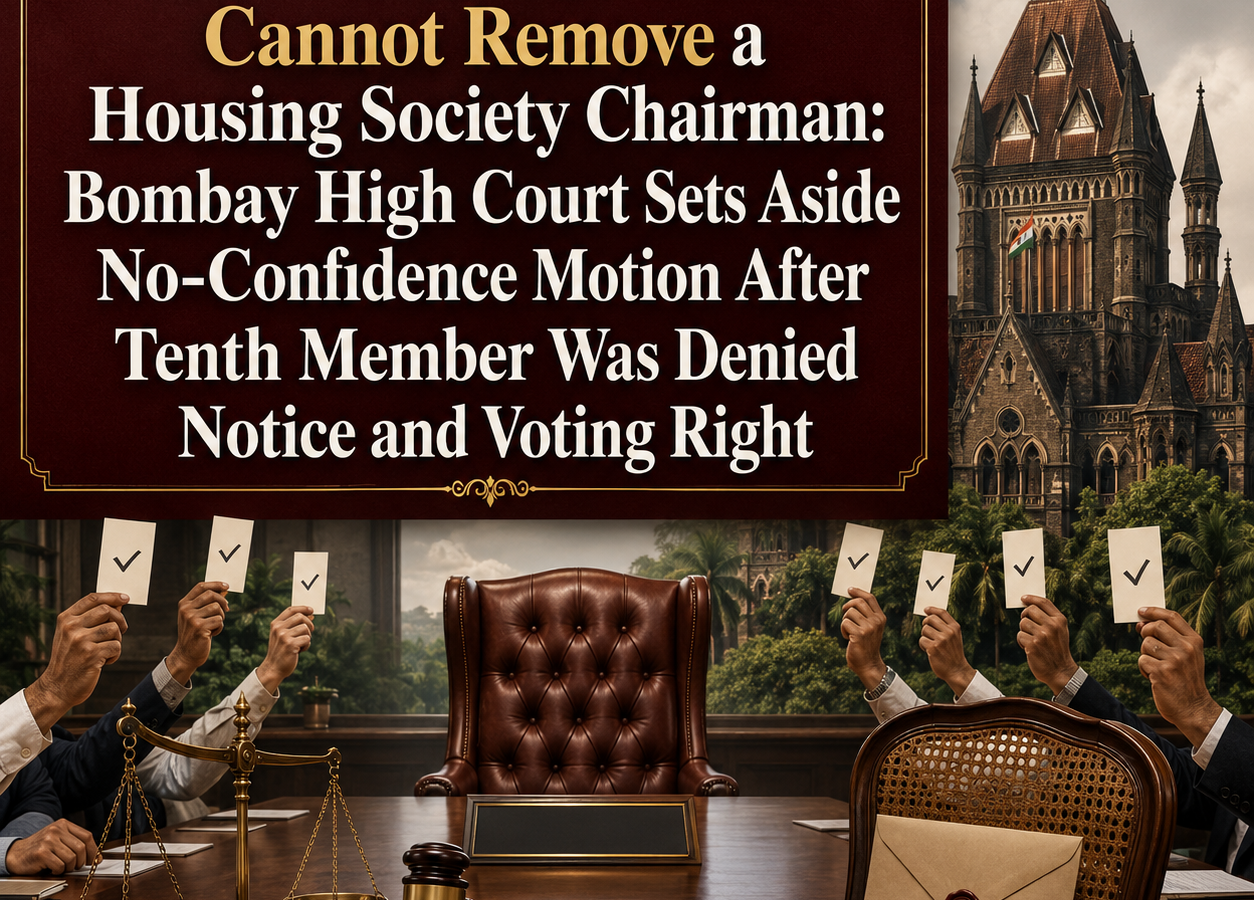
Six Votes Out of Ten Cannot Remove a Housing Society Chairman: Bombay High Court Sets Aside No-Confidence Motion After Tenth Member Was Denied Notice and Voting Right

Case Details
Court: Bombay High Court, Civil Appellate Jurisdiction
Case: Madhavi Vilas Gosavi and Another v. Rajesh Mishra and Others
Case Number: Civil Writ Petition No. 6416 of 2026
Coram: Justice Sandeep V. Marne
Reserved On: June 8, 2026
Pronounced On: June 12, 2026
Legal Provisions Involved
- Section 73-ID of the Maharashtra Co-operative Societies Act, 1960
- Section 154B-24 of the Maharashtra Co-operative Societies Act, 1960
- Chapter XIII-B of the Maharashtra Co-operative Societies Act, 1960
- Article 226/227 of the Constitution of India
Brief Background
The dispute arose from the removal of Petitioner No. 2 from the position of Chairman of Padmavati Nagar Co-operative Housing Society Limited, Goregaon East, Mumbai.
The Society had entered into a Development Agreement with M/s Viraj Properties on September 27, 2012 for redevelopment of its old building. A supplementary agreement was executed in December 2014 and another supplementary agreement was executed in February 2022.
The Society’s building was demolished in or around October 2020. However, according to the petitioners, the developer failed to make meaningful progress in the redevelopment project even after the members had vacated their homes.
On September 22, 2025, 51 out of 73 members reportedly withdrew their consent to continue redevelopment through the existing developer.
A Special General Body Meeting was initially proposed for March 15, 2026 to consider, among other issues, termination of the developer. The meeting was postponed after objections were raised regarding the notice.
A fresh notice dated April 4, 2026 was then issued for holding a Special General Body Meeting on April 12, 2026. The agenda included:
- Termination of the existing developer; and
- Appointment of a Managing Committee member against the seat reserved for the SC/ST/NT category.
Meanwhile, on April 6, 2026, six Managing Committee members submitted a requisition to the Deputy Registrar seeking a no-confidence motion against Petitioner No. 2, who was the Chairman.
Acting on the requisition, the Deputy Registrar issued a notice on April 9, 2026 convening a special Managing Committee meeting on April 15, 2026.
At the time the notice was issued, the Managing Committee consisted of nine members.
Appointment of the Tenth Committee Member
The Special General Body Meeting was held on April 12, 2026.
At this meeting:
- The Society resolved to terminate the appointment of the developer; and
- Petitioner No. 1 was appointed as a Managing Committee member against the reserved-category seat with immediate effect.
The Society informed the Deputy Registrar about Petitioner No. 1’s appointment through a letter dated April 13, 2026. The Deputy Registrar’s office acknowledged the communication on the same day.
Petitioner No. 2 also referred to the appointment of Petitioner No. 1 in her response submitted to the Deputy Registrar.
Therefore, before the no-confidence meeting was actually held on April 15, 2026, the Deputy Registrar was aware that the Managing Committee’s working strength had increased from nine to ten members.
No-Confidence Motion Passed by Six Votes
The special meeting was held on April 15, 2026 under the chairmanship of the Deputy Registrar.
Nine members participated in the meeting:
- Six members voted in favour of the no-confidence motion; and
- Three members voted against it.
Petitioner No. 1 was not given notice of the meeting and was consequently unable to attend or vote.
The Deputy Registrar treated six votes out of the nine participating members as the required two-thirds majority. He declared that the no-confidence motion had been validly passed and that Petitioner No. 2 had ceased to be Chairman.
The position of Chairman was accordingly declared vacant.
Thereafter, a notice dated April 25, 2026 was issued for electing a new Chairman. A Managing Committee meeting was held on May 2, 2026, in which another person was elected as Chairman.
The petitioners challenged:
- The no-confidence resolution dated April 15, 2026;
- The Deputy Registrar’s decision and certificate declaring the Chairman’s post vacant;
- The notice dated April 25, 2026; and
- The resolution dated May 2, 2026 appointing a new Chairman.
Petitioners’ Arguments
The petitioners argued that there were ten valid Managing Committee members on April 15, 2026.
Accordingly, a minimum of seven votes were required to satisfy the statutory requirement of a two-thirds majority. Six votes could not constitute two-thirds of ten because two-thirds of ten is 6.67, which could not be rounded down to six.
They further argued that Petitioner No. 1 had been validly appointed on April 12, 2026 and that her appointment was communicated to the Deputy Registrar on April 13, 2026.
Therefore, the Deputy Registrar was required to recognise her right to participate and vote in the meeting.
The petitioners contended that denying notice and voting rights to Petitioner No. 1 rendered the entire no-confidence process void from the beginning.
They also alleged that the members who moved the no-confidence motion were acting in support of the developer, whose appointment had been terminated by the General Body after prolonged delay in redevelopment.
Respondents’ Arguments
The contesting respondents argued that Petitioner No. 2 had lost the confidence of more than two-thirds of the Managing Committee members.
They alleged that the appointment of Petitioner No. 1 was being used to protect Petitioner No. 2’s position as Chairman after the no-confidence process had already commenced.
It was argued that:
- The requisition was submitted when there were only nine committee members;
- The Deputy Registrar’s notice was also issued when the committee had nine members;
- The law prohibited adjournment of a no-confidence meeting;
- Petitioner No. 1 had not attempted to attend the meeting; and
- Petitioner No. 2 had not objected during the meeting to Petitioner No. 1’s absence.
The respondents also claimed that the writ petition involved disputed questions of fact and had become infructuous because a new Chairman had already been elected.
Issue Before the Court
The principal issue before the High Court was whether the no-confidence motion passed by six votes in the meeting held on April 15, 2026 was valid under Section 154B-24 read with Section 73-ID of the Maharashtra Co-operative Societies Act.
Difference Between Section 73-ID and Section 154B-24
The High Court explained the important distinction between the two provisions.
Societies Other Than Co-operative Housing Societies
Under Section 73-ID(1), the no-confidence motion must be passed by a two-thirds majority of the total number of committee members entitled to vote.
Therefore, the total working strength of the committee is considered even when some members do not attend the meeting.
Co-operative Housing Societies
Section 154B-24 specifically applies to co-operative housing societies.
It requires the motion to be passed by not less than a two-thirds majority of the committee members who are present and entitled to vote at the meeting.
Sub-sections (2) to (7) of Section 73-ID continue to apply to housing societies through Section 154B-24(2).
Statutory Vacuum Recognised by the Court
The Court observed that the case presented an unusual situation.
When the requisition was submitted on April 6 and the notice was issued on April 9, the Managing Committee consisted of nine members.
However, before the meeting was held on April 15, a tenth member had been validly appointed with immediate effect.
Neither Section 73-ID nor Section 154B-24 expressly deals with the appointment of a new committee member during the period between issuance of the meeting notice and the actual meeting.
The Court acknowledged that the Deputy Registrar could not adjourn the meeting because Section 73-ID(5) prohibits adjournment of a no-confidence meeting for any reason.
However, the prohibition against adjournment did not authorise the Deputy Registrar to disregard the voting right of the newly appointed member.
Strict Compliance Required in No-Confidence Proceedings
The Court held that removal through a no-confidence motion carries drastic consequences and attaches a stigma to the office bearer.
The Maharashtra Co-operative Societies Act permits an office bearer to be removed through a no-confidence motion without the members being required to establish any specific misconduct or give any reason.
Therefore, the statutory procedure and majority requirement must be strictly followed.
Where the statute does not expressly deal with a peculiar factual situation, the provisions should be interpreted in favour of the office bearer sought to be removed rather than against that person.
Newly Appointed Member Was Entitled to Vote
The Court found that Petitioner No. 1 had been validly appointed as a committee member on April 12, 2026 and was entitled to vote in the meeting held on April 15, 2026.
Her appointment had also been brought to the Deputy Registrar’s attention before the meeting.
The Court rejected the contention that Petitioner No. 1 could be excluded because she was not present.
She had never been given notice or invited to attend the meeting. Therefore, she had no opportunity to remain present.
The expression “committee members who are present and entitled to vote” could not be used to exclude a member who was deliberately not called to attend the meeting.
The Court held that a member’s absence caused by the authority’s failure to issue notice could not be relied upon to reduce the committee strength for calculating the required two-thirds majority.
Appointment Was Not Made to Defeat the No-Confidence Motion
The Court also rejected the suggestion that Petitioner No. 1 had been appointed merely to save the Chairman.
The notice proposing appointment of a reserved-category member had been issued on April 4, 2026, two days before the six committee members submitted their no-confidence requisition on April 6, 2026.
The members moving the no-confidence motion were therefore aware that a tenth member was likely to be appointed.
The Court further noted that Petitioner No. 1 was again denied notice when the meeting for electing a new Chairman was held on May 2, 2026. This indicated that her membership and voting rights were never intended to be recognised by the contesting members.
Six Votes Were Not Two-Thirds of Ten
The Court held that if Petitioner No. 1 had been permitted to participate, the voting would apparently have been:
- Six votes in favour of the motion; and
- Four votes against the motion.
Two-thirds of ten is 6.67. Therefore, at least seven affirmative votes were necessary.
Six votes could not satisfy the statutory requirement.
The Court relied on its earlier judgment in Radhakishan Sadarangani and Others v. Deepa Rohera and Others, where it had held that a fractional two-thirds figure cannot be rounded down.
If the required majority works out to 5.33, five votes are insufficient. Similarly, where the required majority works out to 6.67, six votes are insufficient.
The statute does not authorise the authority or the Court to ignore the fraction or round it down.
Deputy Registrar Could Have Declared That the Motion Failed
The Court accepted that the Deputy Registrar was prohibited from adjourning the meeting.
However, after being informed that a tenth member had been appointed and was entitled to vote, the Deputy Registrar could have recorded that the motion had failed to obtain the required two-thirds majority.
The statutory prohibition against adjournment did not prevent him from recognising the tenth member’s voting right and declaring that six votes were insufficient.
Court Would Not Examine the Merits of the No-Confidence Motion
The Court clarified that it was not examining whether the Chairman had actually created hurdles in redevelopment or misled the members.
The law does not require reasons to be given for moving or passing a no-confidence motion.
Once a motion is validly passed with the legally required two-thirds majority, the Court would ordinarily not examine the wisdom or merits of the committee’s decision.
The motion in this case failed not because the allegations were found to be incorrect, but because the mandatory voting procedure and majority requirement were violated.
Bombay High Court’s Decision
The High Court held that denying Petitioner No. 1 notice and an opportunity to vote violated Section 154B-24(1) of the Maharashtra Co-operative Societies Act.
The resolution dated April 15, 2026 and the Deputy Registrar’s decision and certificate were declared illegal and void ab initio.
Since the no-confidence motion was void from the beginning, the position of Chairman never became vacant.
Petitioner No. 2 therefore continued to legally occupy the position of Chairman.
Consequently, the subsequent meeting held on May 2, 2026 and the resolution electing a new Chairman were also illegal and were set aside.
Final Order
The Bombay High Court ordered that:
- The Managing Committee resolution dated April 15, 2026 passing the no-confidence motion was set aside.
- The Deputy Registrar’s decision and certificate dated April 15, 2026 were set aside.
- The Court declared that the Chairman’s position had not become vacant.
- Petitioner No. 2 was restored and continued as Chairman of the Society.
- The resolution dated May 2, 2026 appointing a new Chairman was set aside.
- The other Managing Committee members were granted liberty to submit a fresh requisition and initiate a new no-confidence motion in accordance with law.
- Section 73-ID(7), which restricts a fresh motion after rejection of an earlier motion, would not apply because the earlier motion had not been rejected on merits; it had been set aside as legally invalid.
- The writ petition was allowed with no order as to costs.
Request for Stay Rejected
After the judgment was pronounced, the respondents requested the Court to stay its operative directions for six weeks.
The Court rejected the request considering the nature of the findings recorded in the judgment.
Key Legal Principles
- A housing society’s no-confidence motion must strictly comply with Section 154B-24 of the Maharashtra Co-operative Societies Act.
- A committee member who is validly appointed before the no-confidence meeting is entitled to participate and vote, even if the requisition and original meeting notice were issued before the appointment.
- Authorities cannot rely on a member’s absence when that member was never given notice or an opportunity to attend.
- Two-thirds majority cannot be calculated by rounding down a fraction.
- Where the Managing Committee consists of ten members, six votes do not constitute a two-thirds majority; at least seven affirmative votes are required.
- No-confidence proceedings have serious and stigmatic consequences and must therefore satisfy the statutory requirements strictly.
- The statutory prohibition against adjournment does not permit the presiding authority to disregard the rights of a newly appointed voting member.
- Setting aside a motion as void for procedural illegality does not prevent members from initiating a fresh no-confidence motion in accordance with law.
Conclusion
The Bombay High Court held that the no-confidence motion was illegal because the newly appointed tenth committee member was neither given notice nor allowed to vote. Since six votes could not constitute the required two-thirds majority of ten members, the Chairman’s removal and the subsequent appointment of a new Chairman were set aside.
Implications
The judgment makes it clear that housing societies must strictly follow the voting and notice requirements under the Maharashtra Co-operative Societies Act. A valid committee member cannot be excluded while calculating the two-thirds majority, and fractional numbers cannot be rounded down. However, the committee members remain free to initiate a fresh no-confidence motion by following the proper legal procedure.