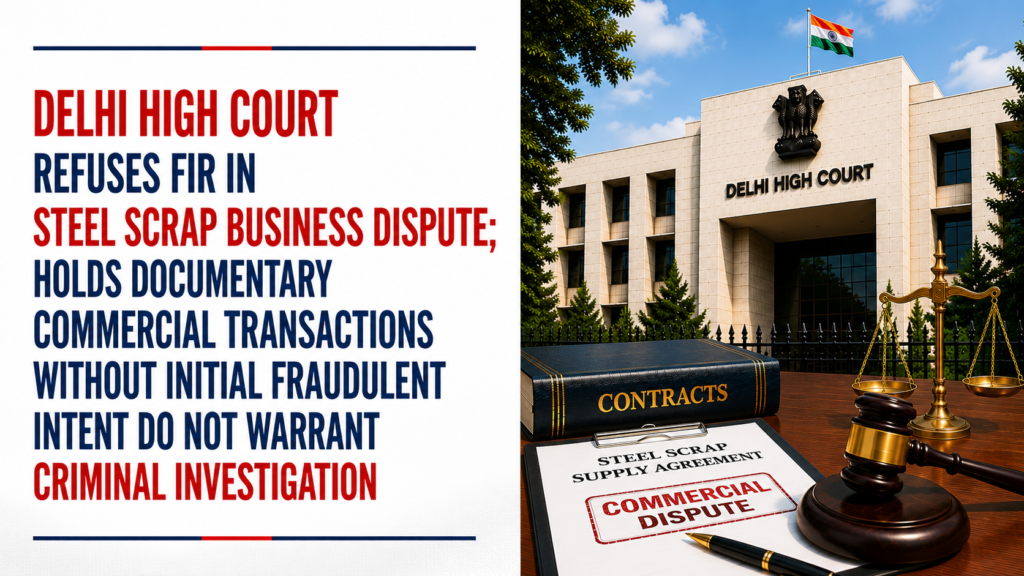
Delhi High Court Refuses FIR in Steel Scrap Business Dispute; Holds Documentary Commercial Transactions Without Initial Fraudulent Intent Do Not Warrant Criminal Investigation

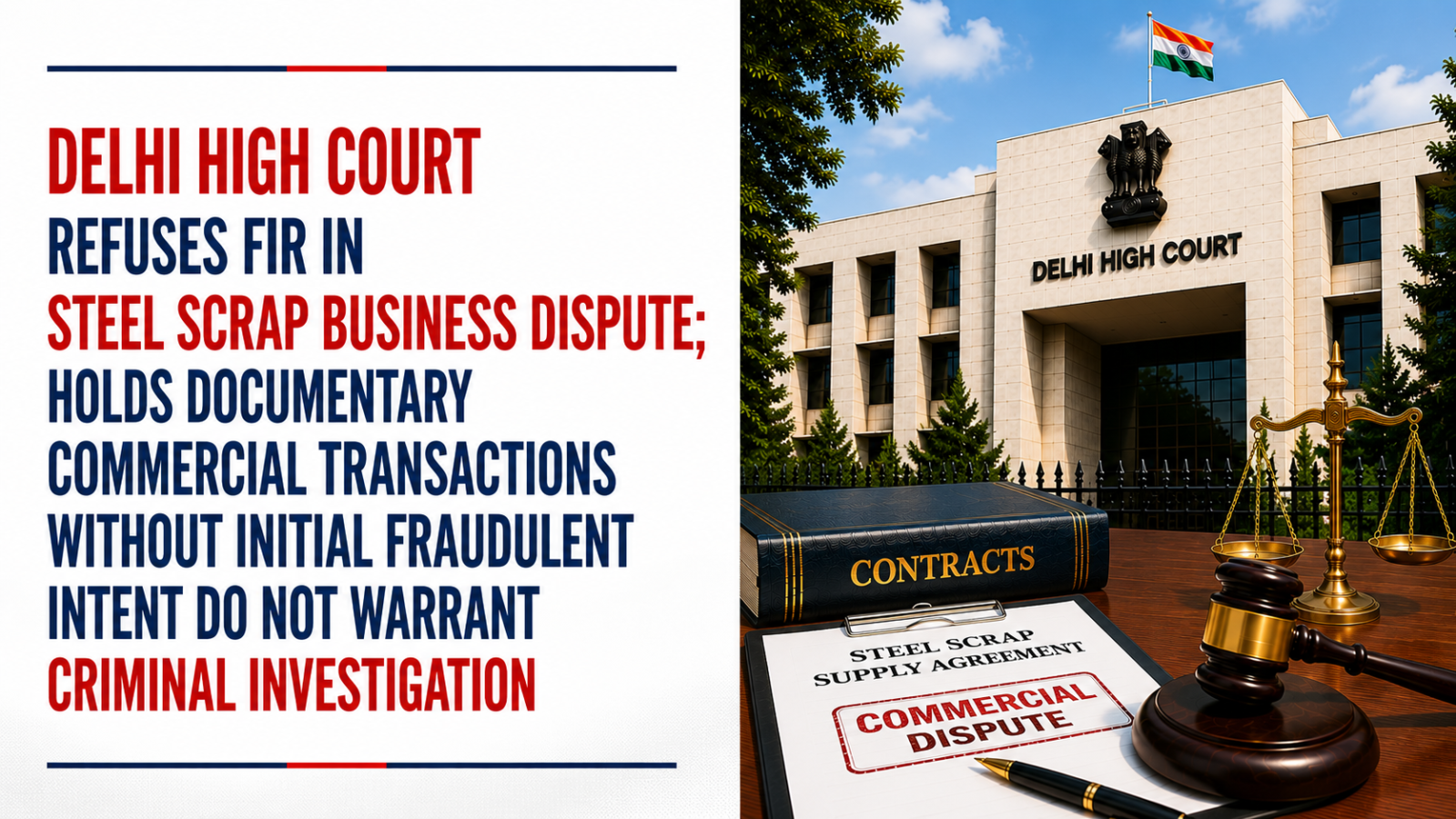
Breach of Commercial Contract Alone Does Not Justify Criminal Investigation, Holds Delhi High Court
Facts
The petitioner, I.F. Hussain, an Australia-based exporter of steel scrap operating through M/s Haidery Metals, alleged that Respondent No. 1 induced him into a commercial relationship for import of steel scrap into India.
According to the petitioner, after successfully completing smaller transactions, the respondent placed a large order for 420 tonnes of steel scrap under a Sale Contract dated 7 November 2005. The petitioner alleged that after shipment, the respondent falsely represented that payments had been processed, persuaded him to dispatch additional consignments, demanded alteration of shipping documents and payment of USD 20,000 for customs clearance, and ultimately failed to clear the consignments or pay the sale consideration, causing losses of approximately USD 193,882.
After complaints to the police, a Vigilance Enquiry Report dated 2 May 2016 reportedly concluded that cognizable offences were disclosed. However, the police filed a closure report treating the dispute as civil in nature. The petitioner’s application under Section 156(3) CrPC seeking registration of an FIR, and the accompanying complaint under Section 200 CrPC, were dismissed by the Metropolitan Magistrate and later by the Revisional Court. The petitioner challenged those orders before the Delhi High Court under Section 528 BNSS.
Issues
- Whether the Magistrate erred in refusing to direct registration of an FIR under Section 156(3) CrPC.
- Whether the Vigilance Enquiry Report itself warranted compulsory registration of an FIR.
- Whether the allegations disclosed prima facie offences of cheating and criminal misconduct or merely a commercial dispute.
- Whether dismissal of the complaint under Section 200 CrPC required interference.
Petitioner’s Arguments
The petitioner contended that:
- the respondent dishonestly induced him from the very beginning to dispatch steel scrap by making false assurances regarding payment;
- after obtaining the consignments, the respondent demanded changes in shipping documents and additional payments while refusing to honour contractual obligations;
- the Vigilance Enquiry Report specifically concluded that cognizable offences were made out;
- both the Magistrate and Revisional Court ignored the Sale Contract, email correspondence and Vigilance Report, all of which prima facie disclosed criminal offences;
- pendency of proceedings before the Directorate General of Foreign Trade (DGFT) did not bar criminal prosecution.
Respondent’s Arguments
The private respondent did not appear at the stage when judgment was reserved.
The State supported the impugned orders and relied upon the reasoning adopted by the Magistrate and the Revisional Court, namely that the dispute essentially arose out of a commercial transaction based on contractual obligations and documentary evidence.
Analysis of the Law
The Court examined:
- Section 156(3) CrPC relating to directions for registration of an FIR;
- Section 200 CrPC governing private complaints;
- the principles governing exercise of a Magistrate’s discretionary power to direct police investigation;
- the distinction between civil contractual disputes and criminal offences involving dishonest intention from inception.
The Court reiterated that powers under Section 156(3) CrPC are discretionary and cannot be exercised mechanically. Before directing registration of an FIR, the Magistrate must be satisfied that the complaint discloses a cognizable offence requiring police investigation. Where the complainant already possesses all relevant documentary evidence and the identities of the parties are known, police investigation may not be necessary.
Precedent Analysis
The judgment primarily applies settled principles governing Section 156(3) CrPC rather than undertaking an extensive discussion of reported precedents.
The Court emphasised that:
- a Vigilance Enquiry Report is only one piece of material and does not compel the Magistrate to direct registration of an FIR;
- the Magistrate must independently evaluate the complaint, the Action Taken Report and the accompanying documents before exercising jurisdiction under Section 156(3).
Court’s Reasoning
The High Court observed that the petitioner’s entire case rested upon:
- the Sale Contract;
- email correspondence;
- DGFT communications;
- the Vigilance Enquiry Report; and
- other documentary records already available with him.
Since the identity of the parties was undisputed and the material evidence was already in the petitioner’s possession, no investigation requiring police expertise was demonstrated.
The Court further held that the Vigilance Enquiry Report could not automatically compel registration of an FIR. The Magistrate was duty-bound to independently assess whether the complaint disclosed a cognizable offence requiring investigation.
The Court agreed with the Revisional Court that the dispute fundamentally arose from commercial contractual obligations. Whether the respondent breached the contract or whether the petitioner suffered financial loss did not, by itself, establish offences such as cheating unless there was prima facie material showing dishonest or fraudulent intention at the inception of the transaction.
The High Court found that the complaint and accompanying documents failed to disclose such initial fraudulent intent. Accordingly, it upheld both the refusal to direct registration of an FIR under Section 156(3) and the dismissal of the complaint under Section 200 CrPC.
Conclusion
The Delhi High Court dismissed the petition and upheld the orders of the Metropolitan Magistrate and the Revisional Court.
The Court held that the dispute was essentially contractual and documentary in nature, with no prima facie material demonstrating dishonest or fraudulent intention at the inception of the transaction. It further held that the Vigilance Enquiry Report did not automatically mandate registration of an FIR and that the Magistrate had rightly exercised discretion in refusing police investigation under Section 156(3) CrPC as well as in dismissing the complaint under Section 200 CrPC.
Case Details
Case: I.F. Hussain v. Jitender Kharbanda & Anr.
Court: Delhi High Court
Case Number: CRL.M.C. 2539/2026
Judge: Justice Madhu Jain
Date: 4 August 2026
Result: Petition dismissed. The Delhi High Court upheld the rejection of the petitioner’s application under Section 156(3) CrPC and the dismissal of the complaint under Section 200 CrPC, holding that the dispute arose from a commercial transaction and did not prima facie disclose dishonest or fraudulent intention at the inception warranting criminal investigation.