State Deducts ₹84 Lakh From Three Unrelated Road Contracts for Alleged Earlier Overpayment; Supreme Court Quashes Recovery, Says Disputed Claim Cannot Become Debt Without Adjudication

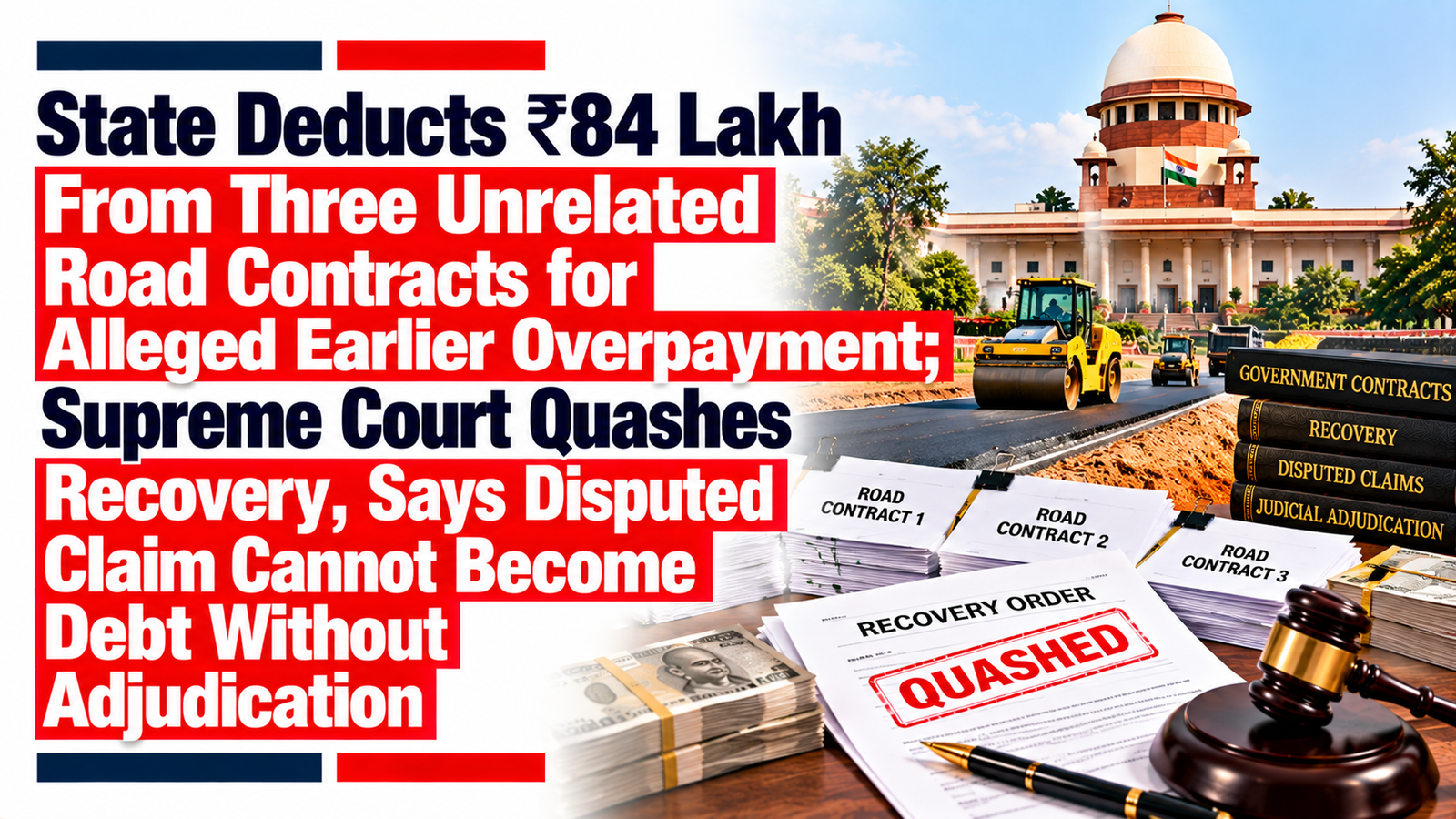
Can Government Recover Dues Under One Contract From Payments Under Another? Supreme Court Says Only With Contractual Authority and Compliance With Conditions
Facts
M/s Awadhesh Singh Gautam, a partnership firm, was awarded three road-work packages under the Pradhan Mantri Gram Sadak Yojana (PMGSY) by the Chhattisgarh Rural Road Development Agency. After completing approximately 40% of each project, it raised running bills of ₹39.78 lakh, ₹45.62 lakh and ₹23.55 lakh, but payment remained unreleased. AWADHESH SINGH GAUTAM
The contractor had previously been awarded two separate road contracts in January 2023. Complaints regarding those earlier works led to an inquiry by a five-member committee.
The committee concluded that although approximately ₹3.55 crore had been paid, the work actually executed was worth approximately ₹1.54 crore, resulting in an alleged excess payment of ₹2.01 crore. It recommended recovery, blacklisting and departmental action. AWADHESH SINGH GAUTAM
A revenue recovery notice was initially issued for ₹2.01 crore. The High Court quashed that notice on 5 March 2025 because the contractor had received neither notice nor an opportunity of hearing, while leaving the authorities free to proceed afresh in accordance with law. AWADHESH SINGH GAUTAM
Separately, an FIR was registered against a partner of the firm and CGRRDA officials under Sections 420, 467, 468, 471, 409 and 120-B IPC, and a chargesheet was filed on 30 December 2025. AWADHESH SINGH GAUTAM
Thereafter, the Executive Engineer passed an order dated 27 September 2025, blocking ₹84,17,003 from amounts payable under the three later contracts to recover the alleged liability arising from the earlier contracts. AWADHESH SINGH GAUTAM
The contractor challenged this cross-contract recovery before the Chhattisgarh High Court. The High Court dismissed the writ petitions on the ground that the controversy involved disputed questions of fact unsuitable for adjudication under Article 226. AWADHESH SINGH GAUTAM
The matter reached the Supreme Court.
Issues
The Supreme Court formulated two principal questions:
Whether the ₹84.17 lakh cross-contract recovery could be traced to any contractual clause relied upon by the State.
And, even if contractual authority existed, whether the State had satisfied the conditions prescribed by the relevant clause and complied with the principles of natural justice. AWADHESH SINGH GAUTAM
Contractor’s Arguments
The contractor argued that the recovery order was passed without notice or an opportunity of hearing, contrary to Clause 4.1 of the Special Conditions of Contract.
It submitted that Clause 4.1 specifically governed recoveries arising from technical audits and itself required an opportunity to explain before recovery.
More importantly, according to the contractor, the State could not appropriate amounts payable under three entirely different and ongoing contracts to satisfy an alleged liability arising from earlier contracts.
The contractor also pointed out that approximately ₹1.07 crore remained payable to it under the earlier contracts themselves, yet instead of proceeding against those amounts, the State deducted money from unrelated projects. AWADHESH SINGH GAUTAM
State’s Arguments
The State contended that its contractual right of cross-contract recovery arose from several provisions, particularly:
Clause 7(iv) of the Pre-Contract Integrity Pact;
Clause 38 of the Conditions of Contract;
Clause 44.1; and
Clause 53.1(ii) of the General Conditions.
It argued that the allegations involved manipulation of measurement books and withdrawal of public money and therefore were considerably more serious than an ordinary billing dispute. AWADHESH SINGH GAUTAM
Analysis of Law
Clause 44.1 Could Not Authorise the Recovery
Clause 44.1 concerned liquidated damages for delay in completion or failure to achieve contractual milestones, subject to a maximum of 10% of the initial contract price.
The ₹84.17 lakh recovery, however, was not for delay.
It arose from an allegation that the contractor had been overpaid following a technical audit.
The Supreme Court therefore held that Clause 44.1 provided no contractual foundation whatsoever for the recovery. AWADHESH SINGH GAUTAM
Clause 53.1(ii) Also Did Not Apply
Clause 53.1(ii) permitted cross-contract recovery in a specific situation: where a contract had been terminated for a fundamental breach relating to defects-liability and five-year road-maintenance obligations.
Neither the earlier contracts nor the subsequent contracts had been terminated on such grounds.
The allegation concerned manipulation of measurement books during execution—not post-completion defects or maintenance obligations.
Accordingly, Clause 53.1(ii) could not justify the deduction. AWADHESH SINGH GAUTAM
Integrity Pact Did Not Save the State
Clause 7(iv) of the Integrity Pact did contemplate recovery from payments outstanding under another contract.
But the Supreme Court identified an important precondition: there first had to be a determination that the contractor had violated the Integrity Pact.
The impugned recovery order neither invoked the Integrity Pact nor recorded any finding that it had been violated.
Therefore, the State could not retrospectively rely upon that clause to justify its action. AWADHESH SINGH GAUTAM
Clause 38 Required Prior Determination of Breach
Clause 38 was broad enough, once validly invoked, to permit recovery from sums due under other contracts.
But it operated only after a breach of the relevant contract had first been ascertained.
The Supreme Court held that this necessarily required the Government to identify the breach and inform the contractor so that the contractor could answer the allegation.
Here, the recovery order recorded no finding of contractual breach and was preceded by no notice.
Clause 38 therefore could not justify the deduction either. AWADHESH SINGH GAUTAM
Clause 4.1 Was the Relevant Provision
The Supreme Court found that Clause 4.1 of the Special Conditions of Contract was the only clause actually corresponding to what the State had done.
It specifically governed technical examination of works and recovery of amounts found to have been overpaid following an audit. AWADHESH SINGH GAUTAM
But Clause 4.1 imposed important safeguards.
The contractor had to receive an opportunity to explain its case.
No recovery following technical audit could be made without an order of the CEO, CGRRDA.
Action also had to be initiated and communicated within the contractual time prescribed.
None of those requirements was shown to have been satisfied. AWADHESH SINGH GAUTAM
Further, Clause 4.1 permitted recovery from the contractor’s security deposit or amounts payable from the account relating to the audited work itself.
Approximately ₹1.07 crore was admittedly still payable under the earlier works, but the State instead proceeded against three separate ongoing contracts.
The Court therefore concluded that none of the contractual provisions, individually or cumulatively, authorised the deduction in the manner undertaken by the State. AWADHESH SINGH GAUTAM
Disputed Claim Is Not an Ascertained Debt
This is the judgment’s most important proposition.
The Supreme Court held that until the alleged overpayment is established in accordance with law, it remains merely a:
disputed and unadjudicated claim for damages — not a debt presently due.
The Court relied upon Union of India v. Raman Iron Foundry, (1974) 2 SCC 231. AWADHESH SINGH GAUTAM
Merely because the Government holds money otherwise payable to the contractor does not permit it to convert its own disputed claim into an ascertained debt and appropriate those funds.
The recovery therefore violated both the contractual requirements and the principles of natural justice. AWADHESH SINGH GAUTAM
Serious Fraud Allegations Do Not Eliminate Due Process
The Court expressly acknowledged that the allegations concerning the earlier works were serious and were already the subject of departmental and criminal proceedings.
But the seriousness of those allegations did not answer the question whether the Government could make an immediate monetary recovery without complying with the contract and natural justice.
The Supreme Court carefully clarified that it was not deciding whether the contractor had actually received excess payments or committed the alleged offences. AWADHESH SINGH GAUTAM
Article 226 Was Maintainable
The Supreme Court also disagreed with the High Court’s approach that the writ petitions necessarily required adjudication of disputed questions of fact.
The actual issue was narrower:
Could the State appropriate a disputed amount arising from earlier works against money admittedly payable under three independent subsequent contracts?
That question depended upon interpretation of the contractual clauses and compliance with their requirements, rather than determination of the underlying factual allegations of overpayment. AWADHESH SINGH GAUTAM
Thus, the existence of a contractual dispute did not prevent scrutiny under Article 226 where the challenged State action was contrary to the governing contract and natural justice.
Court’s Reasoning
The Court drew an important distinction between the State’s right eventually to recover money and its right to recover that money in the particular manner adopted.
The judgment did not immunise the contractor from recovery.
Instead, it held that the State could not unilaterally treat an unresolved allegation as a crystallised debt and deduct it from unrelated contracts without satisfying the contractual mechanism governing such recovery.
The State remained free to establish the alleged overpayment through lawful proceedings and thereafter recover whatever amount was ultimately determined to be due.
Conclusion
The Supreme Court quashed the recovery order dated 27 September 2025.
It directed the State to release ₹84,17,003 to the contractor together with 6% interest per annum from 27 September 2025 until actual payment. AWADHESH SINGH GAUTAM
Importantly, the Court expressly preserved the State’s right to institute appropriate recovery proceedings concerning the earlier contracts.
It also clarified that its judgment would have no bearing upon the pending criminal proceedings or upon the merits and quantum of the alleged overpayment, both of which remained to be independently adjudicated. AWADHESH SINGH GAUTAM
Case Details
Case: M/s Awadhesh Singh Gautam v. State of Chhattisgarh & Ors.
Citation: 2026 INSC 1072
Court: Supreme Court of India
Proceedings: Civil Appeals arising from SLP(C) Nos. 10464/2026, 12766/2026 and 12346/2026
Bench: Justice Pamidighantam Sri Narasimha and Justice Alok Aradhe
Judgment: Justice Alok Aradhe AWADHESH SINGH GAUTAM
Date: 30 September 2026 AWADHESH SINGH GAUTAM
Result: Appeals allowed; ₹84.17 lakh recovery quashed; amount directed to be released with 6% annual interest; State permitted to pursue lawful recovery proceedings independently.