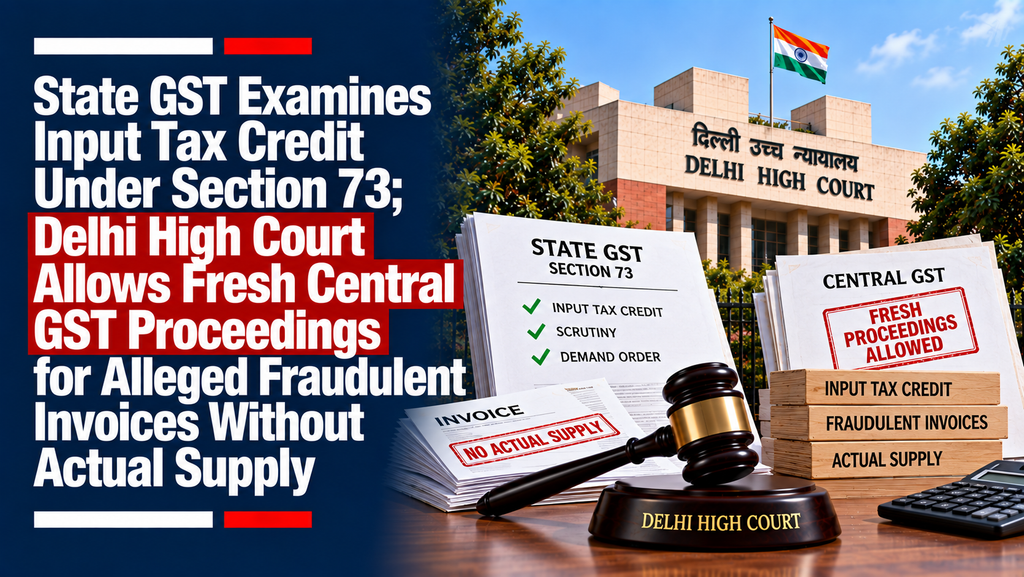
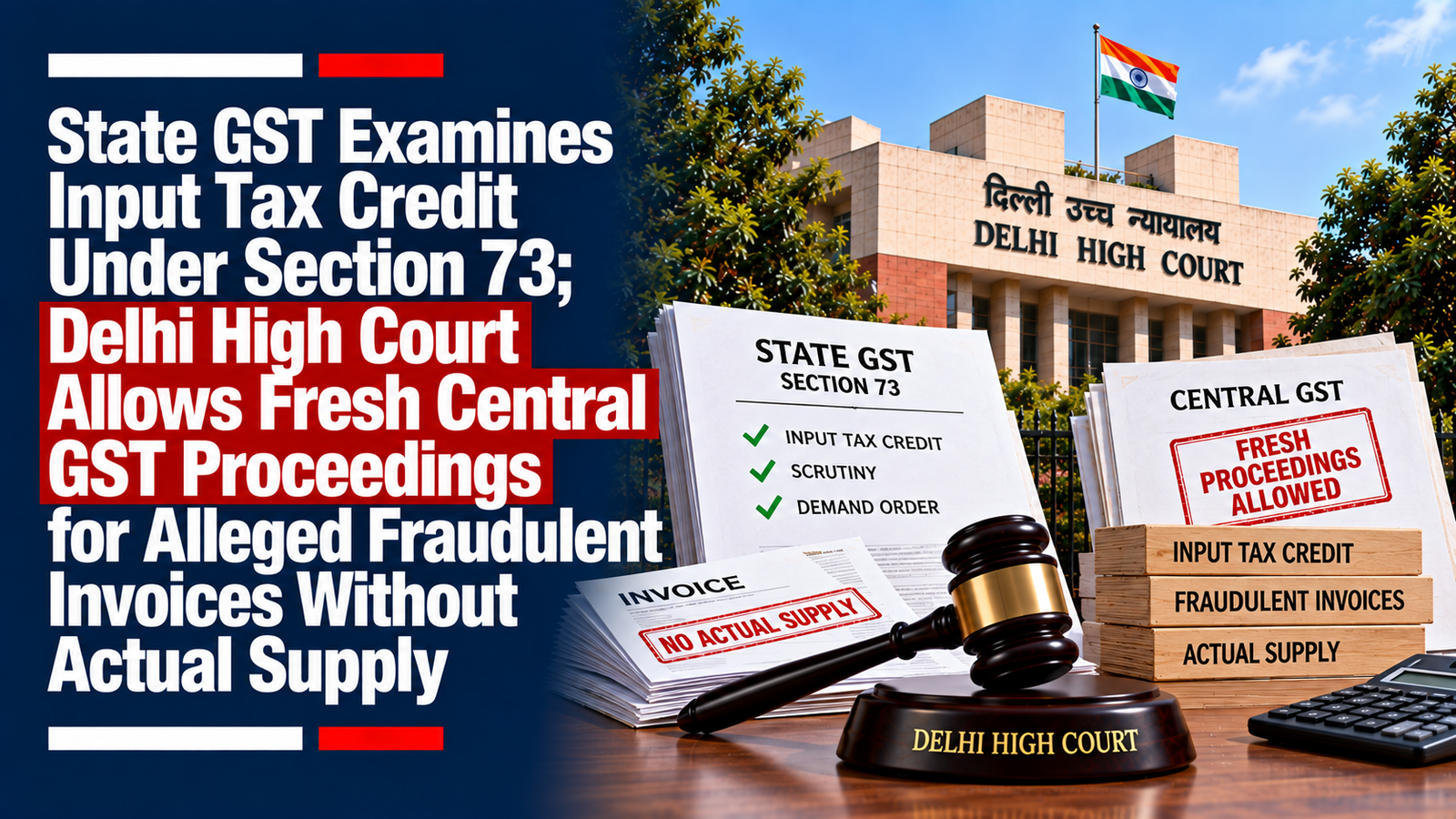
State GST Examines Input Tax Credit Under Section 73; Delhi High Court Allows Fresh Central GST Proceedings for Alleged Fraudulent Invoices Without Actual Supply

Same Taxpayer, Same Year and Same ₹6.12 Lakh Input Tax Credit Does Not Automatically Mean ‘Same Subject Matter’: Delhi High Court
Facts
The petitioner, Shri Krishna Industries, a proprietorship concern of Mohan Lal engaged in manufacturing plastic products, challenged two show-cause notices and consequential orders issued by Central GST authorities concerning allegedly inadmissible Input Tax Credit (ITC) availed from entities operating under the name M.R. Enterprises.
The controversy arose because the State GST authorities had already initiated proceedings for Financial Year 2017–18 under Section 73 of the Central Goods and Services Tax Act, 2017, which included ITC claimed by the petitioner from M.R. Enterprises.
A State GST show-cause notice was issued on 23 September 2023. After an earlier order and intervention by the Delhi High Court, the State authority re-adjudicated the matter and passed a fresh order on 29 July 2024.
Shortly thereafter, the Central authorities initiated separate proceedings under Section 74.
The DGGI issued a show-cause notice dated 2 August 2024, alleging inadmissible ITC based on investigation suggesting invoices were issued without actual supply of goods.
Another Central GST show-cause notice followed on 4 August 2024 in relation to another M.R. Enterprises bearing a different GSTIN.
Both proceedings ultimately resulted in confirmation of demands of ₹6.12 lakh, together with applicable interest and penalty.
The petitioner approached the Delhi High Court arguing that the Central proceedings amounted to prohibited duplication because the State authorities had already proceeded against it regarding the same ITC.
Issues
The principal issue was:
Whether Section 6(2)(b) of the CGST Act prohibits Central GST authorities from initiating Section 74 proceedings when State GST authorities had earlier initiated Section 73 proceedings involving the same taxpayer, financial year and ITC claimed from a supplier bearing the same trade name.
The Court also considered the petitioner’s allegations regarding:
- overlapping/duplicate demands;
- failure to consider its reply;
- non-supply of relied-upon documents;
- violation of natural justice;
- absence of fraud or suppression necessary for Section 74; and
- availability of the statutory appeal under Section 107.
Petitioner’s Arguments
The petitioner argued that the Central proceedings were barred by Section 6(2)(b) because the State GST authority had already dealt with ITC claimed from M.R. Enterprises.
It emphasised that both sets of proceedings concerned:
the same assessee, the same Financial Year and ITC of ₹6.12 lakh.
According to the petitioner, the Department could not escape Section 6(2)(b) simply by changing the statutory provision from Section 73 to Section 74.
The petitioner further claimed that its reply dated 31 August 2024 was not properly considered; relied-upon investigation material was not supplied; the orders were non-speaking; the transactions were genuine; goods had actually been received; and there was no fraud, wilful misstatement or suppression justifying Section 74.
Respondents’ Arguments
The Central GST authorities contended that Section 6(2)(b) applies only where the subsequent proceedings concern the same subject matter.
According to the Department, the State proceedings under Section 73 and Central proceedings under Section 74 were materially different.
The later Central proceedings were based upon intelligence and investigation allegedly revealing fraudulent availment of ITC through invoices not accompanied by actual supply of goods.
The Department also pointed out that the two Central proceedings concerned M.R. Enterprises entities bearing different GSTINs and arose from separate investigative material.
Analysis of the Law
Meaning of “Same Subject Matter”
The Court held that the expression “same subject matter” in Section 6(2)(b) cannot be determined merely by looking at:
- the identity of the taxpayer;
- the financial year;
- the amount of ITC; or
- some common factual background.
The decisive inquiry is the particular liability, deficiency or contravention being adjudicated.
If both proceedings concern the same liability or contravention, Section 6(2)(b) operates as a bar.
But where the proceedings concern distinct infractions, they do not become the same subject matter merely because they concern the same assessee, same period or similar tax liability.
Section 73 vs Section 74 Is Not By Itself Decisive
The Court accepted an important proposition advanced by the petitioner:
The Department cannot circumvent Section 6(2)(b) merely by changing the statutory provision invoked.
In other words, if the underlying contravention is actually identical, simply calling the second proceeding a Section 74 proceeding instead of Section 73 would not save it.
However, the reverse is equally important.
The Court held that the inquiry cannot stop at comparing the statutory sections. What matters is the underlying liability and alleged contravention.
Precedent Analysis
Armour Security (India) Ltd. v. Commissioner, CGST
The Delhi High Court treated the Supreme Court’s decision in Armour Security as furnishing the controlling principle.
Section 6(2)(b) operates where the proceedings concern the same subject matter.
However, proceedings arising from distinct infractions or liabilities are not prohibited merely because they share a common factual or transactional background.
Metalax Industries
The petitioner relied upon Metalax Industries to argue against overlapping proceedings.
The Court held that it did not assist the petitioner because the application of Section 6(2)(b) necessarily turns on whether the subject matter of the proceedings is actually identical.
Commonality of taxpayer, period or background is not sufficient.
Court’s Reasoning
The State proceedings undoubtedly concerned ITC claimed from M.R. Enterprises.
However, the subsequent Central proceedings were founded on a more specific allegation arising from DGGI investigation: that invoices were not accompanied by actual supply of goods and that ITC had consequently been fraudulently availed.
The petitioner had not placed sufficient material before the High Court demonstrating that this precise contravention had already been adjudicated by the State GST authority.
The Court also considered the different GSTINs:
- 07BDIPS1163G1ZI
- 07EJVPS7789Q1ZC
The Court did not treat the different GSTINs as conclusive. It held that they were merely a relevant circumstance. Ultimately, the nature of the liability and contravention must be compared.
Therefore, on the material before it, the Court could not hold that the Central proceedings were ex facie barred by Section 6(2)(b).
Natural Justice and Alleged Duplicate Demand
The Court did not finally reject the petitioner’s factual objections.
Instead, it held that allegations concerning:
- failure to consider the reply;
- non-supply of relied-upon documents;
- genuineness of transactions;
- actual receipt of goods;
- absence of fraud/suppression;
- overlapping demands; and
- whether Section 74 was properly invoked
required examination of the adjudication record and could appropriately be raised before the statutory appellate authority.
The impugned orders were appealable under Section 107 of the CGST Act.
The Court clarified that existence of an alternative remedy does not make a writ petition inherently non-maintainable. However, where disputed factual questions and examination of the adjudication record are required, the High Court ordinarily does not substitute Article 226 jurisdiction for the statutory appellate mechanism.
Conclusion
The Delhi High Court dismissed the writ petition.
It held that Shri Krishna Industries had failed to establish that the Central GST proceedings concerned the “same subject matter” as the earlier State GST proceedings so as to attract Section 6(2)(b).
Importantly, the Court did not finally decide whether:
- the transactions were bogus;
- goods were actually supplied;
- ITC was genuinely available;
- fraud, wilful misstatement or suppression existed;
- ₹6.12 lakh had been duplicated;
- the petitioner’s reply had been properly considered; or
- the tax, interest and penalty were correct.
Those issues were expressly left open.
The petitioner was permitted to file a statutory appeal under Section 107, and the appellate authority was directed to independently consider all available contentions, including Section 6(2)(b), overlapping proceedings, non-supply of documents and the validity of invoking Section 74.
Case Details
Case: Shri Krishna Industries Through Its Proprietor Mohan Lal v. Commissioner of Central Goods and Services Tax & Ors.
Court: Delhi High Court
Case No.: W.P.(C) 4897/2025 & CM APPL. 22525/2025
CNR: DLHC010211512025
Coram: Justice Anil Kshetrapal and Justice Shail Jain
Reserved: 7 August 2026
Pronounced: 18 September 2026
Result: Writ petition dismissed; Section 6(2)(b) bar not established on the material before the Court; petitioner permitted to pursue statutory appeal under Section 107.