Supreme Court Acquits Man of Wife and Son’s Murder; Finds Child Witness Tutored, Recoveries Doubtful, FIR Delayed and Circumstantial Evidence Incomplete Beyond Reasonable Doubt

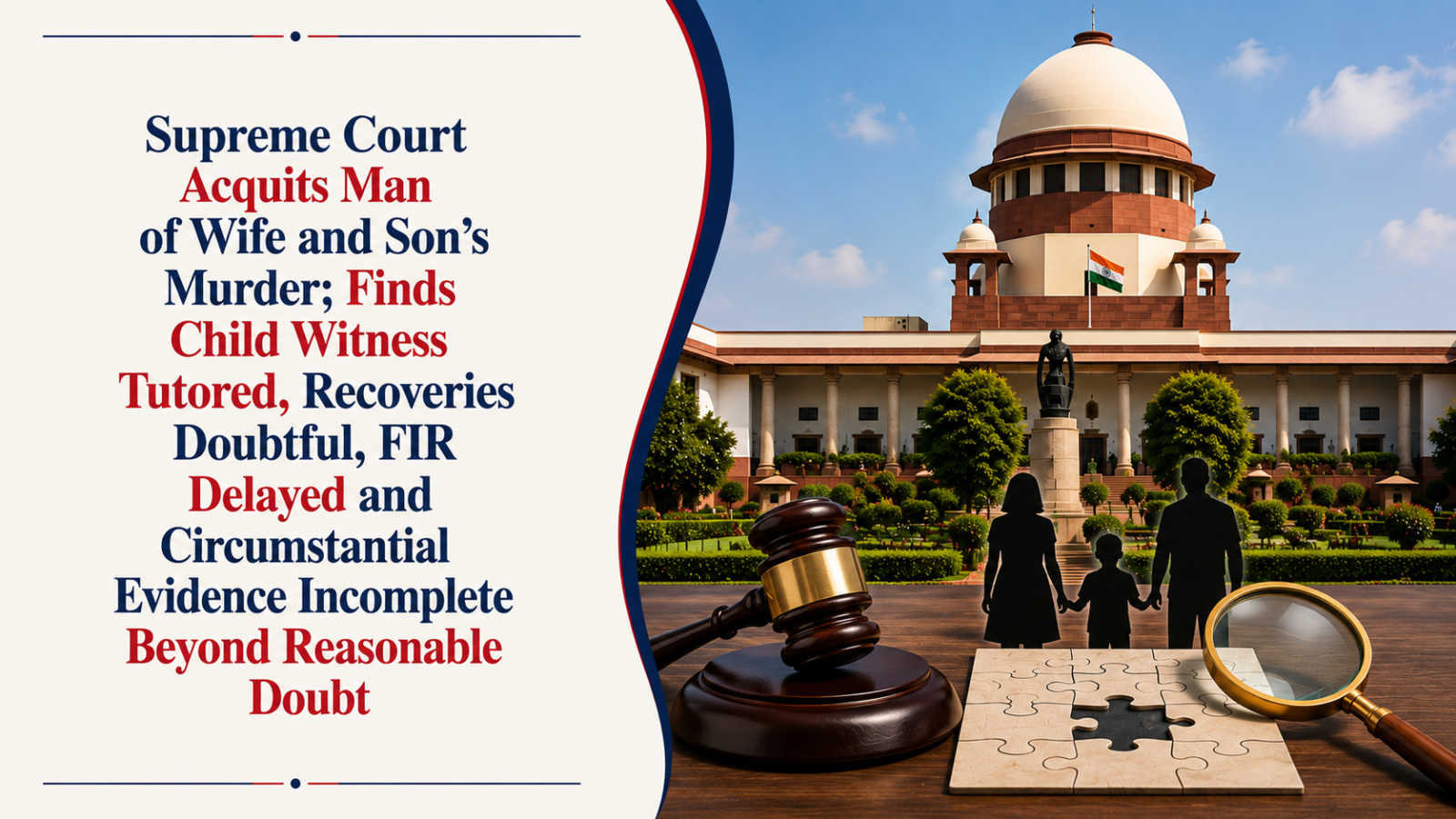
Supreme Court Overturns High Court’s Murder Conviction; Holds Tutored Child Testimony, Unexplained FIR Delay and Missing Forensic Links Left Reasonable Doubt About Guilt
Facts
The case arose from events in September 1989. On 26 September 1989, truck driver Mohammed Naimuddin found a naked, injured boy aged approximately four to five years at Bhero Ghat. The child was taken to the police and thereafter for medical treatment. Over the following two days, the bodies of a woman and another male child were recovered from the ghat.
The prosecution alleged that the deceased woman, Sushma, had left Kanpur on 20 September 1989 with her two sons and their father, appellant Ravi Kumar Singh Malhotra, ostensibly for a trip to Khajuraho. The appellant had been living separately from Sushma and the children for approximately six years. According to the prosecution, he strangled Sushma and one son and attempted to kill the surviving son, PW-28, who escaped.
Two FIRs were registered on 1 October 1989. The surviving child subsequently implicated his father, claiming to have witnessed him killing his mother and brother. The appellant was arrested in March 1990, after which the prosecution claimed that clothes and an empty bottle allegedly used for pouring acid were recovered at his instance.
The Additional Sessions Judge, Panna, acquitted the appellant on 14 December 1993, finding that the prosecution had failed to establish guilt beyond reasonable doubt. The Trial Court considered the child’s testimony unreliable and contradictory and found insufficient corroborative evidence.
On State appeals, however, the Madhya Pradesh High Court reversed the acquittal on 9 October 2012, treated the child’s testimony as reliable, relied additionally upon the appellant’s conduct and convicted him under Sections 302 and 201 IPC, sentencing him to life imprisonment for murder and two years’ rigorous imprisonment for causing disappearance of evidence.
The appellant challenged that reversal before the Supreme Court.
Issues
The principal issues were:
- Whether the High Court was justified in reversing a reasoned Trial Court acquittal when the Trial Court’s appreciation of evidence constituted a plausible view.
- Whether the testimony of PW-28, who was only four-and-a-half years old when the incident occurred and whose evidence was recorded approximately four years later, was sufficiently reliable to sustain the conviction.
- Whether the possibility that the child witness had been tutored by the police materially affected the evidentiary value of his testimony.
- Whether the prosecution had produced sufficient independent medical, forensic and circumstantial evidence to corroborate the child’s version.
- Whether the alleged recoveries, abscondence, motive and last-seen circumstances established a complete chain pointing exclusively towards the appellant’s guilt.
- Whether the unexplained delay in registration of the FIR despite the police allegedly knowing the accused’s identity undermined the prosecution case.
Appellant’s Arguments
The appellant argued that the High Court had impermissibly substituted its own view for a plausible view taken by the Trial Court. Once acquitted, the appellant enjoyed a reinforced presumption of innocence, and interference was unwarranted merely because another view of the evidence was possible.
He contended that the prosecution case rested principally upon the uncorroborated testimony of PW-28. Significantly, the child himself stated that before entering Court, a police official had read out his earlier statement and instructed him to testify along the same lines.
The appellant further pointed out that the child’s account of being strangled and subjected to acid was contradicted by the medical evidence, which disclosed neither throat injuries nor injuries attributable to acid.
There was no reliable evidence connecting the appellant to the crime scene; the blood evidence was inconclusive; the alleged vehicles and their drivers were never traced; and no motive was established. Indeed, evidence indicated that relations between the appellant and Sushma were amicable.
The defence also emphasised that although PW-28 was brought to the police on 26 September 1989, the FIR was registered only on 1 October 1989, creating serious doubt regarding the prosecution version.
Respondent’s Arguments
The State defended the High Court’s conviction, arguing that PW-28 was a natural and reliable eyewitness who correctly identified himself and narrated travelling with his mother, brother and appellant from Kanpur to Khajuraho before witnessing the murders.
The State relied upon medical evidence concerning the deceased child’s neck injury and chemical analysis detecting traces of sulphuric acid on articles recovered from the crime scene.
It further relied upon the appellant’s alleged financial burden as motive, his subsequent absence, and recovery of clothes and a bottle at his instance. According to the prosecution, these circumstances collectively completed the chain and pointed exclusively towards guilt.
Analysis of the Law
Reversal of Acquittal and Double Presumption of Innocence
The Supreme Court emphasised that the case involved an appellate reversal of acquittal. Consequently, the appellant enjoyed a double presumption of innocence: the ordinary presumption available to every accused and the strengthened presumption arising from his acquittal by the Trial Court.
The High Court could not interfere merely because it preferred another interpretation of the evidence. If two reasonable conclusions were possible, the Trial Court’s acquittal should not have been disturbed.
The Supreme Court held that this threshold had not been satisfied. The Trial Court had provided evidence-based reasons for distrusting PW-28, and its approach could not be characterised as unreasonable.
Child Witness Evidence
The Court clarified that there is no inflexible legal requirement that a child witness’s evidence must invariably be corroborated. Nevertheless, corroboration ordinarily operates as a rule of prudence because children of tender age are particularly susceptible to tutoring.
Here, the concern was not hypothetical. PW-28 expressly stated that the Station House Officer made him read his statement before Court and instructed him to repeat it. He had also been living with a police constable.
Further, aspects of his account were inconsistent with medical evidence and appeared unnatural. The Supreme Court therefore found the Trial Court’s insistence upon independent corroboration entirely reasonable.
Circumstantial Evidence
The Supreme Court reiterated that suspicion, however strong, cannot substitute proof.
Every incriminating circumstance must be proved through reliable evidence, and collectively the circumstances must constitute an unbroken chain admitting no reasonable hypothesis other than the guilt of the accused.
If even a material link is missing or another reasonable hypothesis remains possible, the accused must receive the benefit of doubt.
Precedent Analysis
1. Chandrappa v. State of Karnataka, (2007) 4 SCC 415
The Supreme Court relied upon Chandrappa for the governing principles concerning appeals against acquittal.
An acquitted accused enjoys a double presumption of innocence, and where two reasonable conclusions are possible from the evidence, an appellate court should not disturb the Trial Court’s acquittal.
This principle was decisive because the Trial Court’s doubts regarding the child witness were supported by the evidentiary record.
2. Bhagwan Singh v. State of M.P., (2003) 3 SCC 21
The Court relied on Bhagwan Singh for the proposition that although a child is legally competent to testify, the evidence of a child of tender age requires careful evaluation because of susceptibility to tutoring.
Corroboration, while not an absolute legal prerequisite, is ordinarily a rule of prudence.
The judgment also referred through Bhagwan Singh to Panchhi v. State of U.P., (1998) 7 SCC 177.
3. Karakkattu Muhammed Basheer v. State of Kerala, (2024) 10 SCC 813
The Court relied upon this decision for the settled principles governing conviction based on circumstantial evidence.
The circumstances must be established by reliable and clinching evidence and form a complete chain incapable of supporting any hypothesis other than guilt. Suspicion cannot replace proof.
The precedent discussion also referred to Ramreddy Rajesh Khanna Reddy v. State of A.P., Anil Kumar Singh v. State of Bihar, Reddy Sampath Kumar v. State of A.P., State of U.P. v. Satish and Bodhraj v. State of J&K while explaining the principles governing circumstantial and last-seen evidence.
Court’s Reasoning
The Supreme Court identified several substantial defects in the prosecution case.
First, PW-28’s testimony was unsafe to rely upon without independent corroboration. He was only four-and-a-half years old at the time of the occurrence, testified four years later, lived with a police constable and expressly acknowledged police tutoring before his testimony.
Second, there was no medical or scientific evidence connecting the appellant to the murders. Due to decomposition of the bodies, no definite cause of death could be given, while the blood-stained soil examination was inconclusive.
Third, the alleged recoveries did not establish any forensic connection between the appellant, the deceased and the crime scene. The independent recovery witnesses turned hostile.
The recoveries themselves occurred approximately six months after discovery of the bodies, and the condition of the articles was inconsistent with the prosecution’s claim that they had remained buried six feet underground for months. The Supreme Court expressly observed that the possibility of planting could not be ruled out.
Fourth, the prosecution failed to establish last-seen evidence. One witness specifically stated that the person sitting in the car with Sushma was not the appellant and that the appellant had not visited for seven or eight months.
Fifth, motive was absent. Evidence suggested that the appellant and deceased had amicable relations and had resolved their differences while living separately.
Sixth, the police failed to trace the truck driver whom PW-28’s version effectively made a witness to the killings, and also failed to trace the relevant car and its driver. This constituted a significant missing link.
Seventh, there was an inordinate and unexplained delay in registration of the FIR. PW-28 reached the police station on 26 September; the bodies were recovered shortly thereafter; and the prosecution itself claimed that the child identified the appellant by 29 September. Yet the FIR was registered only on 1 October.
The Supreme Court held that this delay seriously undermined the credibility of the prosecution version and lent credence to the possibility of embellishment during investigation.
Conclusion
The Supreme Court held that the prosecution had failed to establish a complete and reliable chain of evidence pointing exclusively towards Ravi Kumar Singh Malhotra’s guilt.
The Trial Court’s acquittal represented a plausible and reasonable appreciation of the evidence, particularly given the serious concerns surrounding the child witness, absence of corroboration, lack of forensic linkage, doubtful recoveries, absence of motive and last-seen evidence, investigative gaps and unexplained FIR delay.
Accordingly, the High Court was not justified in overturning the acquittal merely because it took a different view of the evidence.
The Supreme Court allowed the appeal, set aside the Madhya Pradesh High Court judgment dated 9 October 2012 and acquitted the appellant of the charges under Sections 302 and 201 IPC. His bail bonds were discharged.
Case Details
Case: Ravi Kumar Singh Malhotra v. State of Madhya Pradesh
Court: Supreme Court of India, Criminal Appellate Jurisdiction
Citation: 2026 INSC 899
Case Number: Criminal Appeal No. 937 of 2014
Judges: Justice Sanjay Karol and Justice Augustine George Masih
Date: 20 August 2026
Result: Appeal allowed; High Court conviction under Sections 302 and 201 IPC set aside; Trial Court acquittal effectively restored; appellant acquitted and bail bonds discharged.