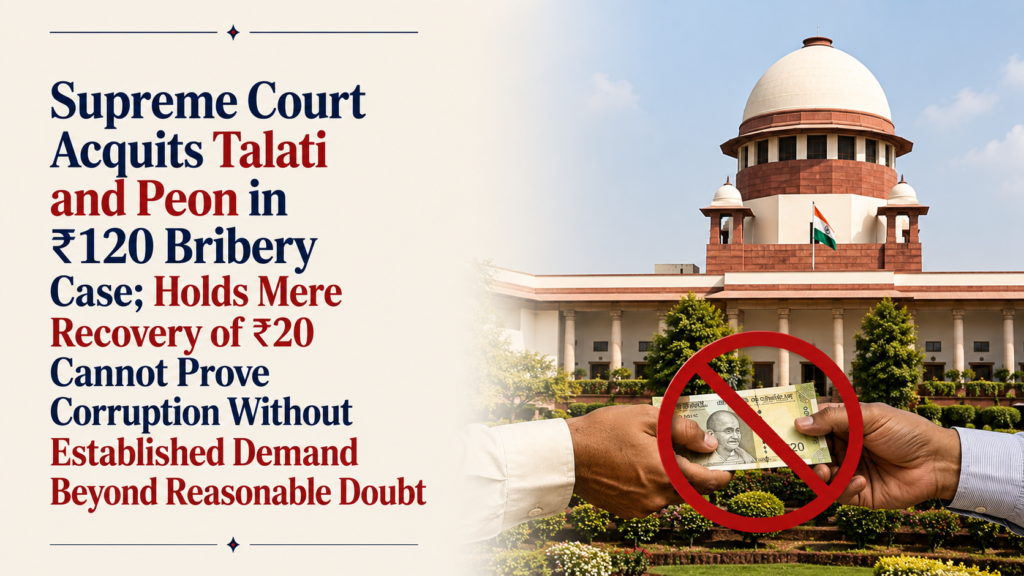
Supreme Court Acquits Talati and Peon in ₹120 Bribery Case; Holds Mere Recovery of ₹20 Cannot Prove Corruption Without Established Demand Beyond Reasonable Doubt

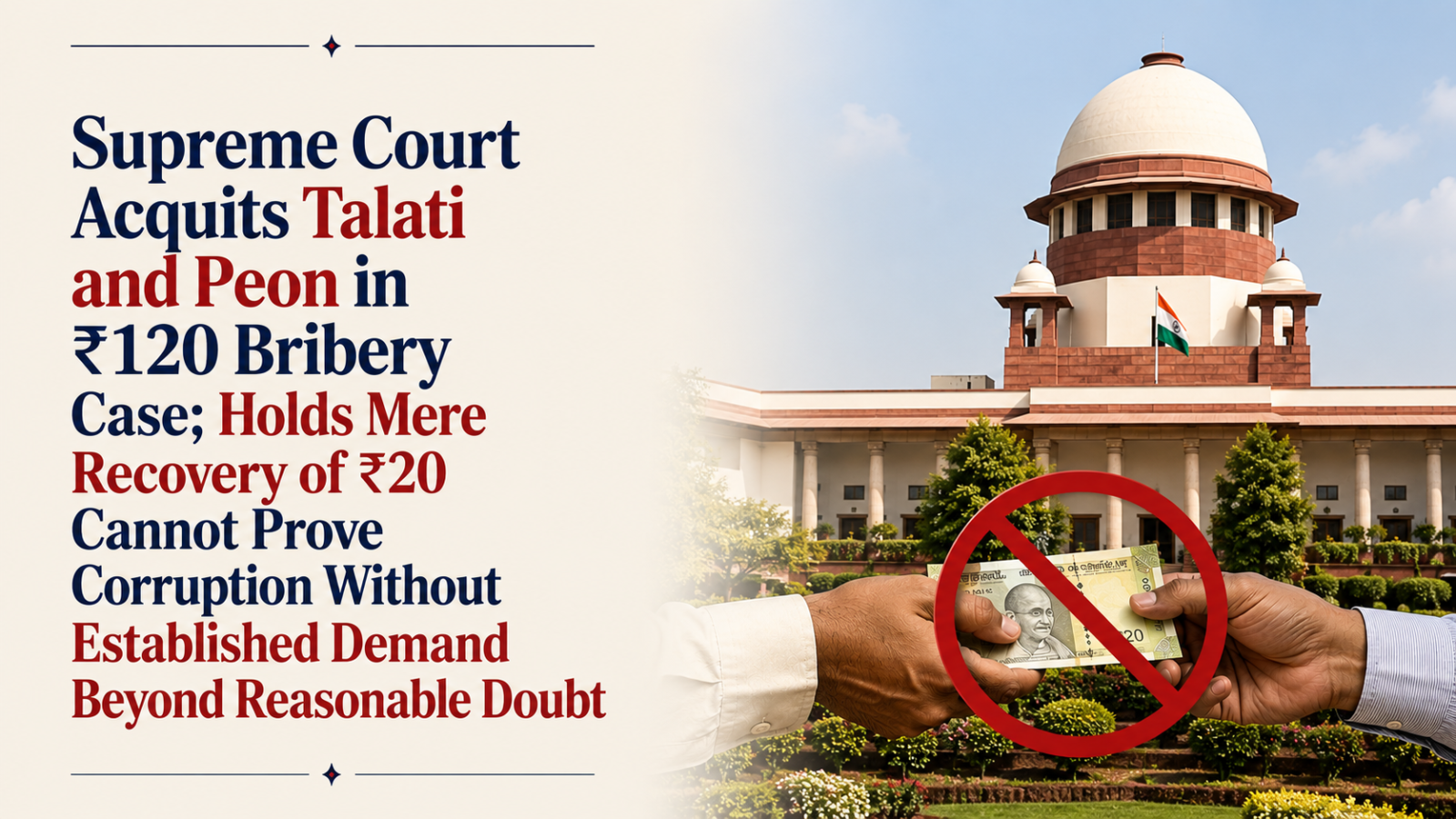
Supreme Court Acquits Talati and Peon of Corruption Charges; Finds Doubtful Bribe Demand, Invalid Sanction and Mere ₹20 Recovery Insufficient
Facts
The case arose from an application made by complainant Hasmukhbhai Maganbhai Chauhan for an Income Certificate required to obtain educational concessions. His application was forwarded to the Talati-cum-Mantri of Village Bechri, Rafikmiya Ahmedmiya Malek (A1). According to the prosecution, A1 demanded ₹120, stating that ₹100 was for himself and ₹20 for the Peon, Sirajbhai Rasulbhai Vora (A2). The alleged demand was initially made on 7 February 1996 and was said to have been repeated subsequently.
The complainant approached the Anti-Corruption Bureau, which arranged a trap on 19 February 1996. After receiving his Income Certificate, the complainant gave only a ₹20 currency note to A2, who placed it in his pocket. The raiding party thereafter entered and completed the trap proceedings.
The Trial Court found the demand proved against A1 but not against A2. It also found that the prosecution had failed to establish any criminal conspiracy between them. Nevertheless, both were convicted under Sections 7 and 13(1)(d) of the Prevention of Corruption Act, 1988 and sentenced to imprisonment.
The Gujarat High Court affirmed their convictions. The appellants thereafter approached the Supreme Court.
Issues
The principal issues before the Supreme Court were:
- Whether the prosecution had proved the alleged demand of ₹120 by A1 beyond reasonable doubt.
- Whether mere recovery of ₹20 from A2 could sustain a conviction when the courts themselves found that A2 had made no demand.
- Whether the statutory presumption under Section 20 of the Prevention of Corruption Act could be invoked without first proving the foundational fact of demand.
- Whether inconsistencies in the complainant’s versions regarding the amount demanded rendered the prosecution case doubtful.
- Whether the sanction for prosecuting A1 was valid when it was granted by the Deputy District Development Officer rather than the authority competent to remove him from office.
Appellants’ Arguments
A1 argued that his prosecution itself suffered from an invalid sanction. Since the District Development Officer was the authority competent to appoint/remove a Talati-cum-Mantri, sanction granted by the Deputy District Development Officer did not satisfy Section 19 of the Prevention of Corruption Act.
On merits, the appellants argued that although the prosecution alleged a ₹120 demand—₹100 for A1 and ₹20 for A2—no money was ever paid to or recovered from A1. Only ₹20 was recovered from A2. They further relied upon the concurrent finding that A2 himself had made no demand.
A2 contended that the ₹20 note had been given to him without any demand on his part and that the complainant had given it because Eid was to be celebrated the following day. Since no demand by A2 had been proved, mere possession of the currency note could not establish the corruption charge.
Respondent’s Arguments
The State of Gujarat relied upon the concurrent findings of the Trial Court and High Court that A1 had demanded ₹120, of which ₹100 was meant for himself and ₹20 for A2.
According to the State, payment and recovery of ₹20 from A2 successfully established the trap, and the fact that ₹100 was not actually paid to A1 did not destroy the prosecution case. The State also maintained that the sanction orders were legally valid and had been issued after proper application of mind.
Analysis of the Law
The Supreme Court emphasised that proof of demand is foundational in a prosecution for bribery. The statutory presumption under Section 20 cannot be invoked merely because tainted money is recovered from an accused.
The prosecution must first establish the initial demand beyond reasonable doubt. Only thereafter can the statutory presumption operate.
The Court found material discrepancies in the complainant’s account. In the present proceedings, he spoke of a demand of ₹120. However, in an earlier criminal case arising shortly after the incident, he had stated that A1 initially demanded ₹200 and that ₹120 was subsequently settled as the final amount. The Court considered this variance material to the very fact and quantum of the alleged demand.
Another important circumstance was the complainant’s conduct during the trap. Although expressly instructed by the ACB to hand over the entire ₹120 when the demand was made, he handed only ₹20 to A2. A2 admittedly made no demand and did not even ask why only ₹20 was being handed over when A1 had allegedly directed payment of ₹120. The Supreme Court held that these circumstances generated serious suspicion about the prosecution version.
Precedent Analysis
The Supreme Court principally relied upon N. Vijayakumar v. State of Tamil Nadu for the proposition that the Section 20 presumption cannot substitute the prosecution’s obligation to first prove demand.
The Court held that where the initial demand itself remains doubtful, recovery of currency from an accused cannot “resurrect” the prosecution case.
The Court also referred to State of Lokayuktha Police, Davanagere v. C.B. Nagaraj, particularly because the ₹20 was handed over only after the Income Certificate had already been prepared and delivered. The mere fact of payment after delivery could not, by itself, establish that the payment was pursuant to an earlier illegal demand.
On sanction, the Court examined Section 19(1)(c), which requires previous sanction from the authority competent to remove the public servant from office. It found that the prosecution had failed to establish that the Deputy District Development Officer possessed authority to remove A1 from his substantive post as Talati-cum-Mantri.
Court’s Reasoning
The Supreme Court identified several cumulative defects in the prosecution case.
First, the complainant gave materially different versions regarding the amount allegedly demanded. Second, although instructed to pay the entire ₹120 during the trap, he paid only ₹20. Third, A2 admittedly made no demand. Fourth, A1 neither received nor possessed any bribe money. Fifth, the Trial Court had already rejected the prosecution’s allegation that A1 and A2 had conspired together.
The Court therefore found the evidence insufficient to prove A1’s alleged demand beyond reasonable doubt.
Consequently, recovery of ₹20 from A2 could not independently establish the offences. Since the foundational demand was not proved, Section 20 could not be invoked.
The Court additionally held that the sanction against A1 was invalid because it had been granted by the Deputy District Development Officer, whereas the District Development Officer was the authority competent to remove the Talati-cum-Mantri. Importantly, however, the Supreme Court expressly stated that it was not acquitting A1 solely because of defective sanction; the prosecution evidence independently fell “woefully short” of proving guilt beyond reasonable doubt.
Conclusion
The Supreme Court held that the prosecution failed to prove the alleged bribe demand against A1 beyond reasonable doubt, while both courts had already found that A2 made no demand.
Mere possession of the ₹20 currency note by A2 was insufficient to sustain the convictions. The Court also considered A2’s explanation—that the ₹20 was given because Eid was the following day—to be a probable defence in the circumstances.
Accordingly, the Supreme Court set aside the Trial Court judgment as affirmed by the Gujarat High Court and acquitted both appellants of the offences under Sections 7, 12 and 13(1)(d) of the Prevention of Corruption Act, 1988. Their bail bonds were cancelled and both appeals were allowed.
Case Details
Case: Rafikmiya Ahmedmiya Malek v. State of Gujarat, with Sirajbhai Rasulbhai Vora v. State of Gujarat
Court: Supreme Court of India
Case Number: Criminal Appeal No. 1177 of 2015 with Criminal Appeal No. 1183 of 2015; 2026 INSC 890
Judge: Justice Ujjal Bhuyan and Justice Atul S. Chandurkar; judgment authored by Justice Atul S. Chandurkar
Date: 19 August 2026
Result: Appeals allowed; convictions set aside; both appellants acquitted of offences under Sections 7, 12 and 13(1)(d) of the Prevention of Corruption Act, 1988.