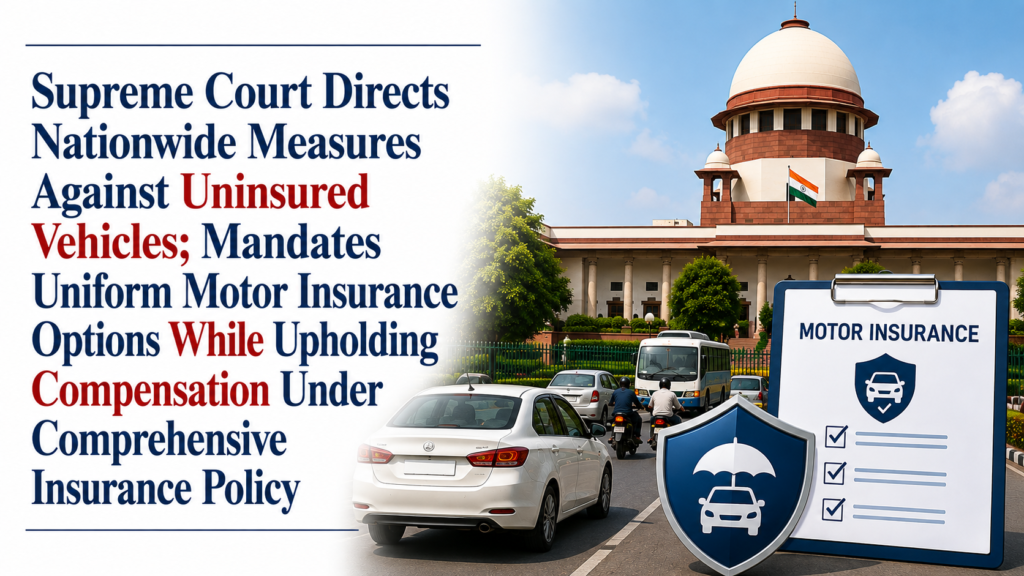
Supreme Court Directs Nationwide Measures Against Uninsured Vehicles; Mandates Uniform Motor Insurance Options While Upholding Compensation Under Comprehensive Insurance Policy

Uninsured Vehicles Face Automated E-Challans as Supreme Court Issues Comprehensive Road Insurance Directions
Facts
The appeal arose from a motor accident claim in which the owner of a Maruti 800 car died after an unknown lorry hit his vehicle from behind. The Motor Accident Claims Tribunal dismissed the claim against the insurer on the ground that no additional premium had been paid to cover the personal risk of the vehicle owner.
The Telangana High Court reversed that finding and awarded compensation of ₹10,00,500 with 7.5% interest, holding that the comprehensive insurance policy covered the owner travelling in the insured vehicle.
While hearing the appeal, the Supreme Court expanded the scope of the proceedings to examine larger issues concerning:
- widespread use of uninsured vehicles in India; and
- lack of uniformity in motor insurance policies offered by different insurers.
The Court sought responses from the Central Government, IRDAI, the General Insurance Council and all major insurance companies before deciding the matter.
Issues
- Whether stronger mechanisms were required to enforce mandatory motor insurance under Section 146 of the Motor Vehicles Act.
- Whether India required a uniform structure for motor insurance policies to improve consumer awareness and coverage.
- Whether the insurer remained liable under a comprehensive insurance policy to compensate the legal representatives of the deceased owner travelling in the insured vehicle.
Petitioner’s Arguments
- The insurance company argued that the deceased owner was not covered because no separate premium had been paid for personal accident risk.
- It challenged the High Court’s finding that a comprehensive policy automatically covered the owner travelling in the insured vehicle.
- It sought restoration of the Tribunal’s order rejecting the compensation claim.
Respondent’s Arguments
- The claimants argued that the insurance policy was a comprehensive/package policy.
- They relied upon IRDAI’s circular dated 16 November 2009 recognising that comprehensive policies cover occupants travelling in the insured vehicle.
- They also submitted that compensation in motor accident cases should not be denied on technical grounds.
Analysis of the Law
The Supreme Court examined:
- the Insurance Regulatory and Development Authority Act, 1999;
- the Insurance Act, 1938; and
- Chapter XI of the Motor Vehicles Act, 1988, particularly Sections 146, 147, 149 and 207.
The Court observed that although third-party insurance is statutorily compulsory, nearly 56% of vehicles on Indian roads remain uninsured, defeating the object of compulsory insurance and leaving accident victims without timely compensation.
Recognising road safety as an integral facet of Article 21, the Court held that technology-based enforcement, regulatory reforms and greater consumer awareness were necessary to ensure compliance with mandatory insurance requirements.
Precedent Analysis
The Supreme Court relied upon several important decisions, including:
- General Insurance Council v. State of Andhra Pradesh — compliance with accident information reports.
- Jai Prakash v. National Insurance Co. Ltd. — speedy processing of motor accident claims.
- M.R. Krishna Murthi v. New India Assurance Co. Ltd. — expeditious disposal of MACT cases.
- S. Rajaseekaran v. Union of India — mandatory long-term third-party insurance for new vehicles.
- Shishu Pal @ Shish Ram v. Surjeet — concern regarding delay in MACT proceedings.
- In Re: Phalodi Accident v. NHAI — road safety as part of Article 21.
- Surekha v. Santosh — courts should avoid a hyper-technical approach in motor accident compensation matters.
Court’s Reasoning
The Supreme Court observed that enforcement of compulsory motor insurance remains weak despite statutory mandates. To address this, it issued wide-ranging directions in public interest.
The Court directed:
- integration of Automatic Number Plate Recognition (ANPR) cameras with insurance databases for automatic e-challans;
- real-time insurance verification through handheld devices and mobile applications for traffic police;
- implementation of a uniform four-layer motor insurance structure, consisting of:
- mandatory third-party cover,
- optional legal liability cover for occupants,
- optional personal accident cover, and
- optional own-damage cover;
- issuance of a mandatory customer option form enabling consumers to consciously choose optional covers (the template is reproduced on page 17 of the judgment); and
- consumer-friendly disclosure explaining mandatory and optional insurance benefits.
The Court further directed that third-party insurance for newly registered vehicles be increased from:
- three years to four years for private cars; and
- five years to six years for new two-wheelers.
It also issued additional directions for faster disposal of pending MACT claims and better implementation of Detailed Accident Reports (DAR).
Conclusion
The Supreme Court dismissed the insurer’s appeal and upheld the High Court’s award of compensation, holding that the comprehensive insurance policy covered the deceased owner travelling in the insured vehicle.
Simultaneously, exercising its constitutional powers in public interest, the Court issued landmark nationwide directions to strengthen enforcement against uninsured vehicles, standardise motor insurance options, improve consumer awareness, integrate technology with enforcement mechanisms, and accelerate disposal of motor accident compensation claims.
Case Details
Case: National Insurance Co. Ltd. v. Smt. Thungala Dhana Laxmi & Others
Court: Supreme Court of India
Case Number: Civil Appeal No. 14369 of 2025
Judges: Justice Sanjay Karol and Justice Prashant Kumar Mishra
Date: 4 August 2026
Result: Appeal dismissed; compensation awarded by the High Court upheld. Supreme Court additionally issued comprehensive nationwide directions regarding mandatory motor insurance, uninsured vehicles, uniform insurance policy structure, and motor accident claims administration