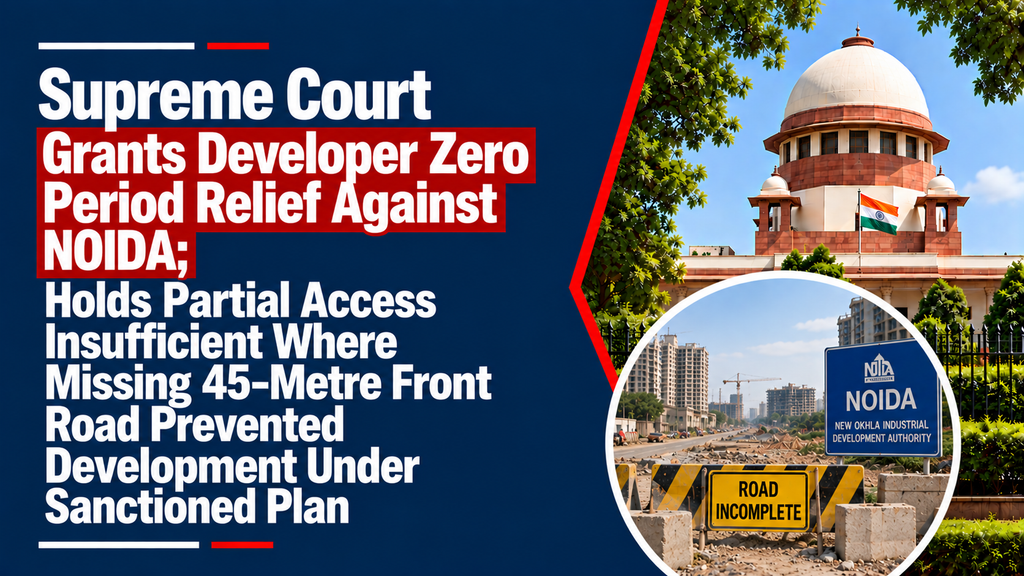
Supreme Court Grants Developer Zero Period Relief Against NOIDA; Holds Partial Access Insufficient Where Missing 45-Metre Front Road Prevented Development Under Sanctioned Plan

NOIDA Cannot Deny Zero Period Benefit Merely Because Some Access Existed: Supreme Court Upholds Relief to Developer Denied Promised 45-Metre Front Road
Facts
In 2011, the New Okhla Industrial Development Authority (NOIDA) launched a scheme for allotment of commercial plots to builders and developers. M/s Sunshine Trade Tower Pvt. Ltd. was selected as the successful developer, and on 11 January 2012, NOIDA executed a lease deed for Plot No. 5-A, Sector 94, Noida, for a total consideration of approximately ₹133.86 crore. Possession was handed over on the same day.
The sanctioned site plan contemplated a 45-metre-wide Front Road and a 24-metre-wide Side Road. The Developer claimed that proper construction could not proceed because the 45-metre road was encroached and the 24-metre road was sandy, unpaved and non-motorable.
Construction was additionally stopped after the National Green Tribunal, on 17 September 2013, restrained construction within 10 kilometres of the Okhla Bird Sanctuary. The restriction affecting the project was removed only on 19 August 2015.
In March 2016, NOIDA introduced its Zero Period Policy, intended to grant financial relief where development was prevented for circumstances beyond the allottee’s control. Clause 5 specifically covered situations where possession and lease had been given but there was no access road, preventing construction or development.
The Developer sought Zero Period benefits on account of both the NGT restraint and lack of access roads. NOIDA granted limited relief for the NGT period but repeatedly refused Zero Period relief on the access-road issue.
However, several official reports established that the promised 45-metre road ran through unacquired Abadi land under habitation and encroachment. The Tehsildar specifically recorded that the access road was blocked because NOIDA had never acquired the concerned land.
The 24-metre Side Road was eventually completed only on 18 February 2020, while the 45-metre Front Road remained unavailable.
The Allahabad High Court ultimately granted the Developer the benefit of the Zero Period Policy, directed NOIDA to issue a fresh calculation, and thereafter approve the revised plan in accordance with law. NOIDA challenged this decision before the Supreme Court.
Issues
The Supreme Court principally considered:
- Whether Clause 5 of NOIDA’s Zero Period Policy applied only where there was absolutely no physical access to the plot, or whether inadequate access preventing development in accordance with the sanctioned plan was sufficient.
- Whether the Developer had adequate access to Plot No. 5-A despite the non-availability of the promised 45-metre Front Road.
- Whether limited access through the 24-metre Side Road disentitled the Developer from Zero Period relief.
- Whether NOIDA could impose financial consequences upon the Developer when the authority itself had failed to provide the access and frontage contemplated in the sanctioned plan.
- Whether NOIDA’s refusal to sanction a revised site plan after it became clear that the 45-metre road could not be provided was legally sustainable.
Appellant – NOIDA’s Arguments
NOIDA argued that Clause 5 should be strictly construed and should apply only where there was absolutely no physical access to the allotted land, making construction impossible.
According to NOIDA, the Developer had access through the 24-metre road and partially through the 45-metre road and had actually undertaken construction, including excavation and basement work. Therefore, the condition prescribed by Clause 5 was not satisfied.
NOIDA further alleged that construction had stopped because of the Developer’s own financial difficulties and payment defaults, rather than absence of access. It characterised the access-road complaint as an afterthought raised after introduction of the Zero Period Policy to avoid contractual payment obligations.
It also resisted the Developer’s attempt to claim parity with other developers who had previously received Zero Period benefits, arguing that their factual circumstances were materially different.
Respondent – Developer’s Arguments
The Developer argued that the High Court had correctly granted Zero Period relief.
The lease deed, site plan and sanctioned building plan treated the 45-metre road as the project’s principal frontage, while the 24-metre road was merely a side road.
Multiple official authorities—including the Tehsildar, UPRERA, NOIDA’s Additional CEO, the State Government and Deputy Collector—had confirmed that the land required for the 45-metre road was unacquired Abadi land under habitation and that future acquisition was impracticable.
The Developer emphasised that the real question was not whether somebody could physically reach the plot from one corner. Rather, it was whether the commercial project could be developed in accordance with its sanctioned plan.
The missing frontage required changes to the building’s orientation, setbacks, entry and exit, configuration and commercial presentation.
It therefore contended that the Zero Period benefit should operate until sanction of the revised plan.
Analysis of the Law
1. Policy provisions should not be interpreted exactly like statutes
An important principle emerging from the judgment concerns the interpretation of governmental policies.
The Supreme Court rejected NOIDA’s attempt to interpret Clause 5 in an excessively literal manner.
It held that provisions of a policy such as the Zero Period Policy “are not to be interpreted like the provisions of a statute.” Courts must examine both the immediate object of the particular clause and the broader purpose of the policy.
Accordingly, Clause 5 could not be reduced to a mechanical question of whether some physical access to the property existed.
2. Access must be effective and commercially meaningful
The Court interpreted Clause 5 as ensuring that the developer receives:
- easy access;
- effective access; and
- legitimate access,
so that construction can actually proceed.
A developer who barely manages to obtain limited physical access does not thereby lose the protection of the policy.
This distinction between mere physical access and adequate developmental access is central to the judgment.
3. Public development authorities must provide certainty to private investment
The Court situated the Zero Period Policy within the broader framework of infrastructure development.
Where private enterprises commit substantial financial resources to infrastructure and commercial development, statutory authorities must create an environment providing security and certainty concerning those investments.
The Zero Period Policy was therefore intended to protect developers from continuing financial burdens where construction became stalled because of circumstances beyond their control.
Precedent Analysis
The judgment is predominantly based upon the interpretation and application of NOIDA’s Zero Period Policy to the particular factual record rather than upon an extensive analysis of earlier Supreme Court precedents.
The Court’s reasoning instead develops principles concerning:
- purposive interpretation of administrative policies;
- obligations of statutory development authorities;
- protection of legitimate commercial expectations arising from sanctioned plans;
- adequate versus merely nominal access to development land; and
- the commercial significance of frontage and accessibility.
Importantly, the Supreme Court expressly stated that the issue before it concerned the true understanding and applicability of the Zero Period Policy, rather than its legality or validity.
Accordingly, the judgment should principally be understood as an authoritative interpretation of Clause 5 in the context of infrastructure and real-estate development rather than as a ruling turning upon a particular earlier precedent.
Court’s Reasoning
Five official records conclusively established the missing road
The Supreme Court relied upon five significant official documents:
- Tehsildar’s report dated 14 February 2019;
- UPRERA order dated 22 October 2020;
- NOIDA Additional CEO’s Inspection Report dated 4 March 2021;
- State Government’s Second Revisional Order dated 14 September 2022; and
- Deputy Collector’s report dated 20 February 2023.
Their cumulative effect left “no doubt” that NOIDA had never made the 45-metre Front Road available to the Developer.
The Court also observed that NOIDA, being the statutory development authority, possessed the institutional ability to remove the encroachments and open the road but had failed to do so.
Some access did not defeat the Developer’s claim
The Supreme Court expressly rejected NOIDA’s central contention that some physical access through another road was sufficient.
It held that if adequate access was not provided for reasons attributable to NOIDA, Zero Period relief could not be denied merely because some access happened to exist.
Frontage is commercially significant
The judgment contains significant observations concerning the commercial importance of frontage in real estate.
The Court held that elevation and frontage are not merely matters of architectural aesthetics. They directly influence commercial value, visibility, marketability, footfall, branding and business prospects.
This was particularly significant because the original project had been designed with the 45-metre road as its principal frontage.
Missing road fundamentally altered the sanctioned project
Since the 45-metre road could not be provided, the Developer would have to redesign:
- setbacks;
- positioning and orientation of the building;
- entry and exit points;
- building configuration; and
- frontage.
The 24-metre Side Road would effectively have to become the new frontage.
The Court therefore rejected any suggestion that the problem could be addressed through minor internal modifications.
Developer could not be made liable for NOIDA’s default
The Supreme Court ultimately held that the Developer could neither be expected to continue construction under the original sanctioned plan nor be fastened with financial liability for NOIDA’s failure to provide the 45-metre road.
Consequently, NOIDA’s denial of Zero Period benefits and its persistent refusal to sanction the revised plan were held “unreasonable and untenable in law.”
Conclusion
The Supreme Court found no error in the Allahabad High Court’s judgment granting Zero Period relief to Sunshine Trade Tower.
It held that Clause 5 of NOIDA’s Zero Period Policy could not be interpreted to require total physical inaccessibility. Where the authority failed to provide adequate, effective and legitimate access necessary for construction under the sanctioned plan, the Developer could claim Zero Period protection even though limited access to the plot existed.
The Supreme Court therefore dismissed NOIDA’s civil appeals and upheld the Allahabad High Court’s judgment.
The Developer also stated before the Court that it would complete the project within four years from approval of the revised site plan and pay the amounts due in eight instalments. NOIDA was directed to take note of this statement and issue necessary directions for commencement of the project under revised schedules.
Case Details
Case: New Okhla Industrial Development Authority & Ors. v. M/s Sunshine Trade Tower Private Limited & Anr.
Court: Supreme Court of India
Case Number: Civil Appeal Nos. 10900–10902 of 2025; 2026 INSC 975
Judges: Justice Pamidighantam Sri Narasimha and Justice Alok Aradhe
Date: 8 September 2026
Result: NOIDA’s appeals dismissed; Allahabad High Court judgment granting Zero Period benefit upheld; Developer entitled to relief arising from NOIDA’s failure to provide the promised 45-metre Front Road and consequent need for a revised site plan.