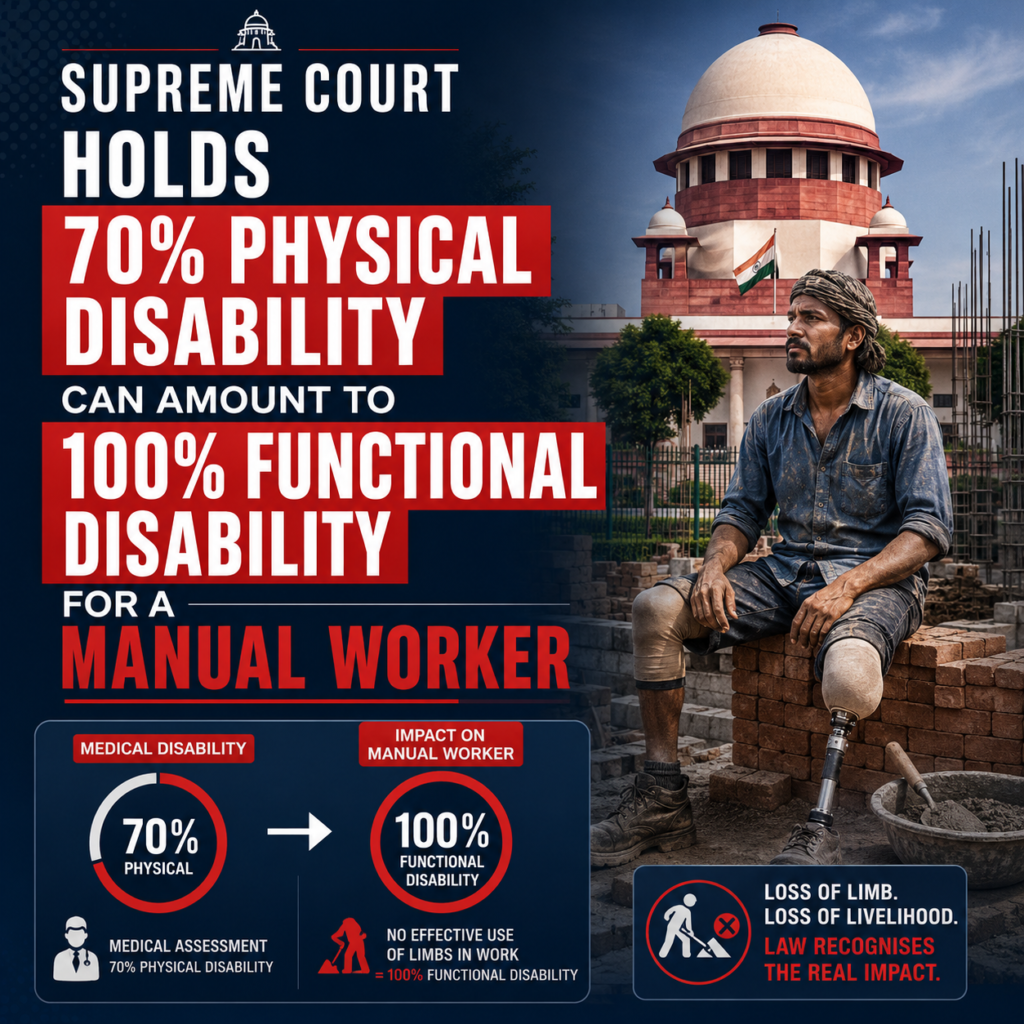
Courts Cannot Mechanically Equate Medical Disability With Loss of Income: Supreme Court Enhances Accident Award
Facts
M. Paramesh was riding his bicycle on the left side of the Namakkal–Salem NH-7 Road on 18 April 2017 when a lorry belonging to VRL Logistics Limited struck him from behind. The accident caused serious injuries to his head, jaw, eye and right leg. Owing to the severity of the injuries, his right leg was amputated above the knee.
An FIR was registered against the lorry driver under Sections 279 and 338 of the Indian Penal Code. The Motor Accident Claims Tribunal found the lorry driver negligent, and that finding was not challenged before the Supreme Court.
The appellant filed a compensation claim under Section 166 of the Motor Vehicles Act, 1988. He stated that he was approximately 30 years old, worked as a mason and earned around ₹20,000 per month. A disability certificate assessed his permanent physical disability at 70%. According to him, the above-knee amputation made it impossible to continue working as a mason.
The Tribunal assessed his monthly income at ₹6,000, treated his loss of earning capacity as 70%, and awarded ₹10,84,330 with interest at 7.5% per annum.
On appeal, the Madras High Court increased his monthly income to ₹12,000, granted 40% future prospects and awarded amounts for attendant charges, loss of amenities and an artificial limb. It stated that the compensation stood enhanced to ₹23,86,320.
Still dissatisfied, the appellant approached the Supreme Court seeking further enhancement of compensation.
Issues
- Whether the appellant’s 70% physical disability should have been treated as 100% functional disability because he could no longer work as a mason.
- Whether the High Court correctly calculated the amount payable towards future prospects after increasing the appellant’s monthly income.
- Whether amounts awarded by the Tribunal for nutrition, clothing and medical expenses were wrongly omitted from the High Court’s final calculation.
- Whether the amount awarded for future medical expenses and replacement of the artificial limb was adequate.
- Whether the compensation required further enhancement to constitute just compensation under the Motor Vehicles Act.
Petitioner’s Arguments
The appellant contended that the compensation awarded by the High Court remained inadequate considering the seriousness and permanent nature of his injuries.
He argued that although the medical disability was assessed at 70%, his actual loss of earning capacity was complete. Masonry is a manual occupation requiring mobility, balance and continuous use of both legs. Following the above-knee amputation, he could no longer effectively perform that work.
The appellant therefore submitted that his functional disability should be assessed at 100%, rather than mechanically equating it with the medical assessment of 70%.
He also sought correction of the High Court’s calculation of future prospects. After increasing the monthly income to ₹12,000, the High Court calculated 40% future prospects on the lower figure adopted by the Tribunal instead of the revised loss of income.
The appellant further sought adequate compensation for future medical treatment, maintenance and periodic replacement of the prosthetic limb.
Respondent’s Arguments
VRL Logistics Limited and the insurer had disputed the manner of the accident and the compensation claimed before the Tribunal. However, they did not produce any oral or documentary evidence in support of their defence.
Before the Supreme Court, the respondents opposed further enhancement and relied upon the compensation already granted by the High Court.
They effectively supported the assessment of the appellant’s earning capacity at 70%, corresponding to the percentage mentioned in the disability certificate.
They also disputed the appellant’s claim that he earned ₹20,000 per month, pointing out that no documentary evidence had been produced to establish that income.
Analysis of the Law
Physical Disability and Functional Disability
The Supreme Court distinguished between medical or physical disability and functional disability.
Physical disability refers to the medically assessed impairment suffered by the injured person. Functional disability concerns the actual effect of that impairment upon the person’s ability to carry on their occupation and earn a livelihood.
The percentage mentioned in a disability certificate cannot automatically be treated as the percentage of economic loss. Courts must examine:
- The injured person’s occupation before the accident;
- The physical requirements of that occupation;
- The activities the person can no longer perform;
- Whether the person can continue in the same profession; and
- Whether any realistic alternative employment remains available.
The same physical injury may have very different economic consequences for different persons. An above-knee amputation may not completely destroy the earning capacity of a person engaged in sedentary office work, but it may result in total functional disability for a person whose livelihood depends entirely upon strenuous manual labour.
Just Compensation
Compensation under the Motor Vehicles Act must be fair, reasonable and responsive to the actual consequences of the accident.
In cases of permanent disability, the award must account not only for immediate medical expenses but also for:
- Loss of future earning capacity;
- Future prospects;
- Pain and suffering;
- Loss of amenities;
- Attendant charges;
- Rehabilitation; and
- Future expenses for artificial limbs and their replacement.
The assessment should restore, as far as money can, the financial and practical position the injured person would have occupied but for the accident.
Correct Calculation of Future Prospects
Once the High Court increased the appellant’s monthly income from ₹6,000 to ₹12,000, it was required to calculate future prospects on the revised figure.
The revised loss of earning capacity at 70% was ₹17,13,600. Therefore, 40% future prospects should have been ₹6,85,440, rather than ₹3,42,720, which had been calculated on the lower figure adopted by the Tribunal.
The Supreme Court also found that the High Court had inadvertently omitted the amounts awarded for nutrition, clothing and ornaments, and medical expenses even though it had not set aside those amounts.
Precedent Analysis
Raj Kumar v. Ajay Kumar, (2011) 1 SCC 343
The Supreme Court relied principally upon this decision to explain the distinction between permanent physical disability and loss of earning capacity.
In Raj Kumar, the Court held that tribunals must not mechanically equate the percentage of medical disability with the percentage of economic loss. The relevant consideration is the effect of the injury upon the claimant’s actual occupation and capacity to earn.
The precedent prescribed a three-step examination:
- Identify the activities the claimant can and cannot perform after the injury.
- Examine the claimant’s occupation, nature of work, age and professional background.
- Determine whether the claimant is totally prevented from earning, can continue the earlier work, or can only perform reduced or alternative work.
Applying these principles, the Supreme Court found that the appellant’s 70% physical disability translated into 100% functional disability because masonry was his sole occupation and required full physical mobility and use of both legs.
Court’s Reasoning
The Court first upheld the High Court’s assessment of the appellant’s monthly income at ₹12,000. Although he claimed to earn ₹20,000 per month as a mason, no reliable documentary evidence supported that figure. The High Court’s assessment was therefore considered fair and reasonable.
However, the Court found that both the Tribunal and the High Court had incorrectly confined the loss of earning capacity to the 70% physical disability mentioned in the certificate.
The appellant worked exclusively as a mason. Masonry involves continuous standing, climbing, balancing, lifting materials and performing physically demanding work. The loss of his right leg above the knee effectively prevented him from continuing that occupation.
There was no suggestion that he had any other sedentary employment or that he could continue to earn at the same level despite the amputation. The Court therefore assessed his functional disability at 100%.
Using the monthly income of ₹12,000, multiplier of 17 and 100% functional disability, the Court calculated the basic loss of income at ₹24,48,000. After adding 40% future prospects, compensation for loss of earning capacity came to ₹34,27,200.
The Court also identified errors in the High Court’s computation:
- Future prospects had been calculated on the Tribunal’s lower figure rather than the revised income;
- Amounts for nutrition, clothing and medical expenses had been omitted despite not being set aside; and
- The High Court’s figure for future medical expenses was inadequate.
Considering that an above-knee amputee would require maintenance, rehabilitation and periodic replacement of the prosthetic limb throughout life, the Court increased future medical expenses from ₹1 lakh to ₹2 lakh.
The compensation under the remaining heads was left undisturbed.
Conclusion
The Supreme Court held that the impact of a permanent injury on earning capacity must be assessed with reference to the claimant’s actual occupation and not merely by adopting the percentage stated in the medical disability certificate.
Although the appellant’s physical disability was assessed at 70%, his above-knee amputation made it practically impossible for him to continue working as a mason. His functional disability was therefore assessed at 100%.
The Court also corrected the High Court’s calculation of future prospects, restored amounts inadvertently omitted from the final computation and increased compensation for future medical expenses and prosthetic requirements.
The total compensation was enhanced to ₹40,29,730, carrying interest at 7.5% per annum. The insurance company was directed to deposit the enhanced amount before the Tribunal within six weeks.
Case Details
Case: M. Paramesh v. VRL Logistics Ltd. and Another
Court: Supreme Court of India
Case Number: Civil Appeal No.8708 of 2026, arising out of SLP (Civil) No.35337 of 2025
Neutral Citation: 2026 INSC 655
Judges: Justice Prashant Kumar Mishra and Justice N.V. Anjaria
Date: 23 June 2026
Result: Appeal partly allowed. Functional disability was increased from 70% to 100%, and compensation was enhanced to ₹40,29,730 with interest at 7.5% per annum.