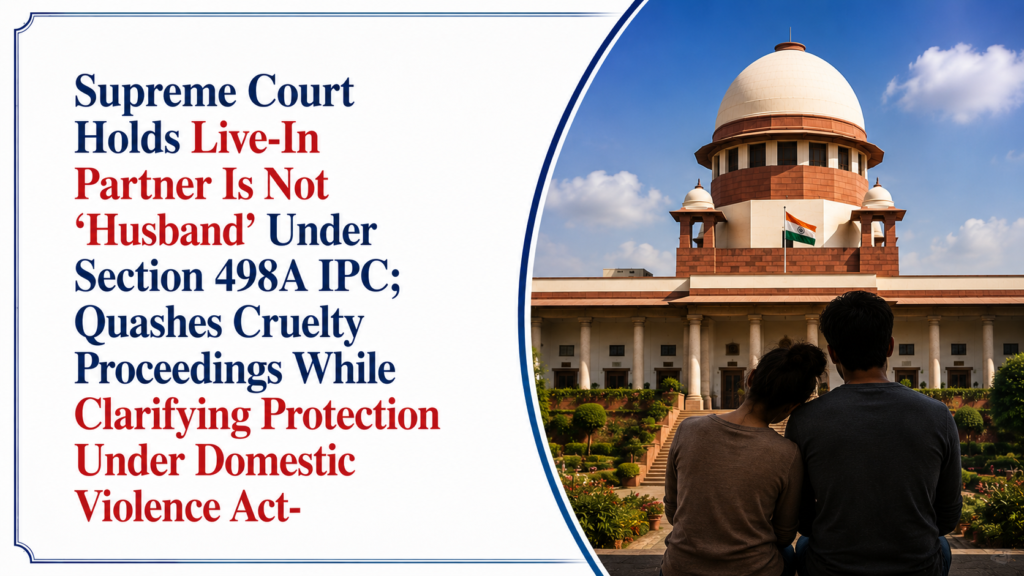
Supreme Court Holds Live-In Partner Is Not ‘Husband’ Under Section 498A IPC; Quashes Cruelty Proceedings While Clarifying Protection Under Domestic Violence Act

Supreme Court Distinguishes Domestic Violence Act from Section 498A IPC in Live-In Relationship Cases
Facts
The appeals arose from criminal proceedings initiated against Dr. Lokesh B.H. under Section 498A IPC, among other offences, by Respondent No. 2.
The central dispute was whether the parties were legally married. The appellant maintained that no valid marriage had ever taken place, whereas the complainant asserted that they had lived together as husband and wife and that the appellant had subjected her to cruelty.
The Karnataka High Court refused to quash the proceedings, holding that the expression “husband” under Section 498A IPC should receive a purposive interpretation to include not only legally married spouses but also persons in live-in relationships bearing the attributes of marriage.
The appellant challenged that view before the Supreme Court.
Issues
- Whether a man in a live-in relationship can be prosecuted as a “husband” under Section 498A IPC.
- Whether the expression “husband” in Section 498A IPC should receive a purposive interpretation extending it to relationships in the nature of marriage.
- Whether women in live-in relationships are left remediless if Section 498A IPC is held inapplicable.
- Whether the Karnataka High Court correctly refused to quash the criminal proceedings.
Petitioner’s Arguments
The appellant contended that:
- Section 498A IPC is a penal provision and therefore requires strict interpretation.
- The expression “husband” refers only to a man in a legally recognised marriage.
- Expanding the provision to cover live-in relationships would amount to judicial legislation.
- Women in live-in relationships are not without remedies, as they are protected under the Protection of Women from Domestic Violence Act, 2005, besides other provisions of criminal law.
- Previous Supreme Court decisions consistently recognised that penal statutes cannot be enlarged beyond their plain language.
Respondent’s Arguments
The complainant, the State of Karnataka and the amicus curiae argued that:
- Section 498A is a social welfare legislation enacted to combat cruelty against women.
- The expression “husband” should receive a purposive interpretation to include relationships in the nature of marriage.
- A man who induces a woman into believing she is in a marital relationship should not escape criminal liability merely because the marriage is legally invalid.
- Restricting Section 498A to legally valid marriages would defeat the object of the provision and undermine constitutional guarantees of equality and dignity.
Analysis of the Law
The Supreme Court undertook an extensive examination of:
- principles governing strict interpretation of penal statutes;
- the mischief rule and purposive interpretation;
- the legislative history and object of Section 498A IPC;
- the distinction between criminal liability and civil protective remedies;
- the concept of a relationship in the nature of marriage under the Domestic Violence Act.
The Court observed that while beneficial legislation may warrant purposive interpretation, penal provisions cannot ordinarily be expanded beyond their statutory language unless the legislative intent clearly supports such interpretation.
The Court also examined the object behind Section 498A and the separate statutory framework created under the Domestic Violence Act to protect women in live-in relationships.
Precedent Analysis
The Supreme Court comprehensively analysed several earlier decisions, including:
- Reema Aggarwal v. Anupam
- Rajinder Singh v. State of Punjab
- U. Suvetha v. State
- Shivcharan Lal Verma v. State of Madhya Pradesh
- D. Velusamy v. D. Patchaiammal
- Indra Sarma v. V.K.V. Sarma
- Badshah v. Urmila Badshah Godse
- Prathiba Tyagi v. Kamlesh Devi
- Kamala v. M.R. Mohan Kumar
The Court distinguished cases concerning void or voidable marriages from genuine live-in relationships, observing that earlier decisions extending protection to deceived women in void marriages could not automatically justify extending Section 498A to all live-in relationships. It also reiterated that the Domestic Violence Act expressly recognises relationships in the nature of marriage, whereas Section 498A contains no such language.
Court’s Reasoning
The Supreme Court held that Section 498A is a penal provision, and although purposive interpretation has an important role, courts cannot rewrite the statute by expanding the meaning of the expression “husband” beyond what Parliament has enacted.
The Court observed that Parliament consciously recognised relationships in the nature of marriage under the Domestic Violence Act but did not amend Section 498A or its successor provision under the Bharatiya Nyaya Sanhita to include such relationships.
Accordingly, the Court held that while women in live-in relationships enjoy substantial civil protection under the Domestic Violence Act and may invoke other criminal offences where applicable, a live-in partner cannot be treated as a “husband” solely for attracting Section 498A IPC.
The Court concluded that extending criminal liability in such circumstances would amount to judicial legislation rather than statutory interpretation.
Since the prosecution under Section 498A rested upon treating the appellant as the complainant’s husband despite the absence of a legally recognised marriage, the criminal proceedings under that provision could not be sustained.
Conclusion
The Supreme Court held that a man in a live-in relationship cannot be prosecuted as a “husband” under Section 498A IPC merely because the relationship bears the attributes of marriage.
The Court set aside the Karnataka High Court’s judgment to that extent, quashed the proceedings under Section 498A IPC, and clarified that women in live-in relationships continue to have remedies under the Protection of Women from Domestic Violence Act, 2005 and other applicable provisions of law.
Case Details
Case: Dr. Lokesh B.H. & Ors. v. State of Karnataka & Anr.
Court: Supreme Court of India
Case Number: Criminal Appeal arising out of SLP (Crl.) Nos. 2240–2241 of 2026
Judge: Hon’ble Justice Sanjay Karol
Date: 03 August 2026
Result: Appeals Allowed. The Supreme Court held that a live-in partner is not a “husband” for the purposes of Section 498A IPC, quashed the proceedings under that provision, and clarified that women in live-in relationships continue to have protection under the Domestic Violence Act and other applicable laws