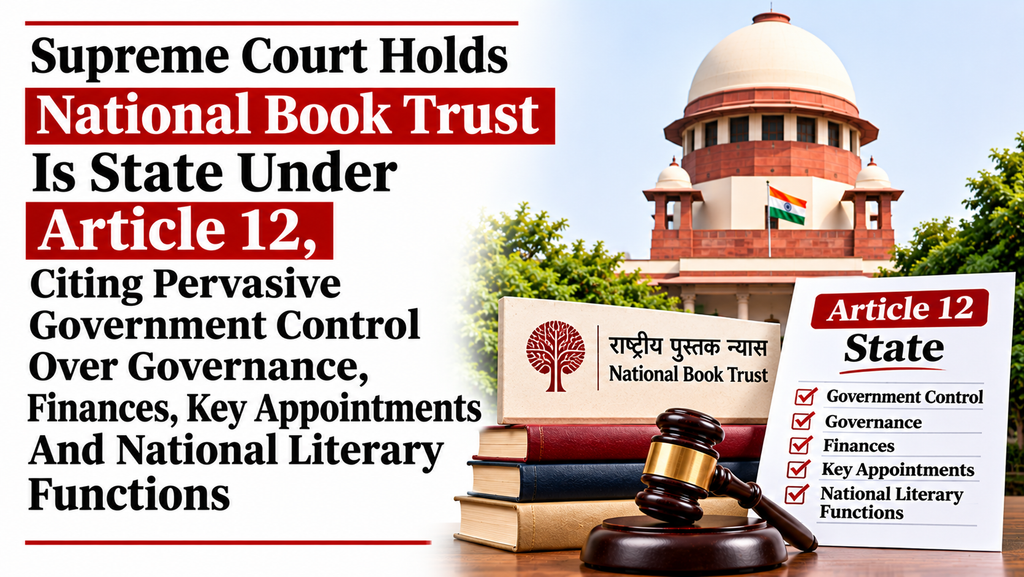
Supreme Court Holds National Book Trust Is State Under Article 12, Citing Pervasive Government Control Over Governance, Finances, Key Appointments And National Literary Functions

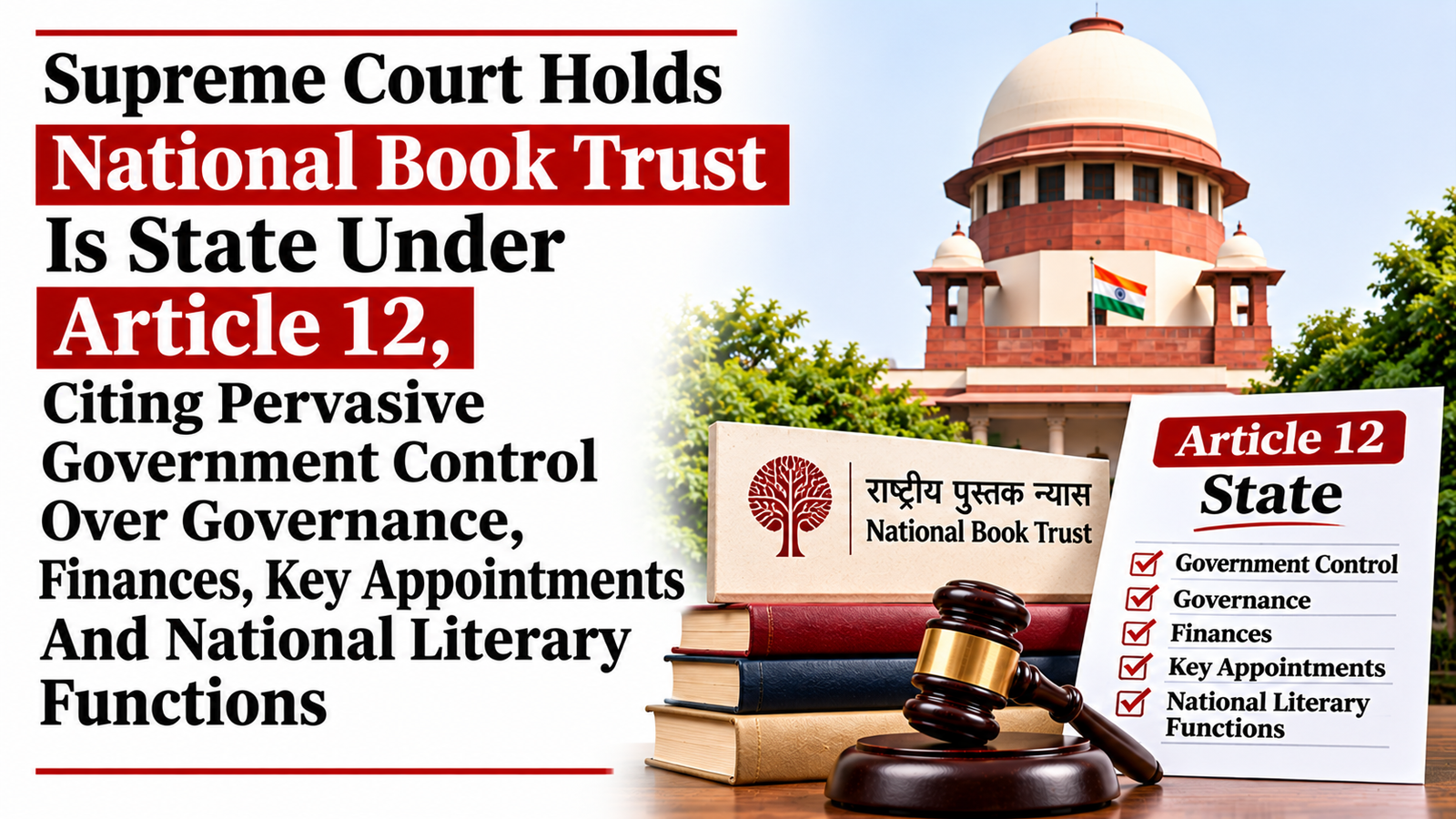
Supreme Court Upholds Delhi High Court Finding That National Book Trust Is A Government Instrumentality, Clarifies Its Employees Do Not Automatically Acquire Civil Servant Status
Facts
The National Book Trust, India (NBT) was constituted under Government of India resolutions dated 15 June 1957 and 28 September 1962 to promote, produce and disseminate literature at moderate prices. A Full Bench of the Delhi High Court, by judgment dated 1 June 2012, held that NBT is an instrumentality of Government and consequently falls within the expression “State” under Article 12 of the Constitution. The Chairman, NBT and another challenged that determination. The Supreme Court examined NBT’s founding resolutions and rules concerning its governing body, Executive Committee, chairman, finances, audit and public objectives.
Issues
Whether NBT, although organised as a society/trust rather than a statutory department, is an “other authority” under Article 12; whether Government influence over its constitution, leadership, decision-making and finances amounts to deep and pervasive control rather than routine regulation; and whether independent publishing receipts or the non-sovereign character of book publication alter that conclusion. The Court also clarified whether Article 12 classification automatically makes NBT personnel civil servants.
Petitioner’s Arguments
NBT disputed its treatment as “State”, stressing its separate institutional form, its own publishing activities and revenue generated through book sales. It submitted that Government grants were only one source of income and that the High Court should not treat such funding as decisive. The appellant’s position was that registration as a society/trust, non-sovereign publishing functions and a degree of financial independence weighed against Government-instrumentality status. It also raised concerns that Article 12 classification might carry the consequences of Government employment for Trust employees.
Respondent’s Arguments
The position accepted by the Delhi High Court Full Bench was that Government control was substantial when NBT’s foundational, managerial and financial arrangements were viewed together. The Supreme Court considered the parties’ submissions and an amicus note from senior advocate Sanjay Jain; the judgment does not separately set out an extensive respondent-side argument. The supporting material highlighted Government nomination of office-holders, appointment of the Chairman, participation of Ministries in executive governance, approvals over important rules and financial controls, and oversight through reports and audit.
Analysis of the Law
Article 12 reaches Government instrumentalities regardless of legal form. The controlling inquiry is whether the body is financially, functionally and administratively dominated by or under Government control, and whether the control is specific and pervasive. Merely receiving Government grants, discharging a public service or being subject to ordinary statutory regulation is insufficient on its own. Equally, independent income or society registration does not immunise a body otherwise controlled by Government. Article 12 obligations under Part III must be distinguished from service protections under Articles 309–311: they do not arise automatically for NBT employees.
Precedent Analysis
Ramana Dayaram Shetty v. International Airport Authority of India, (1979) 3 SCC 489, and Ajay Hasia v. Khalid Mujib Sehravardi, (1981) 1 SCC 722, identified indicative Government-instrumentality factors and rejected an exclusively formal test. The seven-judge decision in Pradeep Kumar Biswas v. Indian Institute of Chemical Biology, (2002) 5 SCC 111, requires a cumulative assessment of financial, functional and administrative domination. Zee Telefilms Ltd. v. Union of India, (2005) 4 SCC 649, confirms that public functions by themselves do not establish Article 12 status. The Court applied, rather than expanded, these principles.
Court’s Reasoning
Justice Prashant Kumar Mishra found Government involvement built into NBT’s structure, not merely superimposed as external regulation. Government appoints the Chairman, who holds office at its pleasure; Ministries and Government nominees occupy governing and Executive Committee positions; important management and rule-making matters require Government approval. Financial administration involves a Government-linked Financial Adviser, audited accounts and Comptroller and Auditor-General oversight, plus reporting obligations. Its objective of affordable literature and knowledge dissemination reinforces the public purpose for which Government created it. Revenue earned independently cannot negate this cumulative control.
Conclusion
The Supreme Court affirmed the Delhi High Court Full Bench’s 1 June 2012 determination: NBT is an “other authority”, hence “State” for Article 12 and the fundamental-rights framework of Part III. Civil Appeal No. 14369 of 2015 was dismissed without interference with that ruling. The decision does not turn NBT into a Government department, nor automatically transform its staff into civil servants or give them Articles 309, 310 or 311 protection. The outcome is confined to NBT’s constitutional status; no individual employee’s service entitlement was adjudicated.
Case: The Chairman, National Book Trust, India & Anr. v. A.R. Abdul Gaffar & Ors.
Court: Supreme Court of India (Civil Appellate Jurisdiction)
Case Number: Civil Appeal No. 14369 of 2015; 2026 INSC 1202
Judge: Justice Prashant Kumar Mishra and Justice Augustine George Masih
Date: 6 November 2026 (Delhi High Court Full Bench: 1 June 2012)
Result: Appeal dismissed; National Book Trust held to be “State” under Article 12; no automatic civil-servant status for its employees.