


Court’s decision
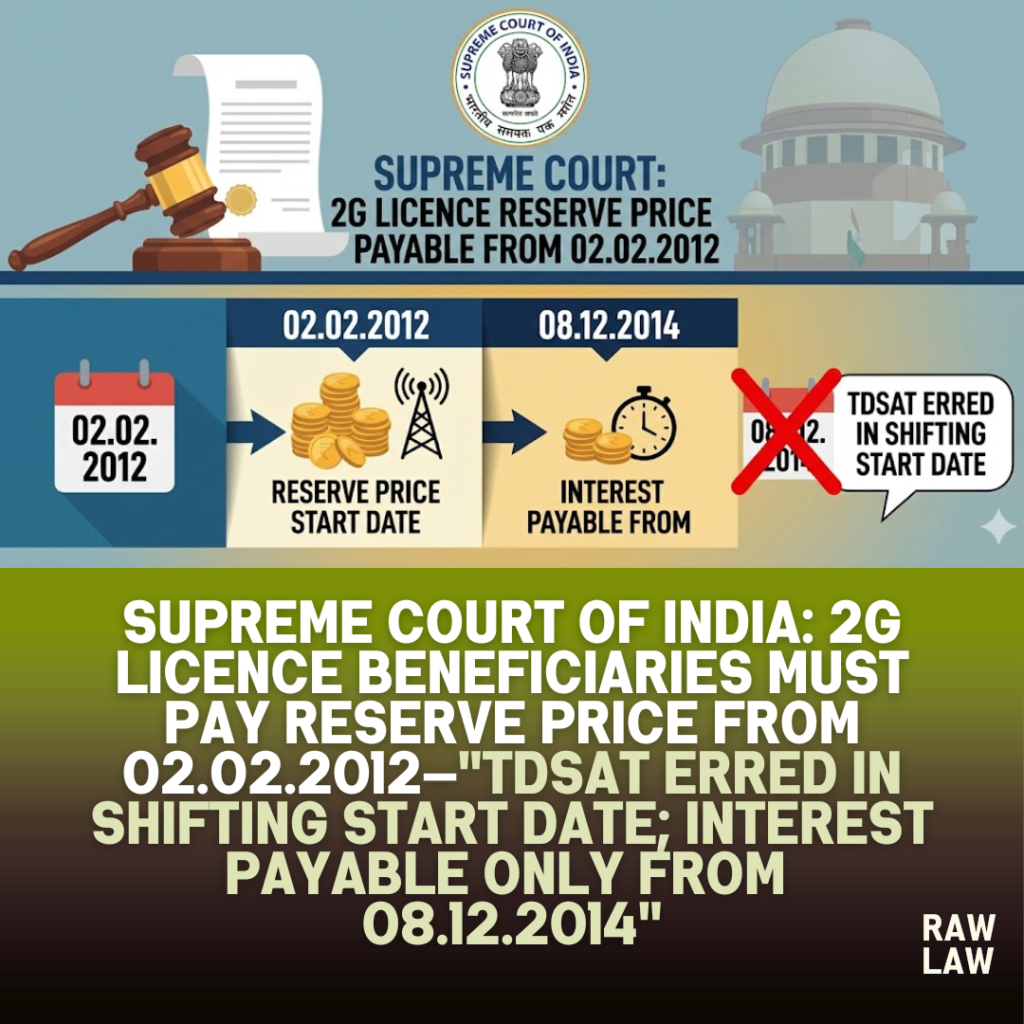
The Supreme Court of India allowed the Union of India’s appeal against the Telecom Disputes Settlement and Appellate Tribunal, holding that licensees whose 2G licences were quashed on 02.02.2012 were liable to pay the November 2012 auction reserve price from 02.02.2012 itself and not from 15.02.2013 as held by the Tribunal.
The Court clarified that the liability commenced from the date of quashing of licences, as expressly indicated in the order dated 15.02.2013. However, it upheld the Tribunal’s view that interest would be payable only from 08.12.2014, being the expiry of the show-cause notice period.
Facts
The dispute arose from the aftermath of the landmark judgment in Centre for Public Interest Litigation v. Union of India (2012) 3 SCC 1, whereby the Supreme Court quashed the grant of 2G Unified Access Service licences, including those of the respondent telecom operator.
Though the licences were declared illegal on 02.02.2012, the Court allowed operations to continue temporarily to prevent disruption of telecom services to the public. Multiple extensions were granted to facilitate fresh spectrum auctions.
On 15.02.2013, the Court directed that licensees who continued operations after 02.02.2012 must pay the reserve price fixed for the November 2012 auction.
Subsequently, the Department of Telecommunications issued show-cause and demand notices seeking recovery of reserve price amounts with interest.
Issues
The appeal centered on:
- The correct “starting date” for levy of reserve price liability under the order dated 15.02.2013.
- The appropriate “end date” for such levy in circles where the respondent was successful in the March 2013 auction.
- The date from which interest would be payable.
- Whether the Tribunal had erred in interpreting and effectively diluting the Supreme Court’s binding direction.
Appellant’s arguments
The Union of India contended that the Tribunal misconstrued the order dated 15.02.2013. The language clearly imposed liability on licensees who continued operations “after 02.02.2012,” making 02.02.2012 the commencement date.
It was argued that the Tribunal impermissibly substituted its own interpretation by holding 15.02.2013 as the starting date, thereby diluting a binding Supreme Court direction.
The Government maintained that the reserve price was a premium imposed on licensees who continued benefiting from licences already declared illegal.
Respondent’s arguments
The telecom operator argued that the Tribunal correctly held that the liability could arise only from 15.02.2013, as that was when the direction to pay the reserve price was issued.
It also contended that once it was successful in the March 2013 auction and issued a Letter of Intent on 30.04.2013, no further levy could continue beyond that date.
With respect to interest, the respondent supported the Tribunal’s finding that interest could not run from 2012 due to delay by the Department itself.
Analysis of the law
The Court examined the context and language of the order dated 15.02.2013. It emphasized that the phrase “continued operation after 02.02.2012” unmistakably indicated the commencement date of liability.
The Tribunal’s reasoning that no specific starting date was mentioned was termed “factually incorrect.”
The Court reiterated that directions of the Supreme Court attain finality and cannot be diluted by interpretative reworking by subordinate forums.
However, on the issue of interest, the Court invoked the equitable principle that a party cannot benefit from its own delay. Since the Department acted only in November 2014, it could not impose interest retrospectively from 2012.
Precedent analysis
The judgment builds directly upon Centre for Public Interest Litigation v. Union of India (2012) 3 SCC 1, which quashed 2G licences and mandated fresh auction.
The present ruling clarifies the operational consequences of subsequent extension orders and reinforces the binding nature of Supreme Court directions.
It underscores that administrative or quasi-judicial tribunals cannot reinterpret Supreme Court orders contrary to their plain language.
Court’s reasoning
The Court held that existing licensees were granted a “lease of life” solely to prevent disruption of telecom services for the public, not for their benefit.
Therefore, the imposition of reserve price liability from 02.02.2012 was a deliberate premium on continued commercial exploitation of spectrum after quashing.
The Court rejected the Tribunal’s view that liability began on 15.02.2013, stating that had that been intended, the order would have explicitly said so.
Regarding the end date, the Court agreed with the Tribunal that once the Letter of Intent dated 30.04.2013 specified commencement of the new 20-year term from that date, levy could not continue beyond it for the successful circles.
For circles where operations ceased earlier, the cut-off date was 23.03.2013.
On interest, the Court upheld that it would accrue only from 08.12.2014, after expiry of the show-cause notice period.
Conclusion
The Supreme Court held:
• Reserve price payable from 02.02.2012
• Liability continues till 30.04.2013 (8 circles)
• Liability till 23.03.2013 (remaining circles)
• Interest payable @ SBI Prime Lending Rate from 08.12.2014
• Amount already paid to be adjusted
The appeal was allowed, and the Tribunal’s order modified accordingly.
Implications
This ruling:
- Reaffirms the binding force of Supreme Court directions.
- Clarifies financial consequences of the 2G licence quashing judgment.
- Imposes premium liability on continued post-quashing operations.
- Balances enforcement with equity by restricting interest due to governmental delay.
- Strengthens judicial discipline in interpretation of apex court orders.
The judgment marks a significant closure chapter in post-2G spectrum litigation.
Case law references
Centre for Public Interest Litigation v. Union of India (2012) 3 SCC 1
Quashed 2G licences and mandated fresh auction; foundation of present liability.
FAQs
1. From which date was the reserve price liability imposed?
From 02.02.2012, the date when 2G licences were quashed.
2. Why was interest not charged from 2012?
Because the Department delayed issuing the show-cause notice; interest runs only from 08.12.2014.
3. Could the Tribunal reinterpret the Supreme Court’s order?
No. Subordinate forums cannot dilute or modify binding Supreme Court directions.