
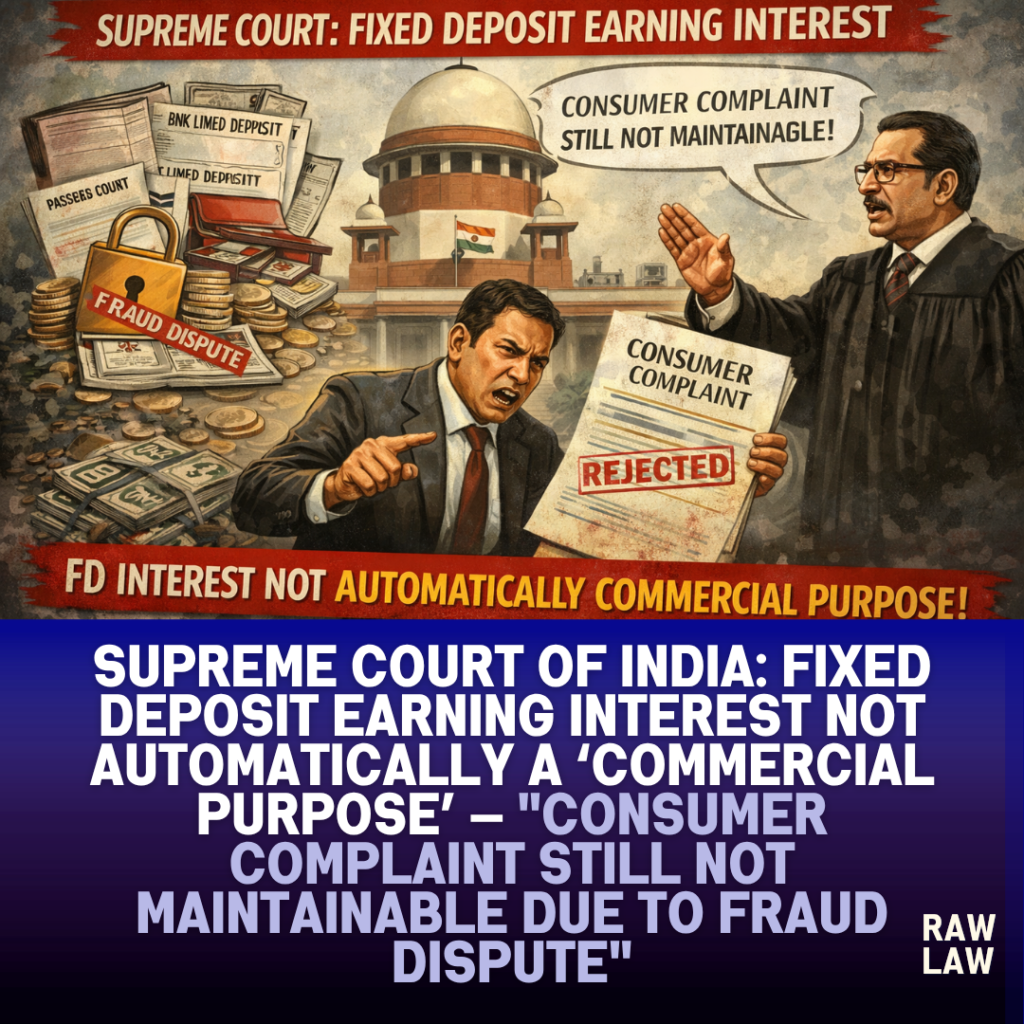

Court’s decision
The Supreme Court dismissed the appeal and upheld the rejection of the consumer complaint, though on different reasoning. It held that merely earning interest on a fixed deposit does not automatically make the transaction a “commercial purpose.” However, since the dispute involved serious allegations of fraud, forgery, and pledge of deposit for overdraft, the matter could not be adjudicated in summary consumer proceedings. The complainant was granted liberty to pursue appropriate civil or criminal remedies.
Facts
The appellant, a government-backed corporation, invested ₹9 crore in a fixed deposit with a bank. A fixed deposit receipt was issued, and interest was credited initially.
Subsequently, the appellant received communication indicating that an overdraft facility had been sanctioned against the fixed deposit. Suspecting fraud, the appellant lodged complaints with authorities and sought reversal of the transaction.
The bank later adjusted the maturity amount of the fixed deposit towards the overdraft dues and remitted only the remaining balance.
The appellant disputed this adjustment and filed a consumer complaint seeking full repayment with interest and compensation.
The National Consumer Disputes Redressal Commission dismissed the complaint, holding that the transaction was for a commercial purpose and thus outside the definition of “consumer.”
Issues
The Court considered whether a company depositing surplus funds in a bank qualifies as a “consumer” under the Consumer Protection Act.
It also examined whether such a transaction constitutes a “commercial purpose” merely because it earns interest.
Another key issue was whether disputes involving fraud and forged banking transactions can be decided in consumer proceedings.
Petitioner’s arguments
The appellant argued that depositing money in a bank does not automatically amount to a commercial activity. It submitted that parking surplus funds is a common financial practice and not necessarily linked to profit generation.
It contended that the dominant purpose of the deposit was not commercial gain but financial management and safe custody.
The appellant also argued that even a company can be a consumer and that deficiency in banking services was clearly established.
Respondent’s arguments
The bank argued that the deposit was made to earn interest and augment profits, thereby constituting a commercial purpose.
It further contended that the fixed deposit was pledged to secure an overdraft facility, which clearly linked the transaction to business activity.
The bank also submitted that allegations of fraud and forgery cannot be adjudicated in summary consumer proceedings and require detailed trial before civil or criminal courts.
Analysis of the law
The Court undertook a detailed interpretation of “consumer” under Section 2(1)(d) of the Consumer Protection Act.
It clarified that the key test is the dominant purpose of the transaction—whether it is directly linked to profit generation.
The Court rejected the blanket assumption that earning interest equals commercial purpose, noting that deposits may serve multiple purposes such as safety, statutory compliance, or liquidity management.
However, it emphasized that if deposits are used to leverage credit facilities for business, they may acquire a commercial character.
The Court also reiterated that consumer forums are designed for summary adjudication and are not suitable for complex disputes involving fraud.
Precedent analysis
The Court relied on several precedents:
- Lilavati Kirtilal Mehta Medical Trust v Unique Shanti Developers
Established the dominant purpose test for determining commercial purpose. - National Insurance Co. Ltd. v Harsolia Motors
Held that services not directly linked to profit generation may still fall within consumer protection. - Karnataka Power Transmission Corporation v Ashok Iron Works
Clarified that companies can be consumers. - Ravneet Singh Bagga v KLM Royal Dutch Airlines
Distinguished deficiency in service from tortious or criminal acts. - City Union Bank v R. Chandramohan
Held that complex disputes involving fraud are not maintainable before consumer forums.
These precedents guided the Court’s nuanced approach.
Court’s reasoning
The Court disagreed with the NCDRC’s blanket conclusion that earning interest makes a transaction commercial.
It held that bank deposits earning interest do not automatically imply a commercial purpose, as deposits may be made for safety or regulatory reasons.
However, the Court found that the present dispute involved serious allegations of fraud, forged documents, and unauthorized pledge of the fixed deposit.
The bank claimed that the deposit was pledged for an overdraft, while the appellant alleged fraud. This created a complex factual dispute requiring detailed evidence.
The Court held that such issues cannot be resolved in summary consumer proceedings and must be adjudicated in civil or criminal courts.
Thus, while correcting the legal reasoning on “commercial purpose,” the Court upheld dismissal on maintainability grounds.
Conclusion
The Supreme Court dismissed the appeal, holding that although the reasoning on commercial purpose was flawed, the complaint itself was not maintainable due to the complexity of fraud allegations.
Implications
This judgment is significant for banking and consumer law.
It clarifies that earning interest on deposits does not automatically disqualify a person from being a consumer.
At the same time, it reinforces that consumer forums are not the appropriate forum for disputes involving fraud, forgery, or complex contractual arrangements.
The ruling strengthens the “dominant purpose” test and ensures that consumer jurisdiction is not stretched to cover matters requiring full-fledged trials.
Case law references
- Lilavati Kirtilal Mehta Medical Trust v Unique Shanti Developers (2020)
Dominant purpose test. - National Insurance Co. Ltd. v Harsolia Motors (2023)
Profit nexus requirement. - Karnataka Power Transmission Corporation v Ashok Iron Works (2009)
Companies as consumers. - Ravneet Singh Bagga v KLM Royal Dutch Airlines (2000)
Deficiency vs tortious acts. - City Union Bank v R. Chandramohan (2023)
Consumer forums cannot decide fraud disputes.
FAQs
1. Does earning interest on a bank deposit make it a commercial activity?
No. The Supreme Court clarified that earning interest alone does not make a transaction commercial.
2. Can companies file consumer complaints?
Yes, companies can be consumers if the service is not availed for a commercial purpose.
3. Can fraud disputes be decided by consumer forums?
No. Complex disputes involving fraud or forgery must be decided by civil or criminal courts.


