

Court’s decision
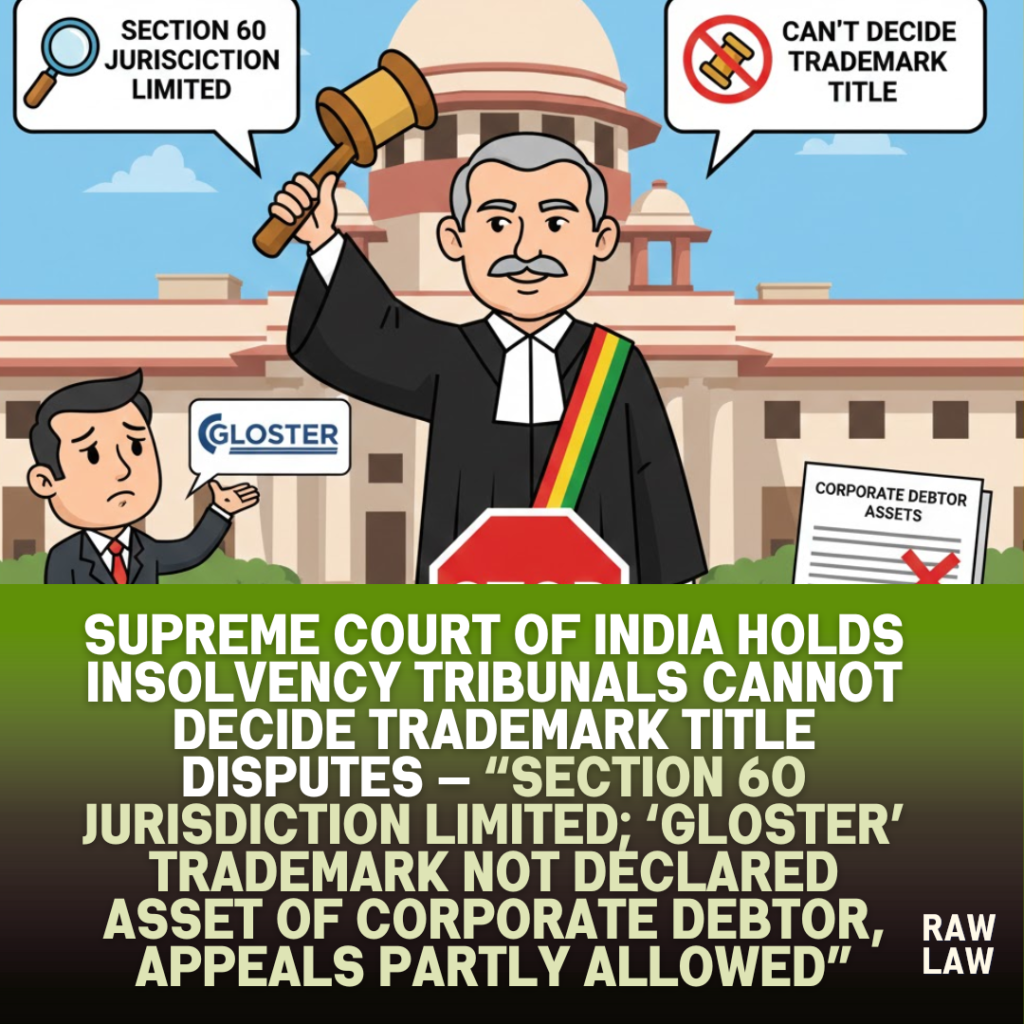
The Supreme Court of India partly allowed cross-appeals arising from insolvency proceedings of a corporate debtor and held that insolvency adjudicating authorities under the Insolvency and Bankruptcy Code cannot, in the guise of Section 60 jurisdiction, conclusively decide rival claims of title over a registered trademark. Setting aside the declaration that the trademark “Gloster” formed part of the corporate debtor’s assets, the Court ruled that such adjudication lay outside the permissible contours of insolvency jurisdiction — “Section 60 cannot be used as a shortcut to decide civil title disputes”; however, the Court affirmed that insolvency tribunals do have limited jurisdiction to entertain applications incidental to the resolution process.
Court’s decision
A Bench led by Justice K.V. Viswanathan held that while the National Company Law Tribunal and the National Company Law Appellate Tribunal were right in examining whether an application was maintainable under Section 60(5) of the Insolvency and Bankruptcy Code, they erred in conclusively pronouncing on ownership of the trademark. The Court restored the position that the approved resolution plan merely acknowledged rival claims and did not vest undisputed title in the successful resolution applicant. The appeals were disposed of by limiting insolvency jurisdiction and leaving trademark title to be determined by competent civil or statutory fora.
Facts
The corporate debtor had been admitted into corporate insolvency resolution proceedings following a creditor’s application. During the resolution process, a dispute arose regarding ownership of the trademark “Gloster”. The trademark was originally registered in the name of the corporate debtor but had been licensed, hypothecated, and later purportedly assigned to a group company through a series of agreements spanning several years. While the resolution plan was pending approval, the group company filed an application before the insolvency tribunal seeking exclusion of the trademark from the resolution plan, asserting that it was not an asset of the corporate debtor. The resolution professional, the committee of creditors, and the successful resolution applicant opposed this claim.
Issues
The principal issue before the Supreme Court was whether the insolvency adjudicating authority, while dealing with an application under Section 60(5) of the Insolvency and Bankruptcy Code, could conclusively determine title to a trademark and declare it an asset of the corporate debtor. A connected issue was whether such a declaration could be made when the approved resolution plan itself recognised the existence of rival claims and did not assert an undisputed transfer of title in favour of the successful resolution applicant.
Appellant’s arguments
The successful resolution applicant argued that the insolvency tribunal had jurisdiction under Section 60(5) to decide all questions of law or fact arising in relation to the insolvency resolution process. It was contended that the assignment of the trademark was void as it violated statutory restraints, insolvency moratorium provisions, and amounted to a preferential or undervalued transaction. The applicant submitted that the trademark was consistently reflected as an asset of the corporate debtor in audited balance sheets and information memoranda, and that permitting a third party to assert ownership would defeat maximisation of value under the insolvency framework.
Respondent’s arguments
The respondent company contended that the insolvency tribunals had no jurisdiction to adjudicate ownership of intellectual property rights, which involved complex questions of trademark law and civil title. It was argued that the assignment of the trademark had taken effect prior to commencement of insolvency proceedings and that registration was merely a recording of title already transferred. The respondent emphasised that the resolution plan itself acknowledged rival claims and therefore could not be read as vesting clear title in the resolution applicant. It was further submitted that any dispute over trademark ownership had to be decided by appropriate civil courts or statutory authorities under trademark law.
Analysis of the law
The Court undertook a detailed examination of Section 60(5) of the Insolvency and Bankruptcy Code, reiterating that its residuary jurisdiction extends only to questions arising out of or in relation to insolvency resolution. Drawing from earlier precedents, the Court emphasised that insolvency tribunals cannot assume the role of civil courts or substitute specialised statutory forums. While Section 60 ensures a single forum for insolvency-related issues, it does not permit adjudication of disputes that exist independently of insolvency, particularly disputes concerning ownership of property where rival claims pre-date the insolvency process.
Precedent analysis
The Court relied extensively on its earlier rulings clarifying the limits of insolvency jurisdiction. It distinguished cases where contractual disputes were directly triggered by insolvency from those involving pre-existing civil rights. The Court reiterated that insolvency tribunals may incidentally examine facts to preserve the resolution process but cannot conclusively determine rights that must be adjudicated under separate statutory regimes. Applying these principles, the Court held that declaration of trademark ownership went beyond incidental determination and amounted to an impermissible assumption of civil jurisdiction.
Court’s reasoning
The Court noted that the approved resolution plan did not assert an undisputed right over the trademark but expressly recorded the existence of competing claims and the resolution applicant’s belief that the assignment was invalid. In such circumstances, the insolvency tribunal could not, merely because an application was filed, convert an unresolved civil dispute into a final declaration of title. The Court stressed that insolvency law is designed to resolve financial distress, not to rewrite proprietary rights. It therefore held that the declaration that the trademark formed part of the corporate debtor’s assets could not be sustained.
Conclusion
The Supreme Court set aside the findings declaring the trademark “Gloster” as an asset of the corporate debtor and clarified that insolvency tribunals lack jurisdiction to conclusively adjudicate trademark title disputes under Section 60(5) of the Insolvency and Bankruptcy Code. At the same time, it upheld the limited jurisdiction of insolvency fora to entertain applications incidental to the resolution process. The appeals were disposed of accordingly, leaving parties to pursue appropriate remedies before competent civil or statutory authorities.
Implications
This judgment draws a clear jurisdictional boundary for insolvency tribunals, reinforcing that the Insolvency and Bankruptcy Code is not a forum for resolving complex civil or intellectual property disputes. It protects the integrity of specialised legal regimes while preventing resolution applicants from acquiring disputed assets through insolvency shortcuts. For insolvency practitioners and bidders, the ruling underscores the importance of factoring unresolved title disputes into resolution plans rather than expecting insolvency courts to settle them conclusively.
Case law references
- Limits of Section 60 jurisdiction: Insolvency tribunals cannot adjudicate disputes that do not arise solely from insolvency. Applied to trademark ownership dispute.
- Rival proprietary claims: Recognition of competing claims in a resolution plan bars conclusive declaration of title by insolvency authorities. Applied to set aside NCLT findings.
- IBC not a civil court substitute: Insolvency fora cannot usurp jurisdiction of civil courts or statutory authorities. Applied to restrict scope of adjudication.
FAQs
1. Can insolvency tribunals decide ownership of trademarks?
No. Insolvency tribunals may incidentally examine facts but cannot conclusively decide trademark title disputes, which must be resolved under trademark law.
2. Does Section 60 of the Insolvency Code give unlimited jurisdiction?
No. Section 60 applies only to issues arising out of or directly related to insolvency resolution and cannot be used to decide independent civil disputes.
3. What happens if a resolution plan notes rival claims over assets?
Such acknowledgment prevents insolvency tribunals from declaring clear title; parties must pursue appropriate remedies before competent fora.


