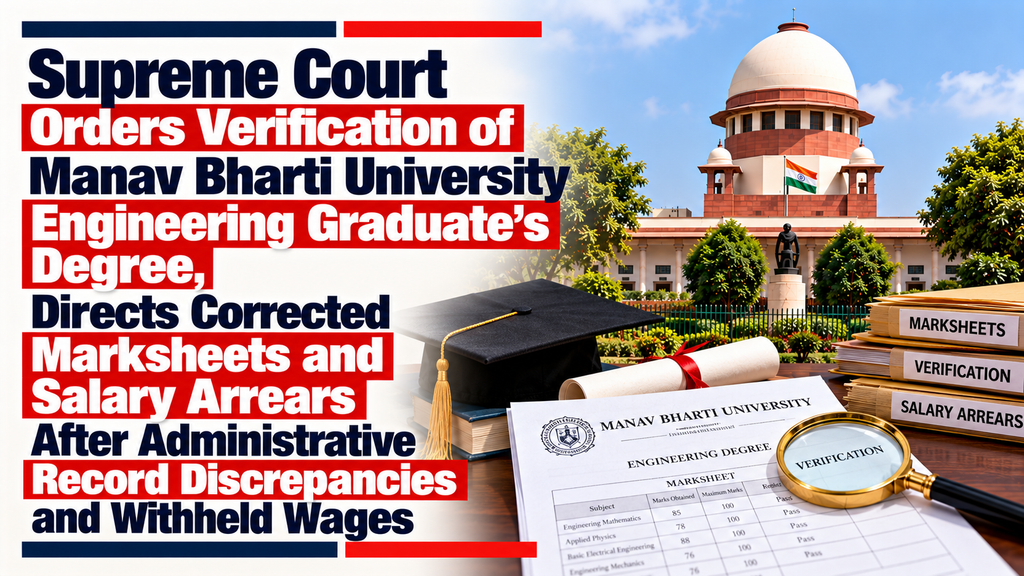
Supreme Court Orders Verification of Manav Bharti University Engineering Graduate’s Degree, Directs Corrected Marksheets and Salary Arrears After Administrative Record Discrepancies and Withheld Wages

Engineering Graduate Denied Salary Over University Record Errors Wins Supreme Court Relief; Himachal Authorities Told to Verify Degree and Correct Disputed Semester Marksheets Within Weeks
Facts
Mohd. Asad Choudhary was admitted to the B.Tech. (Civil Engineering) programme at Manav Bharti University, Himachal Pradesh, for 2014–2018 (Admission No. R14BTCE0031; Registration No. MBU-2014-0964). He completed eight semesters, received detailed marks certificates and a degree dated 15 October 2018, and joined the State Taxes Department, Jammu and Kashmir, as a Sub-Inspector. His employer repeatedly sought confirmation of the degree between May 2022 and July 2024, but verification remained pending and his salary was withheld. Investigations into allegations of sale of degrees by the University had resulted in the seizure of university records. A High Court-supervised Document Verification Committee was constituted, but discrepancies between the University’s Green Sheet, admission disclosures and result gazettes impeded certification. On 20 December 2024, the Himachal Pradesh High Court disposed of the connected petitions, leaving students, including the appellant, to seek relief before a competent court.
Issues
Whether a graduate whose admission, attendance in the examination process and successful completion of the course were confirmed could be denied academic verification because his name was omitted from an admission disclosure list; whether discrepancies between recorded marks for the seventh and eighth semesters justified withholding degree verification; whether the matter required a separate civil proceeding; and what consequential directions were appropriate concerning correction of records and unpaid salary.
Petitioner’s Arguments
The appellant submitted that he had been admitted against an allocated seat in an approved course, duly completed all examinations and possessed the degree and individual semester certificates. His admission was reflected in the University’s Green Sheet/Register and examination records. The omission of his name from the list furnished to the Himachal Pradesh Private Educational Institutions Regulatory Commission (HP-PERC) was attributable to the University’s previous administration, not to him. He emphasised that the dispute concerned verification of documents already issued, rather than obtaining any new qualification, and that his government employment and remuneration had been prejudiced while the verification remained unresolved.
Respondent’s Arguments
The State and the verification authorities pointed out that the appellant’s name was absent from the admission disclosure list and that the seventh- and eighth-semester marks in the result gazette differed from those entered in the Green Sheet and detailed marks certificates. The Committee explained that it could verify records but was not empowered to create or alter university documents; it held photocopies, while original records were with the trial courts. Crucially, the University acknowledged in its Supreme Court affidavit that the appellant had been duly admitted, passed all eight semesters and had his name recorded in its primary Green Sheet Register. It characterised the omission from the disclosure list as an inadvertent clerical error by the prior administration.
Analysis of the Law
The Court distinguished the substantive validity of an academic qualification from curable inconsistencies in the institution’s own records. A student who was properly admitted, completed the examinations and obtained the degree could not suffer adverse employment consequences on account of a disclosure omission expressly admitted to be the University’s fault. The discrepancies in the final two semesters did not undermine the degree because both sets of recorded scores reflected a pass. Identifying the accurate marks was a confined exercise of administrative verification, not a dispute requiring witnesses or an independent civil trial. The University’s contradictory explanation that the later marks mismatch caused an omission from the 2014–15 admission list was also rejected as chronologically untenable.
Precedent Analysis
The judgment does not rest on an extended survey of earlier reported cases or formulate a general rule validating disputed degrees. It is principally a record-specific determination based on the University’s admissions, the Committee’s verification material and the uncontested fact that the appellant passed the course. The operative distinction is between a genuinely disputed claim to a qualification and administrative mistakes requiring verification or correction by the authority responsible for the records.
Court’s Reasoning
The three-Judge Bench held that the University’s counter-affidavit and the Committee’s additional affidavit confirmed the appellant’s enrolment and completion of the prescribed course. The University admitted responsibility for the missing admission disclosure entry. Although the result gazette and Green Sheet/DMCs recorded different marks for semesters seven and eight, every version showed that the appellant passed. The Court therefore found no remaining factual controversy concerning the degree itself. Only reconciliation of the correct marks remained; the Government could furnish existing records to the University and the University could issue accurate certificates and verify the qualification. The High Court was wrong to send the appellant to another court for that limited exercise.
Conclusion
On 14 October 2026, the Supreme Court allowed the appeal and set aside the High Court’s order dated 20 December 2024 insofar as it concerned Mohd. Asad Choudhary. The State was directed to provide the Committee’s available results for semesters seven and eight to the University, which must issue corrected detailed marks certificates and consequential documents and send a verification report to the Additional Commissioner, State Taxes (Administration and Enforcement), Kashmir, within three weeks. On receiving verification, the employer was expected to release salary arrears and consequential benefits within a further four weeks. No costs were awarded. The Court did not itself determine which conflicting marks were correct.
Case: Mohd. Asad Choudhary v. State of Himachal Pradesh & Ors.
Court: Supreme Court of India, Civil Appellate Jurisdiction
Case Number: Civil Appeal of 2026 arising out of SLP (C) No. 474 of 2026; 2026 INSC 1127
Judge: Justices Vikram Nath, Augustine George Masih and Sandeep Mehta
Date: 14 October 2026
Result: Appeal allowed; High Court order set aside qua appellant; corrected records and verification directed; employer expected to release salary arrears and benefits; no costs.