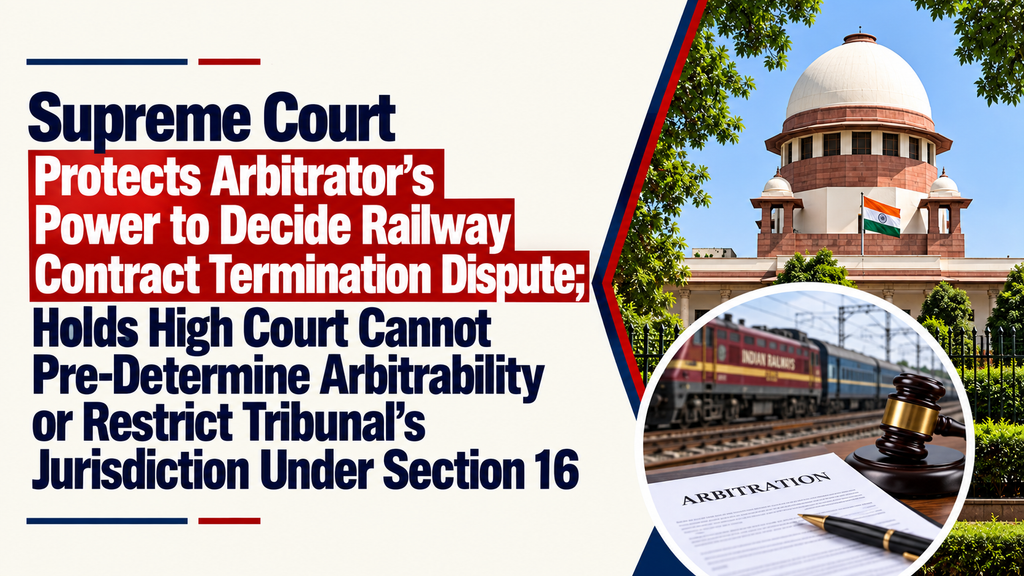
Supreme Court Protects Arbitrator’s Power to Decide Railway Contract Termination Dispute; Holds High Court Cannot Pre-Determine Arbitrability or Restrict Tribunal’s Jurisdiction Under Section 16

Railway Contractor Challenges Termination Before Arbitration; Supreme Court Holds High Court Cannot Pre-Determine Whether Dispute Falls Within ‘Excepted Matters’
Facts
M/s GVV Constructions Private Limited, a construction and infrastructure company, participated in a tender invited by South Central Railway on 21 February 2017 for doubling of the Guntur–Guntakal railway track, involving earthwork, bridges, RUBs and allied works. Its bid was accepted and a formal contract was executed on 30 November 2017, with 23 October 2018 fixed as the completion date.
On 10 June 2022, the Railways terminated the contract under Clause 62 of the Indian Railways Standard General Conditions of Contract (“GCC”). The contractor’s performance guarantee and security were forfeited, and it was held disentitled to compensation for loss.
GVV Constructions challenged the termination through a writ petition, alleging non-compliance with the GCC procedure and seeking consequential directions under Clause 17. The Single Judge dismissed the petition because serious and complicated factual questions were unsuitable for adjudication under Article 226. Although the contractor was permitted to pursue its defences in arbitration, the Single Judge also recorded that there was no irregularity in the termination.
On appeal, the Telangana High Court Division Bench found that the Single Judge had upheld the validity of termination without giving reasons. It therefore set aside that finding and permitted the contractor to raise all its claims before the Arbitral Tribunal. However, it directed that the Tribunal decide the claims “strictly in accordance with the terms of the contract”.
Thereafter, a former Supreme Court judge was appointed Sole Arbitrator and arbitration commenced on 20 January 2026. Among the twelve issues framed were the validity of the termination and whether certain claims were barred by limitation, constituted “excepted matters”, or were otherwise non-arbitrable.
The contractor approached the Supreme Court essentially challenging the effect of the Division Bench’s direction upon the Arbitral Tribunal’s jurisdiction.
Issues
The principal issue before the Supreme Court was:
Whether the High Court’s direction that the Arbitrator decide the contractor’s claims “strictly in accordance with the terms of the contract” exceeded the permissible scope of judicial review under Article 226 and improperly restricted the Arbitral Tribunal’s jurisdiction under Section 16 of the Arbitration and Conciliation Act, 1996.
This required the Court to consider who should determine whether the dispute concerning termination was an “excepted matter” under Clause 63 of the GCC—the Court or the Arbitral Tribunal itself.
Petitioner/Appellant’s Arguments
GVV Constructions argued that the delay in completing the railway work was not attributable to it and that the termination was illegal.
It emphasised that the Railways had themselves earlier contended that the writ petition was not maintainable because arbitration constituted an effective alternative remedy. According to the contractor, the respondents therefore could not subsequently contend that the validity of termination was incapable of determination by the Arbitral Tribunal.
The contractor further submitted that the legality of termination was intrinsically connected with its other claims pending before the Tribunal. Therefore, the Tribunal should be free to determine the termination issue as well, without being restricted by the High Court’s direction.
Reliance was placed on ABS Marine Services v. Andaman and Nicobar Administration.
Respondent’s Arguments
The Union of India/Railways argued that allowing the Arbitrator to determine the validity of termination would directly violate Clause 63 of the GCC, which had been contractually accepted by both parties.
According to the respondents, the validity of termination constituted an “excepted matter” excluded from arbitration. Such exclusion did not leave the contractor remediless because it could approach the competent civil court.
The respondents therefore maintained that the Arbitral Tribunal lacked jurisdiction over excepted matters and relied upon General Manager, Northern Railway v. Sarvesh Chopra and Harsha Constructions v. Union of India.
Analysis of the Law
The Supreme Court first examined Clauses 63 and 64 of the GCC.
Clause 63 specifically identifies certain matters as “excepted matters”, declares the Railway authority’s decisions upon them final and binding, and excludes those matters from the arbitration clause. Clause 64 provides for arbitration of contractual disputes while expressly excluding the “excepted matters” referred to in Clause 63.
Importantly, the Supreme Court observed that the contractual provisions exclude excepted matters from arbitration, but do not exclude the jurisdiction of courts of law to examine the validity of decisions concerning such matters.
The Court then examined Sections 5 and 16 of the Arbitration and Conciliation Act, 1996. Section 5 embodies the policy of minimal judicial intervention, while Section 16 empowers the Arbitral Tribunal to rule upon its own jurisdiction, including objections concerning the existence or validity of the arbitration agreement.
The Court emphasised the doctrine of kompetenz-kompetenz, under which the Arbitral Tribunal has authority to determine questions relating to its own jurisdiction.
The Supreme Court ultimately held that whether a particular claim falls within or outside an “excepted matters” clause is squarely within the competence of the Arbitral Tribunal under Section 16. If even a court exercising Section 11 jurisdiction ordinarily cannot pre-determine such an issue, a writ court exercising discretionary jurisdiction under Article 226 has still less justification to do so.
Precedent Analysis
The Court traced the evolution of judicial scrutiny at the arbitration-reference stage.
It discussed Konkan Railway, SBP & Co. v. Patel Engineering, National Insurance Co. v. Boghara Polyfab, Duro Felguera v. Gangavaram Port, and Mayavati Trading, explaining how arbitration jurisprudence progressively narrowed the scope of judicial scrutiny at the reference stage.
Particular importance was attached to Vidya Drolia v. Durga Trading Corporation, which established that reference should ordinarily be refused only where it is manifestly and ex facie certain that the arbitration agreement is nonexistent, invalid, or the dispute is non-arbitrable—the governing approach otherwise being “when in doubt, do refer.”
The Court also relied on SBI General Insurance Co. Ltd. v. Krish Spinning, reiterating that a referral court conducts only prima facie scrutiny, while contested jurisdictional enquiries are for the Arbitral Tribunal under Section 16.
The appellant’s reliance upon ABS Marine Services was distinguished because the contractual clause there was differently worded. The Court also held General Manager, Northern Railway v. Sarvesh Chopra inapplicable because that decision arose under the Arbitration Act, 1940, whereas the 1996 Act represents a material departure from the earlier statutory regime.
Court’s Reasoning
The Supreme Court held that the High Court could not prescribe in advance how the Arbitrator should determine the jurisdictional question.
The direction requiring the Arbitrator to decide the claims “strictly in accordance with the terms of the contract”, irrespective of its intended meaning, was capable of circumscribing the Arbitrator’s enquiry and interfering with the Tribunal’s statutory power under Section 16 to determine the scope of its own jurisdiction.
Whether the termination dispute was wholly or partly an “excepted matter”, whether it therefore fell outside the Tribunal’s jurisdiction, and what remedy would remain available to the contractor were questions that had to be determined by the Arbitrator in the first instance.
The Division Bench also ought not to have made the restrictive observation because the arbitrability of the termination itself was not an issue before it.
Thus, the Court preserved the Tribunal’s jurisdiction without itself deciding whether the termination dispute was ultimately arbitrable.
Conclusion
The Supreme Court clarified that the Telangana High Court’s direction requiring the Arbitrator to decide the appellant’s claims strictly according to the contractual terms must not be construed as restricting or impinging upon the Arbitral Tribunal’s jurisdiction to adjudicate the dispute concerning termination of the contract.
Crucially, the Supreme Court did not itself hold that the termination dispute was arbitrable. It left that jurisdictional determination to the Arbitral Tribunal under Section 16 and expressly stated that it had expressed no opinion on the merits.
The appeal was accordingly disposed of with no order as to costs.
Case Details
Case: M/s GVV Constructions Private Limited v. Union of India & Ors.
Court: Supreme Court of India
Case Number: 2026 INSC 976; Civil Appeal arising out of SLP (Civil) No. 7338 of 2026
Judge: Justice Pamidighantam Sri Narasimha and Justice Alok Aradhe
Date: 8 September 2026
Result: Appeal disposed of; High Court’s direction clarified as not restricting the Arbitral Tribunal’s Section 16 jurisdiction to determine the termination dispute; no opinion expressed on merits and no order as to costs.