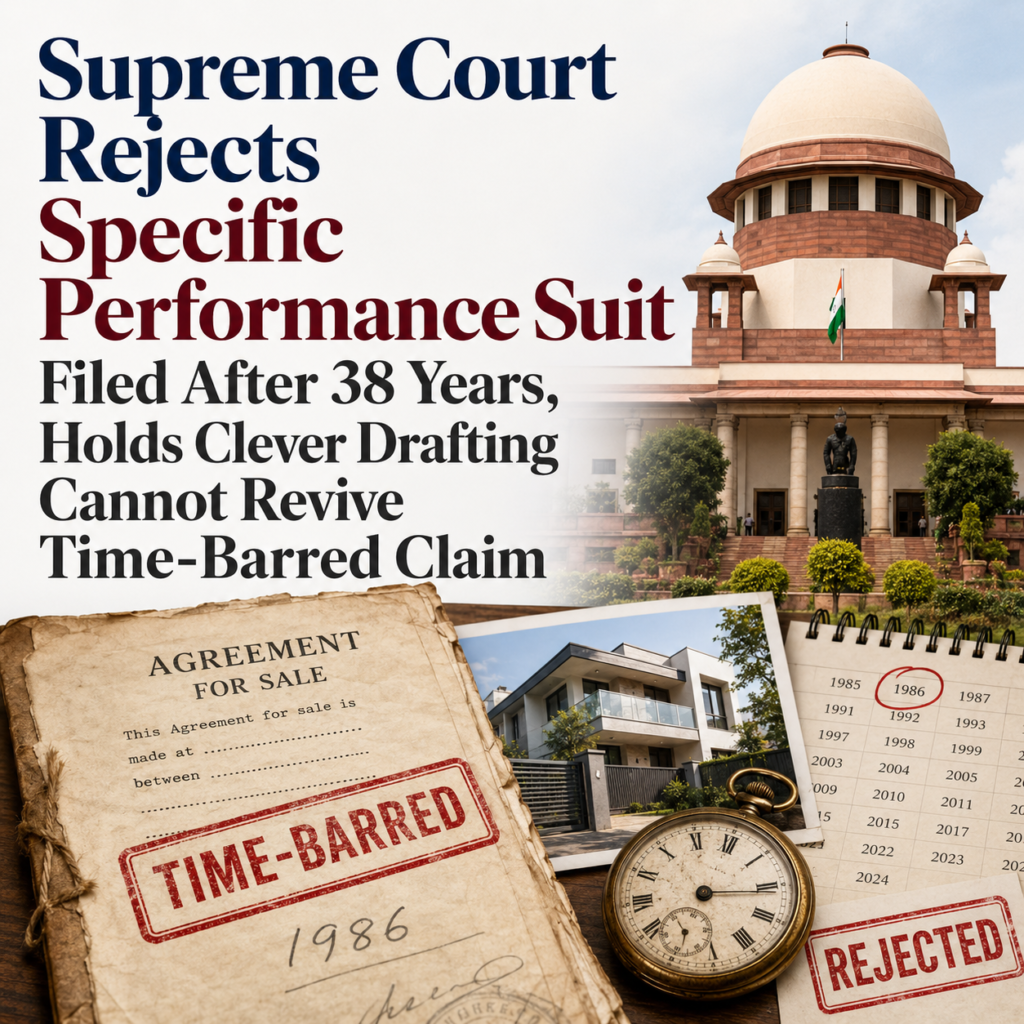
Supreme Court Rejects Specific Performance Suit Filed After 38 Years, Holds Clever Drafting Cannot Revive Time-Barred Claim

Supreme Court Rejects Specific Performance Suit Filed After 38 Years, Holds Clever Drafting Cannot Revive a Time-Barred Claim
Facts
The dispute concerned Plot No. 1480 at Ulhasnagar, Maharashtra. According to the appellants, the property originally belonged to Tukaram Daji Bhoir, their predecessor-in-interest.
Under the 1974 Development Plan for Ulhasnagar, certain lands were reserved for public infrastructure and affected owners were to be rehabilitated by allotment of alternative sites. The disputed plot was reserved for a police station, and its possession was handed over to the Managing Officer, Ulhasnagar, on 13 January 1988 for construction of the Hill Line Police Station.
The respondents claimed rights under an alleged unregistered agreement for sale dated 21 August 1984 executed by Tukaram Daji Bhoir. They also relied upon a power of attorney allegedly executed in 1991.
In 2003, Tukaram Daji Bhoir filed an affidavit stating that he had never sold, mortgaged, gifted or transferred the property through an agreement for sale, power of attorney or any other instrument. He died in 2010 and was represented thereafter by the appellants.
Following proceedings before the settlement authorities, the appellants were directed to identify alternative land in lieu of the acquired plot. The respondents sought allotment of that alternative property in their favour, claiming rights under the alleged agreement for sale. Their claim was rejected by the revenue authorities.
On 28 February 2019, alternative properties were allotted to the appellants, followed by execution of a conveyance deed on 2 March 2019. The respondents challenged the allotment before the Bombay High Court, but their writ petition was dismissed on 17 November 2021. The High Court noted that they had not instituted any civil proceedings to establish their substantive rights.
Thereafter, on 3 March 2022, the respondents instituted Special Civil Suit No. 80 of 2022 seeking specific performance of the alleged agreement and consequential reliefs.
The appellants filed applications under Order VII Rule 11(d) CPC seeking rejection of the plaint on the ground that the suit, instituted approximately 38 years after the alleged agreement, was barred by limitation under Article 54 of the Limitation Act, 1963.
The Trial Court rejected the applications, holding that the suit did not appear from the plaint to be completely barred by limitation. The Bombay High Court affirmed that order. The appellants consequently approached the Supreme Court.
Issues
- Whether the suit for specific performance filed approximately 38 years after the alleged agreement for sale was ex facie barred by limitation.
- Whether the plaint was liable to be rejected under Order VII Rule 11(d) CPC.
- Whether the Bombay High Court’s order dated 17 November 2021 gave the respondents a fresh cause of action or a fresh starting point for limitation.
- Whether clever drafting could be used to create an illusion of a subsisting cause of action despite the statutory bar of limitation.
Petitioner’s Arguments
The appellants argued that the entire suit was founded upon an alleged unregistered agreement for sale dated 21 August 1984.
Under Article 54 of the Limitation Act, a suit for specific performance must be instituted within three years from the date fixed for performance or, where no date is fixed, from the date when the plaintiff first has notice that performance is refused.
The respondents had taken no steps to obtain execution of a conveyance deed for more than three decades. No explanation capable of extending or postponing limitation was disclosed in the plaint.
It was submitted that the 2021 order of the Bombay High Court merely recorded that the respondents had not instituted civil proceedings to establish their rights. That observation did not grant them a fresh cause of action or restart limitation.
The appellants contended that the plaint was a belated afterthought and an abuse of the judicial process. Since the bar of limitation was apparent from the respondents’ own pleadings, the plaint was liable to be rejected at the threshold under Order VII Rule 11(d).
Respondent’s Arguments
The respondents contended that the suit could not be rejected at the preliminary stage because the issue of limitation involved disputed questions of fact requiring evidence.
They relied upon the alleged agreement for sale and subsequent power of attorney to assert an interest in the original property and, consequently, in the alternative properties allotted in its place.
They argued that the cause of action arose or became crystallised after the Bombay High Court’s order dated 17 November 2021, which observed that they had not instituted a substantive civil suit to establish their rights.
Accordingly, they claimed that the suit filed in March 2022 was not demonstrably barred by limitation merely on the basis of the statements contained in the plaint.
Analysis of the Law
Order VII Rule 11(d) CPC requires rejection of a plaint where the suit appears, from the statements contained in the plaint itself, to be barred by any law.
While considering such an application, the court must examine:
- the averments made in the plaint;
- the documents relied upon as part of the plaint; and
- the plaint as a whole, through a meaningful rather than formal reading.
The written statement, defence of the defendant and disputed material introduced by the defendant are ordinarily irrelevant at this stage.
The power under Order VII Rule 11 is intended to prevent judicial time from being consumed by litigation which is manifestly barred by law. Although rejection of a plaint is a drastic power, a court is duty-bound to exercise it where the statutory conditions are clearly satisfied.
Article 54 of the Limitation Act prescribes a period of three years for instituting a suit for specific performance. The period begins:
- from the date fixed for performance; or
- where no such date is fixed, from the date when the plaintiff has notice that performance has been refused.
The Court held that a litigant cannot, by referring to subsequent administrative or judicial proceedings, artificially postpone the date on which the right to sue first accrued.
An observation by a court that a party has not pursued an available civil remedy does not revive an extinguished claim or commence a fresh period of limitation.
Precedent Analysis
Dahiben v. Arvindbhai Kalyanji Bhanusali
The Supreme Court relied upon this decision to reiterate that Order VII Rule 11 provides an independent and special remedy to terminate a suit at the threshold without recording evidence where the action is barred by law.
The provision prevents plaintiffs from unnecessarily prolonging sham or legally untenable litigation.
Correspondence, RBANMS Educational Institution v. B. Gunashekar
The Court reiterated that Order VII Rule 11 operates as a crucial filter against fictitious and legally barred claims.
Where clever drafting conceals the legal bar and creates an illusory cause of action, the court must lift the veil and reject the plaint rather than permit an unnecessary trial.
Madansuri Sri Rama Chandra Murthy v. Syed Jalal
This decision affirmed that the plaint must be read as a whole and meaningfully.
Where the plaint, even after accepting all its allegations as correct, shows that the suit is barred by law or does not disclose a right to sue, the court must reject it. Clever drafting cannot be allowed to create an artificial cause of action.
Mukund Bhavan Trust v. Shrimant Chhatrapati Udayan Praje Pratapsinh Maharaj Bhonsle
The Supreme Court relied upon this authority for the principle that limitation begins when the right to sue first accrues.
A subsequent event cannot be used to postpone or restart limitation where the claimant had an earlier enforceable cause of action but failed to act within the prescribed period.
Court’s Reasoning
The Supreme Court found that the respondents’ entire claim was founded upon the alleged agreement dated 21 August 1984.
There was no satisfactory explanation in the plaint as to why no suit seeking execution of the conveyance deed was instituted for more than three decades.
Article 54 prescribed a limitation period of three years. On the respondents’ own pleadings, the suit filed in March 2022 was therefore manifestly beyond limitation.
The Court rejected the contention that limitation began from the Bombay High Court’s order dated 17 November 2021. The High Court had merely observed that the respondents had not filed any substantive civil proceedings to establish their rights.
That observation did not:
- recognise or declare the respondents’ title;
- validate the alleged agreement;
- direct them to institute a suit;
- grant a fresh cause of action; or
- revive a claim already barred by limitation.
The earlier High Court order had also recorded that there was no material showing that the respondents were in possession of the disputed property. That finding was not challenged.
The Supreme Court held that a person who remained silent for decades could not subsequently institute a specific performance suit as an afterthought while ignoring the law of limitation.
The suit was therefore not merely delayed but constituted an abuse of the process of the court. The Trial Court and High Court had failed to meaningfully examine the plaint and the statutory bar apparent from it.
Conclusion
The Supreme Court held that the respondents’ suit for specific performance, instituted approximately 38 years after the alleged agreement for sale, was clearly barred by limitation under Article 54 of the Limitation Act.
The Bombay High Court’s 2021 observation regarding the respondents’ failure to institute civil proceedings did not provide a fresh starting point for limitation.
The plaint was liable to be rejected under Order VII Rule 11(d) CPC because the statutory bar was apparent from the respondents’ own pleadings.
The Supreme Court allowed the appeal, set aside the orders of the Trial Court and the Bombay High Court, and rejected the respondents’ time-barred claim.
Case: Shobha Vasant Bhoir and Others v. Soni alias Vandana Gurumukhdas Jagiasi and Others
Court: Supreme Court of India
Case Number: 2026 INSC 664; Civil Appeal arising out of SLP (C) No. 27748 of 2025
Judge: Justice Sanjay Karol and Justice Nongmeikapam Kotiswar Singh
Date: 1 July 2026
Result: Appeal allowed; Bombay High Court and Trial Court orders set aside, and the suit held barred by limitation and an abuse of the court process.