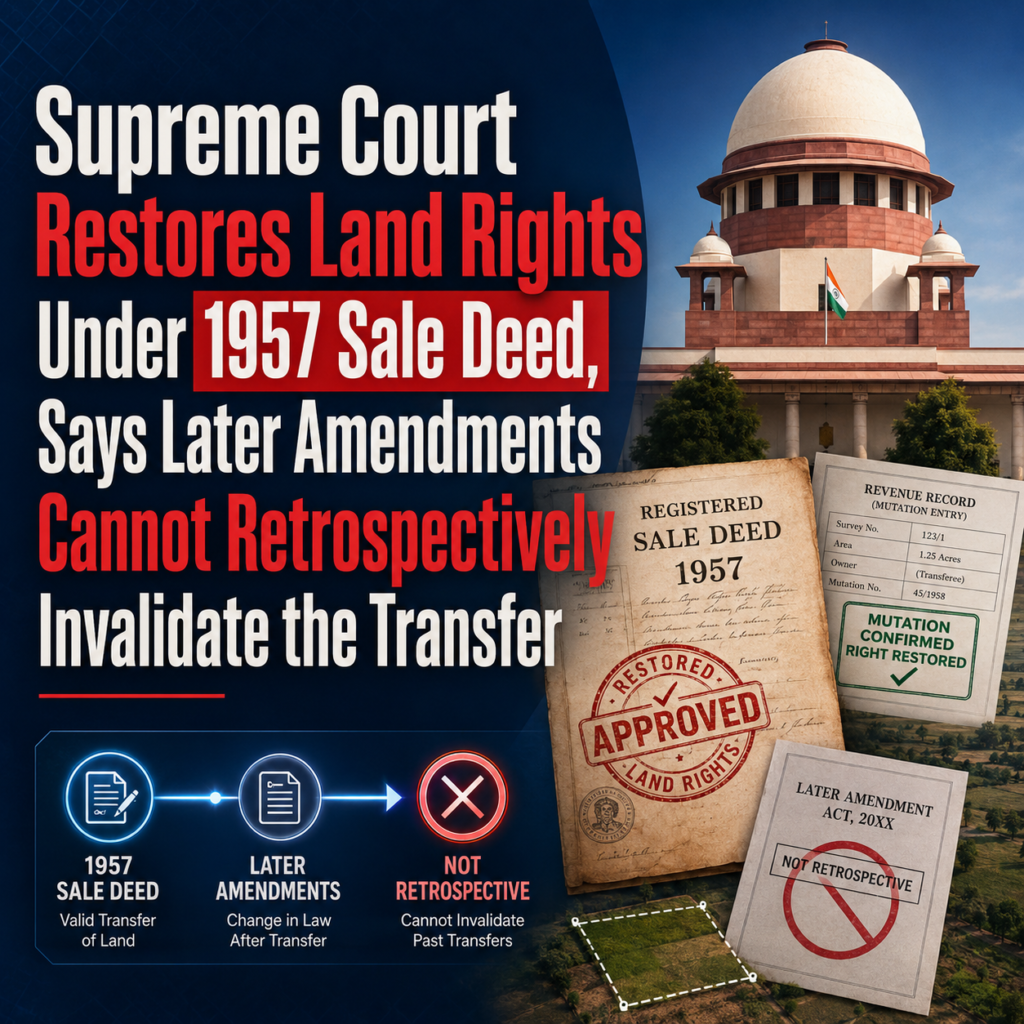
Supreme Court Restores Land Rights Under 1957 Sale Deed, Says Later Amendments Cannot Retrospectively Invalidate the Transfer

1957 Registered Sale Deed Cannot Be Declared Void by Applying Later Land Laws: Supreme Court Orders Buyers’ Names Entered in Revenue Records
Facts
The dispute concerned agricultural land measuring 15 bighas and 11 biswas in Khasra No.70/32, situated at Narsipur Kalan village, Haridwar District. The predecessors of the appellants, who were minors at the relevant time, claimed to have purchased the land through a registered sale deed dated 4 June 1957. They asserted that possession was delivered to them pursuant to the sale.
In 1983, the appellants applied for mutation under Section 34 of the Uttar Pradesh Land Revenue Act, 1901. One of the sellers initially objected but later withdrew the objection and consented to the mutation. The Naib Tehsildar consequently ordered mutation in the appellants’ favour on 3 April 1984.
After consolidation proceedings commenced, the appellants sought entry of their names as bhumidhars under Section 9-A of the Uttar Pradesh Consolidation of Holdings Act, 1953. An ex parte order was initially passed in their favour in 1991 but was subsequently recalled.
In 1993, one of the sellers entered into a compromise acknowledging the sale deed and the appellants’ possession. Since all co-tenure holders were not parties to that compromise, the proceedings continued on merits.
The Consolidation Officer rejected the appellants’ claim in 1999, holding that the execution of the 1957 sale deed had not been proved because of discrepancies concerning the attesting witness. The Settlement Officer and Deputy Director of Consolidation affirmed that decision. The revisional authority additionally held that the transfer violated Section 154 of the U.P. Zamindari Abolition and Land Reforms Act, 1950 and was therefore void.
On 18 August 2017, the High Court dismissed the appellants’ writ petition and upheld the findings of the consolidation authorities. The appellants then approached the Supreme Court.
Issues
- Whether the registered sale deed dated 4 June 1957 was void for allegedly violating Section 154 of the U.P. Zamindari Abolition and Land Reforms Act.
- Whether the amendments to Sections 166 and 167, which subsequently made prohibited transfers void and provided for automatic vesting in the State, could be applied retrospectively to a sale executed in 1957.
- Whether a transfer made in violation of Section 154 under the law prevailing in 1957 was void from inception or merely voidable at the instance of the Gaon Sabha.
- Whether consolidation authorities could disregard a registered sale deed that had never been cancelled by a competent civil court.
- Whether the execution of the sale deed could be rejected merely because of a minor discrepancy regarding the residence of an attesting witness examined nearly 38 years after the transaction.
- Whether the registered deed and its certified copy carried a legal presumption of genuineness and due execution.
Petitioner’s Arguments
The appellants contended that the authorities had incorrectly treated the 1957 sale deed as void under Section 154.
They initially argued that the ceiling limit applicable on the date of sale was 30 acres and not 12.5 acres. In any event, they submitted that even a transfer exceeding the prescribed limit was not void under the law then in force. It was merely open to challenge by the Gaon Sabha through an ejectment suit under the then-existing Section 163.
The appellants argued that the subsequent amendments to Sections 166 and 167 could not retrospectively convert a transaction that was valid or merely voidable when executed into a void transaction resulting in automatic vesting in the State.
They further contended that the consolidation authorities could not invalidate or disregard the registered deed. A voidable instrument remains legally operative unless set aside by a competent civil court.
The deed had been registered and was more than 30 years old when the dispute was adjudicated. It therefore carried a strong presumption of validity, authenticity and due execution.
The appellants submitted that attestation was not legally required for a sale deed. The authorities had therefore erred in rejecting the entire transaction merely because the witness described his residence differently when examined decades later.
There was no allegation that the deed was forged, fabricated or obtained through coercion, impersonation or fraudulent misrepresentation. The appellants accordingly sought restoration of their rights and entry of their names in the revenue records.
Respondent’s Arguments
The respondents supported the concurrent decisions of the High Court and the consolidation authorities.
They argued that the sale violated Section 154 of the U.P. Zamindari Abolition and Land Reforms Act and was therefore void.
According to them, since the consolidation proceedings commenced after the amendment of Sections 166 and 167, the law prevailing at the time of those proceedings should apply. On this basis, the prohibited transfer was void and the land stood vested in the State.
The respondents also contended that the appellants had failed to prove the execution of the 1957 sale deed. They relied upon the difference between the address of the attesting witness recorded in the deed and the address given by him during his testimony.
They therefore sought dismissal of the appeal and affirmation of the decisions passed by the authorities below.
Analysis of the Law
Effect of Section 154
Section 154 restricted a bhumidhar from transferring land where the transferee’s aggregate holding, including the land already held by the transferee or the transferee’s family, exceeded the statutory ceiling.
The Supreme Court observed that the prohibition was not attracted merely because a sale deed transferred a particular quantity of land. It was necessary to establish that the transferee’s total holding crossed the prescribed ceiling.
Although the 12.5-acre limit was introduced by U.P. Act 37 of 1958, that amendment was expressly given retrospective operation from 1 July 1952. The 12.5-acre limit was therefore applicable on the date of the 1957 transaction.
However, this did not automatically make the deed void.
Transfer Voidable, Not Automatically Void
Under Section 163, as it existed at the time of the transaction, a transferee under a transfer violating Section 154 was merely liable to ejectment through a suit instituted by the Gaon Sabha.
The transfer did not automatically become void, nor did the land automatically vest in the State. Until successful proceedings were brought by the Gaon Sabha, the transferee continued to enjoy the land.
The Court also noted that an ejectment suit under Section 163 had to be filed within six years of the transfer. No such proceedings were ever instituted in the present matter.
Subsequent Amendments Could Not Apply Retrospectively
In 1981, Section 163 was omitted and Sections 166 and 167 were expanded. Under the amended regime, every transfer made in violation of the Act was declared void, and the land was deemed to vest in the State from the date of transfer.
The Supreme Court held that this amendment fundamentally altered the legal consequences of a prohibited transfer. It was therefore substantive, rather than merely procedural, declaratory or clarificatory.
There was no express language or necessary implication showing that the legislature intended the amended provisions to invalidate transactions completed before the amendment.
Applying the amended provisions retrospectively would destroy accrued rights and impose a new consequence upon a transaction which, under the earlier law, was merely voidable at the instance of the Gaon Sabha. The amendments therefore operated prospectively.
Powers of Consolidation Authorities
The Consolidation of Holdings Act grants consolidation authorities exclusive jurisdiction to determine rights and interests in land during consolidation operations.
However, the Supreme Court distinguished between:
- A document that is void and may be ignored by an authority; and
- A document that is merely voidable and continues to operate until cancelled by a competent civil court.
Since the 1957 sale deed was at most voidable under the law prevailing at the time, the consolidation authorities could not disregard it without its prior cancellation by a competent court.
Presumption Attached to Registered Sale Deeds
A registered sale deed carries a strong presumption of valid execution and genuineness. The burden lies heavily upon the person challenging it to produce cogent evidence of fraud, fabrication, lack of execution, incapacity or another fundamental illegality.
The original deed was unavailable, but a certified copy had been produced. Section 79 of the Indian Evidence Act, 1872 required the Court to presume the genuineness of a duly certified copy admissible in evidence.
Attestation is also not an essential legal requirement for the validity of a sale deed. Accordingly, minor discrepancies regarding an attesting witness could not, by themselves, defeat the registered conveyance.
Precedent Analysis
Kripashanker v. Director of Consolidation, (1979) 4 SCC 199
The Supreme Court had previously held that a transfer by a bhumidhar in violation of Section 154 was not void under the pre-amendment law. It was voidable at the instance of the Gaon Sabha and only to the extent of the land exceeding the statutory ceiling.
The Court applied this decision directly and held that the authorities had wrongly treated the appellants’ sale deed as void from inception.
Zile Singh v. State of Haryana, (2004) 8 SCC 1
This decision reiterated that legislation affecting vested rights, creating new burdens or imposing new liabilities is presumed to operate prospectively unless retrospectivity is expressly provided or follows by necessary implication.
The Court relied upon this principle to refuse retrospective application of the amended Sections 166 and 167.
Thakoor Hurdeo Bux v. Thakoor Jowahir Singh, (1879) 6 IA 161 and State of Kerala v. Philomina, (1976) 4 SCC 314
These decisions supported the principle that a transfer valid when made cannot ordinarily be invalidated by a subsequent statutory prohibition.
Gorakh Nath Dube v. Hari Narain Singh, (1973) 2 SCC 535
This judgment distinguished instruments that are inherently void from those requiring cancellation. Consolidation authorities may disregard a void instrument, but they cannot ignore a deed whose legal effect continues until it is cancelled by a competent court.
The Supreme Court held that this distinction squarely applied to the 1957 sale deed.
Ningawwa v. Byrappa Shiddappa Hireknrabar, 1968 SCC OnLine SC 206
The Court relied upon this decision to explain that transactions induced by ordinary fraud are generally voidable, while a document may be void where the person was deceived about its very nature or character.
No such fundamental fraud, coercion or impersonation had been alleged against the appellants’ sale deed.
Khursheed v. Shaqoor, 2024 SCC OnLine SC 2929
This decision reaffirmed that a voidable document remains binding until set aside by a competent civil court. Consolidation authorities lack the power to cancel such an instrument.
Hemalatha v. Tukaram, 2026 SCC OnLine SC 106
The Court relied upon this recent decision to affirm that registration gives a sale deed substantial sanctity and creates a formidable presumption of genuineness and validity.
A registered conveyance cannot be declared ineffective on conjecture or insignificant inconsistencies. The challenger must produce clear and convincing evidence capable of displacing the presumption.
Court’s Reasoning
The Court held that the High Court and the consolidation authorities had committed two fundamental errors.
First, they applied the legal consequences introduced in 1981 to a transaction executed in 1957. Under the law governing the transaction, even a violation of Section 154 did not automatically render the deed void. It merely exposed the transferee to a possible ejectment action by the Gaon Sabha.
No such ejectment suit was filed within the prescribed six-year period. The deed therefore could not be retrospectively treated as void or the land as automatically vested in the State.
Second, the authorities rejected a registered conveyance on the basis of an immaterial discrepancy concerning the attesting witness. The witness was described in the deed as a resident of Nihandpur Suthari, while he described himself during testimony as a resident of Nasirpur Kalan.
The Court found this variation insignificant because:
- His evidence was recorded approximately 38 years after the transaction;
- The two villages were situated close to each other;
- No suggestion was made during cross-examination that he was fictitious or impersonating the actual witness;
- He consistently stated that he had witnessed the deed and that possession was delivered;
- No material contradiction established fabrication; and
- Attestation was not legally essential for a sale deed.
The respondents had not alleged forgery, coercion, impersonation or fraud going to the character of the document. Their challenge rested only upon peripheral discrepancies.
The appellants had consistently asserted possession under the sale deed, and that claim had not been effectively controverted. The registered deed, certified copy, presumption of validity, supporting testimony and absence of any substantive allegation of fraud collectively established that the findings against the appellants were legally unsustainable.
Conclusion
The Supreme Court held that the registered sale deed dated 4 June 1957 could not be declared void by retrospectively applying the amended provisions of the U.P. Zamindari Abolition and Land Reforms Act.
Under the law applicable when the sale was executed, a transfer violating Section 154 was merely voidable at the instance of the Gaon Sabha and did not automatically vest the land in the State. Since no timely ejectment proceedings had been instituted, the consolidation authorities could not disregard the deed.
The Court further held that a registered sale deed carrying a presumption of genuineness could not be rejected because of a minor discrepancy concerning an attesting witness examined nearly four decades after its execution.
Accordingly, the Supreme Court set aside the High Court judgment and the orders of the consolidation authorities. It directed that the appellants’ names be entered in the revenue records. The civil appeal was allowed without any order as to costs.
Case Details
Case: Sarafat Ali (Deceased) Through Legal Representatives and Others v. Deputy Director of Consolidation, Haridwar and Others
Court: Supreme Court of India
Case Number: Civil Appeal No.8705 of 2026, arising out of SLP (Civil) No.24352 of 2017
Neutral Citation: 2026 INSC 652
Judges: Justice Prashant Kumar Mishra and Justice N.V. Anjaria
Date: 23 June 2026
Result: Civil appeal allowed. The High Court and consolidation authorities’ orders were set aside, and the appellants’ names were directed to be recorded in the revenue records.