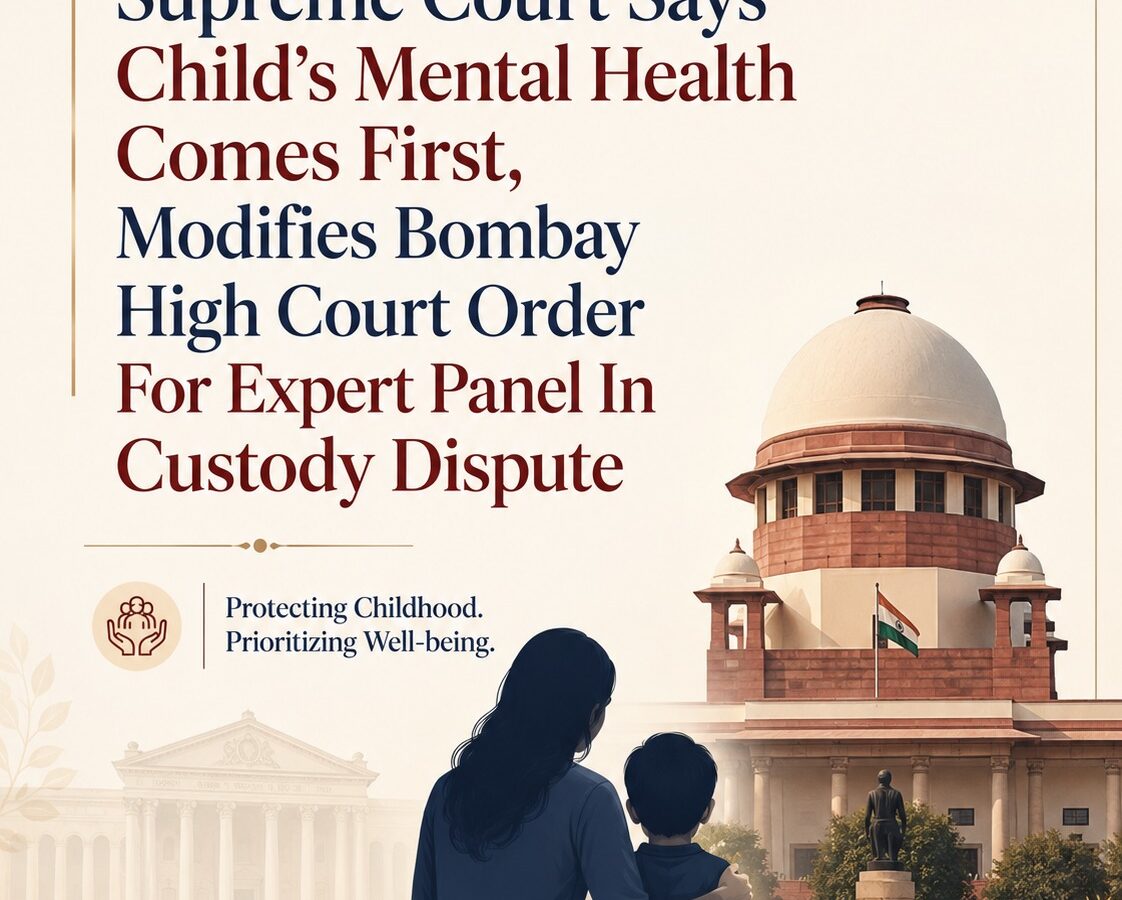
Supreme Court Says Child’s Mental Health Comes First, Modifies Bombay High Court Order For Expert Panel In Custody Dispute

Court
Supreme Court of India
Coram
Justice Sanjay Karol and Justice Nongmeikapam Kotiswar Singh
Case
Sheetal Vasant Thakur v. Chirag Arora
Case No.
Civil Appeal Nos. ___ of 2026, arising out of Special Leave Petition (Civil) Nos. 18701-18702 of 2024
Neutral Citation
2026 INSC 638
Date of Judgment
11 June 2026
Judgment By
Justice Nongmeikapam Kotiswar Singh
Court’s Decision
The Supreme Court partly allowed the appeal filed by the mother and modified the orders passed by the Bombay High Court dated 27.04.2023 and 07.12.2023. The High Court had modified its earlier direction for appointment of a single independent expert by substituting it with a “panel of experts” and later constituted a four-member expert panel to evaluate the minor child for facilitating reconnection with the father.
The Supreme Court held that such directions could not be sustained in their existing form because the High Court had not adequately considered the risk of repeated psychological evaluation, secondary victimisation, re-traumatisation, minimum intrusion, institutional neutrality, and the best interest of the child. The matter was remitted to the Family Court to pass appropriate orders in terms of the Supreme Court’s directions.
Facts
The appellant-mother and respondent-father were married on 10.02.2015 at Faridabad and later moved to the United States of America. Their daughter was born on 24.06.2016 in New Jersey, USA.
According to the mother, during 2018-2019, while the parties were residing in the USA, the father subjected her to physical abuse and allegedly subjected the minor child to sexual abuse when the child was around two years old. After an alleged domestic assault on 29.12.2019, the mother returned to India with the child on 30.12.2019.
The father initiated proceedings seeking custody/access to the child, including habeas corpus proceedings. Limited video access was granted at one stage. The mother also raised allegations of sexual abuse and filed a complaint. A Zero FIR was registered at Yerwada Police Station, Pune, and another FIR was registered at Faridabad Police Station under provisions of IPC and the POCSO Act. The Supreme Court later directed that investigation in both FIRs be conducted at Yerwada Police Station under the supervision of a woman ACP officer.
The Family Court, Pune, had earlier continued custody of the child with the mother. The father then sought appointment of an independent psychiatric expert specialising in child psychology to evaluate the child, her living situation, and both parents for re-establishing connection with the child. The mother opposed this, stating that the child was already undergoing therapy and that further evaluation could harm her mental well-being.
The Family Court rejected the father’s application on 28.04.2022, observing that serious POCSO allegations were pending, the child was already undergoing therapeutic treatment, and exposing the child to further evaluative processes or access to the father would not be appropriate at that stage.
The father challenged this before the Bombay High Court. On 07.01.2023, the High Court directed the Family Court to appoint an independent expert in child psychology. Thereafter, on 27.04.2023, the High Court modified the word “expert” to “panel of experts.” Subsequently, on 07.12.2023, while dealing with another writ petition seeking virtual access, the High Court constituted a four-member panel of experts, including names suggested by the father and experts situated outside Jalgaon and even outside India.
The mother approached the Supreme Court challenging these two High Court orders.
Issues
- Whether the High Court was justified in modifying the direction for appointment of a single independent expert into a direction for appointment of a panel of experts.
- Whether repeated or multiple psychological evaluations of a child, particularly where the child is an alleged victim under the POCSO Act, may cause re-traumatisation or secondary victimisation.
- Whether the constitution of a panel of multiple experts for evaluating a minor child was consistent with the child-friendly and protective framework of the POCSO Act.
- Whether the High Court sufficiently considered the best interest, dignity, emotional security, and psychological welfare of the child.
- Whether the expert-evaluation process must remain institutionally neutral and not appear to be driven by one litigating parent’s suggested panel.
Appellant-Mother’s Arguments
The mother argued that the High Court’s orders were contrary to the welfare, dignity, and psychological well-being of the child, who was an alleged victim under the POCSO Act. She contended that converting one independent expert into a panel of experts, without recording reasons, would expose the child to repeated and intrusive psychological evaluation, thereby creating a risk of re-traumatisation and secondary victimisation.
She submitted that the child had already interacted with multiple agencies, investigating authorities, counsellors, psychologists, and judicial authorities, and therefore further evaluation by multiple experts was unwarranted. It was further argued that the process could become adversarial, especially because the father had invoked concepts such as “parental alienation syndrome” and “false memory creation” to challenge the allegations.
The mother also argued that the expert panel was substantially drawn from names suggested by the father, including experts outside the local jurisdiction and one from the USA, which compromised neutrality and created unnecessary burden upon the child. According to her, if any evaluation was necessary, it should have been by one independent trauma-informed child psychologist.
Respondent-Father’s Arguments
The father argued that the POCSO allegations were false, fabricated, and motivated by matrimonial discord. He contended that the mother had alienated the child from him and that expert evaluation was necessary to facilitate restoration of emotional bonding between him and the child.
He submitted that the request for expert evaluation was not intended to harass the child or conduct an adversarial inquiry, but was made in the child’s welfare. He also argued that the mother herself had participated in the process of suggesting experts and that the High Court’s earlier order dated 07.01.2023 directing appointment of an independent expert was not challenged by the mother and had attained finality.
Analysis
The Supreme Court clarified that it was not deciding the criminal culpability of the father in the pending POCSO proceedings. The dispute before it concerned custody, visitation, and psychological evaluation of the minor child. However, since the child was also an alleged victim under the POCSO Act, the protective framework of that Act could not be ignored.
The Court explained that the POCSO Act is not merely punitive. It also recognises that the justice system must be child-sensitive, trauma-informed, child-friendly, and protective of the psychological well-being of the child victim. The Court referred to Sections 24, 33(5), 36 and 39 of the POCSO Act, which collectively reflect the legislative concern that child victims should not be repeatedly exposed to processes that may create fear, distress, emotional harm, or secondary victimisation.
The Court held that in custody and visitation disputes, the welfare of the child is the paramount consideration. This principle becomes even more significant where the child is an alleged victim of sexual abuse. The Court observed that emotional stability, psychological security, dignity, and mental health are vital components of the welfare of a child.
The Supreme Court found that the High Court failed to sufficiently examine the effect that repeated and multi-layered evaluation by multiple experts may have upon the psychological well-being of the child. The change from one independent expert to a panel of experts was not a mere procedural change. It directly affected the degree of psychological exposure to which the child could be subjected.
The Court also held that the High Court ought not to have confined itself to whether the mother’s rights would be prejudiced. The real question was whether the child’s welfare, dignity, and psychological safety would be affected. The High Court failed to record reasons explaining why one independent expert was inadequate, why multiple experts were necessary, how the process would satisfy the principle of minimum intrusion, and whether the possibility of re-traumatisation had been considered.
Precedents Referred
The Supreme Court referred to Sakshi v. Union of India, where the Court recognised that repeated exposure of child victims to intimidating judicial procedures may aggravate trauma.
The Court also referred to Gaurav Nagpal v. Sumedha Nagpal, Yashita Sahu v. State of Rajasthan, and Rajeswari Chandrasekar Ganesh v. State of Tamil Nadu to reiterate that in custody matters, child welfare is the paramount consideration and parental claims remain subordinate to the best interest of the child.
The Court referred to Thrity Hoshie Dolikuka v. Hoshiam Shavaksha Dolikuka to emphasise that repeated interviews of a child in custody disputes can adversely affect the sensitive mind of the child.
The Court also discussed Vivek Singh v. Romani Singh and Col. Ramneesh Pal Singh v. Sugandhi Aggarwal on parental alienation, cautioning that courts should not prematurely label a parent as causing parental alienation without identifying specific instances of alienating behaviour.
Reasoning
The Court drew a clear distinction between therapeutic engagement and adversarial evaluation. Therapeutic engagement is meant to support healing and recovery. Repeated evaluation in litigation, however, can turn the child into an object of forensic scrutiny in a dispute between parents.
The Court held that psychological evaluation of a child cannot be directed as a routine measure merely because custody or visitation is in dispute. If such evaluation is necessary, the court must record specific reasons showing necessity, purpose, relevance, and why less intrusive alternatives will not suffice.
The Court further held that ordinarily, psychological evaluation should be conducted by one independent court-appointed child psychologist, psychiatrist, or similarly qualified professional with expertise in child psychology and child trauma. Constitution of a panel of experts should be exceptional and must be supported by reasons.
The Supreme Court also emphasised confidentiality. The identity of the child, disclosures made during evaluation, therapy records, and evaluation reports must remain confidential and should not ordinarily be disclosed beyond what is necessary for adjudication. Evaluation reports should not contain findings on criminal culpability.
The Court observed that the Family Court must first assess the psychological condition of both parents, without involving the child. The court-appointed psychologist must then interact with the child’s treating psychologist to ascertain the child’s present psychological status. Only after considering this material should the Family Court decide whether any further psychological assessment of the child is necessary.
Directions Issued
The Supreme Court directed that the Family Court shall appoint a psychologist to interact with both parents and assess their present mental and psychological condition, particularly that of the mother, with whom the child presently resides.
The appointed psychologist shall thereafter interact with the child psychologist who is currently treating the child and ascertain the current psychological status and condition of the child.
The court-appointed psychologist shall submit a report to the Family Court. The Family Court shall then decide whether psychological assessment of the child is desirable or necessary at this stage. If it is not necessary, there shall be no psychological assessment of the child. If the Family Court finds that such assessment is necessary, it must be done by an independent child psychologist in consultation with the child’s existing psychologist, with utmost care and minimum possible interaction.
The Family Court must also remain alive to the changing needs of the growing child and may review the need for psychological assessment from time to time after obtaining a report from the treating child psychologist.
The Court also directed the Family Court to ascertain, without necessarily interacting with the child on the issue, whether there is any adverse influence by either parent regarding “parental alienation syndrome” or “false memory creation.”
Both parties were directed to apprise the Family Court of the status of the POCSO proceedings against the father, as that would have a significant bearing on any order regarding visitation or custodial rights.
Conclusion
The Supreme Court modified the Bombay High Court’s orders dated 27.04.2023 and 07.12.2023 and remitted the matter to the Family Court for fresh consideration in accordance with its directions. The Court held that child victims cannot be subjected to routine, repeated, overlapping, or multi-layered psychological evaluation merely because parental access or visitation is disputed.
The appeal was partly allowed. There was no order as to costs.
Implications
This judgment is significant because it lays down a child-centric framework for courts dealing with custody, visitation, and parental access disputes where the child is also an alleged victim under the POCSO Act. The Supreme Court has made it clear that parental rights cannot override the child’s emotional security and psychological welfare.
The ruling warns courts against turning psychological evaluation into an adversarial tool. It also reinforces that expert assistance must be neutral, proportionate, confidential, minimally intrusive, and strictly welfare-oriented. The judgment will guide Family Courts and High Courts in handling custody disputes involving allegations of sexual abuse, parental alienation, and child trauma.
Important Note
The Supreme Court did not decide whether the father was guilty or innocent in the POCSO case. The criminal proceedings remain pending before the competent forum. The judgment is confined to the legality of psychological evaluation directions and the manner in which courts must protect the welfare of a child in custody and visitation proceedings.