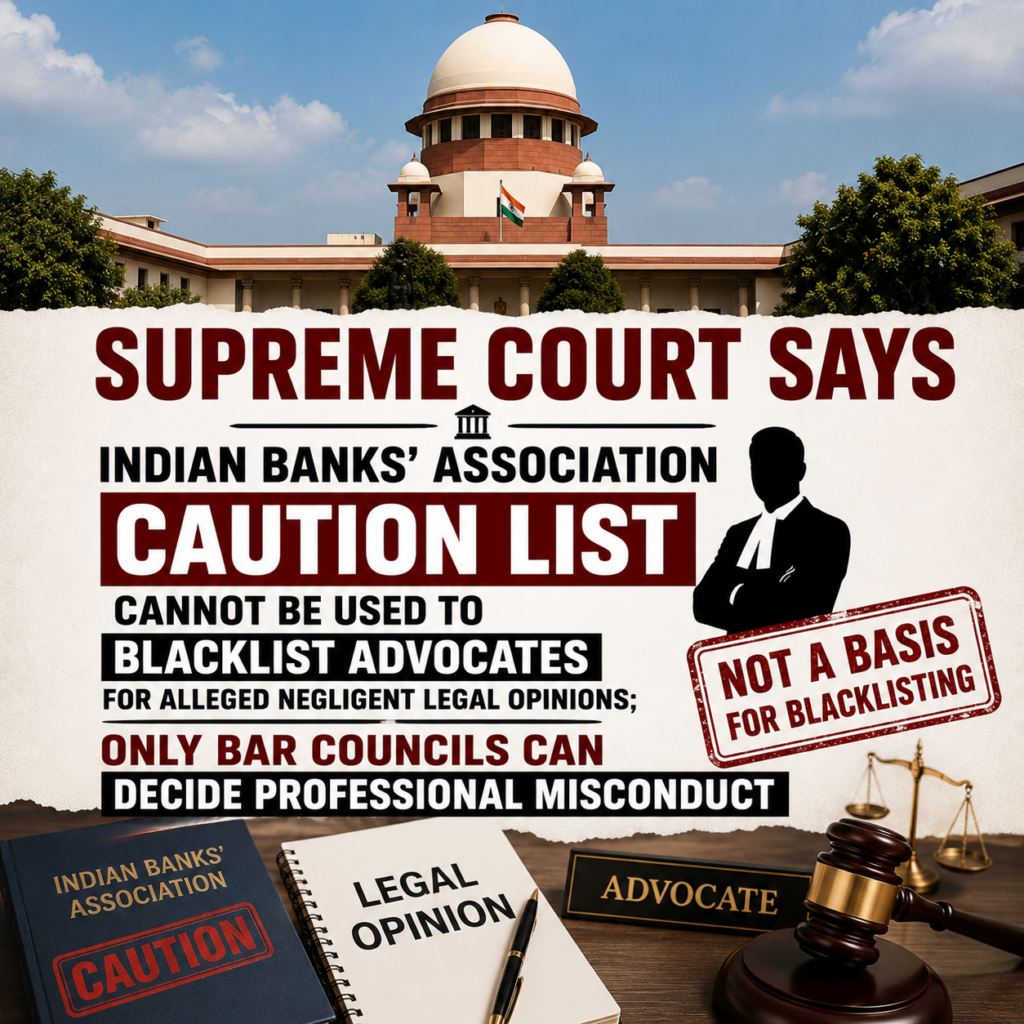
Supreme Court Says Indian Banks’ Association Caution List Cannot Be Used to Blacklist Advocates for Alleged Negligent Legal Opinions; Only Bar Councils Can Decide Professional Misconduct

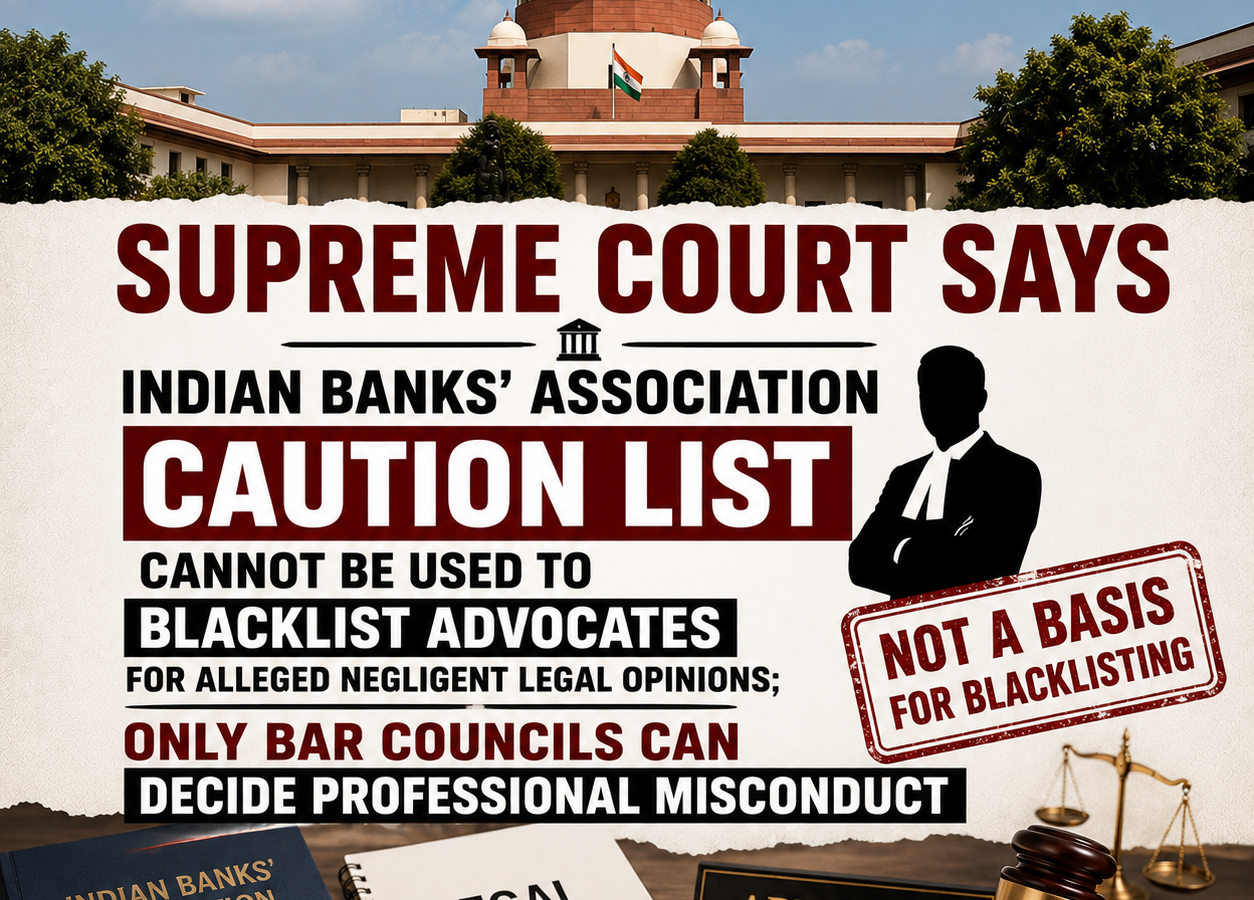
Supreme Court Holds Writ Petition Maintainable Against IBA Caution List, Directs Removal of Advocate’s Name for Alleged Negligent Legal Opinion
Facts
The appellant, Ajay Vijh, is an advocate who was empanelled with Canara Bank for rendering legal opinions. In 2015, he gave a title verification opinion in respect of immovable property offered as security for a credit facility of ₹2 crore.
The Bank later alleged that the legal opinion was erroneous because part of the property had already been sold under sale deeds dated 31.10.2012. According to the Bank, the advocate failed to detect this and thereby exposed the Bank to financial risk.
The appellant submitted his explanation, stating that his opinion was based on the search certificate and records available with the Sub-Registrar’s office. Despite this, the Bank removed him from its panel and forwarded his name to the Indian Banks’ Association for inclusion in the Caution List.
His name was included in the IBA Caution List titled “Third Party Entities Involved in Fraud”, with remarks that he had given a wrong legal opinion and was negligent in conducting the search. The appellant alleged that this was done without notice or hearing and that it affected his reputation and professional engagements with other banks.
The Allahabad High Court dismissed his writ petition on the ground that the Indian Banks’ Association was not “State” under Article 12 of the Constitution. The advocate then approached the Supreme Court.
Issues
- Whether a writ petition under Article 226 is maintainable against inclusion of an advocate’s name in the IBA Caution List.
- Whether inclusion in the Caution List is merely an internal banking measure or whether it affects the advocate’s legal and constitutional rights.
- Whether allegations of professional negligence or misconduct against an advocate can be dealt with by banks and the IBA, or whether they fall within the exclusive disciplinary jurisdiction of the Bar Councils under the Advocates Act, 1961.
Petitioner’s Arguments
The appellant argued that his grievance was not merely against removal from Canara Bank’s panel, but against the wider circulation of his name in the IBA Caution List. He submitted that such inclusion damaged his reputation, affected his future professional engagements, and interfered with his fundamental right to practise law under Article 19(1)(g) of the Constitution.
He contended that the Caution List was meant for cases involving fraud, dishonesty or active involvement in fraudulent banking transactions, and not for cases of alleged negligence or an incorrect legal opinion.
The appellant further argued that if the Bank believed that he had committed professional misconduct, the proper remedy was to approach the State Bar Council under the Advocates Act, 1961. Banks and the IBA could not themselves declare an advocate negligent or professionally incompetent.
He also submitted that his name was included in the Caution List without notice, without opportunity of hearing, and in violation of principles of natural justice.
Respondent’s Arguments
The respondents contended that the IBA was not “State” within the meaning of Article 12 and, therefore, a writ petition was not maintainable against it.
The Bank sought to justify its action on the basis that the appellant had given an incorrect title verification opinion, which exposed the Bank to financial risk. It relied on RBI circulars and guidelines permitting banks to report third-party entities, including advocates, valuers, chartered accountants and other professionals, whose conduct may affect banking transactions.
The respondents treated the inclusion in the Caution List as a regulatory or cautionary measure meant to protect banks from future risk.
Analysis of the Law
The Supreme Court held that the High Court had adopted an unduly narrow approach by examining only whether the IBA was “State” under Article 12. The Court clarified that Article 226 is wider than Article 32 and can apply not only to statutory bodies but also to private bodies performing public duties or actions having a public law element.
The Court observed that the appellant’s grievance concerned his professional reputation and his right to practise law. Inclusion in the IBA Caution List was not a private contractual matter limited to Canara Bank. It had an industry-wide effect and could influence other banks and financial institutions.
The Court then examined the RBI circulars governing caution lists. It held that the object of such circulars was to prevent fraud in the banking system. The Caution List was intended for cases involving fraud, dishonesty, collusion, criminality or serious misconduct affecting banking transactions.
The Court drew a clear distinction between fraud and professional negligence. Fraud involves dishonest intention and deliberate design to deceive. An erroneous legal opinion or omission during due diligence, without any allegation of dishonest intent, collusion or deliberate facilitation of fraud, cannot be treated as fraud.
The Court further held that questions concerning professional conduct, competence or negligence of advocates fall within the disciplinary framework of the Advocates Act, 1961. The Bank could remove an advocate from its panel if dissatisfied with the services, but it could not circulate an adverse declaration about the advocate’s professional competence to all banks.
Precedent Analysis
The Supreme Court relied on Andi Mukta Sadguru Shree Muktajee Vandas Swami Suvarna Jayanti Mahotsav Smarak Trust v. V.R. Rudani, where it was held that writ jurisdiction under Article 226 can extend to any person or body performing a public duty.
The Court also referred to Zee Telefilms Ltd. v. Union of India, which recognised that even private bodies performing functions of public significance may be amenable to writ jurisdiction under Article 226.
The Court relied on S. Shobha v. Muthoot Finance Ltd., where it was reiterated that a public law remedy can be enforced against a private body if it performs a public function and the action affects legal rights.
On the regulatory independence of the legal profession, the Court referred to Bar of Indian Lawyers v. D.K. Gandhi PS National Institute of Communicable Diseases, where the legal profession was held to be unique and not comparable with ordinary commercial services.
The Court also relied on Supreme Court Bar Association v. Union of India, which held that disciplinary action against advocates for professional misconduct lies exclusively with the statutory authorities under the Advocates Act.
Further, the Court referred to Bar Council of Maharashtra v. M.V. Dabholkar, which explained the role of State Bar Councils in receiving and examining complaints of professional misconduct against advocates.
The Court also discussed Yash Developers v. Harihar Krupa Co-operative Housing Society Ltd. while directing the Bar Council of India to undertake a performance audit of its disciplinary framework.
Court’s Reasoning
The Supreme Court held that the appellant’s writ petition was maintainable because the action complained of had serious civil and professional consequences. The inclusion of his name in the IBA Caution List affected his reputation, livelihood and right to practise law.
The Court found that the allegation against the appellant was only negligence in rendering a title verification opinion. There was no allegation of fraud, collusion, criminal misconduct or deliberate wrongdoing.
The Court held that RBI circulars relating to caution lists could not be stretched to include cases of mere professional negligence or an alleged wrong legal opinion. Such circulars were meant to caution banks against fraudulent third-party entities, not to create a parallel disciplinary mechanism for advocates.
The Court further held that if the Bank believed that the advocate had committed professional negligence or misconduct, it could approach the appropriate Bar Council. However, it could not bypass the Advocates Act and cause the advocate to be professionally blacklisted through an industry-wide caution list.
At the same time, the Supreme Court acknowledged the need for accountability in the legal profession. It directed the Bar Council of India to undertake a performance audit of its disciplinary mechanism and to consider institutionalising Continuing Legal Education for lawyers. The Court also suggested consideration of a National Legal Academy for advocates.
Conclusion
The Supreme Court allowed the appeal and set aside the judgment of the Allahabad High Court.
The Court held that the writ petition under Article 226 was maintainable. It declared that inclusion of the appellant’s name in the IBA Caution List was impermissible and without jurisdiction because the allegation against him was only of negligence, not fraud or dishonest conduct.
The Court directed the respondents to remove the appellant’s name from the Caution List with immediate effect.
The matter was directed to be listed again on 31.08.2026 for further consideration of issues relating to Continuing Legal Education and the proposed National Legal Academy.
Case Details
Case: Ajay Vijh v. Indian Banks Association & Ors.
Court: Supreme Court of India
Case Number: Civil Appeal No. ___ of 2026, arising out of SLP (C) No. ___ of 2026 @ Diary No. 10787/2024; 2026 INSC 670
Judge: Justice Pamidighantam Sri Narasimha and Justice Alok Aradhe
Date: 07 July 2026
Result: Appeal allowed; Allahabad High Court judgment set aside; writ petition held maintainable; advocate’s name directed to be removed from IBA Caution List.