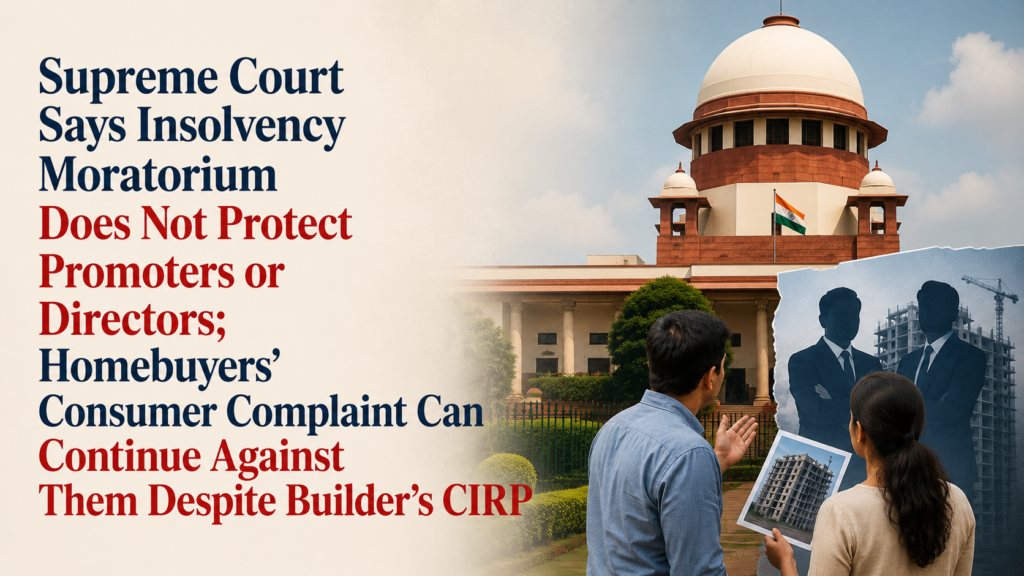
Supreme Court Says Insolvency Moratorium Does Not Protect Promoters or Directors; Homebuyers’ Consumer Complaint Can Continue Against Them Despite Builder’s CIRP

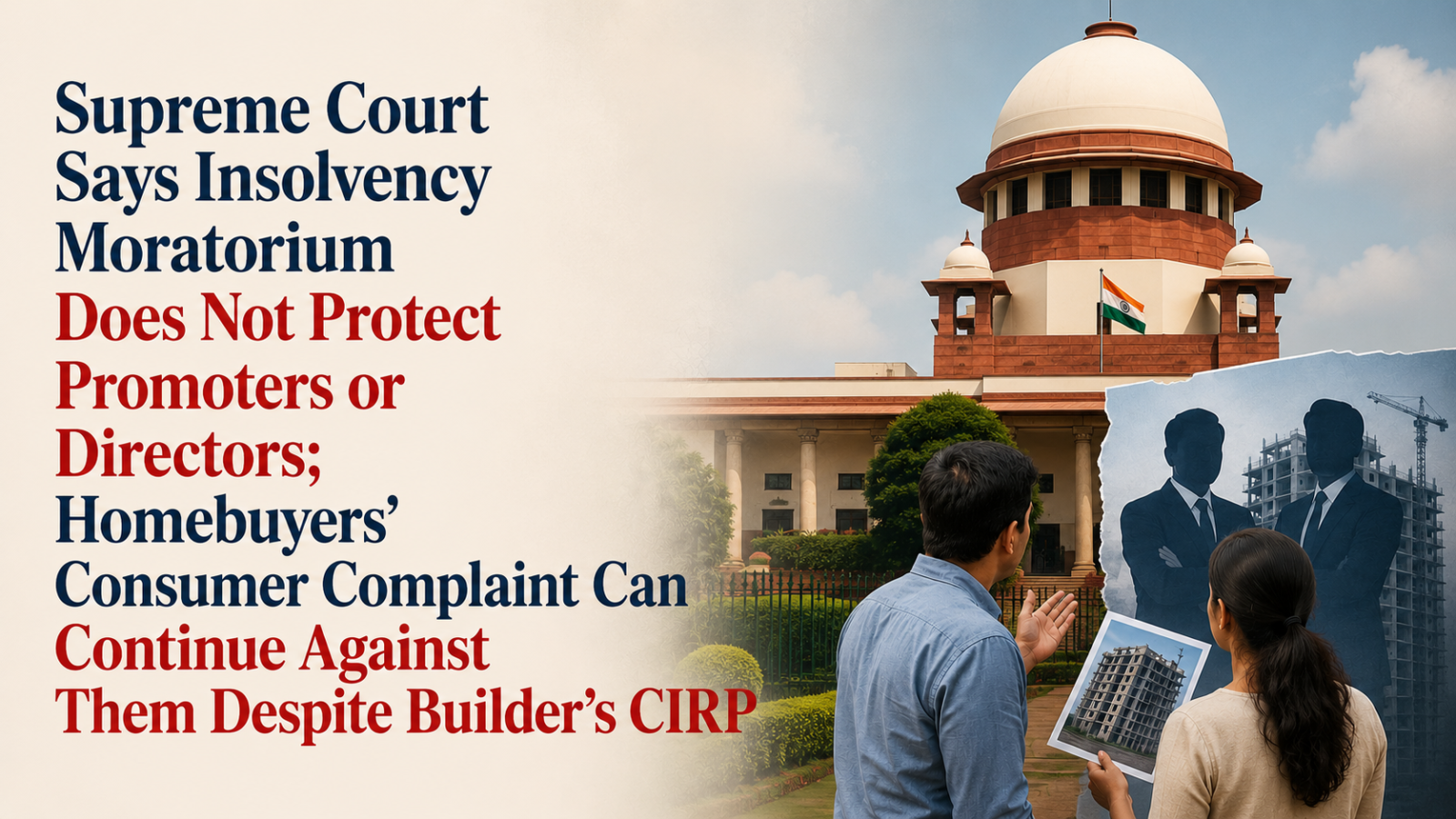
Builder Entered Insolvency After Delaying Flat Possession; Supreme Court Allows Homebuyers to Continue Consumer Case Against Promoters, Directors and Landowners
Facts
The appellants were homebuyers who booked apartments in the “Mantri Manyata Energia” project being developed by Respondent No. 1. They executed agreements for sale and construction in 2016, with possession promised by 31 December 2018. Despite paying a substantial portion of the consideration, possession was not delivered.
The homebuyers filed a consumer complaint before the National Consumer Disputes Redressal Commission (NCDRC) alleging deficiency in service and unfair trade practices against the builder, its associated company, promoters/directors, and the landowners.
During the pendency of the complaint, the NCLT admitted insolvency proceedings (CIRP) against the builder under the Insolvency and Bankruptcy Code, 2016, resulting in a moratorium under Section 14. The homebuyers requested the NCDRC to continue the complaint against the remaining respondents even if it could not proceed against the corporate debtor. The NCDRC refused and adjourned the complaint indefinitely (sine die), leading to the present appeals.
Issues
- Whether the moratorium under Section 14 of the Insolvency and Bankruptcy Code bars continuation of consumer proceedings against promoters, directors, associated companies and landowners who are not corporate debtors.
- Whether the NCDRC was justified in refusing to continue the complaint against Respondent Nos. 2 to 7 merely because insolvency proceedings had commenced against Respondent No. 1.
- Whether the Consumer Commission could determine, at the interlocutory stage, that only the corporate debtor could be liable.
Petitioners’ Arguments
- Section 14 of the IBC protects only the corporate debtor.
- There was no statutory bar preventing continuation of the consumer complaint against the remaining respondents.
- The NCDRC ought to have continued proceedings against Respondent Nos. 2 to 7 while keeping proceedings against Respondent No. 1 subject to the moratorium.
- The complaint should not have been adjourned indefinitely merely because one respondent had entered CIRP.
Respondents’ Arguments
- The respondents argued that the agreements were exclusively with Respondent No. 1.
- They raised objections regarding:
- absence of privity of contract;
- maintainability of the consumer complaint;
- absence of any independent contractual obligation against Respondent Nos. 2 to 7.
- They contended that liability, if any, primarily arose against the corporate debtor.
Analysis of the Law
The Supreme Court analysed Section 14 of the Insolvency and Bankruptcy Code and reiterated that:
- the moratorium is statutory in nature;
- it suspends proceedings only against the corporate debtor;
- courts cannot enlarge the scope of the moratorium beyond what Parliament has expressly provided;
- promoters, directors, associated companies, guarantors and other persons are not automatically protected merely because the corporate debtor is undergoing CIRP.
The Court also observed that the object of the IBC is to facilitate insolvency resolution, not to extinguish independent statutory remedies available under consumer law.
Precedent Analysis
The Court relied upon:
- P. Mohanraj v. Shah Brothers Ispat Pvt. Ltd. — Section 14 moratorium applies only to the corporate debtor and not to natural persons.
- Ansal Crown Heights Flat Buyers Association v. Ansal Crown Infrabuild Pvt. Ltd. — Consumer proceedings may continue against promoters and directors despite a moratorium against the corporate debtor.
- Saranga Anilkumar Aggarwal v. Bhavesh Dhirajlal Sheth — The protective scope of a moratorium cannot be expanded beyond the statutory language so as to defeat consumer remedies.
Court’s Reasoning
The Supreme Court held that the NCDRC committed an error by refusing to continue proceedings against Respondent Nos. 2 to 7.
The Commission had itself observed that liability had yet to be determined. Despite that, it prematurely concluded that only the corporate debtor could be liable. This amounted to deciding the merits before trial.
The proper question before the NCDRC was whether there existed any legal prohibition against continuing proceedings against the remaining respondents. Since no moratorium operated in their favour, the complaint ought to have proceeded against them.
However, the Supreme Court declined to decide the merits of the consumer complaint itself because several factual and legal objections remained pending before the NCDRC and required adjudication.
Conclusion
The Supreme Court partly allowed the appeals.
It set aside the NCDRC’s order rejecting the homebuyers’ applications and directed the NCDRC to continue hearing Consumer Complaint No. 13 of 2023 against Respondent Nos. 2 to 7.
Proceedings against Respondent No. 1, the corporate debtor, will continue to remain stayed in accordance with the moratorium under Section 14 of the Insolvency and Bankruptcy Code.
Case Details
Case: Tejas J. Shah & Amisha T. Shah & Ors. v. Mantri Technology Constellations Pvt. Ltd. (now known as Buoyant Technology Constellations Pvt. Ltd.) & Ors.
Court: Supreme Court of India
Case Number: Civil Appeal Nos. 4289–4290 of 2025
Judge: Justice Vikram Nath and Justice Sandeep Mehta
Date: 27 July 2026
Result: Appeals partly allowed; NCDRC’s order set aside. Consumer complaint directed to proceed against Respondent Nos. 2 to 7, while proceedings against the corporate debtor remain subject to the IBC moratorium.