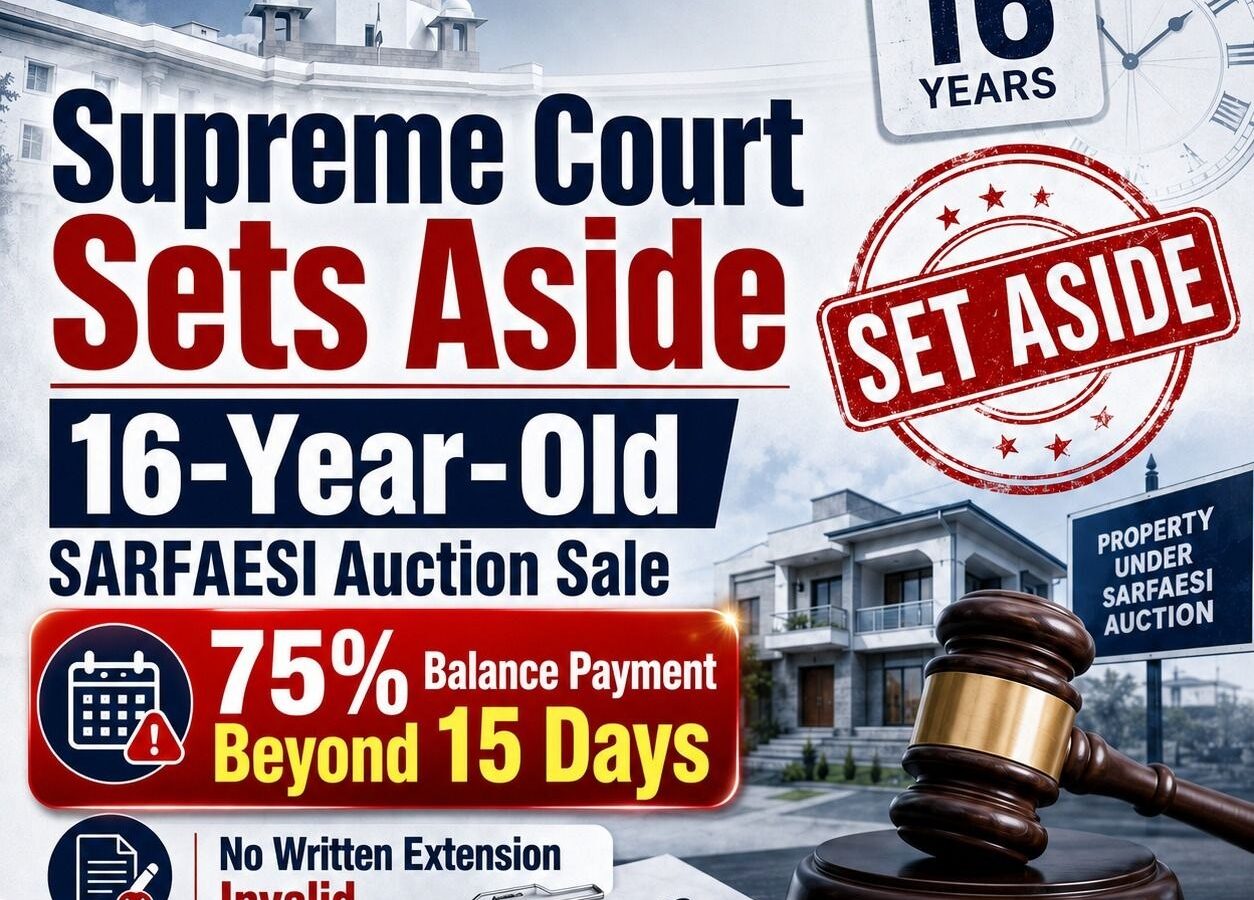
Supreme Court Sets Aside 16-Year-Old SARFAESI Auction Sale: Says 75% Balance Payment Beyond 15 Days Without Written Extension Invalid

Court’s Decision
The Supreme Court of India allowed Civil Appeal No. 1606 of 2026 in part. The Court set aside the judgment of the Madras High Court dated 21.09.2020 in W.P. No. 29641 of 2019, as well as the orders of the Debts Recovery Appellate Tribunal (DRAT) and the Debts Recovery Tribunal (DRT), Chennai. The auction sale of the secured asset conducted on 11.03.2010 under the SARFAESI Act was quashed and set aside. The auction purchaser was directed to receive a full refund of the bid amount with interest at 7% per annum from the respective dates of deposit. The appellant daughter of the deceased guarantor was granted a one-time opportunity to redeem the mortgage upon payment of Rs. 95,42,372.52 together with interest at 5% per annum from the date of the Section 13(2) notice. The directions were issued under Article 142 of the Constitution of India.
Facts
One S. Murugesan, sole proprietor of M/s Shiv Shankar Agencies, had availed financial assistance from Indian Bank in 1984. G. Ramanujam stood as guarantor and mortgaged his immovable property in favour of the Bank to secure the loan.
The borrower defaulted and the Bank filed O.S. No. 4067 of 1996 before the City Civil Court, Chennai. On 10.09.1997, the court passed a preliminary decree for Rs. 1,87,004.23 (total Rs. 1,92,400.23 inclusive of court fee of Rs. 5,396/-) with interest at 18% per annum.
G. Ramanujam died on 26.09.2001 leaving behind his legal heirs, including the appellant M.R. Vasumathi. Multiple attempts at amicable settlement between the Bank and the heirs between 2001 and 2003 did not fructify.
On 08.09.2009 — nearly 12 years after the passing of the preliminary decree — the Bank issued a demand notice under Section 13(2) of the SARFAESI Act to the borrower and the heirs of G. Ramanujam, claiming Rs. 95,42,372.52. A possession notice followed on 21.12.2009 and a sale notice on 03.02.2010.
The secured asset was put to auction on 11.03.2010. Respondent No. 2 emerged as the successful bidder at Rs. 2,11,00,500/- against a reserve price of Rs. 1,58,00,000/-. The 25% deposit was paid vide demand draft of Rs. 9,00,000/- prepared on 10.03.2010 and further demand drafts of Rs. 6,80,000/- and Rs. 36,95,125/- on 11.03.2010. The balance 75% was paid on 31.03.2010. The Bank’s own communication dated 11.03.2010 had expressly stated the balance was payable within 15 days of confirmation, i.e., by 26.03.2010. The sale certificate was issued on 10.04.2010.
The heirs challenged the demand notice before the DRT in S.A. No. 28 of 2010 and later filed S.A. Sr. No. 6473/2010 to set aside the auction, along with miscellaneous applications for permission to redeem (M.A. 6504/2010), condonation of delay (M.A. 6505/2010), and interim stay (M.A. 6506/2010). The DRT dismissed all applications on 30.12.2010. Appeals before the DRAT were dismissed in 2016. The Madras High Court dismissed both writ petitions by the impugned judgment dated 21.09.2020, holding that the Bank had validly exercised its SARFAESI powers and that the writ petitioners had remained indolent for over 4,500 days without taking steps to set aside the ex parte decree.
Issues
- Whether the SARFAESI proceedings initiated in 2009, nearly 12 years after the passing of the preliminary decree, stood vitiated on the ground of limitation?
- Whether the auction sale of the secured asset stood vitiated on account of non-compliance with the statutory requirements and procedural irregularities under the SARFAESI Rules?
Appellant’s Arguments
Mr. Ratnakar Dash, learned Senior Counsel, contended that the demand notice issued nearly 25 years after the preliminary decree was unjustifiable. He argued that once the claim stood adjudicated by the civil court, the Bank ought to have proceeded by execution of the decree rather than invoking the SARFAESI Act, and referred to Section 36 of the SARFAESI Act which mandates that measures under Section 13(4) must be taken within the limitation period under the Limitation Act.
It was submitted that the Bank obtained the valuation report through the original borrower S. Murugesan rather than through its own authorised officer, in breach of Rule 8(5) of the SARFAESI Rules.
On the payment timeline, it was contended that the auction purchaser failed to pay 25% of the sale price immediately in the prescribed mode on the date of sale. Further, the balance 75% was paid on 31.03.2010, beyond the mandatory 15-day period, without any written agreement for extension, rendering the sale a nullity. It was argued that any waiver of the payment delay could not be a unilateral act of the Bank.
It was further urged that since the outstanding debt was approximately Rs. 95 lakhs and the market price of the property was Rs. 2.11 crore, only a portion of the property ought to have been sold and not the entire property.
The appellant also contended that reliance on the amended definition of “debt” under Section 2(ha) of the SARFAESI Act, as introduced by Act 44 of 2016, was impermissible since the proceedings were governed by the unamended definition as it stood at the time of initiation.
Respondents’ Arguments
Mr. Brijesh Kumar Tamber, learned counsel for the Bank, contended that the definition of “debt” under the SARFAESI Act and the Recovery of Debts Due to Banks and Financial Institutions Act, 1993, expressly includes liabilities payable under a decree together with accrued interest. He submitted that SARFAESI proceedings were initiated only after the heirs defaulted on settlement attempts between 2001 and 2003.
It was further contended that the auction was conducted transparently with the bid at Rs. 2.11 crore, well above the reserve price of Rs. 1.58 crore. Any minor delay in payment was within the Bank’s power to waive or extend under the SARFAESI Rules. Emphasis was laid on the concurrent findings of the DRT, DRAT and the High Court, all of which had upheld the validity of the sale.
Mr. Soumya Chakraborty, learned Senior Counsel for the auction purchaser, sought protection of his client’s rights as a bona fide purchaser who had been kept out of the property for over a decade. He submitted that the payment of Rs. 2.11 crore was duly made in 2010, the sale was confirmed and the certificate issued in April 2010, making the transaction final. He urged that cancelling an auction conducted 16 years ago would be catastrophic given the deprivation of use of the property, costs, and inflation suffered by the purchaser as a result of the prolonged litigation.
Analysis of the Law
The Court held that the validity of an auction conducted under the SARFAESI statutory regime is not to be tested on equitable considerations but strictly on whether the mandate of the statute and the rules has been breached. The SARFAESI Rules, being subordinate legislation, bind the secured creditor and the auction purchaser with equal rigour.
On Rule 9 of the SARFAESI Rules, the Court held that Sub-Rules 3, 4 and 5 of the unamended Rules are mandatory in character and go to the root of the validity of the sale. Rule 9(3) requires immediate payment of 25% of the sale price on the date of sale; in default, the property shall forthwith be resold. Rule 9(4) requires the balance to be paid on or before the 15th day of confirmation of sale or within such extended period as may be agreed upon in writing between the parties. Rule 9(5) provides that default in Rule 9(4) results in forfeiture of the deposit and resale of the property.
The Court noted that the Bank’s own communication dated 11.03.2010 fixed the outer deadline as 26.03.2010. The balance 75% was admittedly paid on 31.03.2010 — five days beyond this deadline. There was no written agreement on record extending the time, and no prayer for extension had been made by the auction purchaser prior to 31.03.2010. The contention that the deviation stood regularised by a valid exercise of the power of extension or waiver was held to be unbacked by any demonstrable material.
The Court further held that the failure of the guarantor’s heirs to repay could not, by itself, validate proceedings that were otherwise vitiated in law. While the protection of an auction purchaser’s rights and the sanctity of a confirmed sale ordinarily merit due protection, such protection is not absolute and must yield where the process generating the sale is demonstrated to be legally infirm. Non-adherence to the timeline contemplated under the SARFAESI Rules constituted a material irregularity going to the root of the matter.
On the question of the appellant’s willingness to redeem, the Court held that the miscellaneous applications filed before the DRT — including M.A. 6504/2010 seeking permission to redeem the property — constituted sufficient indication of the appellant’s willingness to redeem, even in the absence of a formal tender of the redemption amount.
On the limitation issue (Issue I), the Court expressly left the question open in view of its conclusion on Issue II regarding the validity of the auction sale.
Precedent Analysis
The Court relied upon Sri Siddeshwara Cooperative Bank Ltd. v. Ikbal, (2013) 10 SCC 83, which held that Rule 9(1) and Rule 9(3) are mandatory; that the 15-day period under Rule 9(4) is extendable only by a written agreement between the parties (secured creditor, borrower and auction purchaser); that the expression “written agreement” means nothing more than a manifestation of mutual assent in writing; and that mandatory provisions can be waived only by those for whose benefit they exist.
The Court also relied upon IDBI Bank Ltd. v. Ramswaroop Daliya, 2024 SCC OnLine SC 2878, which held that the 15-day period under Rule 9(4) is extendable with the agreement of the parties, and that there must first be a default by the auction purchaser to invite cancellation of the auction.
Court’s Reasoning
The Court reasoned that the object of proceedings under the SARFAESI Act is not the mere mechanical culmination of a sale but the lawful realisation of the secured asset through a process that is fair, transparent and strictly compliant with the prescribed rules. The mere factum that the sale stood confirmed cannot foreclose judicial scrutiny where the process is demonstrated to be infirm.
The Court found that three forums — the DRT, DRAT and the High Court — had proceeded on a broader premise of considering the conduct of the borrower’s heirs and the perceived equities in favour of the auction purchaser, without adequately examining the mandatory statutory non-compliance. A process vitiated by statutory non-compliance cannot be sanctified on considerations of the borrower’s inaction or failure to settle.
The Court also balanced equities under Article 142 of the Constitution. While setting aside the sale, it directed full restitution to the auction purchaser with interest at 7% per annum, recognising that the sale was set aside for reasons not attributable to him and that he had remained deprived of the use of his money for a significant period. At the same time, the appellant was granted a one-time opportunity to redeem the mortgage — the quantum being Rs. 95,42,372.52 with 5% per annum interest from the date of the Section 13(2) notice — reflecting the Court’s effort to balance the competing equities between all parties.
Conclusion
The Supreme Court set aside the auction sale on the ground that the balance 75% of the bid amount was paid five days beyond the mandatory 15-day period under Rule 9(4) of the SARFAESI Rules, and in the absence of any written agreement extending the time. The impugned judgment of the Madras High Court, and the orders of the DRAT and DRT, were set aside. The auction purchaser was directed to receive a refund of the full bid amount with interest at 7% per annum. The appellant was granted a one-time opportunity to redeem the mortgage upon payment of the outstanding dues with interest, failing which the secured asset would be put to fresh auction with a fresh valuation report from a government-empanelled valuer. The limitation question was left open.
Implications
This judgment is significant for several reasons. It firmly settles that Rule 9(3) and Rule 9(4) of the SARFAESI Rules are mandatory in character — non-compliance with the payment timeline, in the absence of a written agreement for extension, constitutes a material irregularity that goes to the root of the validity of an auction sale.
The judgment makes clear that confirmed auction sales under the SARFAESI Act are not beyond judicial challenge merely by virtue of completion. Courts will examine strict compliance with statutory procedure regardless of the time elapsed or the equities that may have built up in favour of an auction purchaser.
For secured creditors and auction purchasers alike, the judgment is a practical reminder that any extension of the 15-day balance payment period must be reduced to writing with the agreement of all parties a verbal or implied waiver or unilateral extension by the bank will not suffice.
The Court’s exercise of Article 142 jurisdiction to simultaneously protect the auction purchaser through a restitution order and grant the mortgagor’s heirs a redemption opportunity demonstrates the Supreme Court’s willingness to craft nuanced relief in SARFAESI matters involving competing equities particularly where long-running litigation has created hardship on multiple sides.