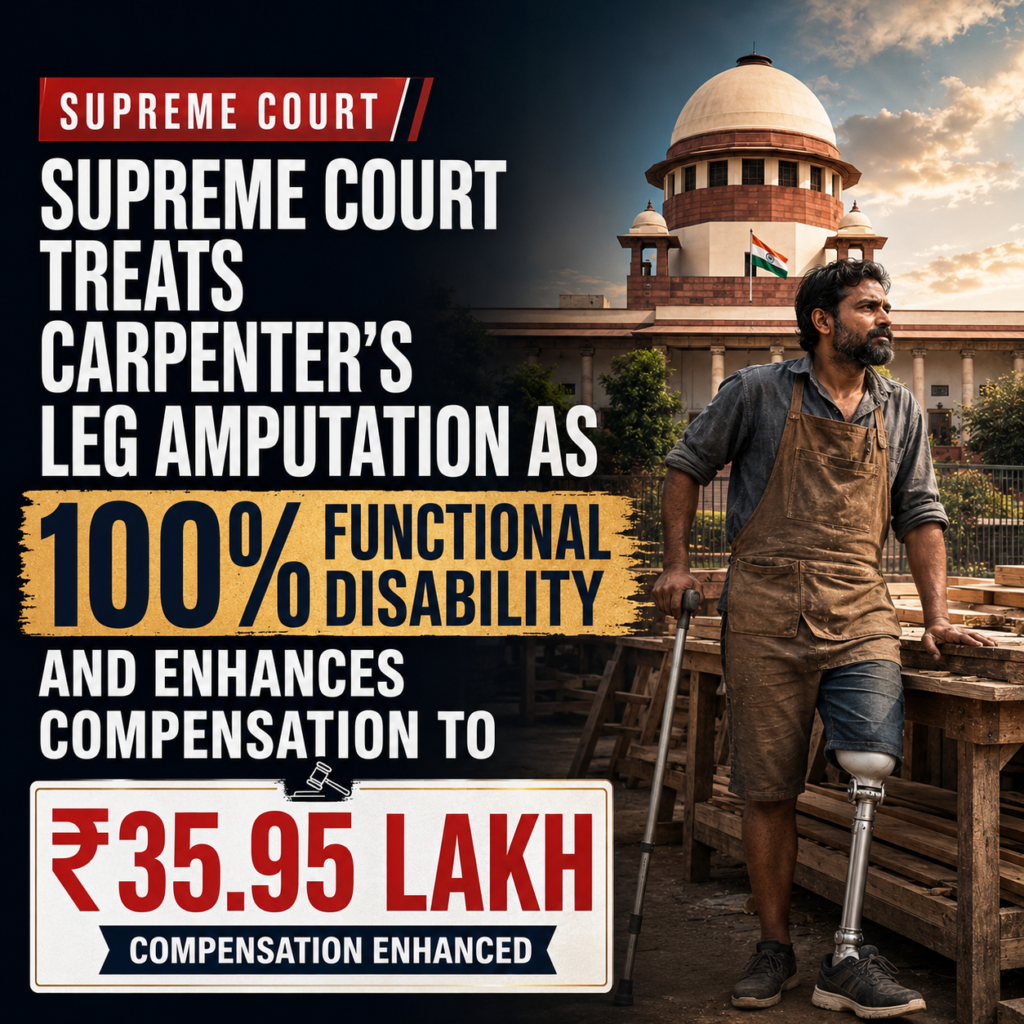
Supreme Court Treats Carpenter’s Leg Amputation as 100% Functional Disability and Enhances Compensation to ₹35.95 Lakh

Carpentry Is Skilled Work and Leg Amputation Destroyed Earning Capacity: Supreme Court Enhances Award
The Supreme Court enhanced compensation payable to a carpenter who lost his right leg above the knee in a road accident from ₹11,51,423 to ₹35,95,923.
A Bench comprising Justice Ujjal Bhuyan and Justice N. V. Anjaria held that although the claimant’s medical disability had been assessed at 70%, the functional disability had to be treated as 100% because the amputation effectively prevented him from continuing his skilled occupation as a carpenter.
The Court also awarded ₹10 lakh toward the future cost, replacement and maintenance of a prosthetic leg and directed United India Insurance Company Limited to deposit the additional compensation of ₹24,44,500 with 6% annual interest within six weeks.
Facts
On 9 November 2004, Shankar Dutt, then aged 38 years, was travelling on his motorcycle from Kotdwar to Motadhak.
At about 8:00 p.m., a Jeep bearing Registration No. UP-06-0915 allegedly came from the opposite direction, entered the wrong side of the road and collided with his motorcycle.
The Jeep was stated to have been driven rashly and negligently by its owner-cum-driver.
Shankar Dutt sustained serious injuries, particularly to his right leg.
He was initially admitted to the Government Hospital at Kotdwar and was shifted the following day to Himalayan Hospital, Jolly Grant, Dehradun.
To save his life, his right leg was amputated above the knee.
He remained hospitalised for approximately 43 days, from 10 November 2004 to 22 December 2004.
At the time of the accident, the appellant was working as a carpenter and claimed to be earning between ₹8,000 and ₹10,000 per month.
He stated that after the amputation, he could no longer sit in a squatting or cross-legged position, stand without support, or perform carpentry work.
He filed a motor accident claim seeking ₹18.50 lakh in compensation.
The Motor Accident Claims Tribunal awarded ₹4,77,823 with interest at 4% per annum.
On appeal, the Uttarakhand High Court enhanced the compensation to ₹11,51,423 with interest at 6% per annum.
The High Court:
- assessed his monthly income at ₹5,000;
- added 40% toward future prospects;
- applied multiplier 15;
- retained the disability at 70%;
- awarded ₹1 lakh for pain, suffering and loss of amenities;
- awarded ₹25,000 for future nourishment;
- awarded ₹1 lakh toward future medical expenses; and
- retained actual medical expenses of ₹44,423.
Dissatisfied with the amount, Shankar Dutt approached the Supreme Court seeking further enhancement.
Issues
The principal issues before the Supreme Court were:
- Whether the High Court had correctly assessed the claimant’s monthly income at ₹5,000.
- Whether carpentry should be treated as skilled work for determining notional income.
- Whether medical disability of 70% should automatically govern assessment of loss of earning capacity.
- Whether the claimant’s functional disability should be treated as 100% because of his occupation as a carpenter.
- Whether multiplier 15 or multiplier 16 was applicable.
- Whether future prospects had been correctly added.
- Whether compensation should separately be awarded for replacement and maintenance of a prosthetic leg.
- Whether amounts were payable toward attendant charges, transportation, loss of income during treatment, nutrition and loss of amenities.
- Whether the High Court’s award represented just and fair compensation under the Motor Vehicles Act.
Petitioner’s Arguments
The appellant argued that the High Court had substantially undervalued his income.
He submitted that carpentry is a skilled occupation and that his monthly income should have been assessed at not less than ₹8,000.
He relied upon Supreme Court decisions concerning skilled workers and injured carpenters to contend that ₹5,000 per month was inadequate even for an accident that occurred in 2004.
The appellant argued that the High Court had failed to grant any meaningful compensation toward purchase and maintenance of an artificial limb.
He submitted that a prosthetic leg requires periodic replacement and regular repairs throughout the lifetime of an amputee.
He further contended that no compensation had been awarded under important heads such as:
- transportation expenses;
- attendant charges;
- loss of income during treatment;
- out-of-pocket medical expenses; and
- adequate loss of amenities.
The appellant argued that the multiplier should have been 16 instead of 15.
Most importantly, he submitted that his disability should have been assessed at 100% for compensation purposes.
Although the medical certificate mentioned 70% disability, the appellant argued that he was completely incapable of continuing as a carpenter.
Carpentry required him to sit, squat, stand, balance himself and use manual tools with physical stability.
Because of the amputation, he could no longer perform those tasks or earn through his previous occupation.
He therefore sought compensation on the basis of 100% functional disability.
Respondent’s Arguments
United India Insurance Company Limited opposed further enhancement.
It argued that the High Court had correctly assessed the monthly income at ₹5,000 on the basis of the minimum wages prevailing in Uttarakhand around the relevant period.
The insurer relied upon Chameli Devi v. Jivrail Mian to support the income assessment.
It further argued that the 70% disability assessed by the medical authorities was appropriate.
According to the insurer, the appellant was not completely incapable of undertaking all forms of carpentry work and could potentially continue some work despite the amputation.
The insurer therefore submitted that treating the disability as 100% would result in excessive compensation.
National Insurance Company Limited also contested the appeal but emphasised that the accident had been caused by the negligence of the Jeep driver.
The finding of negligence against the offending vehicle was no longer under challenge.
Analysis of the Law
Just and Fair Compensation
The Court reiterated that compensation under the Motor Vehicles Act must be just, fair and adequate.
In cases involving permanent disability, compensation is not confined to reimbursement of medical bills or physical injury.
The award must address both pecuniary and non-pecuniary consequences, including:
- pain and trauma;
- loss of present and future income;
- inability to enjoy normal life;
- future medical treatment;
- need for assistance;
- loss of amenities; and
- reduction in quality and expectation of life.
The object is to place the injured person, as far as money can, in a position reasonably close to the one occupied before the accident.
Carpentry as Skilled Work
The Court held that a carpenter is an artisan and skilled worker.
Carpentry requires:
- specialised training;
- manual dexterity;
- precision;
- use of tools and machinery;
- creativity; and
- physical coordination.
It would therefore be incorrect to treat a carpenter as an unskilled labourer while assessing income.
The Court observed that a skilled occupation ordinarily carries a higher earning potential than general manual labour.
The claimant’s evidence that he earned between ₹8,000 and ₹10,000 per month had remained substantially unrebutted.
Taking into account the nature of the work and the year of the accident, the Court assessed the monthly income at ₹9,000.
Medical Disability Versus Functional Disability
The Court drew a clear distinction between medical and functional disability.
Medical disability refers to the percentage of bodily impairment certified by a doctor.
Functional disability concerns the actual effect of the injury upon:
- the claimant’s occupation;
- earning capacity;
- day-to-day activities;
- mobility; and
- ability to live independently.
A medical disability of 70% does not necessarily mean that the claimant has lost only 70% of his earning ability.
Depending upon the occupation, the same physical injury may result in a much greater, and sometimes total, economic disability.
The Court explained that, for example, partial loss of a hand may completely disable a professional driver from driving.
Similarly, the amputation suffered by the appellant had to be assessed in the context of carpentry.
Functional Disability of the Carpenter
The appellant’s work required him to:
- sit on the ground or in a squatting position;
- sit cross-legged;
- stand and maintain balance;
- handle wood and tools;
- move between work areas; and
- perform physically intensive manual tasks.
After the amputation, he could not sit in the required positions and could not stand without support.
He also required assistance in routine activities.
The Court held that the injury had completely destroyed his capacity to carry on carpentry, which was his only source of livelihood.
Therefore, although the medical disability was 70%, his functional disability and loss of earning capacity were 100%.
Multiplier and Future Prospects
The appellant was 38 years old at the time of the accident.
Under the multiplier table approved in Sarla Verma v. Delhi Transport Corporation, the correct multiplier for the age group of 36 to 40 years is 15.
The Court therefore rejected the appellant’s request for multiplier 16 and upheld multiplier 15.
It added 40% toward future prospects in accordance with the principles laid down in National Insurance Co. Ltd. v. Pranay Sethi.
The loss of future earnings was calculated as follows:
- Monthly income: ₹9,000
- Annual income: ₹1,08,000
- Future prospects at 40%: ₹43,200
- Total annual income: ₹1,51,200
- Multiplier: 15
- Functional disability: 100%
- Loss of future earnings: ₹22,68,000
Prosthetic Leg Expenses
The Court held that the cost of an artificial limb is not a one-time expense.
A prosthetic leg has a limited functional life and requires:
- periodic replacement;
- regular repair;
- maintenance;
- adjustment; and
- associated medical care.
The appellant was 38 years old, and the Court adopted an average life expectancy of 75 years.
It observed that he would likely need replacement of the artificial limb at least six times during the remaining 37 years of his life, apart from half-yearly repairs and maintenance.
The Court therefore awarded ₹10 lakh toward the cost and maintenance of the prosthetic leg.
Other Pecuniary and Non-Pecuniary Heads
The Court separately awarded compensation for:
- pain, shock and suffering;
- loss of amenities;
- loss of income during the period of treatment;
- attendant charges;
- nutrition and incidental expenses;
- actual medical expenses; and
- transportation expenses.
This reflected the principle that a permanently disabled claimant must be compensated for the full impact of the injury and not merely the immediate treatment costs.
Precedent Analysis
Jagdish v. Mohan
The Supreme Court held that compensation for permanent disability must include pain and suffering, loss of income, future income, inability to lead a normal life, medical expenses and loss of amenities.
The Court applied this broad approach while reassessing the appellant’s compensation.
Laxman v. Divisional Manager, Oriental Insurance Co. Ltd.
This decision emphasised that compensation must cover not only physical injury and treatment expenses but also trauma, loss of earnings and inability to enjoy normal life.
It supported a comprehensive award rather than a narrow medical-expense calculation.
State of Orissa v. Adwait Charan Mohanty
The Court discussed the meaning of “artisan” and recognised that an artisan is a skilled craftsperson engaged in work requiring manual dexterity.
This principle supported classification of a carpenter as a skilled worker.
Neeta v. Divisional Manager, Maharashtra SRTC
The Supreme Court treated carpentry as a skilled occupation.
The present Court relied upon this recognition in determining a fair notional income.
Karamjit Singh v. Amandeep Singh
The Supreme Court expressly held that carpentry is skilled fieldwork requiring training and precision and cannot be classified as unskilled labour.
This precedent directly supported the assessment of the appellant’s monthly income at ₹9,000.
Chameli Devi v. Jivrail Mian
The High Court and insurer relied upon this decision, where a carpenter’s income had been assessed at ₹5,000.
The Supreme Court distinguished its factual and temporal context and held that ₹5,000 was too low in the present case.
Sarla Verma v. Delhi Transport Corporation
The decision prescribed the standard multiplier table.
Since the appellant was 38 years old, multiplier 15 was correctly applicable.
Raj Kumar v. Ajay Kumar
The Supreme Court held that the percentage of medical disability should not be mechanically equated with loss of earning capacity.
The Tribunal must separately assess how the disability affects the claimant’s particular occupation.
This formed the central legal basis for treating the appellant’s functional disability as 100%.
R. Halle v. Reliance General Insurance Co. Ltd.
The Supreme Court reiterated that functional disability requires careful evaluation of medical evidence and its practical impact upon the claimant’s occupation.
Failure to undertake that exercise may amount to an error of law.
S. Ettiappan v. D. Kumar
In this case, a vegetable loader whose leg was amputated was held to have suffered 100% functional disability even though the medical disability was assessed at 70%.
The Court applied the same reasoning to the appellant carpenter.
Mohd. Sabeer v. Regional Manager, U.P. State Road Transport Corporation
The decision discussed both pecuniary and non-pecuniary compensation in permanent disability cases.
It also recognised the recurring costs of prosthetic limbs, including replacement, repair and maintenance.
The Court relied upon this judgment while awarding ₹10 lakh for the artificial leg.
Anant v. Pratap
The Supreme Court held that compensation should, as far as possible, restore the injured person to the position occupied before the accident and compensate for the inability to lead a full life.
R.D. Hattangadi v. Pest Control (India) Pvt. Ltd.
The Court distinguished between pecuniary and non-pecuniary losses.
Pecuniary losses include medical expenses and lost earnings, while non-pecuniary losses include pain, suffering, loss of amenities, hardship, inconvenience and mental stress.
National Insurance Co. Ltd. v. Pranay Sethi
The Court relied upon this decision to add 40% toward future prospects while calculating the appellant’s future loss of earnings.
Court’s Reasoning
The Supreme Court found that the High Court had failed to appreciate the true economic impact of the amputation.
The appellant was not merely a person with a medically assessed disability of 70%.
He was a skilled carpenter whose livelihood depended upon his ability to sit, squat, stand, balance himself and perform precise manual work.
The amputation had made those activities practically impossible.
His capacity to earn from the only occupation known to him had therefore been completely destroyed.
The Court held that functional disability must be determined with reference to the injured person’s actual occupation and cannot be derived mechanically from a medical certificate.
The High Court also erred in assessing the appellant’s income at only ₹5,000.
The Court regarded carpentry as skilled work and took the appellant’s unrebutted evidence regarding his income into consideration.
A balanced assessment justified fixing monthly income at ₹9,000.
The Court upheld multiplier 15 because the appellant was 38 years old.
It added 40% future prospects and calculated loss of future earnings on the basis of 100% functional disability.
The Court further found that ₹1 lakh awarded by the High Court for future medical expenses was wholly inadequate.
The appellant would require repeated replacement and maintenance of his prosthetic limb throughout his life.
An award of ₹10 lakh under that head was therefore necessary to ensure meaningful and realistic compensation.
The Court also awarded amounts under several heads that had either been omitted or inadequately considered by the High Court.
Conclusion
The Supreme Court allowed the appeal and enhanced the compensation to ₹35,95,923.
The compensation was awarded under the following heads:
- Loss of future earnings due to 100% functional disability: ₹22,68,000
- Pain, shock and suffering: ₹1,00,000
- Prosthetic leg and its future maintenance: ₹10,00,000
- Loss of income during treatment: ₹13,500
- Attendant charges: ₹50,000
- Nutrition and incidental charges: ₹40,000
- Medical expenses: ₹44,423
- Transportation charges: ₹30,000
- Loss of amenities: ₹50,000
The total award of ₹35,95,923 would carry interest at 6% per annum from the date of filing of the claim petition until actual payment.
Since the High Court had already awarded ₹11,51,423, United India Insurance Company Limited was directed to deposit the balance additional compensation of ₹24,44,500 with interest before the Claims Tribunal within six weeks.
The Claims Tribunal was directed to verify the claimant’s identity and transfer the additional amount directly to his bank account.
Case: Shankar Dutt v. United India Insurance Co. Ltd. & Ors.
Court: Supreme Court of India
Case Number: Civil Appeal No. 8714 of 2026, arising out of SLP (C) No. 19227 of 2021
Judges: Justice Ujjal Bhuyan and Justice N. V. Anjaria
Date: 24 June 2026
Result: Appeal allowed; compensation enhanced from ₹11,51,423 to ₹35,95,923 with 6% annual interest; carpenter’s 70% medical disability treated as 100% functional disability, and ₹10 lakh awarded for future replacement and maintenance of the prosthetic leg.