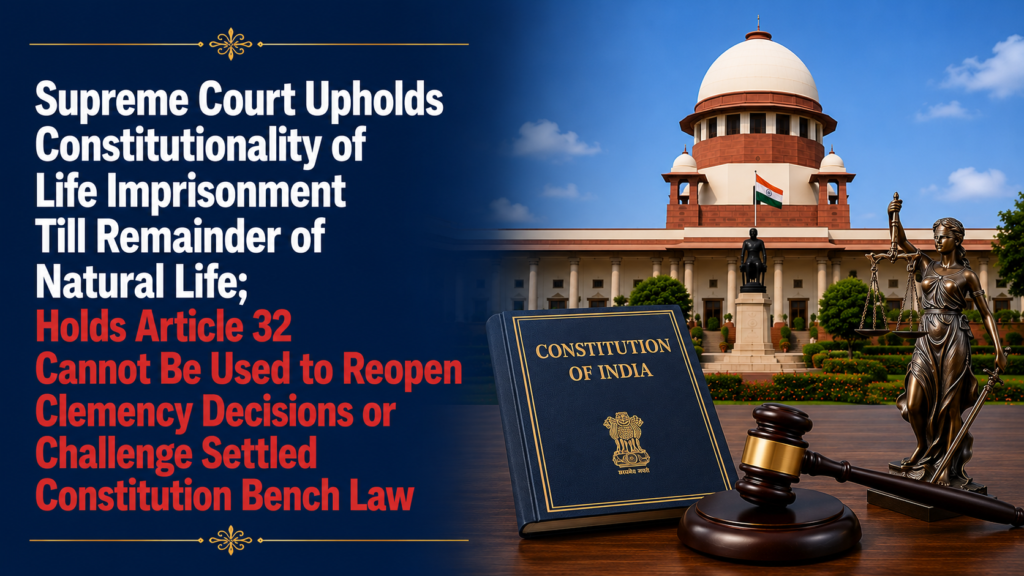
Supreme Court Upholds Constitutionality of Life Imprisonment Till Remainder of Natural Life; Holds Article 32 Cannot Be Used to Reopen Clemency Decisions or Challenge Settled Constitution Bench Law


Life Imprisonment Till Remainder of Natural Life Is Constitutionally Valid; Supreme Court Rejects Convicts’ Challenge to Special Category Sentence.
Facts
The Supreme Court considered a batch of four writ petitions filed by convicts who had originally been sentenced to death for offences including murder and kidnapping for ransom. In each case, the death sentence had subsequently been commuted either by the High Court or through the exercise of constitutional clemency under Article 72 of the Constitution, with the substituted punishment being imprisonment for the remainder of the convict’s natural life, in some cases expressly without remission.
The petitioners challenged the legality and constitutionality of such sentences. They contended that Section 302 of the Indian Penal Code recognises only two punishments—death or life imprisonment—and does not contemplate imprisonment for the remainder of one’s natural life. They further argued that such sentences defeated the statutory remission powers available under Section 432 of the Code of Criminal Procedure.
The batch therefore raised significant constitutional questions regarding the validity of “special category” life sentences and the scope of judicial review over presidential clemency orders.
Issues
The Supreme Court considered:
- Whether imprisonment for the remainder of a convict’s natural life is constitutionally valid.
- Whether Article 32 can be invoked to challenge or modify sentences already altered through the President’s exercise of clemency under Article 72.
- Whether the Supreme Court can effectively sit in appeal over presidential clemency decisions.
- Whether life imprisonment till the remainder of natural life violates the statutory remission provisions under Section 432 CrPC.
Petitioners’ Arguments
The petitioners argued that Section 302 IPC provides only two punishments—death and life imprisonment—and nowhere authorises imprisonment till the remainder of natural life.
They contended that Parliament itself introduced the expression “remainder of natural life” only in later amendments dealing with certain sexual offences, indicating that such punishment was otherwise unavailable under the IPC.
It was further argued that sentences excluding remission defeated the statutory rights conferred upon prisoners under Section 432 CrPC. The petitioners also sought reconsideration of presidential orders commuting death sentences into life imprisonment without remission, urging the Court to reduce those sentences.
Respondents’ Arguments
The Union of India opposed the petitions both on maintainability and merits.
It argued that Article 32 cannot be employed as a substitute for statutory remedies or as a mechanism to reopen sentences that had already attained finality.
The Attorney General submitted that the Constitution Bench judgment in Union of India v. V. Sriharan had conclusively upheld the constitutional validity of the special category sentence of imprisonment till the remainder of natural life. It was also argued that judicial review of presidential clemency is confined to recognised grounds such as mala fides, arbitrariness, non-application of mind or consideration of irrelevant material, none of which had been pleaded in the present petitions.
Analysis of the Law
The Supreme Court first examined the scope of Article 32, reiterating that although it forms part of the Constitution’s basic structure and guarantees direct access to the Supreme Court for enforcement of fundamental rights, it cannot ordinarily be used to bypass established statutory procedures or convert the Court into an appellate authority over executive decisions.
The Court then analysed the constitutional framework governing clemency under Articles 72 and 161, observing that these constitutional powers are executive in nature, distinct from statutory remission under the Code of Criminal Procedure, and remain unaffected by judicial sentencing.
Turning to the meaning of “life imprisonment”, the Court reaffirmed that under Sections 45 and 53 IPC, life imprisonment ordinarily means imprisonment for the remainder of the convict’s natural life, unless lawfully curtailed through remission or commutation by competent constitutional or statutory authorities.
The Court emphasised that the Constitution Bench in V. Sriharan had already upheld the validity of the “special category” sentence recognised earlier in Swamy Shraddananda (2), whereby courts may substitute a death sentence with imprisonment for the remainder of natural life in exceptionally grave cases instead of imposing ordinary life imprisonment.
Precedent Analysis
The Court extensively relied upon earlier Constitution Bench and larger Bench decisions.
It reaffirmed Swamy Shraddananda (2), where the Supreme Court created the special category of life imprisonment extending beyond the conventional remission framework in exceptional cases falling between ordinary life imprisonment and the death penalty.
The Court held that the issue stood conclusively settled by the Constitution Bench in Union of India v. V. Sriharan, where the majority expressly upheld the constitutional validity of imprisonment till the remainder of natural life and recognised the judiciary’s power to impose such punishment.
The Court also reiterated settled principles from Kehar Singh, Maru Ram, Epuru Sudhakar, K.M. Nanavati, and Pyare Lal, explaining that judicial review of clemency orders remains confined to limited grounds such as mala fides, arbitrariness, consideration of irrelevant material or non-application of mind, and does not permit the Court to substitute its own opinion for that of the constitutional authority.
Court’s Reasoning
The Supreme Court held that the petitions fundamentally ignored binding Constitution Bench precedent.
It observed that V. Sriharan had already answered every legal issue raised by the petitioners, including the meaning of life imprisonment, the validity of imprisonment till the remainder of natural life, and the relationship between such sentences and statutory remission under Section 432 CrPC.
The Court further held that where the President has exercised powers under Article 72, the Supreme Court cannot function as an appellate authority over that executive decision. Judicial review remains available only on recognised constitutional grounds, none of which were pleaded or established by the petitioners.
The Bench also rejected the contention that such sentences violate statutory remission rights, explaining that where the Court expressly imposes the special category sentence without remission in accordance with Sriharan, no constitutional infirmity arises.
Describing the challenge as contrary to settled law, the Court observed that asking a two-Judge Bench to declare unconstitutional what had already been upheld by a Constitution Bench amounted to a misuse, if not abuse, of the judicial process.
Conclusion
The Supreme Court dismissed all four writ petitions.
It reaffirmed that imprisonment till the remainder of the convict’s natural life is constitutionally valid and continues to be governed by the Constitution Bench decision in Union of India v. V. Sriharan. The Court further held that Article 32 cannot be used either to reopen settled constitutional law or to seek appellate reconsideration of presidential clemency decisions in the absence of recognised grounds for judicial review.
Accordingly, the sentences imposed upon the petitioners remained undisturbed.
Case Details
Case: Ramasrey @ Fakkad v. State of Uttar Pradesh (along with connected writ petitions)
Court: Supreme Court of India
Case Numbers: Writ Petition (Criminal) No. 553 of 2023; W.P. (Crl.) Nos. 42 of 2024, 69 of 2025 & 198 of 2025
Bench: Justice Sanjay Karol and Justice Augustine George Masih
Date: 29 July 2026
Result: All writ petitions dismissed. The Supreme Court upheld the constitutional validity of imprisonment for the remainder of natural life, reaffirmed the binding authority of Union of India v. V. Sriharan, and held that Article 32 cannot be used to challenge or reopen valid presidential clemency decisions except on limited grounds of judicial review.