Supreme Court Upholds Discharge of RPF Constables Who Concealed Pending Criminal Cases; Holds Deliberate Suppression in Attestation Forms Justifies Removal From Service

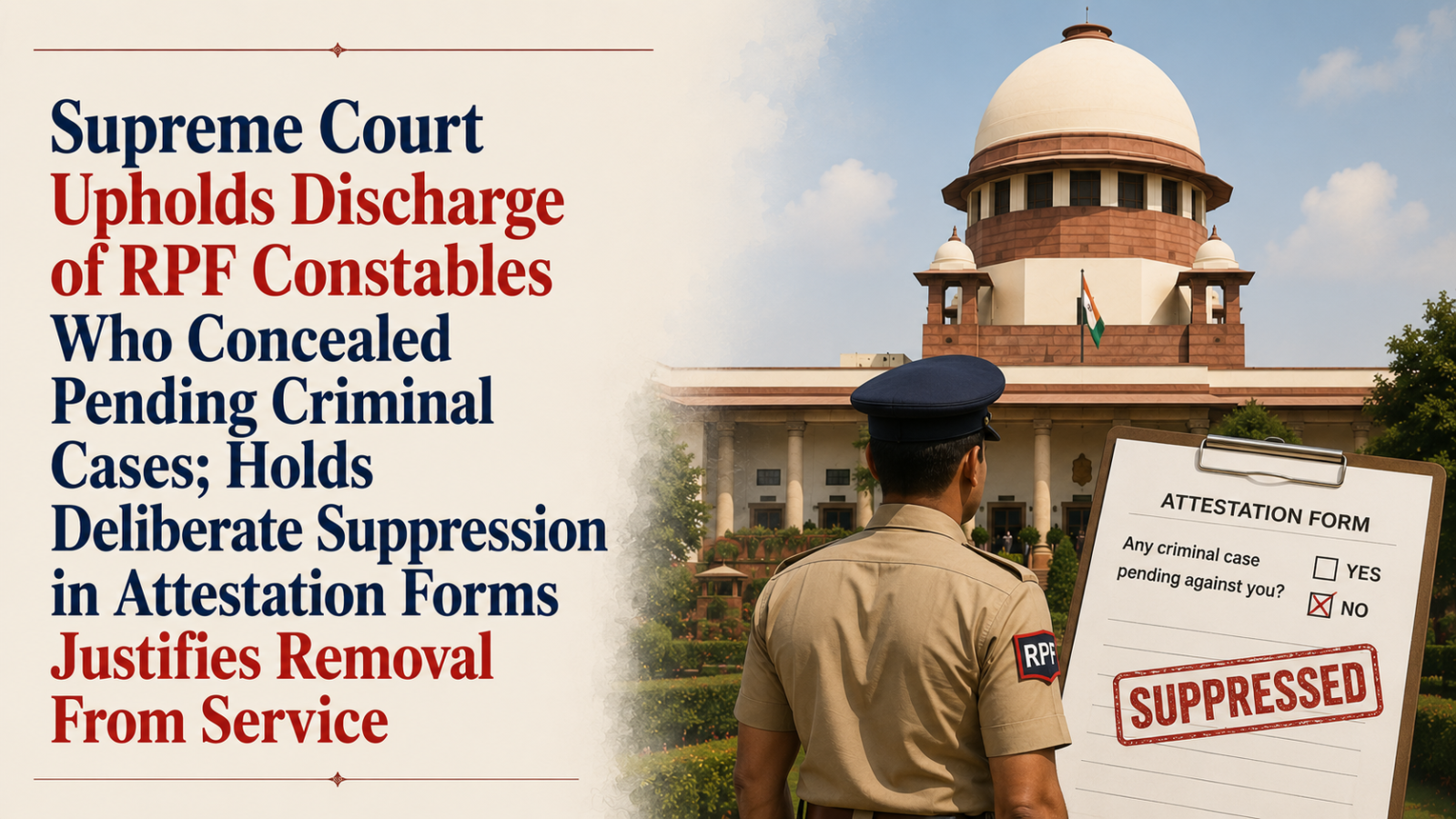
Supreme Court Dismisses RPF Recruits’ Appeals Over Concealed Criminal Cases; Holds False Verification and Deliberate Suppression Valid Grounds for Discharge
Facts
The appeals arose from recruitment to the posts of Constable in the Railway Protection Force (RPF) and Railway Protection Special Force (RPSF) pursuant to an Employment Notice dated 23 February 2011.
The appellants successfully cleared the written examination, physical and efficiency tests and were placed in the select list. They were subsequently called for document verification and medical examination.
During verification, however, none of the appellants disclosed that criminal cases were pending against them. After allotment letters were issued and the appellants were sent for training, the authorities discovered the pending criminal cases as well as the non-disclosure in the verification process. They were consequently discharged from service between June and October 2015 under Rules 52 and 67 of the RPF Rules, 1987, Clause 9(f) of the Employment Notice and the Attestation Form.
In the first round of litigation, Single Judges of the Allahabad High Court set aside the discharge orders and directed reconsideration in light of Avtar Singh v. Union of India.
The authorities thereafter reconsidered each case and, through detailed orders passed in 2017, again discharged the appellants for suppression of criminal antecedents. Their fresh writ petitions were dismissed by Single Judges, and the Division Bench of the Allahabad High Court upheld those decisions on 22 September 2021.
The appellants therefore approached the Supreme Court.
Issues
The principal issues before the Supreme Court were:
- Whether the appellants could lawfully be discharged from RPF/RPSF for failing to disclose pending criminal cases in their attestation forms.
- Whether the authorities had properly applied the principles laid down in Avtar Singh v. Union of India while reconsidering their cases.
- Whether subsequent acquittal of the appellants in the criminal cases entitled them to reinstatement.
- Whether the appellants were entitled to parity with other candidates having criminal antecedents who had subsequently been reinstated.
- Whether the discharge orders suffered from arbitrariness, discrimination or violation of natural justice.
Petitioner’s Arguments
The appellants contended that their discharge orders were based essentially on concealment of criminal antecedents and that such suppression, by itself, could not automatically justify removal without an independent assessment of suitability.
They relied heavily on Avtar Singh v. Union of India, arguing that suppression of information must be evaluated in the factual circumstances of each case and cannot mechanically result in termination.
They also relied upon Pawan Kumar v. Union of India, where this Court had interfered with the discharge of an RPF/RPSF constable for non-disclosure of a criminal case, and upon SPO/Constable IRB Satpal Singh v. State of Punjab, for the proposition that mere pendency of a criminal case cannot by itself justify discharge.
The appellants further pointed out that all of them had ultimately been acquitted. According to them, 14 out of 17 had been acquitted even before the later discharge orders were passed.
They also claimed discrimination, asserting that several similarly situated candidates who had also failed to disclose criminal antecedents had subsequently been reinstated. They therefore sought equal treatment.
Respondent’s Arguments
The Union of India and RPF authorities contended that the appellants’ cases had already been independently reconsidered pursuant to the earlier directions of the Allahabad High Court and in accordance with Avtar Singh.
Detailed and reasoned orders had thereafter been passed in 2017 holding the appellants unsuitable for appointment.
The respondents argued that suppression of material information concerning criminal antecedents directly bears upon the character and suitability of a candidate seeking appointment to a disciplined force. A candidate who deliberately suppresses such information cannot claim an absolute right to appointment or continuation.
They distinguished Pawan Kumar on the ground that the candidate in that case had already been acquitted before he filled the attestation form. In contrast, criminal cases were still pending against the present appellants when they filled their verification forms.
On parity, the respondents contended that reinstatement decisions regarding other candidates were based on their individual circumstances, including prior acquittals or directions issued by different High Courts, and therefore could not automatically benefit the appellants.
Analysis of the Law
The Supreme Court first examined the statutory and recruitment framework governing the RPF and RPSF.
Under Rule 52 of the RPF Rules, 1987, a selected recruit’s character and antecedents must be verified before formal appointment, and a recruit found unsuitable after verification is not to be appointed.
Under Rule 67.2, a direct recruit who has not yet been formally appointed may be discharged at any stage if the competent authority, for reasons recorded in writing, considers such discharge necessary in the interest of the Force.
Clause 9(f) of the Employment Notice further warned candidates that adverse antecedent reports could prevent appointment and that a false declaration could lead to disqualification or dismissal.
The Attestation Form expressly stated that furnishing false information or suppressing factual information could disqualify a candidate and render him unfit for government employment. It specifically asked whether the candidate had ever been arrested or prosecuted.
The Court therefore held that the recruitment framework imposed a clear obligation upon candidates to disclose pending criminal cases.
The appellants had knowingly answered “No” despite pending cases and despite explicit warnings about the consequences of suppression. The Court regarded this as deliberate concealment rather than an inadvertent omission.
Precedent Analysis
Avtar Singh v. Union of India
The principal precedent was Avtar Singh v. Union of India, (2016) 8 SCC 471.
Avtar Singh requires candidates to provide truthful information concerning convictions, acquittals, arrests and pending criminal proceedings. It also requires employers to examine the circumstances of suppression and the applicable recruitment rules before deciding whether candidature should be cancelled or employment terminated.
The Supreme Court considered the present case to fall within the principle dealing with deliberate suppression of pending criminal cases. Since the appellants knowingly failed to disclose the cases, the employer was entitled to consider such concealment material to their suitability.
Pawan Kumar v. Union of India
The appellants relied upon Pawan Kumar v. Union of India, (2023) 12 SCC 317.
The Supreme Court distinguished that judgment because the criminal case there had already resulted in acquittal before the candidate filled the attestation form. The facts were therefore materially different from the present appeals, where criminal proceedings were pending when the appellants made their declarations.
SPO/Constable IRB Satpal Singh v. State of Punjab
The appellants also relied on Satpal Singh, arguing that mere pendency of a criminal case could not justify termination.
The Court found that precedent distinguishable because Satpal Singh had already served for approximately 12 years as a Special Police Officer and his case arose from a civil suit seeking reinstatement and consequential benefits. The factual and procedural circumstances were therefore different from those of recruits who had not yet been formally inducted into the Force.
Court’s Reasoning
The Supreme Court emphasised that this was not a case where the verification form was vague or where the candidates were unaware of the pending cases.
The Attestation Form specifically asked about arrest and prosecution, and the appellants nevertheless answered in the negative.
The Court observed that the appellants’ knowledge of the pending proceedings was not disputed and there was no pleading before the High Court asserting ignorance of those cases.
Accordingly, both the Single Judge and Division Bench were justified in treating the conduct as deliberate suppression.
The Court further rejected any natural justice objection. The original discharge orders had been set aside in the first round of litigation precisely so that the cases could be reconsidered under Avtar Singh. The authorities thereafter passed detailed reasoned orders in 2017, which were subjected to judicial review before both the Single Judge and Division Bench.
The Court therefore held that the appellants had received full opportunity to present their cases and that the requirements of natural justice had been satisfied.
Parity With Reinstated Candidates
The Court also rejected the discrimination argument.
The Additional Solicitor General informed the Court that 19 candidates had been reinstated. Twelve of them had been acquitted before filling their attestation forms and therefore stood on a materially different footing.
The remaining seven were reinstated pursuant to High Court orders. In a few additional cases, the authorities had independently examined the nature of the allegations and found them sufficiently trivial to justify reinstatement.
The Supreme Court held that these circumstances did not establish that the present appellants were similarly situated.
Conclusion
The Supreme Court concluded that the appellants had deliberately failed to disclose pending criminal proceedings despite an explicit requirement in the verification and attestation process.
It held that the RPF authorities had reconsidered their cases individually and passed reasoned orders consistent with the principles laid down in Avtar Singh.
The Court found no error in either the Single Judge’s decisions or the common Division Bench judgment of the Allahabad High Court.
Accordingly, the Supreme Court dismissed all the civil appeals and upheld the discharge of the appellants from RPF/RPSF service. No order as to costs was made.
Case Details
Case: Bappa Barai v. Union of India & Ors. with connected appeals
Court: Supreme Court of India
Case Number: 2026 INSC 882; Civil Appeal arising out of SLP (C) No. 12389 of 2022 and connected SLPs
Judge: Justice Pamidighantam Sri Narasimha and Justice Alok Aradhe
Date: 18 August 2026
Result: Appeals dismissed; discharge of RPF/RPSF constable recruits for deliberate suppression of pending criminal cases upheld; Allahabad High Court judgment affirmed