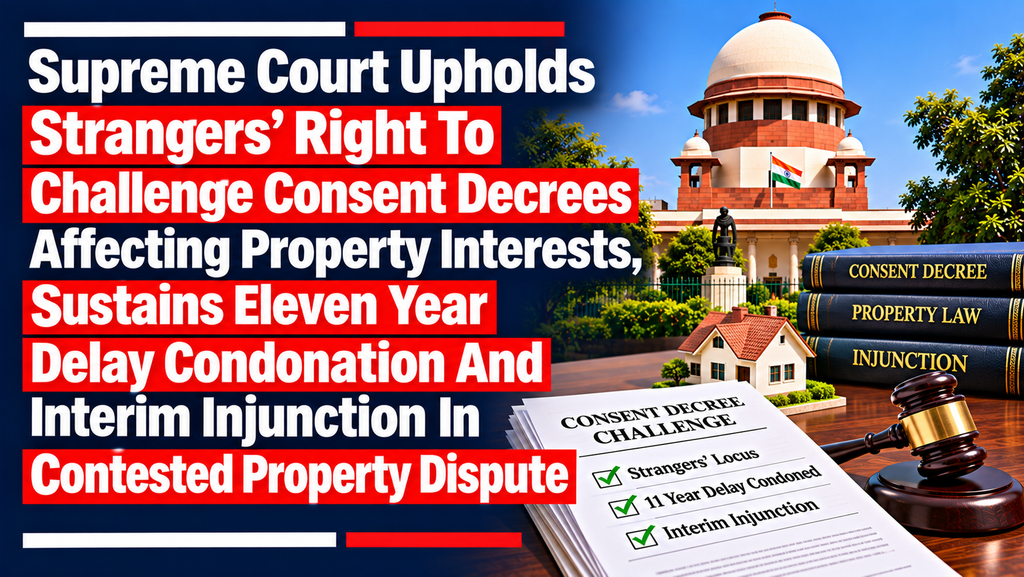
Supreme Court Upholds Strangers’ Right To Challenge Consent Decrees Affecting Property Interests, Sustains Eleven Year Delay Condonation And Interim Injunction In Contested Property Dispute

Supreme Court Rules Consent Decree Appeal Bar Cannot Defeat Independent Rights Of Nonparties, Upholds Gujarat High Court Injunction And Delayed Appeal Against Contested Property Settlement
Facts
The dispute concerns land claimed by the Palkhiwala family through a 1975 registered sale deed and subsequent revenue entries. In 2012, Geetagram Cooperative Housing Society filed a specific-performance suit based on a 1996 agreement executed by the original seller’s heirs. A consent decree followed on 29 April 2013; a court commissioner later executed a 2022 sale deed in favour of Girishbhai Natwarlal Patel. Nine Palkhiwala family claimants, strangers to the suit, alleged collusion and prejudice to their independent rights. In 2024, the Gujarat High Court granted interim restraint against Girishbhai, condoned approximately 11 years’ delay and permitted them to appeal. Girishbhai challenged those orders in the Supreme Court.
Issues
Whether Section 96(3) and Order XXIII Rules 3 and 3A CPC bar a stranger to a consent decree from seeking leave to appeal; whether the claimants demonstrated sufficient independent legal interest and prejudice; whether protection of the land through an initial ex parte injunction was justified; and whether delay of about 11 years could be condoned in light of the claimants’ asserted date of knowledge.
Petitioner’s Arguments
Girishbhai argued that a consent decree is non-appealable, and persons who were not parties to the original compromise lacked standing to challenge it. He asserted that the claim, if any, belonged to an HUF, not the nine applicants individually. An injunction could not operate against him before his formal impleadment and without an initial hearing; nor should a draft amendment ground the restraint. He further challenged condonation of the long, allegedly unexplained delay, and denied collusion, relying on the registered 1996 agreement, 2013 consent decree and 2022 conveyance in his favour.
Respondent’s Arguments
The nine claimants asserted rights tracing to a 1975 registered sale deed and maintained that the 1996 agreement and ensuing decree were collusive because the seller’s heirs had already divested their interest. They pointed to Girishbhai’s alleged links with both litigating sides, his power of attorney for the defendants, association with the Society and ultimate receipt of title. They said they discovered the disputed revenue changes only in 2023, promptly investigated and obtained further records under the RTI process. Interim protection was necessary to prevent alienation pending judicial examination.
Analysis of the Law
Section 96(3) CPC prevents parties from appealing a decree entered by their own consent, while Order XXIII Rules 3 and 3A govern the recording and challenge of compromise decrees. Those provisions do not automatically estop an independent third party who never consented. Such a stranger nevertheless has no appeal as of right: the appellate court must grant leave upon a prima facie showing of a legally cognisable interest adversely affected by the decree. An interlocutory protective injunction may preserve disputed property where subsequent hearing follows. Condonation of delay must consider whether a non-party knew, or reasonably could have known, of the decree and resulting prejudice.
Precedent Analysis
Pushpa Devi Bhagat v. Rajinder Singh, (2006) 5 SCC 566, and Banwari Lal v. Chando Devi address the binding effect and available remedies of parties to compromises; Triloki Nath Singh v. Anirudh Singh was distinguished because its claimant derived title through a litigating party. V.N. Krishna Murthy v. Ravikumar, (2020) 9 SCC 501, and H. Anjanappa v. A. Prabhakar, 2025 INSC 121, require an affected non-party to establish genuine prejudice before obtaining appellate leave. The Court treated these as the controlling principles, not an unrestricted exception to finality.
Court’s Reasoning
Justice J.B. Pardiwala held that the applicants were not bound by a compromise they had not made, while their historic conveyance and claimed title disclosed more than an imaginary interest. The unusual transaction sequence, Girishbhai’s apparent connections on both sides and eventual acquisition of the land justified appellate scrutiny, but did not establish fraud as a concluded fact. The High Court could initially protect the land and subsequently continued its injunction after hearing Girishbhai. As the claimants said they learned of altered entries in 2023 and took investigative steps thereafter, the entire elapsed period since the 2013 decree could not automatically be counted against them.
Conclusion
The Supreme Court dismissed Girishbhai’s appeals and upheld the injunction, grant of leave to appeal and condonation of approximately 11 years’ delay. It requested the Gujarat High Court to decide the main first appeal within three months of 30 October 2026. The ruling clarifies that a genuinely aggrieved stranger may challenge even a consent decree with leave, but does not determine ownership, invalidate the consent decree or make a final finding of fraud or collusion.
Case: Girishbhai Natwarlal Patel v. Gautam Punjabhai Palkhiwala (Dead) by LRs & Ors.
Court: Supreme Court of India
Case Number: Civil Appeal Nos. 14017–14018 of 2026; 2026 INSC 1177
Judge: Justices J.B. Pardiwala (author) and K. Vinod Chandran
Date: 30 October 2026
Result: Appeals dismissed; injunction, leave to appeal and delay condonation upheld; Gujarat High Court requested to decide first appeal within three months.