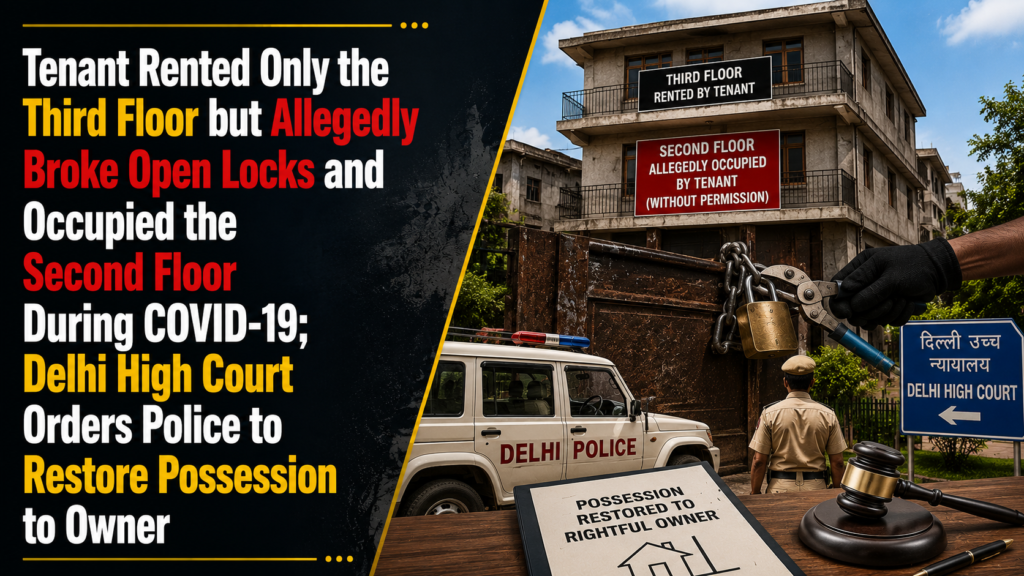
Former Tenant Claimed Building Stood on Gram Sabha Land to Justify Occupying Another Floor; Delhi High Court Rejects Defence and Orders Eviction
Facts
- Abhishek Gupta filed a contempt petition alleging non-compliance with orders dated 31 May 2021, 5 August 2021 and 7 September 2021 passed by the Delhi High Court in RSA 55/2020.
- The dispute concerned property bearing No. RZ-1/2, South Extension Part-III, Uttam Nagar, Delhi.
- Respondent No. 1, Shashi Kumar Shukla, had been inducted as a tenant on the third floor of the property under a rent agreement.
- According to the petitioner, he owned the entire building, but only the third floor had been rented to Respondent No. 1.
- The petitioner alleged that during the COVID-19 period, when the building was lying vacant, Respondent No. 1 broke open the locks of the second floor and occupied it without authority.
- No rent agreement or other document existed granting Respondent No. 1 tenancy rights over the second floor.
- An earlier order dated 5 August 2021 recorded the assurance of the Deputy Commissioner of Police, Dwarka District, that appropriate action would be taken to secure the second floor.
- FIR No. 695/2021 was registered at Police Station Bindapur on 3 August 2021 under Section 448 of the Indian Penal Code concerning the alleged trespass.
- Respondent No. 1 claimed that he had complied with the earlier judgment by vacating the rented third floor and paying the occupation charges.
- However, he disputed the petitioner’s ownership by contending that the property stood on land belonging to the Gram Sabha.
- The petitioner sought implementation of the previous orders and restoration of possession of the second floor.
Issues
- Whether the earlier High Court orders concerning possession of the property had been complied with.
- Whether Respondent No. 1, whose contractual tenancy was limited to the third floor, could claim any right to occupy the second floor.
- Whether the respondent could resist restoration of possession by alleging that the property was situated on Gram Sabha land.
- Whether the title of the property could be adjudicated in the contempt proceedings.
- Whether the police should be directed to secure the second floor and restore peaceful and vacant possession to the petitioner.
Petitioner’s Arguments
- The petitioner was the owner of the entire building.
- Respondent No. 1 had been inducted as a tenant only in respect of the third floor.
- During the COVID-19 period, Respondent No. 1 took advantage of the vacant building, broke open the locks of the second floor and occupied it illegally.
- There was no tenancy agreement or other arrangement authorising Respondent No. 1 to occupy the second floor.
- The earlier order dated 5 August 2021 recorded the police’s assurance that appropriate action would be taken to secure the second floor.
- Despite that assurance, peaceful and vacant possession of the second floor had not been restored.
- The continued occupation of the second floor amounted to non-compliance with the Court’s earlier directions.
Respondents’ Arguments
- Respondent No. 1 submitted that he had complied with the judgment dated 7 September 2021.
- He claimed that he had vacated the rented third floor and handed over its peaceful possession to the petitioner.
- He also claimed to have paid the applicable occupation charges.
- Respondent No. 1 questioned the petitioner’s ownership by asserting that the property was situated on land belonging to the Gram Sabha.
- On that basis, he sought to dispute the petitioner’s entitlement to possession.
Analysis of the Law
- A person inducted as a tenant under a rent agreement acquires only those possessory rights that arise from the agreement.
- In this case, the tenancy was confined to the third floor. No agreement conferred any right upon Respondent No. 1 to occupy the second floor.
- A tenant or former tenant cannot justify forceful occupation of an additional portion of the building merely by questioning the landlord’s ultimate title.
- A dispute regarding whether the land belongs to the petitioner or the Gram Sabha is a separate title dispute requiring adjudication in appropriate proceedings.
- Such a title claim does not create any independent possessory right in favour of the tenant.
- Even if Respondent No. 1 genuinely believed that the land belonged to the Gram Sabha, his remedy was to initiate appropriate legal proceedings. He could not take the law into his own hands or retain possession of premises never rented to him.
- Contempt proceedings are concerned with compliance with earlier judicial directions. They are not the appropriate forum for deciding a fresh and complicated dispute over ownership of the land.
- Restoration of possession could therefore be directed without deciding the ultimate ownership dispute between the petitioner and any public authority.
Precedent Analysis
- No earlier judicial precedent was cited in the order
- The Court did not rely upon or discuss any reported judgment.
- Its directions were based on the admitted landlord-tenant relationship, the limited scope of the rent agreement and the previous orders passed in RSA 55/2020.
- The respondent’s possession originated from the petitioner
- It was undisputed that Respondent No. 1 entered the property as the petitioner’s tenant.
- His contractual possession was confined to the third floor.
- He could not use a subsequent challenge to the petitioner’s title to claim possession over the second floor.
- A third-party title claim does not create rights in favour of the tenant
- The assertion that the land belonged to the Gram Sabha did not establish that Respondent No. 1 had any lawful right over the second floor.
- Even if the Gram Sabha had a claim, it would have to be asserted by the competent authority through lawful proceedings.
- Possession cannot be secured through self-help
- The order reinforces the principle that a party claiming a legal grievance must approach the proper forum.
- A disputed title cannot justify breaking locks, entering premises or continuing an unauthorised occupation.
- The title question remained undecided
- The Court did not declare the petitioner to be the absolute owner against the Gram Sabha or any public authority.
- It only held that Respondent No. 1 could not rely upon that alleged title dispute to justify occupying the second floor.
Court’s Reasoning
- Respondent No. 1’s possession in the building originated solely from the rent agreement concerning the third floor.
- It was undisputed that Respondent No. 1 had already vacated the third floor.
- Nothing on record showed that he had ever been inducted as a tenant on the second floor.
- Whether the building was situated on Gram Sabha land was not the subject matter of the contempt proceedings.
- The alleged Gram Sabha ownership did not give Respondent No. 1 any personal right to forcefully occupy a part of the building.
- If Respondent No. 1 had a legitimate grievance regarding the status of the land, he was free to pursue appropriate legal remedies.
- He could not retain possession of the second floor on that basis, particularly when his admitted occupation of the building had initially been only as a third-floor tenant.
- The police had previously assured the Court that action would be taken to secure the second floor. Further directions were therefore necessary to ensure compliance.
Conclusion
The Delhi High Court held that Respondent No. 1 could not justify occupying the second floor merely by alleging that the building stood on Gram Sabha land. His admitted tenancy was confined to the third floor, and any dispute regarding the title or status of the land had to be pursued separately through lawful proceedings.
The Court directed the local police to:
- ensure that peaceful and vacant possession of the second floor was handed back to the petitioner;
- take appropriate action expeditiously;
- file a status report; and
- submit a compliance affidavit within two weeks.
The contempt proceedings were not finally disposed of. The matter was kept pending for monitoring compliance.
Case Details
Case: Abhishek Gupta v. Shashi Kumar Shukla and Another
Court: High Court of Delhi at New Delhi
Case Number: CONT.CAS(C) 1027/2022
Connected Proceedings: RSA 55/2020
Judge: Justice Mini Pushkarna
Date: 22 July 2026
Next Hearing: 14 August 2026
Result: Local police directed to secure and restore peaceful and vacant possession of the second floor to the petitioner, take expeditious action and file a status report and compliance affidavit within two weeks; contempt case kept pending for compliance.