Two Lease Deeds Prescribed Different Monthly Rents for the Same Commercial Property; Delhi High Court Says the Governing Lease, Alleged Default and Validity of Termination Must Be Decided at Trial

Commercial Court Granted Possession on Admissions; Delhi High Court Finds No Clear Admission of Rent Default and Sets Aside Decree
Facts
The appeal arose from an order of the Commercial Court, Karkardooma, which partly decreed a suit for possession under Order XII Rule 6 of the Code of Civil Procedure, 1908 (CPC) on the basis of alleged admissions made by the tenant.
The respondent-landlady, Anita Gupta, leased a commercial property situated at Garhi Mendu, Bhajanpura, Delhi, to the appellant, Sonu, through a registered lease deed dated 18 November 2022 (registered on 23 November 2022). The registered lease fixed:
- monthly rent at ₹1,60,000;
- tenancy period from 1 January 2023 to 31 December 2028.
The landlady alleged that:
- the tenant defaulted in payment of rent from July 2023;
- the premises were being used for illegal activities;
- a termination notice dated 17 October 2023 was served;
- despite termination, the tenant failed to vacate the premises.
Accordingly, she filed a commercial suit seeking:
- possession of the property;
- arrears of rent;
- mesne profits.
The tenant disputed the claim and relied upon a subsequent notarized lease deed dated 23 November 2022, which allegedly superseded the earlier registered lease and reduced the monthly rent to ₹50,000, while retaining the same tenancy period. He further contended that:
- the landlady refused to accept rent;
- he deposited rent under Section 27 of the Delhi Rent Control Act, 1958;
- the suit was retaliatory to criminal and civil proceedings initiated by him against the landlady.
The Commercial Court nevertheless decreed possession under Order XII Rule 6 CPC. The tenant challenged that order before the Delhi High Court.
Issues
The High Court considered:
- Whether the Commercial Court rightly exercised jurisdiction under Order XII Rule 6 CPC.
- Whether the tenant had made any clear, unequivocal and unconditional admission entitling the landlady to immediate possession.
- Whether disputes regarding the applicable lease deed, rent, default and termination required a full trial.
- Whether the decree for possession could be passed without recording evidence.
Appellant’s Arguments
The tenant contended that:
- there was no unequivocal admission justifying a decree under Order XII Rule 6 CPC;
- the parties had subsequently executed a notarized lease deed reducing the rent from ₹1,60,000 to ₹50,000;
- the later lease superseded the earlier registered lease;
- the tenancy was for a fixed term containing a lock-in arrangement;
- the alleged default in payment of rent was specifically denied;
- the validity of termination and the governing lease could only be decided after evidence.
He therefore argued that the Commercial Court improperly short-circuited the trial.
Respondent’s Arguments
The landlady argued that:
- the tenant admitted execution of the registered lease deed;
- he also admitted paying rent at ₹1,60,000 on several occasions;
- the landlord-tenant relationship and the rate of rent therefore stood admitted;
- the notarized lease deed relied upon by the tenant was fabricated and unregistered;
- it could not override a registered lease deed.
Accordingly, she contended that the Commercial Court rightly decreed possession on the basis of admissions.
Analysis of the Law
Scope of Order XII Rule 6 CPC
The High Court reiterated that Order XII Rule 6 CPC is intended to enable speedy disposal only where the defendant has made clear, categorical, unequivocal and unconditional admissions.
The jurisdiction is discretionary.
Where:
- admissions are ambiguous;
- genuine disputes arise;
- evidence is necessary;
the Court should refrain from granting a decree merely on admissions.
Serious Dispute Regarding Governing Lease
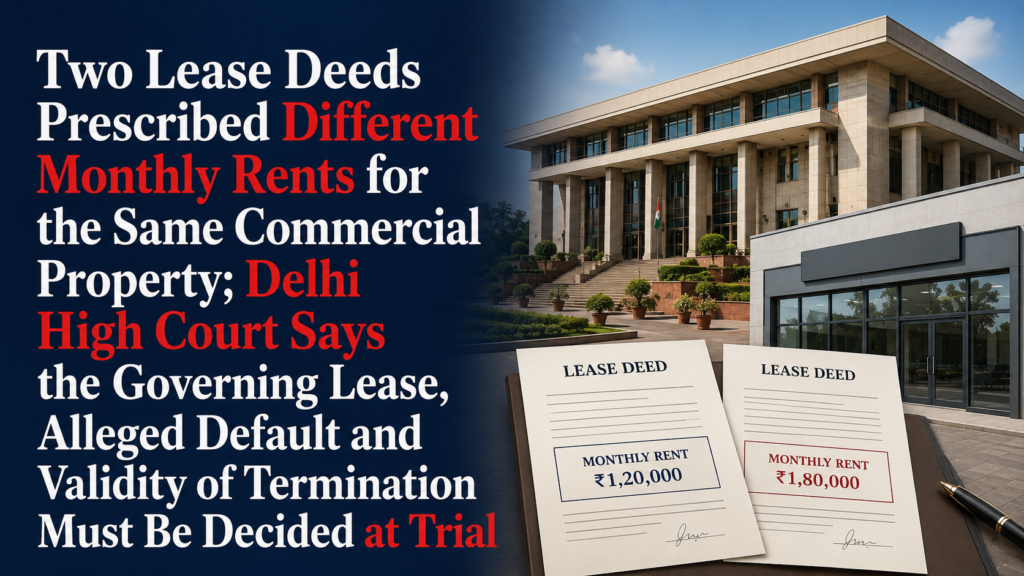
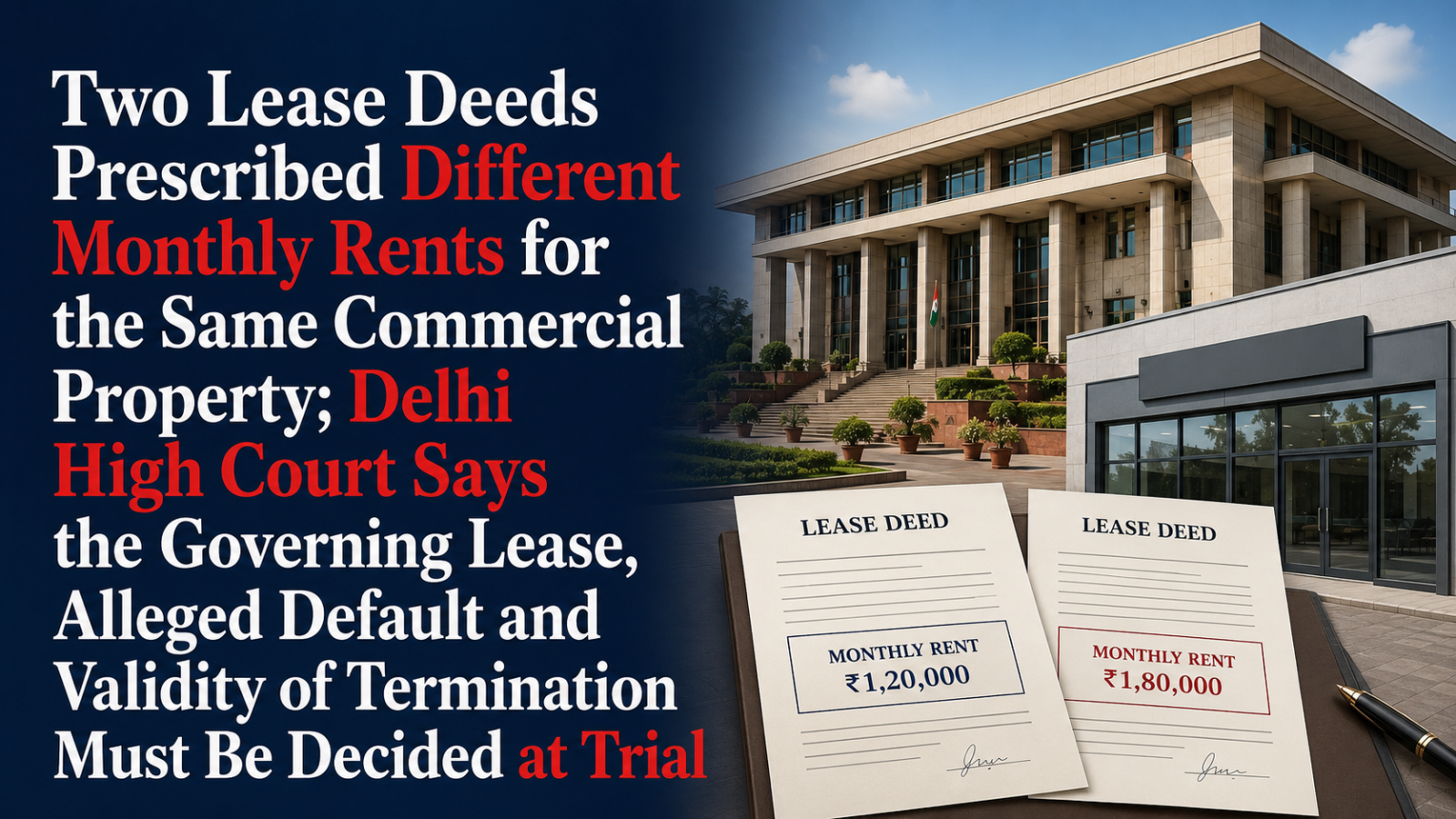
The Court noted that two lease deeds existed:
- a registered lease deed showing monthly rent of ₹1,60,000; and
- a subsequent notarized lease deed showing monthly rent of ₹50,000.
The tenant specifically pleaded that the second agreement superseded the first.
Whether:
- the later document substituted the earlier lease; or
- it was executed for some collateral purpose,
was held to be a disputed question of fact requiring evidence.
The Court observed that this issue could not be decided summarily under Order XII Rule 6 CPC.
No Admission of Rent Default
The High Court found that although the tenant admitted paying rent at ₹1,60,000 on certain occasions, he had never admitted default from July 2023.
Instead, he consistently pleaded that:
- the landlady refused to accept rent;
- he deposited rent through proceedings under Section 27 of the Delhi Rent Control Act.
Whether there was actual default and whether termination of tenancy was valid therefore required adjudication on evidence.
Other Triable Issues
The Court also noticed additional disputes requiring trial:
- both lease deeds contemplated a tenancy lasting until 31 December 2028;
- the tenant alleged the premises had been sealed by the Municipal Corporation due to unauthorized construction;
- he produced bank statements showing several payments made during the tenancy.
The effect of:
- these payments;
- the alleged sealing of the property;
- the lock-in clause;
- the validity of termination,
could not be conclusively determined without recording evidence.
Precedent Analysis
Although the judgment principally relied upon settled principles governing Order XII Rule 6 CPC rather than extensively discussing individual precedents, the Court reaffirmed the established legal position that:
- judgment on admissions is an exceptional remedy;
- admissions must be clear, unequivocal and unconditional;
- where a defence is bona fide and raises genuine triable issues, the court should not bypass a full trial.
Applying these settled principles, the Court found that disputes relating to the governing lease deed, the agreed rent, alleged default and validity of termination all required evidence before adjudication.
Court’s Reasoning
The High Court held that the Commercial Court erred in concluding that the tenant had made admissions sufficient to justify a decree for possession.
It observed that:
- the governing contractual document itself was disputed;
- default in payment of rent had been specifically denied;
- the tenant asserted that rent was tendered and later deposited in court;
- several factual disputes required appreciation of evidence.
Since these were genuine triable issues, the summary procedure under Order XII Rule 6 CPC could not be invoked.
The Court therefore concluded that the Commercial Court had prematurely terminated the litigation.
Conclusion
The Delhi High Court allowed the appeal.
It:
- set aside the Commercial Court’s order dated 3 June 2024;
- restored the commercial suit for trial;
- remitted the matter to the Commercial Court for adjudication in accordance with law.
The parties were directed to appear before the Commercial Court on 4 August 2026.
Key Takeaways
- A decree under Order XII Rule 6 CPC can be passed only on clear, unequivocal and unconditional admissions.
- Genuine disputes regarding contractual terms require a full-fledged trial.
- Conflicting lease deeds ordinarily create triable issues that cannot be resolved summarily.
- Mere admission of a landlord-tenant relationship does not automatically entitle a landlord to possession.
- Whether rent was actually in default and whether tenancy was validly terminated are factual issues requiring evidence when specifically disputed.
- Courts should avoid using Order XII Rule 6 CPC to short-circuit trials where the defence is bona fide.
Case Details
Case: Sonu v. Smt. Anita Gupta
Court: Delhi High Court
Case Number: RFA(COMM) 261/2024
Judges: Justice Anil Kshetrapal and Justice Amit Mahajan
Reserved On: 5 February 2026
Date of Decision: 24 July 2026
Result: Appeal allowed. The decree for possession passed under Order XII Rule 6 CPC was set aside, and the matter was remanded to the Commercial Court for a full trial.