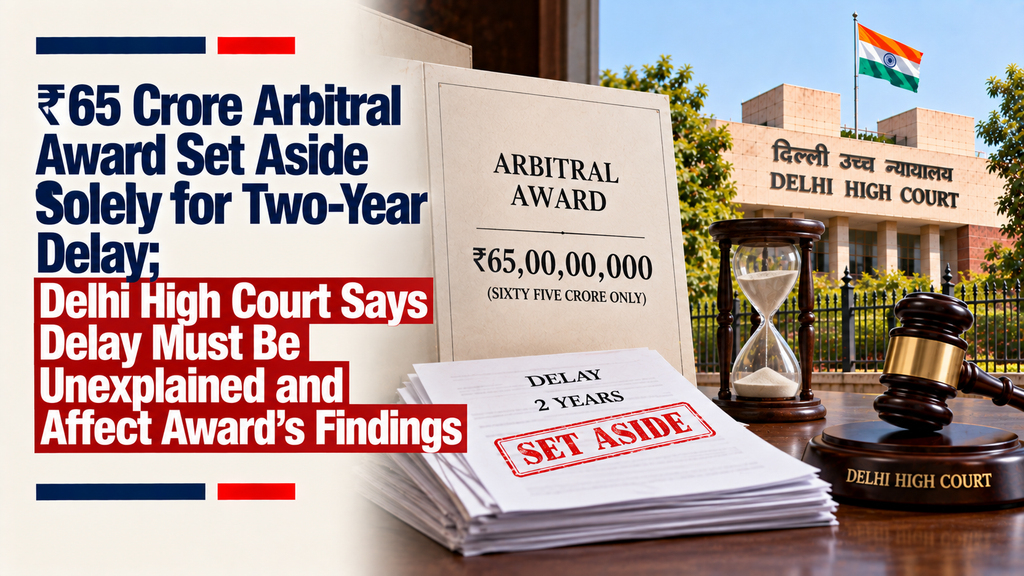
₹65 Crore Arbitral Award Set Aside Solely for Two-Year Delay; Delhi High Court Says Delay Must Be Unexplained and Affect Award’s Findings

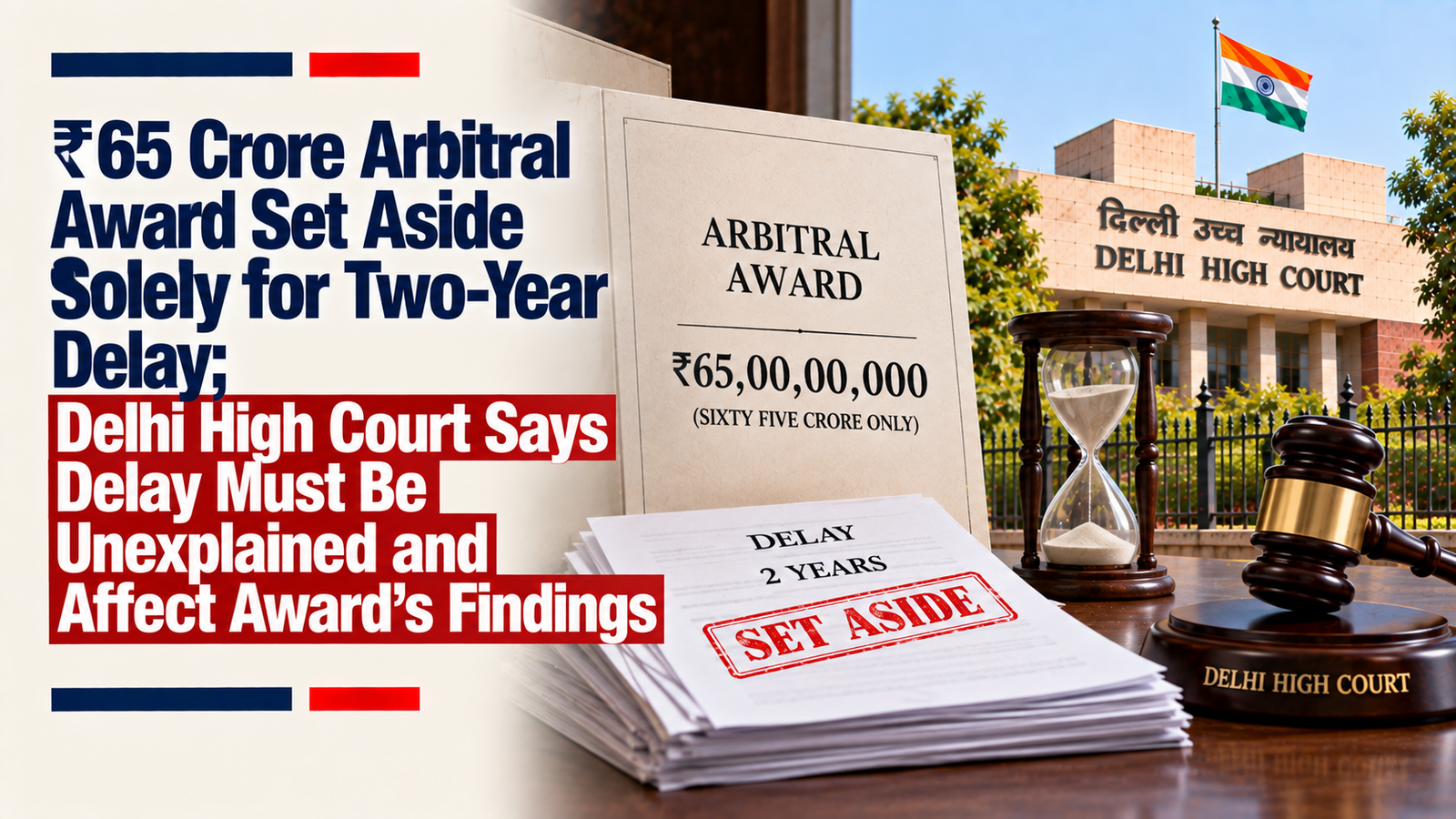
Three-Member Tribunal Awards Hotel ₹65 Crore Against Insurer; Delhi High Court Rejects Setting Aside Based Solely on Delayed Pronouncement
Facts
Unison Hotels Private Limited (UHPL) had insured its hotel with IFFCO Tokio General Insurance Company Limited under two policies:
- Standard Fire and Special Perils Policy for approximately ₹186.44 crore; and
- Fire Loss of Profit Policy for ₹100 crore.
Both policies operated from 1 April 2007 to 31 March 2008.
On 26 January 2008, a fire broke out at the hotel.
UHPL claimed ₹68.64 crore under the Material Damage Policy and ₹100 crore under the Loss of Profit Policy.
The insurer paid ₹20 crore under the Material Damage Policy and ₹30 crore under the Loss of Profit Policy and contended that the claims stood fully and finally settled on 30 January 2012.
UHPL disputed the alleged settlement and invoked arbitration for the unpaid amount.
A three-member Arbitral Tribunal was constituted on 27 April 2012. The Tribunal ultimately found that the alleged settlement was not voluntary and proceeded to decide UHPL’s claims on merits.
The award was:
Reserved: 6 March 2021
Pronounced: 6 March 2023
Thus, there was a two-year gap between reservation and pronouncement.
The Tribunal unanimously awarded UHPL:
₹65,12,97,874 + 9% simple interest + ₹50 lakh costs.
Interest was awarded at 9% from filing of the Statement of Claim until the award and thereafter at the same rate until realisation.
Section 34 Proceedings
IFFCO Tokio challenged the award before a Single Judge under Section 34 of the Arbitration and Conciliation Act, 1996.
Its principal argument was that the award stood vitiated by the inordinate and unexplained two-year delay in its pronouncement.
The Single Judge accepted this argument.
The Single Judge reasoned that passage of time debilitates human memory and creates doubt as to whether oral submissions and arguments remained fresh in the arbitrators’ minds.
The Court also found the explanation based on COVID-19 insufficient and concluded that the jurisdictional issue concerning Clause 13 of the insurance policies had been adversely impacted by the delay.
Accordingly, the entire arbitral award was set aside.
UHPL appealed under Section 37.
Issues
The principal issue before the Division Bench was:
Can an arbitral award be set aside solely because two years elapsed between reserving and pronouncing the award?
The Court additionally examined:
- whether the delay was adequately explained;
- whether actual adverse impact of delay on the award had to be demonstrated;
- whether mere presumed fading of the arbitrators’ memory was sufficient;
- whether the Tribunal had failed to consider Clause 13 and arbitrability;
- the scope of interference under Sections 34 and 37; and
- whether the Section 34 proceedings should be remanded for consideration of the remaining challenges.
Appellant’s Arguments — Unison Hotels
UHPL argued that the Supreme Court’s decision in Lancor Holdings Ltd. v. Prem Kumar Menon had conclusively held that delay by itself cannot invalidate an arbitral award.
According to UHPL, two additional conditions had to exist:
First: the delay must be unexplained.
Second: the delay must have demonstrably affected the findings in the award.
UHPL submitted that neither condition existed here.
The award was detailed, reasoned, unanimous and dealt comprehensively with the evidence and issues.
Moreover, the delay was explained by:
- COVID-19;
- delayed written submissions by the parties; and
- the need for three arbitrators to meet, deliberate and reach consensus.
UHPL further argued that the Single Judge had failed to identify even one argument, issue or piece of evidence forgotten by the Tribunal because of the delay.
Respondent’s Arguments — IFFCO Tokio
IFFCO Tokio argued that the delay itself was sufficiently serious to invalidate the award.
It contended that an unexplained delay of this magnitude creates an inference that:
- arguments may have faded from memory;
- witness demeanour could no longer be recalled;
- intricate details of the record could have been forgotten; and
- independent application of mind became doubtful.
The insurer also argued that the Tribunal had failed to properly consider Clause 13 of the insurance policies, which permitted arbitration only where liability was admitted and the dispute related merely to quantum.
According to the insurer, once the claims had been fully and finally settled through discharge receipts, no arbitrable dispute survived.
Analysis of the Law
Delay Alone Cannot Invalidate an Arbitral Award
This is the central proposition of the judgment.
The Division Bench held:
Delay in pronouncement, standing by itself, is not sufficient to set aside an arbitral award.
Two additional requirements must be satisfied:
- The delay must be unexplained; and
- The delay must have affected the findings contained in the award.
Thus, the equation is not:
Long delay = invalid award.
Instead:
Unexplained delay + demonstrable impact on findings = possible ground for setting aside.
The Court treated this as flowing from the Supreme Court’s decisions in Lancor Holdings and C. Velusamy v. K. Indhera.
Mere Possibility That Arbitrators “Forgot” Arguments Is Insufficient
The Single Judge had reasoned that human memory fades with time and therefore arguments might not have remained fresh in the arbitrators’ minds.
The Division Bench found this reasoning insufficient.
It observed that the Single Judge had not identified any particular argument that the Tribunal had forgotten.
Nor was any specific finding shown to have been negatively affected because of the delay.
The Court held that a mere:
“possibility of forgetting”
without a specific finding showing a negative effect on the award was clearly insufficient to set it aside.
Court Cannot Presume That Arbitrators Forgot Everything
IFFCO Tokio argued that because the three arbitrators had not met for a considerable period after reserving the award, it could be inferred that the matters argued before them had been forgotten.
The Division Bench described this contention as:
“presumptuous, to say the least”
and observed that it was also dismissive of the capability of the arbitrators constituting the Tribunal.
Most significantly, the insurer could not identify a single argument advanced before the Tribunal which the award failed to consider.
For the Court, that fact substantially demolished the contention that delay had impaired the award.
Delay Was Adequately Explained
The Division Bench disagreed with the Single Judge’s finding that the delay was unexplained.
The Court considered:
- the COVID-19 pandemic;
- the delay by the parties themselves in filing written submissions; and
- the practical necessity for three arbitrators to deliberate and arrive at consensus.
The Tribunal consisted of three eminent former judges—a retired Supreme Court Judge, a retired Chief Justice of the Jammu and Kashmir High Court and a retired Delhi High Court Judge.
The Court observed that a three-member Tribunal necessarily requires internal deliberation and concurrence before finalising an award.
Viewed in this context, the Court held:
the delay could not be characterised as unexplained.
Detailed Award Showed No Adverse Impact of Delay
The Division Bench independently examined the award for the limited purpose of determining whether delay had affected it.
It found that the award “discusses all issues threadbare.”
No aspect of the dispute was shown to have been left undecided because of the lapse of time.
The Division Bench clarified that it was not deciding whether the substantive findings would ultimately withstand Section 34 scrutiny; it was only examining whether those findings appeared to have been adversely affected by delayed pronouncement.
It found no such impact.
Clause 13 and Arbitrability Were Effectively Addressed
Clause 13 permitted arbitration where the insurer’s liability was admitted but the quantum payable was disputed.
The insurer argued that the Tribunal had failed to consider whether this requirement was satisfied.
The Division Bench disagreed.
The insurer did not dispute that it was liable to compensate UHPL for losses caused by the fire. Its case was essentially that it had already discharged its entire liability through the settlement and discharge vouchers.
UHPL’s case was that the discharge voucher had been obtained under financial duress and coercion.
The Tribunal examined this question extensively and concluded that the discharge voucher was executed under financial duress and coercion.
Consequently, the discharge voucher did not extinguish UHPL’s remaining claim by accord and satisfaction.
The amount still payable therefore remained open for adjudication.
Since the underlying liability was undisputed and the surviving controversy concerned quantum, the Division Bench held that the dispute remained arbitrable within Clause 13.
Section 14 Application Was Not a Precondition
UHPL also argued that because IFFCO Tokio had never approached the Court under Section 14 seeking termination of the Tribunal’s mandate for undue delay, it should not subsequently be permitted to challenge the award on that basis.
The Division Bench rejected this proposition.
It held that failure to invoke Section 14 does not extinguish the right to challenge an award under Section 34 on the ground of delayed pronouncement, provided the legal requirements for such a challenge are otherwise established.
Thus:
Section 14 is not a mandatory precondition to a subsequent delay-based Section 34 challenge.
Scope of Section 37
The insurer argued that Section 37 jurisdiction was analogous to a second appeal under the Code of Civil Procedure.
The Division Bench described that proposition as:
“jurisprudentially incorrect.”
Although Section 37 jurisdiction is narrow and cannot exceed the limitations imposed by Section 34, it is not technically equivalent to a second appeal under the CPC.
The appellate court must determine whether the Section 34 Court exercised its jurisdiction within the statutory boundaries.
Here, the Single Judge had set aside the award solely for delay without applying the correct legal test.
Section 37 therefore required appellate interference.
Precedent Analysis
Lancor Holdings Ltd. v. Prem Kumar Menon — 2025 SCC OnLine SC 2319
This was the principal authority.
The Supreme Court held that delay in delivering an arbitral award is not by itself sufficient to set it aside.
The Court must determine, on the facts of each case, whether the delay adversely impacted the final decision.
Only where the damaging effect of an undue and unexplained delay is reflected in the award can it potentially attract public policy or patent illegality grounds.
C. Velusamy v. K. Indhera — 2026 SCC OnLine SC 142
The Division Bench relied upon Velusamy as reiterating the two-fold requirement:
unexplained delay + impact upon findings.
It noted that Velusamy was subsequent to the Delhi High Court’s Division Bench judgment in G.L. Litmus Events.
DDA v. G.L. Litmus Events Pvt. Ltd.
The insurer heavily relied on this decision, where an award pronounced after approximately 19 months was set aside.
The Division Bench distinguished it on three material grounds.
First, the award in G.L. Litmus contained no explanation for the delay.
Second, the parties had sent three communications asking the arbitrator to pronounce the award expeditiously.
Third, that decision did not address the subsequent formulation reiterated in Velusamy that the delay must affect the findings of the award.
Accordingly, G.L. Litmus Events did not govern the present case.
Court’s Reasoning
The Division Bench found the Single Judge’s approach fundamentally inconsistent with the Supreme Court’s governing test.
The Single Judge had:
set aside the award for delay → presumed fading of memory → declined to examine the award’s substantive findings.
But Lancor Holdings required precisely the opposite inquiry:
The Court must examine whether the delay actually affected the findings.
The Single Judge’s statement that the merits “need not be gone into” therefore undermined the very basis on which the award had been invalidated.
The Division Bench ultimately found:
- delay alone is insufficient;
- the delay was adequately explained;
- neither party complained about the delay while awaiting the award;
- the award was detailed and comprehensive;
- no finding was shown to have been affected by delay;
- no argument was identified as having been forgotten;
- Clause 13/arbitrability was effectively addressed; and
- speculative concerns about fading memory could not substitute for a demonstrated adverse impact.
Important — The ₹65 Crore Award Was Not Finally “Restored”
This distinction is critical.
The Division Bench set aside the Single Judge’s judgment which had quashed the arbitral award, but it did not finally uphold the ₹65.13 crore award on all Section 34 grounds.
Instead, the Court remanded OMP (Comm) 197/2023 to the Single Judge for de novo consideration.
It expressly clarified that its findings were confined to deciding whether the award could have been set aside solely because of delay.
The answer was no.
Therefore, the accurate formulation is:
The delay-based setting aside was reversed; the Section 34 challenge will now be reconsidered afresh on the remaining grounds.
Conclusion
The Delhi High Court allowed Unison Hotels’ Section 37 appeal.
It quashed the Single Judge’s judgment dated 30 January 2026, which had set aside the ₹65.13 crore arbitral award solely because of delayed pronouncement.
However, rather than finally confirming the award, the Division Bench remanded the Section 34 petition for de novo consideration by the Single Judge, uninfluenced by the earlier judgment.
Key Takeaway
An arbitral award cannot be set aside merely because it was pronounced long after being reserved. Delay becomes legally fatal only where it is unexplained and is shown to have adversely affected the findings in the award. A general presumption that arbitrators may have forgotten arguments because of the passage of time is insufficient; the Section 34 Court must identify a demonstrable impact of the delay on the decision.
Case Details
Case: Unison Hotels Private Limited v. IFFCO Tokio General Insurance Company Limited
Court: High Court of Delhi at New Delhi, Division Bench
Case No.: FAO(OS) (COMM) 29/2026 & CM APPL. 11008/2026
CNR: DLHC010059632026
Coram: Justice C. Hari Shankar and Justice Vinod Kumar
Reserved: 7 September 2026
Pronounced: 16 September 2026
Result: Appeal allowed; Single Judge’s order setting aside the arbitral award quashed; Section 34 petition remanded for de novo consideration.