NIOS Refuses Date-of-Birth Correction After 13 Years Citing Limitation; Delhi High Court Says Genuine Factual Errors Cannot Be Perpetuated, Orders Correction

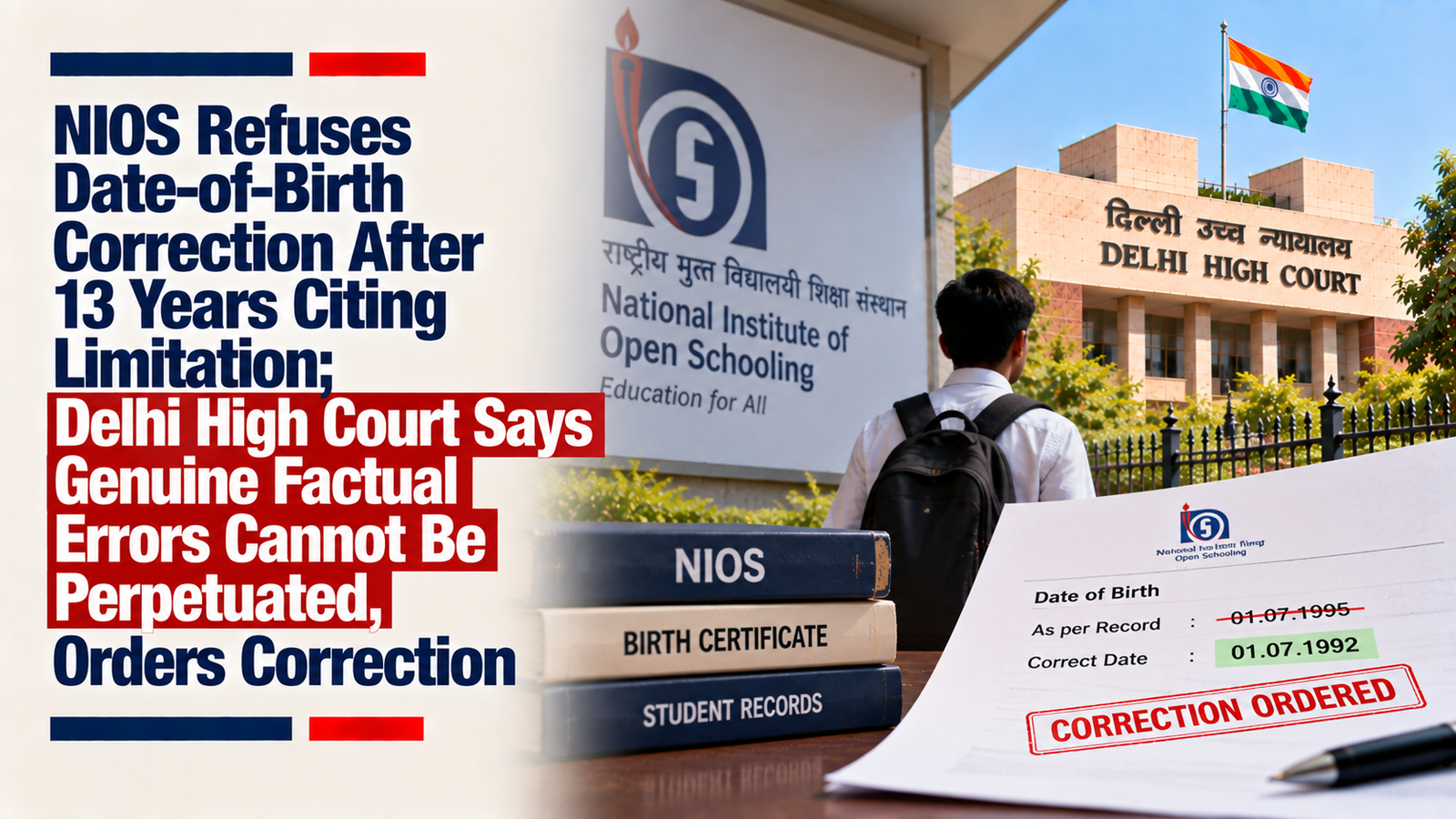
Earlier Writ Dismissed in 2019 on Limitation; Delhi High Court Entertains Fresh Claim After NIOS Rules Change, Orders Date-of-Birth Correction
Facts
The petitioner, Prabhat Shahi, appeared for the NIOS Class X examination in October 2005. His marksheet dated 9 December 2005 and corresponding certificate recorded his date of birth as 10 February 1989.
According to the petitioner, this was a clerical/typographical error. His correct date of birth was 10 February 1990, which was consistently reflected in his:
- Birth Certificate;
- Bona Fide Certificate dated 25 January 2003;
- Transfer Certificate dated 4 September 2004; and
- other public documents.
He first approached NIOS for correction on 13 August 2018, but the request was rejected on 6 September 2018 as being beyond the limitation period prescribed under the then-applicable rules.
His challenge before the Allahabad High Court was dismissed on 8 March 2019, but importantly, there was no adjudication regarding the genuineness of his documents or his actual date of birth.
Thereafter, the regulatory position changed. Following the Supreme Court’s judgment in Jigya Yadav v. CBSE and amendments to the NIOS framework, the petitioner made a fresh representation in October 2025.
When that representation remained undecided, he approached the Delhi High Court under Article 226 seeking correction of his NIOS records from 10.02.1989 to 10.02.1990.
Issues
The principal issues before the Court were:
- Whether NIOS could reject the petitioner’s date-of-birth correction solely on the ground of limitation;
- Whether the earlier 2018 rejection and 2019 Allahabad High Court order barred reconsideration;
- Whether the subsequently amended NIOS rules permitted correction of genuine factual or typographical errors;
- What evidentiary weight should be given to the petitioner’s Birth Certificate and other consistent public records; and
- Whether an educational authority can require a person to continue with two inconsistent dates of birth in official records.
Petitioner’s Arguments
The petitioner submitted that 10 February 1990 was his genuine date of birth and the entry of 10 February 1989 in the NIOS certificate was merely a clerical error.
He relied upon his Birth Certificate, school records and other public documents, all of which consistently reflected 1990.
He further argued that his earlier request had been rejected only because of the limitation provision then in force; neither NIOS nor the Allahabad High Court had found his supporting documents false or determined that 1989 was his correct year of birth.
Reliance was placed principally upon Jigya Yadav v. CBSE and Prema Evelyn D’Cruz v. Union of India to contend that genuine corrections supported by authentic public documents cannot be defeated on hyper-technical grounds.
Respondent’s Arguments
NIOS argued that the petitioner had been admitted in 2004 and, under the rules then applicable, correction of date of birth was permissible only before the first examination or within three years of registration.
NIOS further relied upon Board of Secondary Education of Assam v. Mohd. Sarifuz Zaman to argue that correction of date of birth can legitimately be subjected to limitation and that delay and laches may defeat such a claim.
It also relied on the fact that the petitioner’s earlier writ petition had already been dismissed by the Allahabad High Court.
Analysis of the Law
“Law Is as Clear as Daylight”
Justice Jasmeet Singh described the issue as a simple question concerning correction of date of birth and observed that:
“The law in this regard is as clear as daylight”
in view of the Supreme Court’s authoritative ruling in Jigya Yadav.
The Court emphasised that administrative efficiency cannot be elevated to such a level that it effectively prevents an individual from securing accurate particulars in educational certificates.
The Supreme Court in Jigya Yadav had recognised that students may discover mistakes later or appreciate their consequences only when certificates are required for higher education, employment or other official purposes.
Educational Board’s Responsibility Does Not End After Issuing Certificate
The Court relied on Jigya Yadav for the proposition that the responsibility of an educational board does not end once examination results and certificates are issued.
Educational certificates continue to have substantial consequences throughout a person’s life, particularly for higher education and employment.
The balance of convenience in correcting genuine inaccuracies therefore ordinarily weighs heavily in favour of the student because the student may suffer substantially greater consequences from an incorrect certificate than the administrative inconvenience suffered by the Board.
Birth Certificates and Public Documents Carry Considerable Evidentiary Value
The Court also relied upon the Division Bench ruling in Prema Evelyn D’Cruz, where correction had been directed after 22 years.
That decision recognised that an official Birth Certificate issued by the competent authority is a statutory public document carrying a presumption of correctness and should not ordinarily be disregarded without cogent reasons.
The Court emphasised the broader principle that citizens are entitled to have their relevant particulars correctly reflected across public documents, particularly because a matriculation certificate is routinely relied upon as proof of date of birth.
Crucial Change in NIOS Rules
This was one of the most significant aspects of the judgment.
NIOS issued Notification No. 7/2026 dated 14 May 2026, superseding the earlier 2022 notification.
The new framework provides that although the date of birth recorded in NIOS records ordinarily cannot be “changed,” a:
genuine typographical or factual error may be corrected through the online mode.
The rules contemplate supporting documents issued by public authorities, including Birth and Death Registrars, municipal authorities, passports and School Leaving Certificates, together with an affidavit and indemnity undertaking.
Most importantly, the Court noted that the 2026 notification prescribes no time limit for correction of date of birth.
Consequently, the very foundation of NIOS’s limitation objection had disappeared.
Earlier Rejection Did Not Conclude the Issue
The Court specifically dealt with the petitioner’s earlier unsuccessful proceedings.
It held that the 2018 rejection did not determine the issue on merits.
The rejection was founded upon the limitation provision then applicable, while the Allahabad High Court’s order of 8 March 2019 did not adjudicate upon the correctness or genuineness of the documents relied upon by the petitioner.
This distinction was crucial because the applicable regulatory framework had subsequently changed.
Mohd. Sarifuz Zaman Distinguished
NIOS’s reliance on Board of Secondary Education of Assam v. Mohd. Sarifuz Zaman was rejected.
The Court noted that Jigya Yadav itself had distinguished that judgment as arising from a different factual and legal context.
The Supreme Court in Jigya Yadav had explained that fundamental rights concerning identity cannot necessarily be treated in the same manner as ordinary civil rights governed rigidly by limitation periods.
Court Examines the Petitioner’s Documents
The Court did not merely direct NIOS to reconsider the representation.
It examined the documents placed before it.
The Court found that the petitioner’s:
Aadhaar Card, Driving Licence, Passport, PAN Card, Bona Fide Certificate dated 25 January 2003 and Kendriya Vidyalaya Transfer Certificate
all reflected his date of birth as:
10 February 1990.
This consistent documentary record persuaded the Court that the NIOS entry required correction.
Person Cannot Be Forced to Carry Two Dates of Birth
This is the strongest Raw Law proposition from the judgment.
The Court held:
“A person cannot be made to carry two different dates of birth in official records.”
It further held that an educational authority cannot perpetuate an apparent factual error merely because the error remained uncorrected for a considerable period.
Administrative convenience is legitimate, but it cannot override a statutory educational authority’s obligation to maintain accurate public records, particularly where the correction sought concerns a genuine clerical or factual error.
The Court found that leaving the discrepancy untouched would result in one date of birth appearing across the petitioner’s official documents and another in his Class X certificate—an outcome it characterised as “not only impractical but also impermissible in law.”
Precedent Analysis
Jigya Yadav v. Central Board of Secondary Education, (2021) 7 SCC 535
The principal Supreme Court authority.
The judgment recognises the importance of an individual’s identity and rejects an absolute prohibition against post-result corrections in educational certificates merely in the name of administrative efficiency.
It also requires a realistic approach to limitation because errors may be discovered, or their consequences appreciated, much later.
Prema Evelyn D’Cruz v. Union of India
Particularly significant because the Delhi High Court noted that correction had been directed after a lapse of 22 years.
The case supports the evidentiary significance of statutory public documents such as Birth Certificates and the need for consistency across official records.
Board of Secondary Education of Assam v. Mohd. Sarifuz Zaman, (2003) 12 SCC 408
Relied upon by NIOS for limitation.
The Court held that its application was misplaced because Jigya Yadav had distinguished the decision and adopted a broader constitutional approach toward questions affecting identity.
Court’s Reasoning
The Court’s reasoning can essentially be reduced to four propositions:
- The petitioner’s official and school records consistently established his date of birth as 10 February 1990.
- The earlier proceedings had failed only on limitation and had never adjudicated the genuine date of birth on merits.
- NIOS’s own 2026 Notification now permits correction of genuine factual/typographical date-of-birth errors without prescribing the earlier limitation period.
- An educational authority cannot knowingly perpetuate an apparent factual error and force a citizen to maintain inconsistent dates of birth across official records.
Conclusion
The Delhi High Court allowed the writ petition.
NIOS was expressly directed to:
correct the petitioner’s date of birth from 10.02.1989 to 10.02.1990 and issue the necessary corrected certificates.
Key Takeaway
A genuine date-of-birth error in an educational certificate cannot be perpetuated merely because considerable time has passed, particularly where authentic public and school records consistently establish the correct date and the governing regulations permit correction. A person cannot be compelled to carry two different dates of birth across official records.
Case Details
Case: Prabhat Shahi v. National Institute of Open Schooling (NIOS)
Court: Delhi High Court
Case No.: W.P.(C) 2690/2026
Judge: Justice Jasmeet Singh
Reserved: 30 July 2026
Pronounced: 16 September 2026
Result: Petition allowed; NIOS directed to correct date of birth from 10 February 1989 to 10 February 1990 and issue corrected certificates.