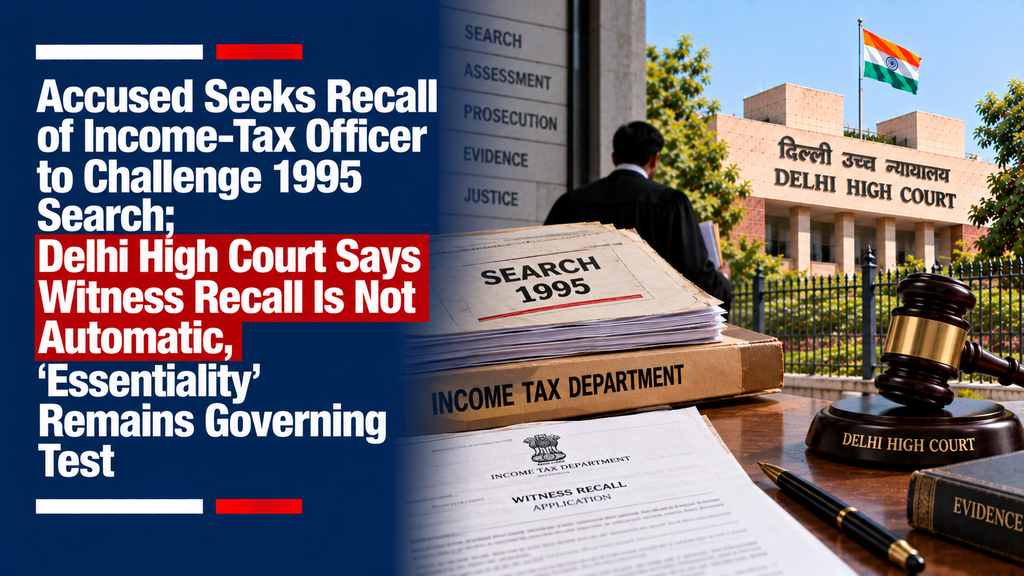
Accused Seeks Recall of Income-Tax Officer to Challenge 1995 Search; Delhi High Court Says Witness Recall Is Not Automatic, ‘Essentiality’ Remains Governing Test

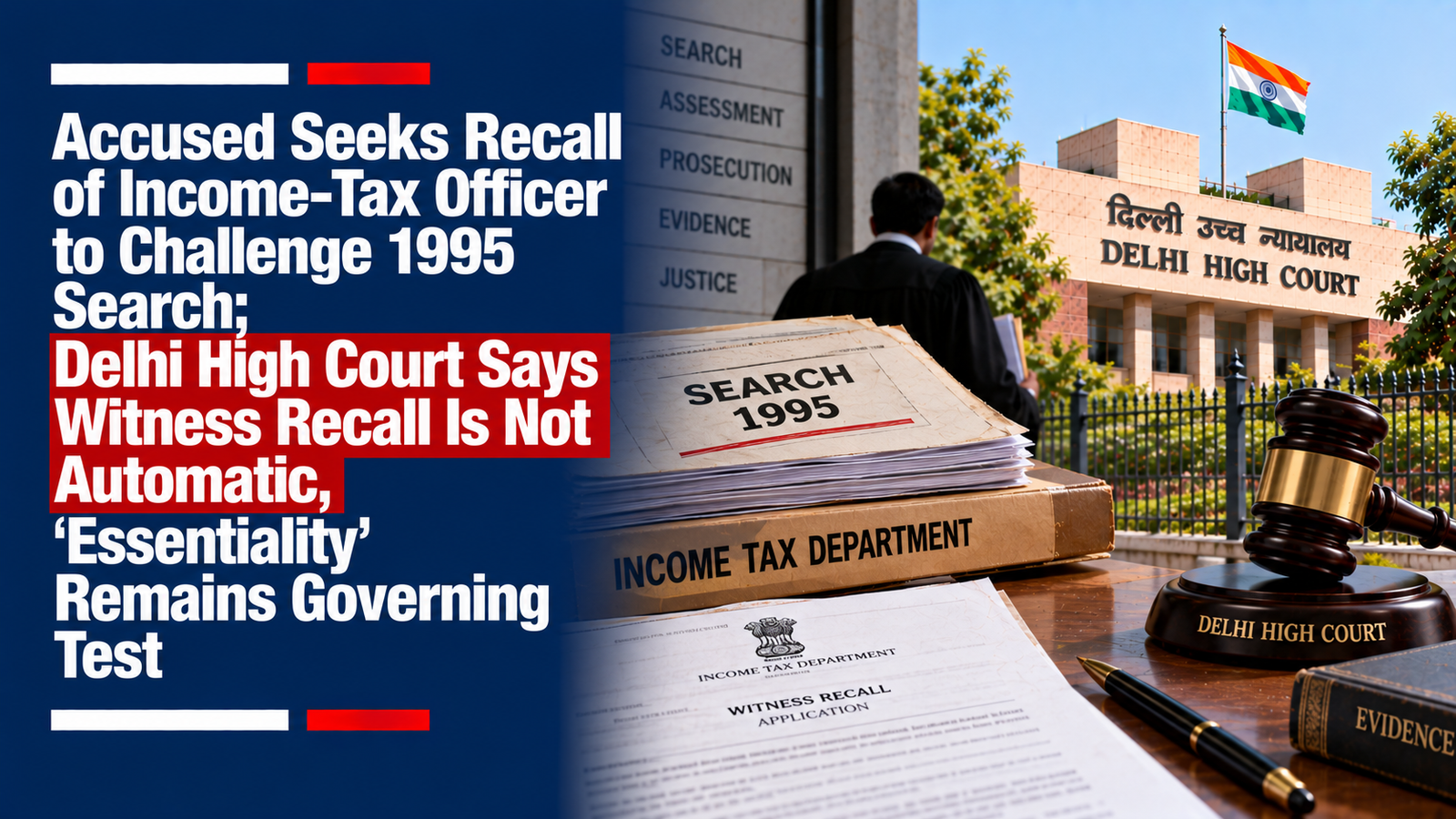
Accused Cannot Demand Recall of Witness Merely to Confront Him With Document Whose Production Already Stands Declined: Delhi High Court
Facts
The prosecution originated from information received by the Income Tax Department regarding alleged tax evasion by Ashok Chawla. Searches were conducted on 31 August 1995 at various premises connected with him and his associates.
During those searches, information was allegedly received regarding a garage at C-517, Defence Colony, New Delhi. An authorization under Section 132 of the Income Tax Act was issued, and during the search of that garage, documents relating to the Ministry of Defence, allegedly classified as “Secret” and “Confidential”, were recovered.
The documents were forwarded to the Ministry of Defence. On its complaint, the CBI registered an RC on 30 August 1996 and subsequently prosecuted the accused for offences under Section 120B IPC read with Section 3(1)(c) of the Official Secrets Act, 1923, along with the substantive offence.
The present petitioner, Vijaya Rajagopala, challenged two orders of the Special CBI Court:
- the 7 September 2022 order, which modified an earlier direction requiring production of the Income-Tax Department’s Satisfaction Note, Authorization Warrant and Panchnama; and
- the 11 October 2023 order, rejecting the petitioner’s application under Section 311 CrPC seeking recall and further cross-examination of PW-15 Y.K. Batra.
Why Were the Documents Initially Summoned?
During cross-examination, PW-3 D. Roy Choudhary disclosed that he had prepared a Satisfaction Note, which had been routed through PW-15 Y.K. Batra to the then Director (Investigation).
PW-3 also stated that the first Authorization Warrant was issued on the basis of this Satisfaction Note.
Based on this disclosure, the defence sought production of the documents.
The Trial Court initially found them relevant and necessary and, on 2 March 2020, allowed the Section 91 CrPC application and directed production of the record.
However, it was subsequently brought to the Trial Court’s notice that a Delhi High Court Division Bench had already examined the validity of the same search proceedings in 2017.
The Trial Court therefore reconsidered the necessity of producing the documents and modified its earlier order.
Issues
The Delhi High Court identified two principal questions:
- Whether the Trial Court was justified in declining further production of documents previously summoned under Section 91 CrPC; and
- Whether PW-15 should have been recalled for further cross-examination under Section 311 CrPC.
A significant ancillary issue was whether the Trial Court’s reconsideration of its earlier Section 91 order amounted to an impermissible review of its predecessor’s order.
Petitioner’s Arguments
The petitioner argued that the earlier orders directing production of the Satisfaction Note and Authorization Warrant had never been challenged by the CBI and had therefore attained finality.
Accordingly, the subsequent Trial Court could not “modify” what was effectively a final order; doing so amounted to an impermissible review.
The petitioner further contended that PW-3’s later testimony revealed for the first time that the Satisfaction Note had been routed through PW-15. It was therefore necessary to recall PW-15 and confront him with this material.
The defence sought to examine whether the foundational requirements for the Income-Tax search had actually been satisfied.
It was also argued that findings in income-tax proceedings could not determine criminal liability, where the prosecution must prove its case beyond reasonable doubt.
CBI’s Arguments
The CBI submitted that neither the Satisfaction Note nor the first Authorization Warrant was relied upon by the prosecution to prove the offences.
Its case rested principally upon the alleged recovery of classified documents from premises stated to be in the possession of the accused.
It further argued that PW-15 had already undergone detailed cross-examination concerning:
- source information;
- preliminary inquiry;
- authorization of the search;
- C-517 Defence Colony; and
- circumstances leading to the search.
The CBI also relied upon the statutory protection concerning disclosure of the “reasons to believe” recorded under Section 132 of the Income Tax Act.
Analysis of the Law
Section 91 — “Necessary or Desirable” Is the Controlling Test
The High Court held that Section 91 CrPC does not operate merely because a document exists or is available.
The first requirement is that its production must be:
“necessary or desirable”
for the investigation, inquiry or trial.
Crucially, necessity or desirability must be assessed at the stage when production is sought.
This meant that an earlier finding that a document was necessary did not prevent the Trial Court from reconsidering that necessity when significant material subsequently came to its notice.
Earlier Section 91 Order Was Not a Final Adjudication
This is one of the strongest propositions from the judgment.
The petitioner argued that because the CBI never challenged the 2020 order directing production, the subsequent Trial Court could not revisit it.
The High Court rejected this.
Relying upon Sethuraman v. Rajamanickam, it noted that orders under Sections 91 and 311 CrPC which decide nothing finally are interlocutory in nature.
The earlier orders merely directed production of documents. They did not decide:
- any ingredient of the offence;
- admissibility or effect of the alleged recovery; or
- any substantive defence available to the accused.
Accordingly, the later order did not constitute a substantive review of a final judicial order.
Non-Challenge Does Not Convert Procedural Order Into Final Adjudication
The Court further held:
The CBI’s failure to challenge the earlier production order did not make it immutable.
Non-challenge to a procedural direction cannot transform that direction into a final adjudication requiring production irrespective of later or previously unnoticed material relevant to its necessity.
Same Search Had Already Undergone Judicial Scrutiny
The 2017 Division Bench judgment assumed considerable importance.
The High Court found that the earlier Division Bench had not merely considered allegations concerning the motive behind the raid.
The material and file notings forming the basis of the warrant had actually been placed before that Court in sealed cover, and the Division Bench had consciously examined the justification for the search.
It had also separately considered procedural objections relating to the C-517 Defence Colony search, including timing, panch witnesses, alleged forcible entry, possible planting of documents and compliance with the Income Tax Rules.
Therefore, requiring production of the same foundational material merely to challenge the legality of the same search again was no longer “necessary or desirable” under Section 91.
But Income-Tax Judgment Does Not Decide Criminal Guilt
The High Court made an important qualification.
It expressly held that the 2017 Division Bench judgment did not determine the criminal liability of the petitioner.
The prosecution must still independently establish the offences charged against the petitioner in accordance with criminal law and the applicable standard of proof.
Thus, the earlier judgment was relevant only to the narrower question of whether the foundational search documents needed to be compulsorily produced again.
Section 311 — Recall of Witness Is Not Automatic
The Court then considered the petitioner’s request to recall PW-15.
It recognised that Section 311 CrPC gives criminal courts wide power to summon, recall or re-examine witnesses at any stage.
However:
Wide power does not mean automatic recall.
The controlling requirement is whether the proposed evidence is essential to the just decision of the case.
Relying upon State (NCT of Delhi) v. Shiv Kumar Yadav, the Court emphasised that merely saying recall is required for a “fair trial” is insufficient.
There must be tangible reasons showing why the absence of further examination would impair the fairness of the trial.
Why PW-15 Was Not Recalled
The petitioner’s specific purpose for recalling PW-15 was to confront him with the Satisfaction Note and question him regarding PW-3’s statement that the Note had been routed through him.
But by then:
the Satisfaction Note itself was not on record and its production had already been declined.
Therefore, the principal purpose for which PW-15’s recall had been sought could no longer be achieved.
Moreover, PW-15 had already undergone substantial cross-examination concerning the search.
He had been questioned regarding the preliminary inquiry, source information, authorization, ownership and possession of C-517, circumstances leading to issuance of the warrant and even the defence allegation that documents had been planted.
Later Disclosure by Another Witness Does Not Automatically Justify Recall
The Court articulated another useful Section 311 proposition:
A witness already examined need not be recalled merely because another witness subsequently refers to a fact connected with him.
The statutory test remains whether the further examination is essential for a just decision.
Here, no independent purpose—apart from confrontation with the Satisfaction Note—was demonstrated for another round of PW-15’s cross-examination.
Since production of that document had already been declined, the essentiality requirement was not satisfied.
Delay Was Not the Reason for Rejecting Recall
The Trial Court had also referred to delay and possible prolongation of the proceedings.
Interestingly, the High Court did not rely on that reasoning.
It held that even if the petitioner’s explanation for the timing of the Section 311 application was accepted, the application still failed because the proposed further examination was not shown to be essential to the just decision of the case.
Thus, the decision rests on lack of essentiality, not merely belatedness.
Precedent Analysis
State of Orissa v. Debendra Nath Padhi, (2005) 1 SCC 568
Relied upon for the principle that the first and foremost requirement under Section 91 is the necessity or desirability of the document, assessed at the stage when production is sought.
Sethuraman v. Rajamanickam, (2009) 5 SCC 153
Important for holding that orders on Sections 91 and 311 applications, where nothing is finally determined, are interlocutory.
The High Court used this principle to reject the contention that the earlier production order had become an immutable final adjudication.
State (NCT of Delhi) v. Shiv Kumar Yadav, (2016) 2 SCC 402
Recall is not a matter of course.
A general invocation of “fair trial” is insufficient; tangible reasons must establish why recall is necessary to prevent failure of justice.
Varsha Garg v. State of Madhya Pradesh
The Supreme Court held that the essentiality of the proposed evidence coupled with the requirements of a just decision constitute the touchstone for Section 311.
The High Court distinguished it because the evidence sought there constituted a crucial evidentiary link, unlike the present case.
Satbir Singh v. State of Haryana
Also distinguished.
In Satbir Singh, a relevant factual issue arose only after the subsequent examination of an expert, meaning the earlier witness had never had an opportunity to address it.
Here, although PW-3 subsequently referred to the Satisfaction Note being routed through PW-15, the very document with which PW-15 was proposed to be confronted was no longer available for that purpose.
Court’s Reasoning
The High Court essentially applied two distinct statutory tests:
For Section 91: Is continued production of the document necessary or desirable?
For Section 311: Is further examination of the witness essential to the just decision of the case?
On both counts, the petitioner failed.
The foundational material behind the Income-Tax search had already undergone judicial scrutiny before a Division Bench, while PW-15 had already been extensively cross-examined on the circumstances of the search.
The Court therefore found no jurisdictional error in refusing further production of the documents and no patent illegality or jurisdictional error in refusing to recall PW-15.
Conclusion
The Delhi High Court dismissed the petition under Section 482 CrPC and refused to interfere with either Trial Court order.
It nevertheless clarified that its observations were confined to the present challenge and would not constitute an expression on the merits of the criminal case.
Key Takeaway
Section 311 CrPC does not permit recall of a witness merely because additional questions can be asked or another witness subsequently mentions a connected fact. The proposed further evidence must be essential to the just decision of the case. Likewise, an earlier Section 91 direction for production of documents is procedural and can be reconsidered when subsequent or previously unnoticed material shows that compulsory production is no longer necessary or desirable.
Case Details
Case: Vijaya Rajagopala v. CBI
Court: Delhi High Court
Case No.: CRL.M.C. 7643/2023 & CRL.M.A. 28477/2023
Judge: Justice Madhu Jain
Reserved: 10 September 2026
Pronounced: 16 September 2026
Result: Petition dismissed; refusal to produce the Satisfaction Note/Authorization Warrant/Panchnama and refusal to recall PW-15 upheld.