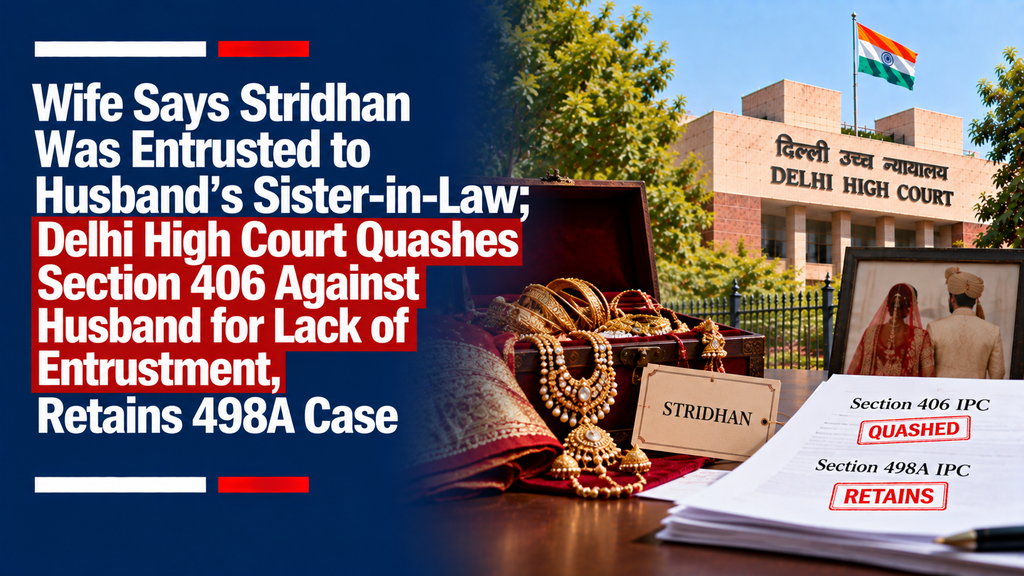
Wife Says Stridhan Was Entrusted to Husband’s Sister-in-Law; Delhi High Court Quashes Section 406 Against Husband for Lack of Entrustment, Retains 498A Case

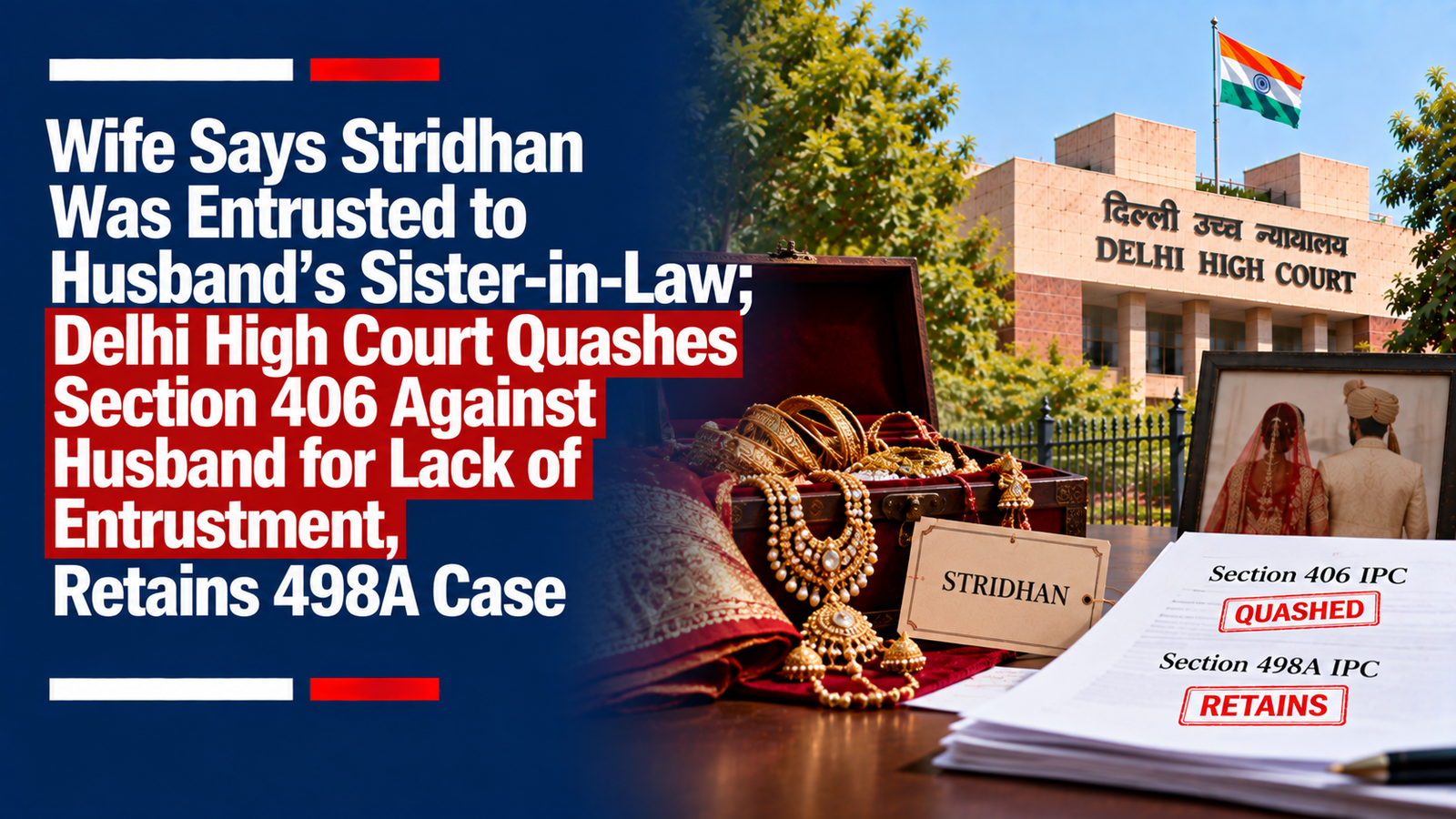
No Entrustment, Dominion or Dishonest Misappropriation Alleged Against Husband; Delhi High Court Partly Quashes Matrimonial FIR, Allows 498A to Continue
Facts
The petitioner, Harcharanjeet Bains, is a medical practitioner and US citizen residing in the United States since 1995. He married Respondent No. 2 on 16 October 2007 in New Delhi. No child was born from the marriage, and after the marriage, the petitioner returned to the United States while his wife remained in India.
A spousal visa was pursued for the wife. The US Embassy declined to issue the visa at that stage and subsequently recorded an ineligibility entry under the category “Alien Smuggling.” The petitioner engaged immigration lawyers, but the visa process did not ultimately progress.
In December 2013, the petitioner instituted annulment proceedings before a Missouri court. On 15 January 2015, the US court annulled the marriage on the ground of fraud. He later filed matrimonial proceedings in India under Section 13(1)(ia) and (ib) of the Hindu Marriage Act but withdrew them in January 2019.
Respondent No. 2 subsequently complained of matrimonial cruelty, demands for money and a vehicle, a demand of approximately ₹16–17 crore for purchase of land and establishment of a hospital, and non-return of jewellery allegedly entrusted to the petitioner’s sister-in-law, Sukhjit Kaur.
This led to FIR No. 184/2019 under Sections 498A and 406 read with Section 34 IPC.
After investigation, the petitioner was charge-sheeted without arrest under Sections 498A and 406 IPC. Significantly, Sukhjit Kaur—the person to whom the jewellery was allegedly entrusted—was placed in Column No. 12 and was not charge-sheeted.
The petitioner therefore approached the Delhi High Court seeking complete quashing of the FIR and consequential proceedings under Section 482 CrPC.
Issues
The Court considered two principal questions:
- Whether the allegations, taken at face value, disclosed offences under Sections 498A and 406 read with Section 34 IPC; and
- Whether the prosecution was liable to be quashed because cognizance had not yet been taken and was allegedly barred by the three-year limitation under Section 468 CrPC.
A further important issue arose: Can Section 406 be quashed independently while the Section 498A prosecution continues?
Petitioner’s Arguments
The petitioner argued that the FIR was a counterblast to the matrimonial proceedings instituted by him.
He contended that the parties had not met after December 2011 and that even the last communication relied upon by the wife was from January 2015, whereas the criminal complaint was instituted only years later.
Since Sections 498A and 406 IPC are punishable with imprisonment up to three years, he invoked the bar under Section 468 CrPC.
He also relied upon the Missouri annulment decree dated 15 January 2015, the wife’s visa history and contemporaneous correspondence with immigration lawyers to contend that the subsequent criminal allegations were inconsistent with the documentary record.
Respondent Wife’s Arguments
The wife opposed quashing and argued that the allegations were specific rather than omnibus.
She referred to allegations of:
- physical and sexual cruelty;
- demand for an Innova vehicle;
- demand of approximately ₹16–17 crore for land and a hospital;
- payment of ₹7 lakh to the petitioner’s brother; and
- retention of her jewellery.
She also stated that relevant bank records, card statements, purchase documents and witness particulars had been supplied to the Investigating Officer.
Regarding delay, she stated that she had continued hoping that the marriage would survive and therefore did not immediately initiate criminal proceedings.
Analysis of the Law
Defence Documents Must Be of “Sterling and Impeccable Quality” for Quashing
The Court relied upon Rajiv Thapar v. Madan Lal Kapoor and reiterated the stringent test applicable when an accused seeks quashing on the basis of his own defence material.
Such material must:
- be of sterling and impeccable quality;
- conclusively rule out the accusations;
- be incapable of being justifiably refuted; and
- establish that continuation of prosecution would constitute abuse of process.
The foreign annulment decree, visa records and immigration correspondence did not satisfy this threshold.
They might support the petitioner’s defence regarding the matrimonial relationship and visa process, but they did not conclusively disprove the wife’s specific allegations of acts allegedly committed in India.
Section 498A — Specific Allegations Survive
The Court rejected the argument that the complaint contained merely vague or omnibus allegations.
It noted specific allegations concerning demands for a vehicle and money, payment of ₹7 lakh to the petitioner’s brother, a ₹16–17 crore demand for establishing a hospital, and alleged acts of physical and sexual cruelty.
At the quashing stage, these allegations had to be accepted at face value.
Whether those incidents actually occurred and whether the complainant could prove them were questions of evidence, which could not be determined by preferring the husband’s version over the wife’s.
Accordingly, the Section 498A prosecution survived.
Section 406 — Entrustment Must Be to the Particular Accused
This is the strongest proposition from the judgment.
For criminal breach of trust, the prosecution must establish:
- entrustment of property or dominion over it to the accused; and
- subsequent dishonest misappropriation, conversion, use or disposal of that property.
Both ingredients must relate to the particular person sought to be prosecuted.
Wife’s Own Complaint Did Not Allege Entrustment to Husband
The Court examined the complaint and found that the wife herself specifically stated that she had handed over her jewellery to:
Sukhjit Kaur — the petitioner’s sister-in-law
for keeping it in her locker.
The complaint did not allege that:
- the jewellery was subsequently handed over to the petitioner;
- the petitioner acquired dominion or control over it;
- the wife demanded its return from the petitioner;
- the petitioner refused to return it; or
- he dishonestly converted or disposed of it.
Therefore, the very foundational ingredient of entrustment qua the husband was absent.
Charge-Sheet Could Not Cure the Defect
The final report itself recorded that the jewellery was allegedly in the possession of Sukhjit Kaur.
Yet, she had been placed in Column No. 12, with the investigating agency recording that no evidence was found against her.
No relevant jewellery was identified in the table of property/articles recovered or seized.
The Court specifically held that the petitioner’s failure to personally join investigation could not supply the missing ingredients of:
entrustment + dominion + dishonest misappropriation.
Matrimonial Relationship Cannot Create Section 406 Liability
The Court further held that merely because jewellery or other articles were purchased or given as gifts does not amount to “entrustment”.
There must be an allegation that the complainant retained ownership and placed those articles with the accused in trust.
Importantly:
Section 34 IPC cannot substitute the foundational ingredients of Section 406.
In the absence of material demonstrating a common intention between the petitioner and Sukhjit Kaur concerning retention or misappropriation, her alleged custody of the jewellery could not be imputed to the petitioner merely because of the matrimonial relationship.
General Stridhan Allegation Cannot Implicate Every Family Member
Relying on Raj Kumar Khanna v. State (NCT of Delhi), the Court crystallised an important matrimonial-criminal-law principle:
A general allegation of non-return of stridhan cannot sustain Section 406 prosecution against every member of the matrimonial family.
The complaint and charge-sheet must disclose:
entrustment or dominion attributable to that particular accused + subsequent dishonest dealing with the entrusted property.
Since even the prosecution material, taken entirely at face value, failed this test against the husband, continuation of Section 406 proceedings against him would amount to an abuse of process.
Partial Quashing of FIR/Charge-Sheet Is Permissible
The Court then addressed whether it could quash Section 406 alone while retaining Section 498A.
Relying principally on Ishwar Pratap Singh v. State of U.P., it held:
There is no legal requirement that a charge-sheet must be quashed entirely or not at all.
Section 482 permits offence-wise or partial quashing where the ingredients of one offence are absent even though another offence survives.
The Court also referred to Hitesh Verma v. State of Uttarakhand and Arun Singh v. State of U.P. as examples where prosecution under particular offences was quashed while other offences were permitted to continue.
Important Limitation Issue — Section 468 CrPC
The petitioner’s second major argument was that prosecution was already time-barred.
Sections 498A and 406 IPC carry imprisonment up to three years. Therefore, the applicable limitation under Section 468(2)(c) CrPC is three years.
The alleged last in-person cruelty was in April 2012 and the last abusive phone call was alleged in December 2012.
The subsequent communications of December 2014 and January 2015 were characterised as an apology and assurance of reconciliation—not fresh acts of cruelty.
Therefore, they did not create a fresh starting point of limitation.
Cognizance Date Is Not the Relevant Date for Section 468
This is another significant proposition.
Relying on the Constitution Bench decision in Sarah Mathew v. Institute of Cardio Vascular Diseases, the High Court reiterated:
For Section 468, limitation is tested with reference to the date of filing the complaint or institution of prosecution—not the later date when the Magistrate takes cognizance.
The Court noted that this principle was recently reiterated by the Supreme Court in Roma Ahuja v. State, 2026 SCC OnLine SC 557, including in the context of police cases: the relevant date is the filing of the complaint before the Magistrate or lodging of the FIR before police, as applicable.
But Why Was the 498A Case Not Quashed as Time-Barred?
On a simple calendar calculation, even taking December 2012 as the last alleged cruelty, the complaint/FIR dates in 2018–2019 were clearly beyond three years.
But the Court held that calendar calculation alone was not conclusive.
Two additional statutory provisions had to be considered.
Section 470(4)(a): Accused’s Absence From India
Section 470(4)(a) mandates exclusion of the period during which the offender:
“has been absent from India.”
Importantly, the Court clarified that this provision operates merely upon absence from India.
It does not require the accused to have been “absconding”.
Absconding is separately dealt with by Section 470(4)(b).
This is particularly important because the petitioner himself claimed that he was a US citizen, had lived there since 1995 and had not met the wife after December 2011.
However, there was no complete passport/immigration entry-exit record before the High Court.
Consequently, the Court could not perform the necessary day-to-day limitation calculation.
Section 473 Can Override the Limitation Bar
The second qualification was Section 473 CrPC.
Even where the statutory limitation has expired, a court may take cognizance if:
- the delay has been properly explained; or
- taking cognizance is necessary in the interests of justice.
The wife attributed her delay to continuing hope of reconciliation and relied upon an alleged apology in December 2014 and assurance of reconciliation in January 2015.
The High Court expressly clarified that it was not condoning the delay and was not accepting her explanation as finally established.
It merely held that the explanation required judicial consideration and therefore prevented Section 468 from operating as an automatic ground for quashing the FIR.
Precedent Analysis
Rajiv Thapar v. Madan Lal Kapoor, (2013) 3 SCC 330
Defence material can justify quashing at the pre-trial stage only when it is unimpeachable, conclusively demolishes the prosecution allegations and cannot reasonably be disputed.
The petitioner’s foreign decree and immigration material did not satisfy that test.
Arun Vyas v. Anita Vyas, (1999) 4 SCC 690
Section 498A cruelty may constitute a continuing offence, with each fresh act of cruelty giving a fresh starting point.
But where no subsequent cruelty is alleged, limitation runs from the last alleged act of cruelty.
Sarah Mathew v. Institute of Cardio Vascular Diseases, (2014) 2 SCC 62
The Constitution Bench established that for Section 468, the relevant date is institution of prosecution/filing of complaint, rather than the date on which cognizance is subsequently taken.
Abhishek Saxena v. State of U.P., 2023 SCC OnLine SC 1711
Reiterated that Section 406 requires entrustment/dominion followed by dishonest misappropriation or dealing contrary to the trust.
Raj Kumar Khanna v. State (NCT of Delhi), 2001 SCC OnLine Del 1159
Highly relevant on the facts. The Delhi High Court had similarly quashed Section 406 where no property was entrusted to the particular accused while permitting Section 498A to continue.
Ishwar Pratap Singh v. State of U.P., (2018) 13 SCC 612
Authoritatively recognises that there is no prohibition against quashing a charge-sheet in part. Each offence can be independently tested under Section 482.
Court’s Reasoning
The Court drew a clear distinction between disputed evidence and absence of an essential legal ingredient.
For Section 498A, specific allegations existed. Whether they were true required evidence and therefore could not be resolved in Section 482 proceedings.
For Section 406, however, even if the wife’s complaint and the police charge-sheet were accepted entirely as true, there was no entrustment or dominion attributed to the petitioner.
The defect was therefore not insufficiency of evidence—it was absence of the legal ingredients of the offence itself.
That distinction justified partial quashing.
Conclusion
The Delhi High Court partly allowed the petition.
It quashed:
FIR No. 184/2019, the charge-sheet and all consequential proceedings against the petitioner insofar as they related to Section 406 IPC.
However, the prosecution under:
Section 498A read with Section 34 IPC
was permitted to continue.
The Trial Court was directed, before taking cognizance of the remaining offence, to independently determine the limitation plea, including:
- the relevant date of institution of prosecution;
- periods liable to exclusion because of the petitioner’s absence from India under Section 470; and
- applicability of Section 473 CrPC.
Strongest Raw Law Takeaway
Stridhan being allegedly entrusted to one matrimonial relative does not automatically make every other family member liable for criminal breach of trust. Section 406 requires specific entrustment or dominion and subsequent dishonest dealing attributable to the particular accused; Section 34 cannot be used to fill that foundational gap.
Case Details
Case: Harcharanjeet Bains v. State & Anr.
Court: Delhi High Court
Case No.: CRL.M.C. 4517/2023 & CRL.M.A. 17279/2023
Judge: Justice Madhu Jain
Reserved: 21 August 2026
Decision: 16 September 2026
Result: Partly allowed — Section 406 IPC quashed against the husband; Section 498A read with Section 34 IPC permitted to continue, subject to independent determination of limitation by the Trial Court.