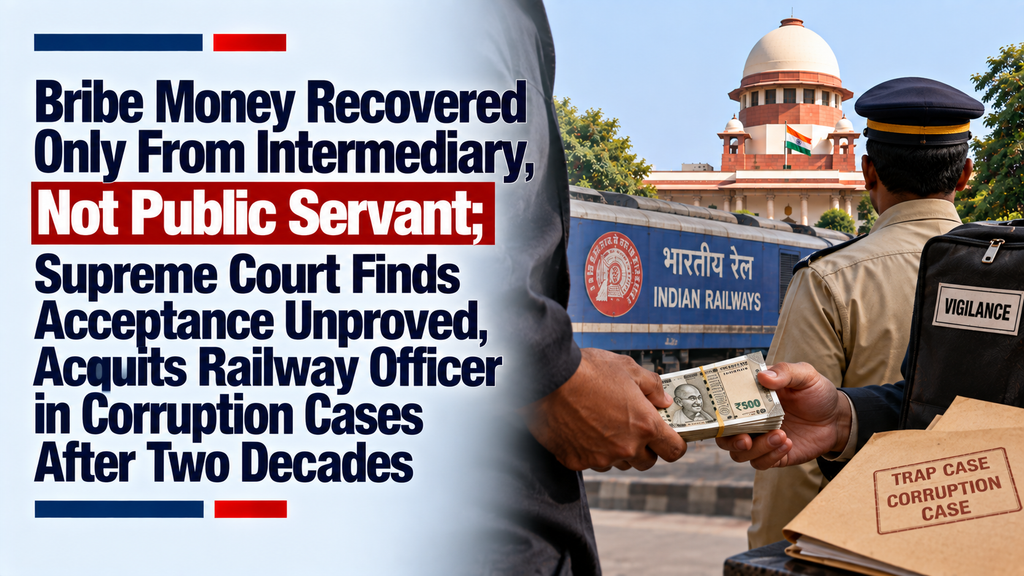
Bribe Money Recovered Only From Intermediary, Not Public Servant; Supreme Court Finds Acceptance Unproved, Acquits Railway Officer in Corruption Cases After Two Decades

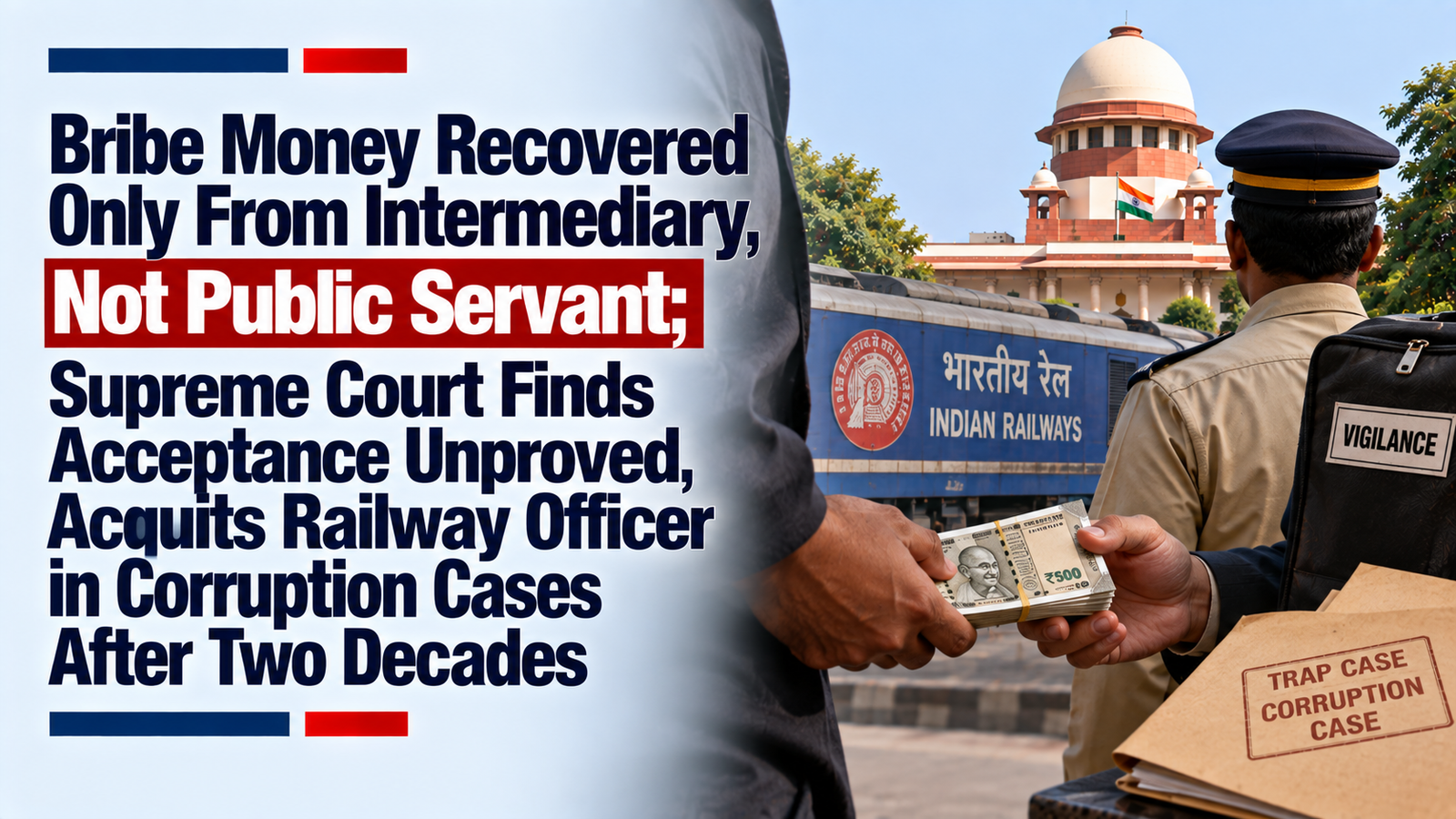
Mere Receipt of Bribe Money by Third Person Cannot Automatically Fasten Criminal Liability on Public Servant: Supreme Court
Facts
The appeals arose from a CBI anti-corruption investigation dating back to 2005 against Bharat Raj Meena, then Divisional Security Commissioner of the Railway Protection Force, Palakkad.
The prosecution alleged that the appellant had developed a system under which RPF personnel seeking favourable transfers, postings and service benefits were required to pay illegal gratification. Instead of ordinarily collecting money himself, he allegedly used subordinate RPF personnel Anantha Narayanan and Abdul Gafoor as intermediaries.
The CBI alleged 12 separate instances of bribery, involving payments ranging from ₹5,000 to ₹13,000.
The investigation began after P.P. Nandakumar, a Junior Clerk, complained that he had been asked to pay ₹10,000 for securing a posting at Palakkad. A CBI trap was organised on 4 August 2005.
However, the appellant himself was not caught accepting the money. Instead, intermediary Anantha Narayanan was apprehended accepting the first instalment of ₹5,000.
Both alleged intermediaries were originally accused. In 2006, they were granted pardon under Section 306 CrPC and subsequently testified for the prosecution as approvers.
The present Supreme Court proceedings concerned two prosecutions:
C.C. No. 2 of 2014: involving Nandakumar’s trap transaction; and
C.C. No. 3 of 2015: of which the surviving conviction before the Supreme Court concerned the alleged payment by N.P. Gopi Kumar.
The Trial Court convicted the appellant and the Kerala High Court substantially affirmed the convictions.
Issues
The Supreme Court considered whether the prosecution had proved beyond reasonable doubt:
- demand of illegal gratification by the appellant, directly or through intermediaries;
- that money received by the intermediaries was actually accepted or obtained on behalf of the appellant;
- whether the approvers’ evidence was sufficiently corroborated;
- whether the statutory presumption under Section 20 of the Prevention of Corruption Act, 1988 could be invoked;
- whether the concurrent convictions required interference; and
- whether the sanction for prosecution was valid.
The Court identified these questions expressly as the core issues.
Appellant’s Arguments
The appellant argued that neither demand nor acceptance had been established beyond reasonable doubt.
In the Nandakumar transaction, the tainted ₹5,000 was admittedly recovered from Anantha Narayanan, not from the appellant. No hand-wash or comparable test connected the appellant with the recovered currency.
He argued that the prosecution had to establish the complete chain:
demand by accused → payment to intermediary → acceptance on behalf of accused → money traceable to accused.
The appellant further argued that Anantha Narayanan and Abdul Gafoor were accomplices turned approvers who had obtained pardon and whose evidence could not safely sustain conviction without independent corroboration.
For the Gopi Kumar transaction, the appellant highlighted that no tainted money or incriminating article was recovered from him and no independent evidence demonstrated that Abdul Gafoor had acted under his authority rather than on his own initiative.
Respondent’s Arguments
The CBI maintained that the evidence of the complainants and intermediaries sufficiently established the demand and acceptance.
It argued that physical receipt of money by the appellant was unnecessary because corruption law recognises acceptance through an intermediary.
According to the CBI, recovery of tainted money together with surrounding circumstances supplied the foundational facts necessary for invoking Section 20.
The prosecution also maintained that the appellant possessed practical influence over transfer and posting decisions and that the concurrent factual findings of the Trial Court and High Court should not be disturbed.
Analysis of the Law
Demand and Acceptance Remain Fundamental
The Supreme Court began with the settled principle that demand and acceptance of illegal gratification constitute the gravamen of corruption offences.
Criminal liability does not arise merely because money changes hands.
The prosecution must establish that the public servant demanded, accepted or obtained gratification other than lawful remuneration as a motive or reward connected with an official act.
Mere Recovery of Money Is Not Enough
Relying on C.M. Girish Babu v. CBI, the Court reiterated that mere recovery of tainted currency cannot sustain a conviction unless voluntary acceptance of the money as illegal gratification is established.
Likewise, B. Jayaraj v. State of Andhra Pradesh establishes that recovery or possession of currency without proof of the essential foundational facts does not establish the offence.
Bribe Can Be Collected Through an Intermediary — But Nexus Must Be Proved
The Supreme Court made an important distinction.
It did not hold that a public servant must personally receive the bribe.
A bribe can legally be demanded or accepted through another person or intermediary acting on behalf of the public servant.
However, the prosecution must establish through reliable evidence that:
the intermediary was acting under the authority or direction of, or for the benefit of, the accused public servant, and the demand itself was attributable to that accused.
The Court stated that:
“Mere receipt of money by a third person cannot automatically result in criminal liability being imputed to a public servant.”
That proposition is the central takeaway from the judgment.
Approver Evidence Requires Caution
Both alleged intermediaries had originally been accused and were subsequently granted pardon.
The Court referred to Section 133 of the Evidence Act, under which an accomplice is a competent witness and conviction based upon uncorroborated accomplice testimony is not technically illegal.
However, Illustration (b) to Section 114 of the Evidence Act embodies the rule of prudence that accomplice evidence should ordinarily receive corroboration in material particulars.
The Court explained that an accomplice who participated in the offence and subsequently secured pardon has an obvious incentive to minimise his own culpability and shift responsibility to others.
Thus, in corruption prosecutions involving intermediaries, courts must look for independent corroborative material connecting the accused himself with the offence, not merely corroboration that some transaction occurred.
Section 20 Presumption Cannot Replace Foundational Proof
The Court relied heavily upon the Constitution Bench judgment in Neeraj Dutta v. State (Government of NCT of Delhi).
Demand need not invariably be established through direct evidence. It may be proved circumstantially.
But the Section 20 presumption does not relieve the prosecution of its primary burden.
It operates only after foundational facts showing that the accused accepted or obtained illegal gratification have first been established.
Where those foundational facts are absent, the statutory presumption never arises.
Precedent Analysis
C.M. Girish Babu v. CBI
Mere recovery of tainted currency is insufficient. The prosecution must prove voluntary acceptance of the money knowing it to constitute illegal gratification.
B. Jayaraj v. State of Andhra Pradesh
Demand is an indispensable element. Recovery without proof of the foundational facts cannot itself establish the offence, and Section 20 cannot be invoked automatically.
P. Satyanarayana Murthy v. District Inspector of Police
Proof of demand is sine qua non for offences under Sections 7 and 13; mere acceptance or recovery without proof of demand cannot establish guilt.
Neeraj Dutta v. State (Government of NCT of Delhi)
The Constitution Bench clarified that demand and acceptance may be proved by circumstantial evidence, but only reliable circumstances capable of establishing the foundational facts will suffice. Section 20 operates after, not instead of, foundational proof.
Sarwan Singh v. State of Punjab
Although accomplice testimony is legally admissible, courts ordinarily insist upon independent corroboration connecting the accused to the offence before safely acting upon it.
R.P.S. Yadav v. CBI
This precedent assumed particular importance because it demonstrated that a demand and initial payment to an intermediary are insufficient where the evidentiary chain does not establish that the money ultimately reached or was intended for the accused.
Court’s Reasoning — Nandakumar Trap Transaction
This was the most significant part of the judgment.
The appellant was alleged to have personally demanded money from Nandakumar. Yet when Nandakumar allegedly offered him the money directly in his office, the appellant did not take it.
Instead, according to Nandakumar, the appellant told him to give it to Anantha Narayanan.
But Anantha Narayanan himself had earlier told Nandakumar to give the money directly to the appellant.
The Supreme Court found that these accounts did not fit neatly together on the most crucial aspects of the prosecution case.
The Court also found the prosecution’s alleged modus operandi difficult to reconcile with its own evidence.
If the appellant wished to insulate himself by collecting bribes only through intermediaries, why had the intermediary instructed Nandakumar to hand the money directly to the appellant?
These inconsistencies generated serious doubt.
CBI Stopped the Trap Too Early
One of the strongest observations concerns the conduct of the trap.
If the prosecution case was that Anantha Narayanan was carrying the ₹5,000 to the appellant’s residence, the CBI could have followed the intermediary and allowed the transaction to proceed.
Had he actually taken the money to the appellant’s residence, the resulting evidence could have directly demonstrated the appellant’s involvement.
Instead, CBI arrested the intermediary immediately and recovered the money from him.
The Supreme Court held that this established, at its highest, unauthorised receipt of money by the intermediary. It did not prove that the money was intended to reach or actually reached the appellant.
The Court described this as a “serious lacuna” and observed that the CBI’s “impatience” in conducting the investigation had to enure to the benefit of the appellant.
Alternative Hypothesis Could Not Be Excluded
The Court considered another reasonable possibility:
The intermediary, claiming closeness to the appellant, could himself have collected the money and intended to retain or otherwise deal with it without the appellant’s knowledge or authority.
Nothing in the evidence excluded this hypothesis.
Under Neeraj Dutta, guilt inferred from circumstances must rest upon circumstances incompatible with innocence or any other reasonable hypothesis.
That standard was not met.
The Court therefore held that although demand and payment to the intermediary might be considered proved, it remained speculative whether the appellant accepted, obtained or would ultimately have obtained the money.
Consequently, Section 20 did not arise and the conviction in C.C. No. 2 of 2014 could not survive.
Gopi Kumar Transaction
The surviving second conviction concerned N.P. Gopi Kumar (PW-11).
Unlike the trap transaction, the prosecution alleged that the appellant was actually present when the money ultimately reached him.
However, the Supreme Court found serious evidentiary deficiencies.
PW-11 claimed that he had been summoned to the appellant’s quarters at the appellant’s instance. Yet:
- the Inspector who allegedly telephoned PW-11 was never examined;
- no call records corroborated the alleged summons;
- no muster roll, movement register or duty record established the appellant’s presence;
- no money was ever recovered from the appellant;
- there was no trap;
- the ₹3,000 allegedly paid was never recovered or tested; and
- the evidence essentially consisted of the approver and alleged bribe giver corroborating one another.
Most significantly, the appellant’s contemporaneous monthly diary recorded that he was away from Palakkad between 29 and 31 July 2005.
The only date appearing anywhere in the prosecution record for the transaction was 30 July 2005.
The prosecution gave no explanation reconciling this documentary alibi with its case.
The Court therefore found lingering reasonable doubt and held that the conviction relating to Gopi Kumar could not stand.
Sanction Issue Left Open
The appellant had separately challenged the sanction for prosecution on the ground that relevant documents had not been placed before the sanctioning authority.
However, having acquitted him on the merits of the evidence, the Supreme Court expressly held that it was unnecessary to decide whether the sanction was vitiated.
Conclusion
The Supreme Court allowed both criminal appeals and acquitted Bharat Raj Meena of all charges.
Criminal Appeal No. 4733 of 2024, arising from C.C. No. 2 of 2014, was allowed and the appellant was acquitted of all charges.
Criminal Appeal No. 4732 of 2024, arising from C.C. No. 3 of 2015, was also allowed and the appellant was acquitted of all charges.
His bail bonds were discharged and any fine deposited was ordered to be refunded.
Key Takeaway
Where alleged bribe money is collected by an intermediary, the prosecution must prove the intermediary’s nexus with the accused and establish that the money was accepted or obtained on the accused’s behalf. The intermediary’s receipt of money—even coupled with an alleged demand—cannot by itself bridge the evidentiary gap or trigger the Section 20 presumption.
Case Details
Case: Bharat Raj Meena v. Central Bureau of Investigation
Court: Supreme Court of India
Case Nos.: Criminal Appeal Nos. 4732 and 4733 of 2024
Bench: Justice Dipankar Datta and Justice Nongmeikapam Kotiswar Singh
Date: 16 September 2026
Neutral Citation: 2026 INSC 999
Result: Both appeals allowed; appellant acquitted of all charges; bail bonds discharged and deposited fine ordered to be refunded.