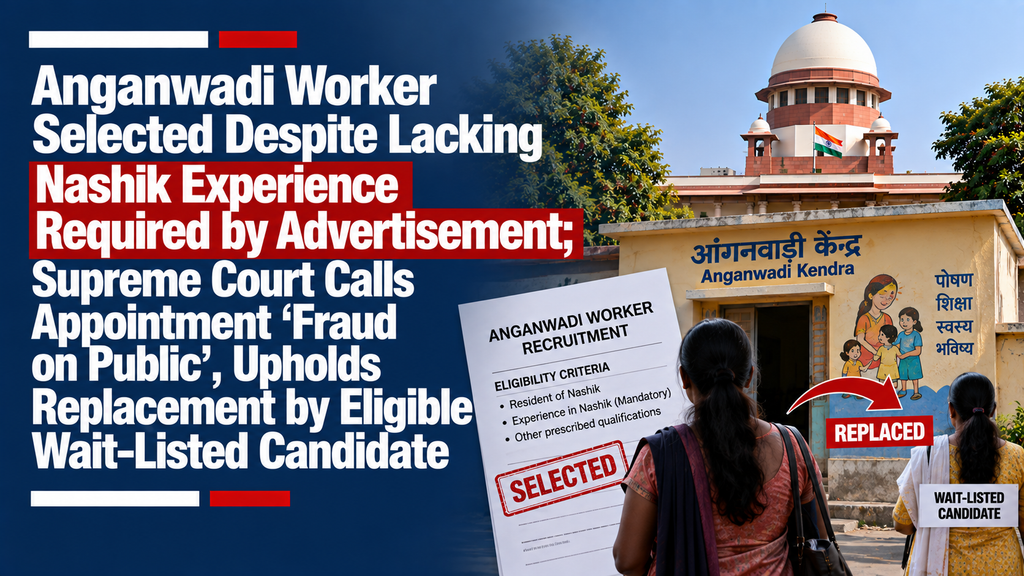
Anganwadi Worker Selected Despite Lacking Nashik Experience Required by Advertisement; Supreme Court Calls Appointment ‘Fraud on Public’, Upholds Replacement by Eligible Wait-Listed Candidate

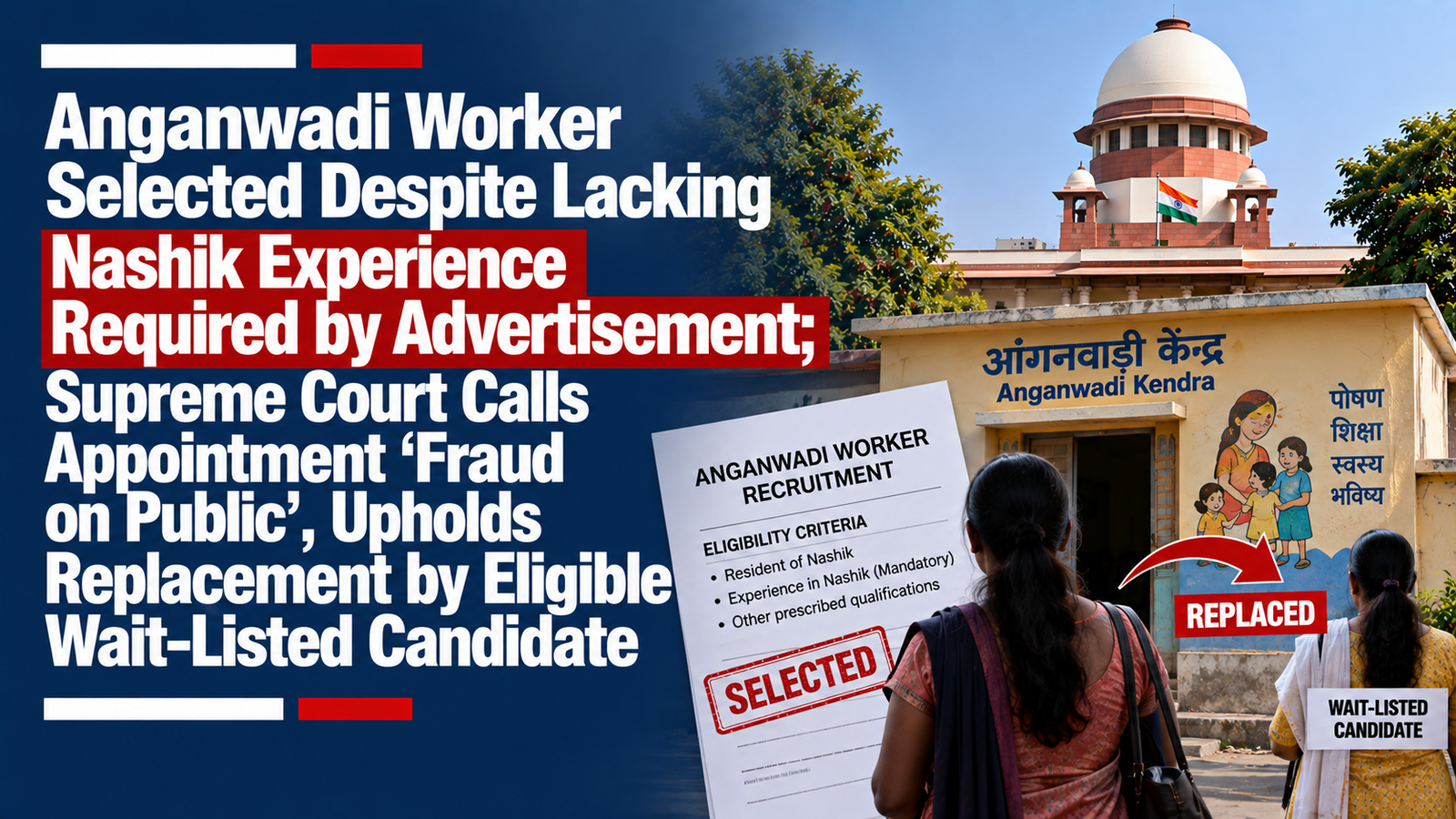
Candidate’s Innocence Cannot Save Appointment Made Contrary to Recruitment Advertisement: Supreme Court Upholds Replacement by Eligible Candidate
Facts
The dispute concerned appointment to the post of Anganwadi Supervisor in Nashik District, Maharashtra.
The appellant, Sunita Lahu Panchpande, had been working as an Anganwadi Sevika in Jalgaon District since February 1992.
On 18 April 2013, Zilla Parishad, Nashik issued an advertisement inviting applications for several posts, including Anganwadi Supervisor.
The advertisement required, among other things, at least 10 years’ experience as an Anganwadi Sevika. Crucially, its instructions expressly stated:
“Only Anganwadi Sevikes currently working in Tribal/Rural projects under Integrated Child Development Services Scheme in Nashik District can apply…”
Despite having never worked in Nashik District, the appellant applied. She was selected and placed at No. 1 on the waiting list for one of three OBC vacancies.
After the appointment of another candidate, Lata Sanjay Kadam, was cancelled for lack of eligibility, the appellant was appointed against that vacancy on 4 March 2014.
The sixth respondent, Gitanjali Sudhakar Shirsat, was fully qualified and stood at No. 2 on the waiting list. She challenged the appellant’s appointment.
The Bombay High Court held that the appellant was ineligible because her experience had been acquired in Jalgaon rather than Nashik District. It set aside her appointment and directed the State to appoint the sixth respondent in her place.
The appellant approached the Supreme Court.
Issues
The principal issue was whether a candidate who possessed more than ten years’ Anganwadi experience, but not in the district specifically required by the recruitment advertisement, could validly be appointed.
The Court also considered:
- whether the 2001 Government Resolution required ten years’ experience in the same district;
- whether the Divisional Commissioner could issue a clarification effectively diluting that requirement;
- whether an appointment could be protected because the candidate herself had disclosed all relevant information and was not responsible for the appointing authority’s mistake;
- whether several years of blemish-free service could cure the initial lack of eligibility; and
- whether an essential eligibility condition could be relaxed when the advertisement contained no power of relaxation.
Appellant’s Arguments
The appellant relied substantially on a clarification issued by the Divisional Commissioner, Nashik on 19 November 2013.
After preparation of the merit and waiting lists, Zilla Parishad had sought clarification regarding whether the Government Resolution dated 17 November 2001 actually required the ten years’ experience to have been acquired within the same district.
The Divisional Commissioner responded that the Government Resolution contained no clear requirement that the candidate must possess ten years’ experience within Nashik District.
The appellant argued that it was only after receiving this official clarification that Zilla Parishad appointed her from the waiting list.
She further stressed that she had already worked as an Anganwadi Supervisor for more than three years without blemish when the High Court interfered with her appointment.
Respondent’s Position
The sixth respondent’s case was straightforward: she satisfied the eligibility conditions stipulated in the advertisement and stood immediately below the appellant on the waiting list.
Since the appellant had never worked as an Anganwadi Sevika in Nashik District, she was not eligible even to apply.
Once the ineligible candidate was excluded, the sixth respondent was entitled to appointment as the next eligible wait-listed candidate.
The Bombay High Court had accepted this position and directed her appointment.
Analysis of the Law
Same-District Experience Was Mandatory
The Supreme Court examined the Government Resolution dated 17 November 2001.
A conjoint reading of clauses 3, 5 and 16-A demonstrated an express requirement that the candidate must possess ten years’ experience as an Anganwadi Sevika in the same district.
The Government Resolution also restricted candidates appearing in the selection list of one district from being considered for appointment to the corresponding post in another district.
The Divisional Commissioner’s contrary interpretation was therefore legally erroneous.
Divisional Commissioner Could Not Rewrite the Government Resolution
The Supreme Court strongly criticised the clarification dated 19 November 2013.
It held that the Divisional Commissioner had failed to properly appreciate the Government Resolution and had issued a clarification “wholly contrary” to its contents.
If any genuine ambiguity required clarification, the Commissioner should have referred the matter to the appropriate department of the State Government.
He could not himself issue a clarification that effectively altered the eligibility framework prescribed by the Government.
Advertisement Itself Was Unambiguous
Even independently of the Government Resolution, the advertisement settled the controversy.
The recruitment instructions expressly restricted applications to Anganwadi Sevikas currently working in tribal/rural ICDS projects in Nashik District.
The call letter issued to the appellant also required a certificate demonstrating ten years’ work experience as an Anganwadi Sevika in Nashik District.
The Supreme Court therefore held that this condition:
“seals the fate of the appellant”
because she was “not even qualified to apply for consideration of her candidature in the first place.”
Authority’s Mistake Cannot Create Eligibility
An important feature was that the appellant had not concealed or misrepresented her experience.
The Bombay High Court itself acknowledged that the fault lay with the appointing authority rather than with the appellant.
Nevertheless, the Supreme Court held that this could not save the appointment.
Zilla Parishad had failed to scrutinise her credentials properly. Had it done so, the appellant would never have crossed the eligibility threshold or entered the zone of consideration.
An appointment contrary to the advertisement and based upon an erroneous administrative clarification does not vest an enforceable right to continue in the post.
Precedent Analysis
District Collector & Chairman, Vizianagaram Social Welfare Residential School Society v. M. Tripura Sundari Devi
This was the decisive precedent.
The Supreme Court reiterated that where an advertisement prescribes a particular qualification, appointing someone who does not possess that qualification is not merely a private matter between the authority and the appointee.
It also prejudices candidates with similar or superior qualifications who did not apply precisely because they honestly understood themselves to be ineligible under the advertisement.
The earlier judgment characterised such an appointment as a “fraud on public”, unless the advertisement clearly states that the prescribed qualification is relaxable.
The Court found that principle fully applicable here.
No Power to Relax the Eligibility Requirement
The Supreme Court held that the only possible basis upon which the appellant’s appointment could have survived was if the advertisement had expressly reserved to the appointing authority a power to relax the essential qualification.
It did not.
Accordingly, there was no legal mechanism through which the Nashik-specific eligibility condition could be waived in the appellant’s favour.
The Court held:
the appointment was not merely contrary to the advertisement but amounted to a “fraud on public” because an ineligible aspirant had been appointed.
Court’s Reasoning
The Court’s reasoning rested on a clear sequence:
The advertisement expressly restricted eligibility to Anganwadi Sevikas working in Nashik District.
The appellant had never worked in Nashik District.
Therefore, regardless of her extensive experience in Jalgaon, she did not satisfy an essential eligibility condition.
The Divisional Commissioner had no authority to issue a clarification inconsistent with the governing Government Resolution.
Zilla Parishad’s failure to scrutinise the appellant’s eligibility could not create a right in her favour.
Her lack of concealment and subsequent blemish-free service were sympathetic considerations, but they could not cure an appointment that was legally invalid at inception.
Most importantly, protecting such an appointment would prejudice persons who obeyed the advertisement and did not apply because they lacked the prescribed qualification.
Conclusion
The Supreme Court found no merit in the appeal and upheld the Bombay High Court’s judgment.
Consequently, Gitanjali Sudhakar Shirsat, the eligible candidate who stood next on the waiting list, remained entitled to the benefits flowing from the High Court’s order. Those benefits were directed to be extended within two months, if not already granted.
The Supreme Court nevertheless gave the appellant limited transitional protection. She was permitted to continue until 30 September 2026 to complete any unfinished work, after which she could no longer continue as Anganwadi Supervisor.
Key Takeaway
When a recruitment advertisement prescribes an essential eligibility qualification, the appointing authority cannot disregard or administratively relax it unless a power of relaxation is expressly provided. Even an innocent candidate’s long and blemish-free service cannot ordinarily validate an appointment for which she was ineligible from the outset.
Case Details
Case: Sunita Lahu Panchpande v. District Collector & Ors.
Court: Supreme Court of India
Case No.: Civil Appeal No. 6379 of 2023
Bench: Justice Dipankar Datta and Justice Sheel Nagu
Date: 16 September 2026
Neutral Citation: 2026 INSC 1002
Result: Appeal dismissed; Bombay High Court’s order setting aside the appellant’s appointment and directing appointment of the eligible wait-listed candidate upheld.