Financier Seizes Borrower’s Truck at 1 A.M. After Breaking Steering Lock; Supreme Court Awards ₹10 Lakh Compensation, Orders Refund of ₹4.5 Lakh Sale Price

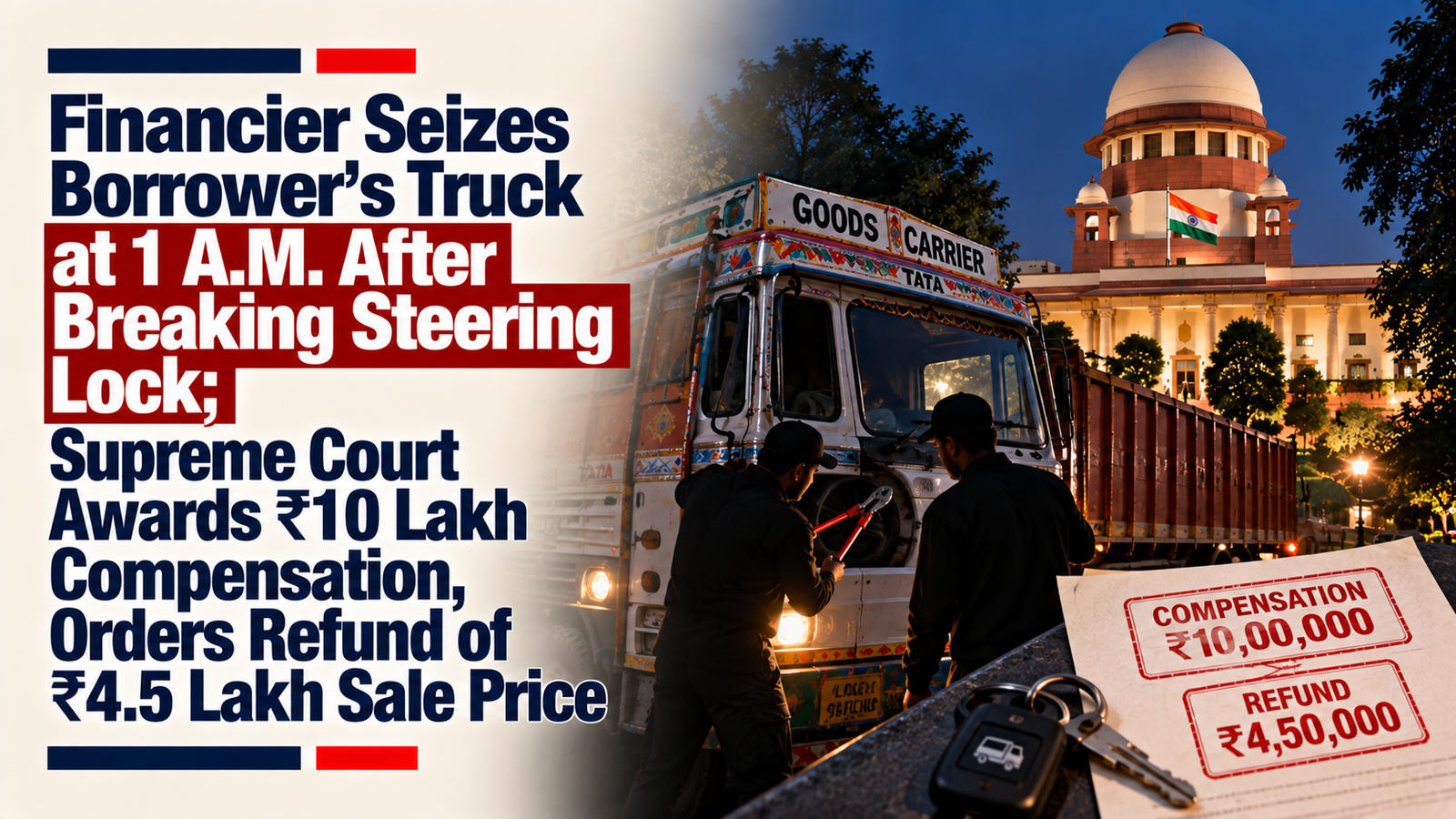
Truck Seized Without Seven-Day Notice and Sold for ₹4.5 Lakh: Supreme Court Orders Refund With Interest and ₹10 Lakh Compensation
Facts
The appellant, Hari Dutta Sharma, obtained a commercial vehicle loan from Cholamandalam Investment and Finance Company Limited on 25 March 2019 for purchasing a Tata SFC 407 truck bearing registration No. UP-16-GT-0449.
Against a sanctioned amount of approximately ₹10.40 lakh, ₹9.36 lakh was disbursed, repayable in 75 monthly instalments and secured by hypothecation of the truck. A further supplementary loan of approximately ₹1.04 lakh was extended in June 2021.
The appellant subsequently defaulted on repayment. The Company issued a recall-cum-demand notice on 17 January 2022 and initially repossessed the vehicle. After the appellant paid ₹86,726 and promised to regularise the account, the truck was released.
Defaults continued.
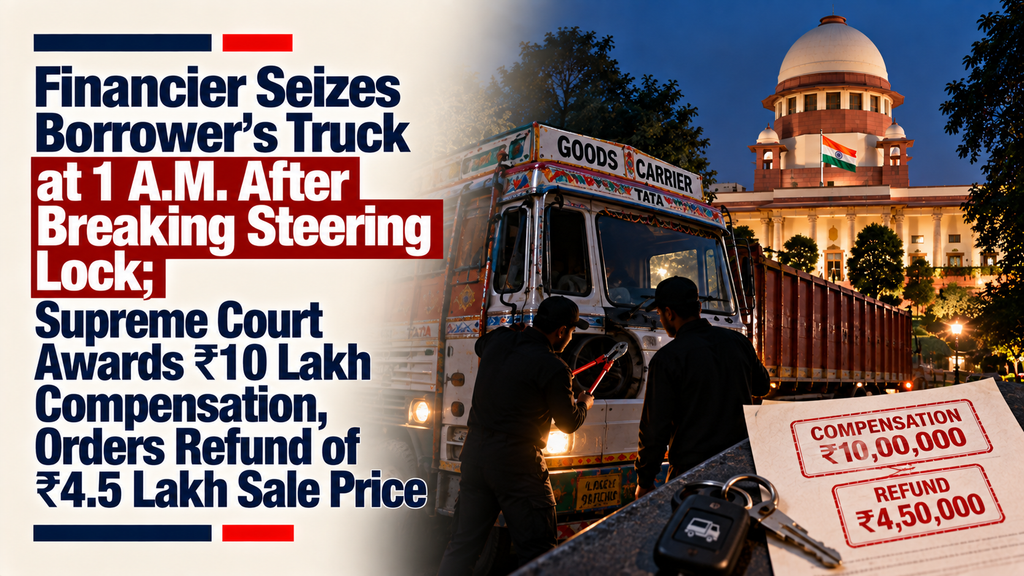
According to the appellant, at around 1:00 a.m. on 9 April 2023, the truck was parked at a consignor’s godown in Ayodhya after delivering goods. Four unidentified persons allegedly broke the steering lock and drove the vehicle away.
Believing that the truck had been stolen, the appellant lodged a lost-article report and an e-FIR on the same day.
It was only through the Company’s subsequent legal notice that the appellant learned that the Company had repossessed the truck and sold it on 31 August 2023 for ₹4.50 lakh.
Remarkably, even after the sale, the Company claimed that ₹1,25,571 remained payable by the appellant.
The appellant’s Section 156(3) CrPC complaint was dismissed. He thereafter approached the Allahabad High Court, which dismissed his writ petition primarily on the grounds that he had defaulted on the loan and had approached the Court belatedly.
The matter reached the Supreme Court. The appeal was captioned Hari Dutta Sharma v. State of U.P. & Ors.
Issues
The Supreme Court considered whether:
- a financier’s contractual right of self-help repossession permits seizure of a financed vehicle by force or stealth;
- the repossession complied with the Company’s own loan agreement and RBI Guidelines;
- a contractual clause permitting waiver of notice and unilateral repossession could operate without adequate procedural safeguards;
- the High Court was justified in dismissing the writ petition on delay;
- the arbitrary deprivation of the appellant’s livelihood warranted compensation; and
- stronger implementation of RBI Guidelines governing recovery agents and repossession was required.
Appellant’s Arguments
The appellant argued that the Company’s action violated Article 11 of the Loan Agreement, which required a seven-day notice before repossession.
A financier’s contractual right of self-help repossession, he submitted, cannot be exercised through force, deceit or in violation of the contractual procedure.
He also highlighted the unusual fact that he continued receiving traffic challans even after the Company claimed to have sold the vehicle.
Respondents’ Arguments
The Company characterised the appellant as a chronic defaulter.
It relied on its consolidated statement of account and pointed out that an earlier repossession had been prevented only because the appellant made a part-payment.
The Company claimed that pre-seizure intimation, inventory, post-seizure intimation and pre-sale notice had been duly provided and maintained that the ₹4.50 lakh sale price was fair and consistent with the loan agreement.
Analysis of the Law
Financiers Can Repossess — But Only Lawfully
The Supreme Court did not hold that self-help repossession clauses are inherently illegal.
Where a valid agreement authorises repossession of a financed vehicle upon default, there is ordinarily no legal impediment to exercising that contractual right, provided the clause is neither unconscionable nor contrary to public policy.
The Court recognised that such clauses make institutional finance commercially viable for persons such as truck operators and small transporters who may lack conventional collateral.
But that right is not unlimited.
Because self-help repossession operates outside immediate judicial supervision, the Court held that it must be construed with great circumspection.
Otherwise, such a clause could become:
an “unbridled licence to seize property by stealth, by force or in the dead of night”.
The Court cautioned against transforming a mechanism designed to facilitate financial inclusion into an instrument of oppression.
RBI Guidelines on Recovery Agents
The Supreme Court extensively examined the RBI’s Fair Practices Code and successive Master Circulars governing banks, NBFCs and recovery agents.
The Court distilled the regulatory framework into several principles, including:
- lenders cannot harass borrowers or use muscle power;
- vehicles can be seized only through lawful means;
- banks and financial institutions cannot employ “goondas” to forcibly take possession;
- recovery agents must undergo appropriate due diligence and comply with RBI requirements;
- repossession clauses must comply with the Indian Contract Act;
- borrowers must ordinarily receive prescribed notice;
- the repossession procedure must be specified;
- borrowers should receive a final opportunity to repay before sale or auction; and
- a fair procedure must govern sale or auction of the repossessed asset.
Precedent Analysis
Orix Auto Finance (India) Ltd. v. Jagmander Singh
The judgment recognises Orix Auto Finance for the principle that a financier’s right to repossess a financed asset primarily depends upon the contractual arrangement between the parties.
Thus, the Supreme Court did not invalidate repossession as a recovery mechanism itself.
Sundaram Finance Ltd. v. T. Thankam
Sundaram Finance was relied upon alongside Orix Auto Finance in recognising contractual repossession rights.
However, the present judgment makes clear that contractual authority must still operate within lawful and fair procedural boundaries.
ICICI Bank Ltd. v. Prakash Kaur
This was particularly significant.
The Supreme Court had earlier condemned the practice of financial institutions employing recovery agents to forcibly seize vehicles.
The Court reiterated that India is governed by the rule of law, and banks cannot employ “goondas” to take possession of vehicles through force.
Internet and Mobile Association of India v. RBI
The judgment relied upon this authority while recognising that directions issued by RBI in exercise of its statutory powers under Section 35-A of the Banking Regulation Act possess statutory force and bind banking companies.
Loan Agreement Itself Failed the Test of Fairness
Article 11 of the Company’s Loan Agreement purported to give the financier extensive repossession powers.
Although one part contemplated a seven-day notice, other provisions purported to allow:
- the borrower’s rights over the vehicle to terminate automatically upon default;
- entry into places where the vehicle might be found;
- unilateral repossession;
- waiver of pre- and post-repossession notice at the Company’s discretion; and
- sale of the asset without Court intervention.
The Supreme Court found that Article 11 effectively placed the borrower “entirely at the mercy of financier’s unilateral discretion.”
The Court identified four major defects.
First, automatic termination of the borrower’s rights without notice conflicted with the requirement of notice before repossession.
Second, allowing recovery agents to “enter any place or places” to search for the asset was inconsistent with RBI Guidelines requiring lawful recovery.
Third, the agreement failed to prescribe a fair procedure for taking possession or conducting the sale/auction.
Fourth, the financier’s unilateral power to waive notice altogether made the supposed procedural protection illusory.
The Court therefore concluded that Article 11 did not satisfy the standards required by RBI Guidelines or the general contractual requirement of fairness.
Court’s Reasoning
The decisive fact was that no seven-day notice was actually issued before the truck was repossessed.
Since the Company’s own agreement made its repossession right conditional upon such notice, the Supreme Court held that:
the Company’s contractual right to repossess the truck had never accrued in the first place.
The appellant’s unrebutted case was that the truck was taken at 1:00 a.m. by breaking its steering lock.
The Supreme Court said this could not possibly be characterised as peaceful repossession and bore the marks of the very “goondaism” condemned in Prakash Kaur and the RBI Guidelines.
The possession memorandum also did not contain the appellant’s signature, reinforcing the conclusion that the Company’s recovery agents had taken possession without due process.
High Court Was Wrong to Dismiss Case for Delay
The Supreme Court also rejected the High Court’s reasoning that the borrower had approached the Court belatedly.
The appellant had lodged an FIR on the very day the truck disappeared and subsequently pursued a Section 156(3) CrPC complaint.
Moreover, he continued receiving traffic challans in January 2024, November 2024 and February 2025, despite the Company’s assertion that the truck had already been sold in August 2023.
The Court held that these circumstances required explanation and the writ petition should not have been thrown out merely on delay without examining its merits.
Borrower’s Right to Livelihood
The Supreme Court gave considerable importance to the nature of the asset.
The appellant was a man of modest means who depended solely upon the truck for his transportation business and livelihood.
By unlawfully taking away and selling the truck, the financier deprived him of his livelihood through an arbitrary and unfair procedure.
The Court expressly held that the Company’s action amounted to a violation of Articles 14 and 21 of the Constitution of India and therefore warranted monetary compensation.
Supreme Court’s Directions to RBI
The judgment goes beyond the individual dispute.
The Supreme Court observed that RBI’s Guidelines, Master Circulars and Clarifications governing recovery practices had effectively remained “only on paper.”
It therefore directed RBI to take effective steps to secure genuine compliance by NBFCs and Scheduled Commercial Banks, so that borrowers are not dispossessed of livelihood-generating assets without notice and lawful procedure.
The Registry was directed to send a copy of the judgment to RBI.
Conclusion
The Supreme Court allowed the appeal and set aside the Allahabad High Court’s order.
Although it declined to undo the sale because the truck had already been sold in August 2023, it granted substantial monetary and consequential relief to the borrower.
The Court directed the financier to:
- Close both loan accounts of the appellant.
- Refund ₹4.50 lakh, representing the sale price of the truck, with 6% annual interest from the date of sale until payment.
- Pay ₹10 lakh compensation for mental agony and loss of livelihood.
- Pay ₹50,000 as litigation costs.
Key Takeaway
A borrower’s default gives a financier a right to recover its debt—not a licence to seize property through force, stealth or recovery agents acting outside due process. Contractual repossession rights remain subject to notice, fairness, RBI Guidelines and the rule of law.
Case Details
Case: Hari Dutta Sharma v. State of U.P. & Ors.
Court: Supreme Court of India
Case: Civil Appeal arising out of SLP (C) / Diary No. 10952 of 2026
Bench: Justice Pamidighantam Sri Narasimha and Justice Alok Aradhe
Date: 16 September 2026
Neutral Citation: 2026 INSC 998
Result: Appeal allowed; ₹10 lakh compensation, ₹4.50 lakh refund with 6% interest and ₹50,000 costs awarded; both loan accounts ordered closed.