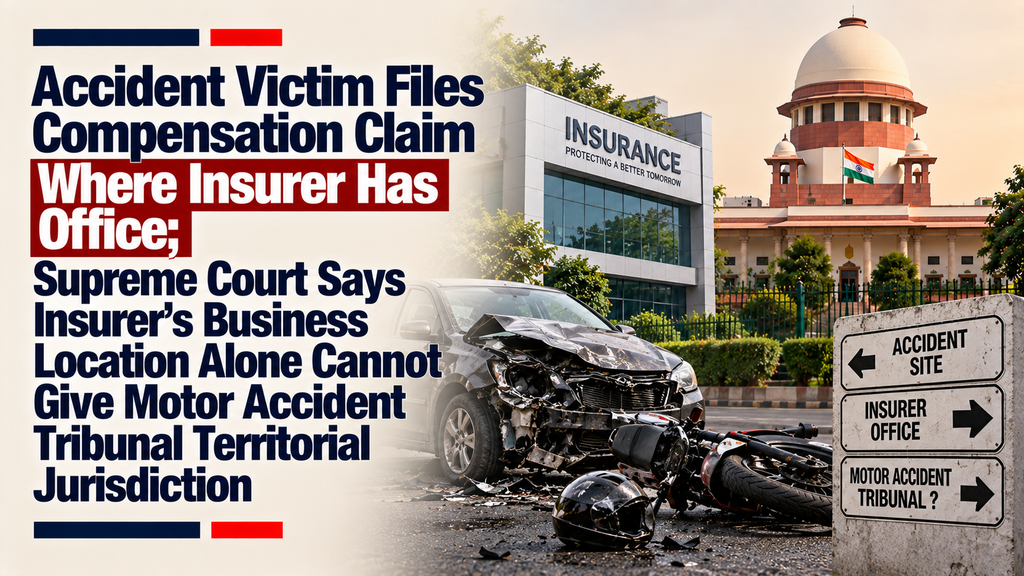
Accident Victim Files Compensation Claim Where Insurer Has Office; Supreme Court Says Insurer’s Business Location Alone Cannot Give Motor Accident Tribunal Territorial Jurisdiction

Insurer’s Branch Office Cannot Determine Territorial Jurisdiction of Motor Accident Claim Tribunal: Supreme Court Upholds Transfer From Chennai to Chittoor
Facts
The appellant, K. Rashik, was riding a two-wheeler with his brother on 25 October 2022 when a mini-truck allegedly struck their vehicle in District Tirupati, Andhra Pradesh.
He filed a compensation claim under Section 166 of the Motor Vehicles Act, 1988 before the Motor Accidents Claims Tribunal at Chennai. National Insurance Company Limited objected to the Tribunal’s territorial jurisdiction, contending that no part of the cause of action had arisen in Chennai.
The Chennai Tribunal rejected the insurer’s objection on 11 July 2025, reasoning that National Insurance Company also carried on business in Chennai and therefore the Tribunal had jurisdiction.
The insurer challenged this order before the Madras High Court under Article 227.
On 16 March 2026, the High Court held that the Chennai Tribunal lacked territorial jurisdiction and directed the proceedings to be transferred to the Tribunal at Chittoor, Andhra Pradesh.
The claimant challenged that decision before the Supreme Court.
Issues
The principal question was:
Can a motor accident compensation claim be filed before a Tribunal merely because the insurance company has an office or carries on business within that Tribunal’s territorial jurisdiction?
The Court also considered:
- the proper interpretation of Section 166(2) of the Motor Vehicles Act;
- whether an insurer is a “defendant” for determining territorial jurisdiction under Section 166(2);
- whether an insurer impleaded by the claimant can object to territorial jurisdiction;
- the distinction between Section 166(2) and Section 20 CPC; and
- the difference between a territorial objection raised at the initial stage and one raised after an award has already been passed.
Appellant’s Arguments
The claimant argued that he was residing and working in Chennai and was therefore entitled to institute the claim there.
He further submitted that National Insurance Company had an office in Chennai, and consequently no prejudice would be caused to the insurer if the proceedings continued there.
Since the Motor Vehicles Act is a beneficial legislation, Section 166(2) should, according to him, receive a liberal interpretation favouring accident victims rather than a restrictive interpretation based upon technical objections to territorial jurisdiction.
Respondent’s Arguments
The insurer argued that the accident occurred in Tirupati, Andhra Pradesh, and no part of the cause of action arose in Chennai.
More importantly, the claimant’s own compensation application stated his residential address as being in Chittoor District, Andhra Pradesh.
The insurer therefore maintained that the Chennai Tribunal had no territorial jurisdiction and that its objection was substantive rather than merely technical.
Analysis of the Law
Where Can a Motor Accident Claim Be Filed?
The Supreme Court closely analysed Section 166(2).
It held that the provision gives a claimant specified choices for instituting a compensation claim.
A claim may be filed before the Tribunal having jurisdiction over:
- the place where the accident occurred;
- the place where the claimant resides;
- the place where the claimant carries on business; or
- the place where the defendant resides.
The Court stressed that these choices flow from the express language of the statute.
Insurer’s Place of Business Is Not Enough
This became the central proposition of the judgment.
Section 166(2) expressly uses the words:
“claimant resides or carries on business”
but when referring to the defendant, it merely says:
“defendant resides.”
The legislature did not add the words “or carries on business” while referring to the defendant.
The Supreme Court held that this difference in language was deliberate and significant.
Therefore, the fact that an insurance company has a branch office or carries on business within a particular city does not, by itself, confer territorial jurisdiction upon the MACT situated there.
Section 166(2) Is Different From Section 20 CPC
The Court specifically contrasted Section 166(2) of the Motor Vehicles Act with Section 20 of the Code of Civil Procedure, 1908.
Under Section 20 CPC, territorial jurisdiction can arise at a place where the defendant carries on business.
Section 166(2), however, deliberately contains no equivalent provision concerning the defendant’s place of business.
Accordingly, principles under Section 20 CPC cannot be imported so as to add words that Parliament omitted from Section 166(2).
Is the Insurance Company a “Defendant” Under Section 166(2)?
The Supreme Court went a step further.
It held that the expression “defendant” in Section 166(2), for the purpose of determining territorial jurisdiction, does not intend to refer to the insurer.
The principal contesting defendants contemplated by the provision are ordinarily the owner and/or driver of the offending vehicle.
The Court reasoned that impleading an insurer as a defendant in a Section 166 claim is not mandatory; it is optional for the claimant.
Moreover, Section 168 requires the Tribunal to issue notice to the insurer even where it has not been impleaded.
These provisions reinforced the Court’s conclusion that an insurer’s location cannot independently be used to manufacture territorial jurisdiction.
Can the Insurer Challenge Territorial Jurisdiction?
Yes.
The claimant argued that the insurer should not be permitted to raise such an objection.
The Supreme Court rejected that contention.
Relying on the three-Judge Bench decision in United India Insurance Co. Ltd. v. Shila Datta, the Court distinguished between:
- an insurer who is merely given statutory notice; and
- an insurer who has actually been impleaded as a party-respondent.
Where the claimant voluntarily impleads the insurer as a party, the insurer is entitled to raise all permissible defences, including an objection to the territorial jurisdiction of the Tribunal.
When Is Prejudice or “Failure of Justice” Relevant?
The Supreme Court drew an important distinction based on when the jurisdictional objection is raised.
Objection Raised at the Beginning
Where the insurer challenges territorial jurisdiction before the MACT itself at the initial stage, Section 166(2) must be satisfied.
There is no additional requirement that the insurer prove actual prejudice or failure of justice.
Objection Raised After Award
The position changes when the objection is raised for the first time or pursued at the appellate stage after an award has already been passed.
In that situation, Section 21(1) CPC becomes relevant.
The objecting party must demonstrate not merely lack of territorial jurisdiction but also that the exercise of jurisdiction resulted in a failure of justice.
This distinction was important because the insurer in the present case had objected to Chennai’s jurisdiction before the Tribunal itself, while the compensation claim was still pending.
Precedent Analysis
United India Insurance Co. Ltd. v. Shila Datta
The three-Judge Bench decision was relied upon to establish that an insurer voluntarily impleaded as a party-respondent is not restricted to the limited statutory defences available to a mere noticee.
It can raise all grounds legally available to resist the claim, including territorial jurisdiction.
Mantoo Sarkar v. Oriental Insurance Co. Ltd.
In Mantoo Sarkar, the territorial objection was considered after the MACT had already passed an award.
The Supreme Court held that the insurer had failed to demonstrate prejudice and restored the award using Article 142.
The present Bench explained that Mantoo Sarkar involved Section 21 CPC because the objection was being considered at the appellate stage.
Malati Sardar v. National Insurance Co. Ltd.
Similarly, in Malati Sardar, the insurer challenged territorial jurisdiction after an award had already been made.
Since no prejudice or failure of justice was established, the Supreme Court restored the award.
The present judgment clarified that observations in Malati Sardar concerning the insurer’s place of business must be understood in that post-award context.
Balveer Batra v. New India Assurance Co.
The Court also examined Balveer Batra, where territorial jurisdiction had been contested before the Tribunal.
That decision reiterated the significance of Section 21 CPC when the jurisdictional controversy reaches the appellate stage and emphasised that a Tribunal lacking jurisdiction should not proceed to decide other issues on merits.
Court’s Reasoning
The Supreme Court examined the claimant’s own pleadings.
They showed that:
- the claimant resided in Chittoor, Andhra Pradesh;
- the accident occurred in District Tirupati;
- the claimant had not pleaded that he carried on business in Chennai;
- the driver of the offending vehicle also resided in District Chittoor; and
- there was no pleading demonstrating that any part of the cause of action arose in Chennai.
The mere fact that National Insurance Company had an office in Chennai therefore could not confer jurisdiction upon the Chennai Tribunal.
The Supreme Court consequently held that the Chennai MACT had wrongly assumed jurisdiction and that the Madras High Court was correct in transferring the proceedings to Chittoor.
Beneficial Legislation Cannot Override Plain Statutory Language
The Court acknowledged that the Motor Vehicles Act is a beneficial legislation intended to alleviate hardships arising from motor accidents.
Nevertheless, purposive interpretation has limits.
A beneficial statute cannot be interpreted in a manner that has no support in its actual statutory language.
The Court held that where the plain language is clear, an interpretation contrary to that language cannot be adopted merely because it may appear more beneficial to the claimant.
Conclusion
The Supreme Court dismissed K. Rashik’s appeal and upheld the Madras High Court’s judgment dated 16 March 2026.
The direction transferring the entire claim proceedings from the Motor Accidents Claims Tribunal at Chennai to the Tribunal at Chittoor was affirmed.
The Chittoor Tribunal was directed to decide the compensation claim expeditiously in accordance with law. No costs were imposed.
Key Takeaway
A motor accident claim cannot be filed at a place merely because the insurance company has an office or carries on business there. Territorial jurisdiction must independently satisfy one of the statutory connecting factors expressly provided under Section 166(2) of the Motor Vehicles Act.
Case Details
Case: K. Rashik v. National Insurance Company Ltd. & Another
Court: Supreme Court of India
Case No.: Civil Appeal No. 10706 of 2026
Bench: Justice Ujjal Bhuyan and Justice Atul S. Chandurkar
Date: 16 September 2026
Neutral Citation: 2026 INSC 996
Result: Appeal dismissed; transfer of motor accident claim from Chennai MACT to Chittoor Tribunal upheld.