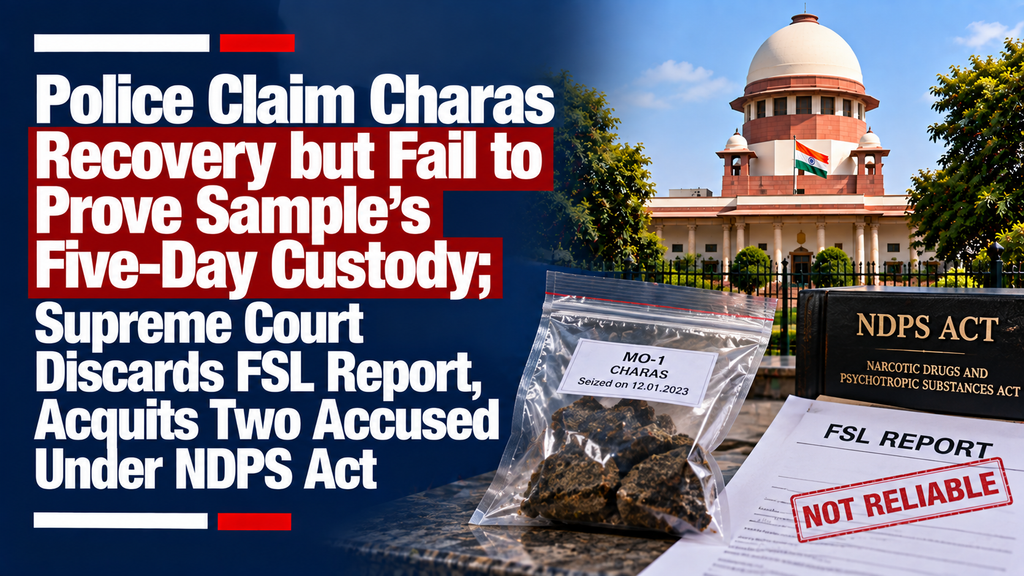
Police Claim Charas Recovery but Fail to Prove Sample’s Five-Day Custody; Supreme Court Discards FSL Report, Acquits Two Accused Under NDPS Act

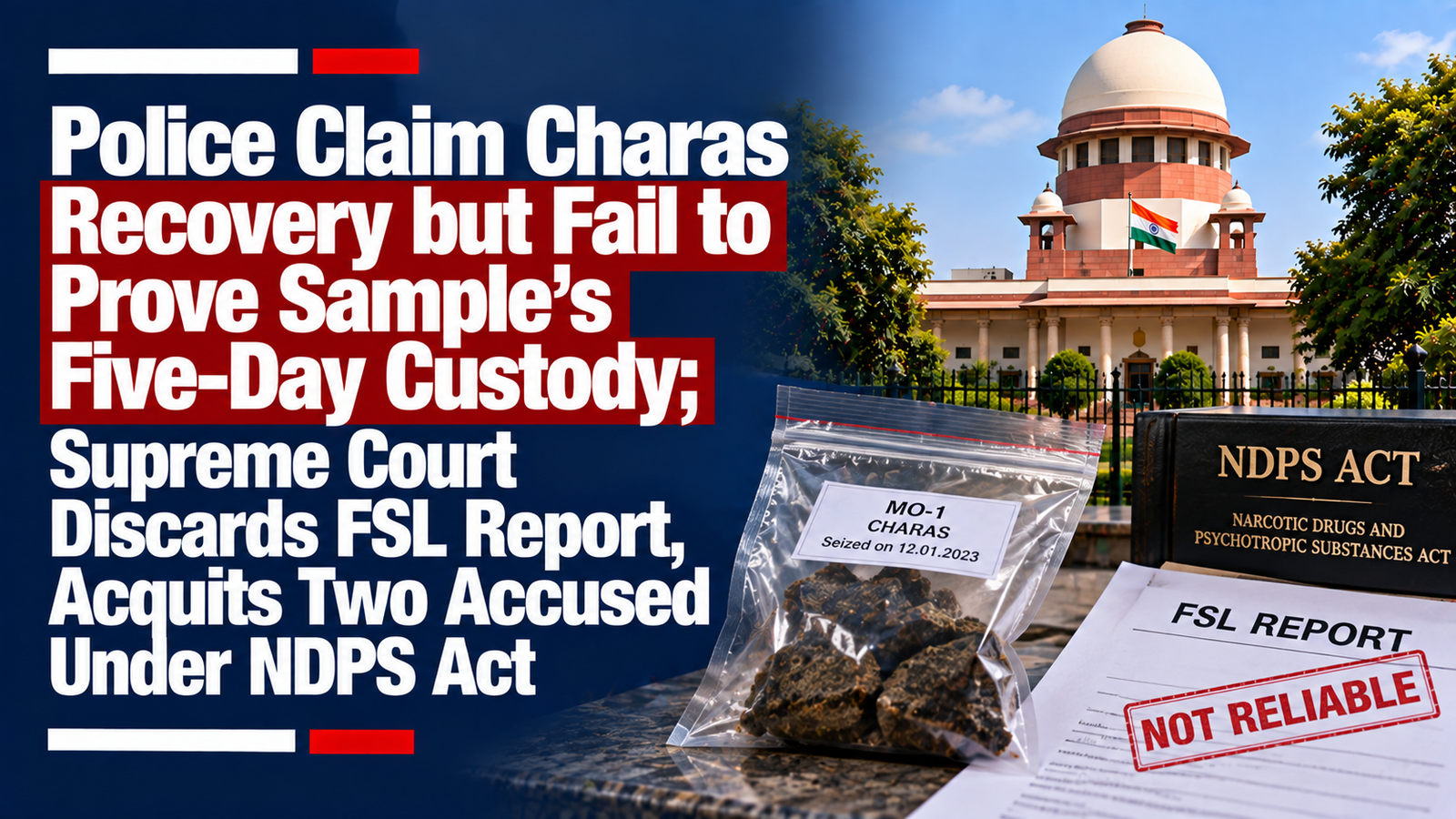
No Record Showing Samples Left Police Maalkhana for FSL: Supreme Court Finds Fatal Break in Chain of Custody, Acquits Accused
Facts
The prosecution’s case was that on 29 November 2004, Inspector Rajesh Tiwari of Police Station Gorakhpur, Jabalpur received information that two persons, one stated to be disabled, were carrying charas in bags near Bandariya Tiraha.
A raiding party apprehended Abdul Rajik and Govind. On searching the bags carried by them, police allegedly found a black, wick-shaped substance wrapped in polythene. A small portion was burnt at the spot, following which the police suspected the substance to be charas.
Police claimed recovery of:
- 1 kilogram from Abdul Rajik; and
- 800 grams from Govind.
Samples were allegedly drawn and subsequently sent to the Forensic Science Laboratory (“FSL”), which reported that the samples contained charas.
The Trial Court convicted Abdul Rajik under Sections 8 read with 20(b)(ii)(C) of the Narcotic Drugs and Psychotropic Substances Act, 1985 and sentenced him to 10 years’ rigorous imprisonment with ₹1 lakh fine.
Govind was convicted under Sections 8 read with 20(b)(ii)(B) and sentenced to 8 years’ rigorous imprisonment with ₹80,000 fine.
The Madhya Pradesh High Court affirmed both convictions.
They consequently approached the Supreme Court.
Issues
The principal issue was whether the prosecution had proved beyond reasonable doubt that the samples examined by the FSL were the same samples drawn from the substance allegedly recovered from the appellants.
The Court considered whether the prosecution had established an unbroken chain of custody, whether the integrity and identity of the samples had been preserved, and what effect the total non-compliance with Section 52-A of the NDPS Act had upon the prosecution’s case.
It also examined whether the police officer’s identification of the substance as charas merely by burning a portion of it could independently establish the nature of the contraband.
Appellants’ Arguments
The appellants challenged the very recovery of the contraband and argued that the prosecution had failed to establish it through credible evidence.
They pointed out that both independent Panch witnesses—Mohan (PW-3) and Amit Sonkar (PW-5)—did not support the prosecution’s case and were declared hostile.
They further alleged non-compliance with Sections 42, 50 and 52-A of the NDPS Act.
Alternatively, they contended that the quantity recovered was intermediate quantity and that the sentences imposed were excessive and disproportionate.
Respondent’s Arguments
The State defended the convictions on the basis of the evidence of the seizure officer and other police officials.
It argued that the police officers had no reason to falsely implicate the appellants and that credible evidence established compliance with the mandatory provisions of the NDPS Act.
The State further contended that the consolidated quantity recovered from the two appellants exceeded commercial quantity and that both the Trial Court and High Court had properly appreciated the evidence.
Analysis of the Law
Sections 42 and 50 Were Not Applicable
The Supreme Court first rejected the appellants’ arguments under Sections 42 and 50.
The alleged recovery was from bags being carried by the appellants while they were apprehended in an open public place.
Accordingly, the Court held that neither Section 42 nor Section 50 applied to the search and seizure in the circumstances of the case.
The acquittal therefore did not rest on violation of Sections 42 or 50.
Identity of Samples Was Doubtful
The decisive problem arose from the prosecution’s link evidence.
The seizure officer claimed that two representative samples of 25 grams each were drawn from the respective quantities.
However, the Supreme Court found that the officer never stated that the sample packets themselves were sealed with identifiable signatures, thumb impressions or other identifying marks belonging to the accused, Panch witnesses or seizure officer.
Even when the muddamal was produced before the Trial Court, the sample packets were not separately produced and exhibited.
The sample panchnamas also did not establish that identifying chits or signatures had been affixed to the packets enabling the samples subsequently examined by the FSL to be correlated with the contraband allegedly recovered from each accused.
The Five-Day Missing Link
This was the most serious defect in the prosecution’s case.
The maalkhana register showed that the samples were deposited on 29 November 2004.
However, there was no corresponding entry recording when the samples actually left the police station for transmission to the FSL. The prosecution also failed to produce the police-station forwarding letter, road certificate or other documents ordinarily establishing the samples’ movement and safe custody.
The only transit document produced was a forwarding letter from the Superintendent of Police’s office dated 1 December 2004, naming Constable Ramkrishna as the carrier.
But the FSL report recorded that the samples were received only on 6 December 2004.
The maalkhana in-charge also testified that they were sent on 6 December.
The prosecution offered no explanation whatsoever as to where the samples remained, or in whose custody, between 1 December and 6 December 2004.
Worse, Constable Ramkrishna—the person supposedly carrying the samples—was never examined.
The Supreme Court held that this unexplained five-day gap “completely breaches the link in the chain of custody.”
Section 52-A of the NDPS Act
The Supreme Court clarified an important legal distinction.
Every violation of Section 52-A does not automatically result in acquittal.
The relevant question is whether the non-compliance prejudiced the accused and undermined the integrity of the seizure and sampling process.
Section 52-A creates safeguards whereby seized contraband is produced before a Magistrate, representative samples are drawn under supervision, and the inventory, photographs and sample list are certified.
Minor lapses or procedural delays may not automatically invalidate the prosecution.
However, total non-compliance becomes highly relevant where the prosecution is simultaneously unable to establish safe custody and an unbroken chain of samples.
In the present case, the seizure officer made no effort whatsoever to follow Section 52-A by having representative samples drawn in the presence of a Magistrate.
Precedent Analysis
Narcotics Control Bureau v. Kashif
The Supreme Court relied on Kashif for the proposition that mere non-compliance with Section 52-A or applicable Standing Orders does not, standing alone, automatically vitiate an NDPS trial.
The Court must examine the nature of the violation and prejudice caused to the accused.
Bharat Aambale v. State of Chhattisgarh
This authority was applied alongside Kashif to reiterate that minor procedural irregularities cannot mechanically result in acquittal.
The focus remains on whether the prosecution can establish the integrity and safe custody of the seized substance and representative samples.
Nadeem Ahamed v. State of West Bengal
This decision was particularly important.
Failure to draw representative samples before a Magistrate, combined with absence of a certified inventory, was held to strike at the root of the prosecution case and render the seizure and sampling process doubtful.
In such circumstances, the FSL report itself could become unfit to be relied upon.
State of Rajasthan v. Tara Singh
Tara Singh concerned the prosecution’s failure to explain the custody of seized samples between dispatch and laboratory receipt.
The Court emphasised that because the NDPS Act prescribes severe punishment, the prosecution must satisfactorily establish where the samples were kept, who possessed them, when they were dispatched and when they reached the laboratory.
An unexplained gap compromises the sanctity of the samples and creates serious doubt about the prosecution case.
Court’s Reasoning
The Supreme Court held that the prosecution must prove through reliable link evidence that samples drawn from the recovered substance were properly sealed and remained safely secured from the moment of seizure until their receipt by the FSL.
The chain must be established through credible oral and documentary evidence because the FSL report becomes relevant only if the prosecution first proves that the substance tested by the laboratory is the very sample originating from the alleged recovery.
Here, that chain had completely collapsed.
There were deficiencies at virtually every stage:
- no adequate identifying marks on the sample packets;
- samples were not separately exhibited during trial;
- no record showing when they left the maalkhana;
- no evidence proving they remained sealed and secure;
- missing road/forwarding documentation;
- inconsistency between the alleged dispatch and receipt dates;
- an unexplained five-day custody gap;
- non-examination of the carrier; and
- total non-compliance with Section 52-A.
The Supreme Court therefore held that the sanctity and integrity of the samples stood completely compromised.
Consequently, the FSL report had to be discarded.
Burning the Substance Was Not Proof of Charas
After excluding the FSL report, the prosecution attempted to rely upon the seizure officer’s claim that he had burnt a portion of the substance and thereby identified it as charas.
The Supreme Court categorically rejected this evidence.
There was no scientific material showing that a substance could reliably be identified as charas merely by burning it.
The police officer’s assertion therefore could not independently establish the identity of the seized substance.
Once the FSL report was excluded, no legally reliable evidence remained to establish that the alleged substance was charas at all.
That meant an essential ingredient of the offence under Section 20 of the NDPS Act remained unproved.
Conclusion
The Supreme Court held that the prosecution had failed to prove that the substance allegedly recovered from Abdul Rajik and Govind was charas.
Both accused were therefore entitled to the benefit of doubt.
The convictions and sentences imposed by the Special NDPS Court in 2006 and affirmed by the Madhya Pradesh High Court in 2010 were set aside.
Abdul Rajik and Govind were acquitted of all charges. Since they were already on bail, they were not required to surrender and their bail bonds were discharged.
Key Takeaway
In an NDPS prosecution, obtaining a positive FSL report is not enough. The prosecution must first prove through an unbroken chain of custody that the sample tested by the laboratory was the same sample drawn from the contraband allegedly recovered from the accused. If that link collapses, the FSL report itself may become unusable.
Case Details
Case: Abdul Rajik v. State of M.P. with Govind v. State of M.P.
Court: Supreme Court of India
Case Nos.: Criminal Appeal Nos. 1561 and 1562 of 2014
Bench: Justice Sandeep Mehta and Justice Manmohan
Date: 16 September 2026
Neutral Citation: 2026 INSC 1001
Result: Appeals allowed; convictions and sentences set aside; both appellants acquitted and bail bonds discharged.