
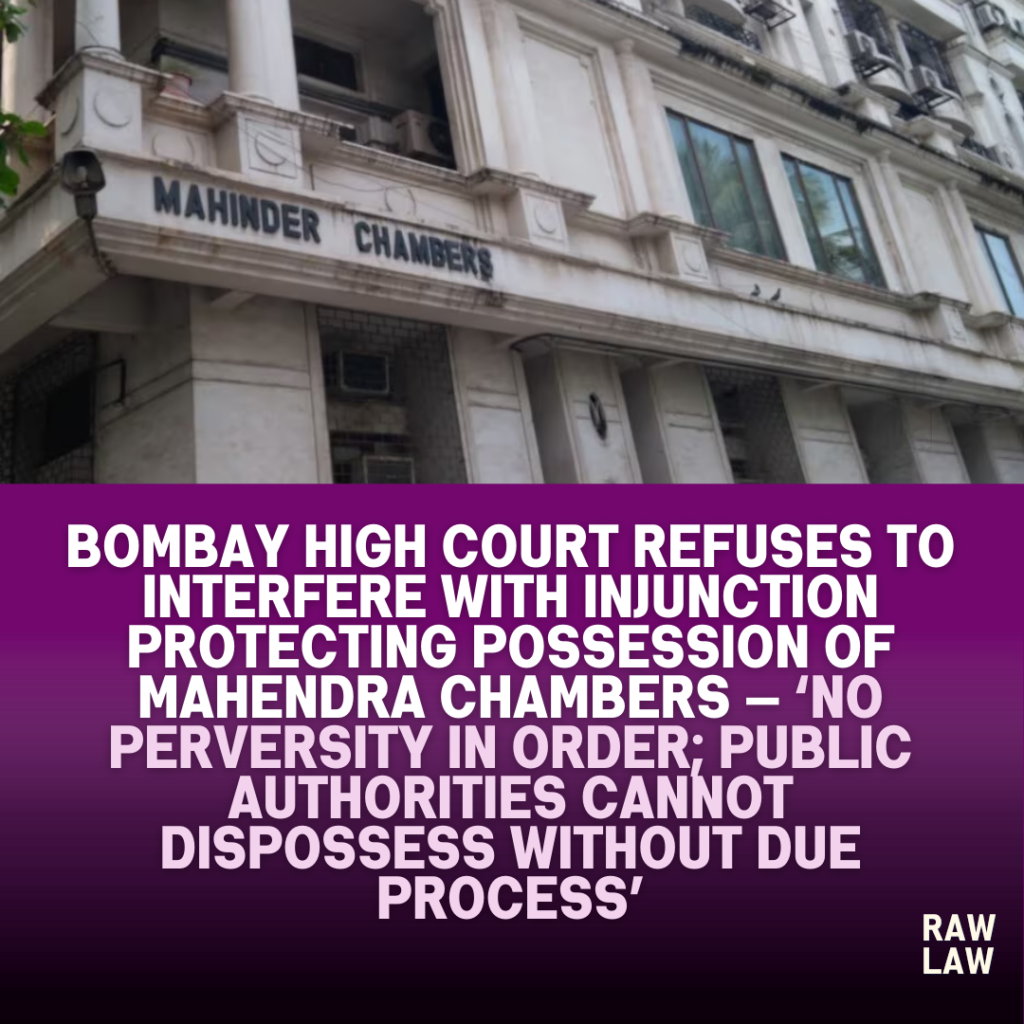

1. Court’s decision
The Bombay High Court dismissed both appeals filed by the Municipal Corporation of Greater Mumbai and the Empire Building Occupants Welfare Association against a 2019 Single Judge order that protected the plaintiff’s possession of Mahendra Chambers. The Court held that the injunction—preventing the Corporation from interfering with possession except through due process—was a discretionary order based on clear legal principles and therefore not open to appellate interference. Applying strict standards under Wander Ltd v Antox India, Neon Laboratories, and Ramakant Choksi, the Court held there was no perversity, arbitrariness, or legal error. It reaffirmed that even public authorities cannot dispossess occupants extra-judicially.
2. Facts
The dispute concerns Plot A1 at DN Road, originally Empire Building, later Mahendra Chambers. The land belonged to the Improvement Trust—predecessor of the MCGM—and was leased in 1901 for 99 years. After subsequent assignments, the Parsi Panchayat held leasehold rights until 13 December 2000. In 1974, the Panchayat agreed to transfer the building and leasehold interest to the plaintiff, a transaction eventually permitted by the Charity Commissioner.
In 1986, MCGM granted licence for assignment and asked for the registered deed. However, the formal deed was executed only on 4 March 2003. Shortly after, in July 2003, MCGM asserted the assignment was void since the lease had already expired, claimed the land vested in the Corporation, and stated that possession had been resumed by a notice and panchanama dated 2 May 2003. The plaintiff denied this and filed Suit No. 3553 of 2004 seeking protection of possession.
3. Issues
The Court examined:
• Whether the plaintiff established a prima facie case for protection of possession.
• Whether a lessee at sufferance or holding-over could assign rights after lease expiry.
• Whether the Single Judge erred in not considering Supreme Court rulings barring assignment by such lessees.
• Whether MCGM’s alleged “re-entry” by affixing a notice amounted to lawful dispossession.
• Whether appellate interference was justified under the restrictive principles governing appeals against discretionary injunctions.
4. Appellants’ arguments
MCGM argued that the Single Judge ignored the crucial illegality that the Parsi Panchayat could not assign any rights after 13 December 2000, relying on IOCL v Sudera Realty and Asgar v Mohan Varma. It submitted the plaintiff had no locus or legal relationship with MCGM, making any injunction untenable. MCGM contended that the acceptance of rent and correspondence after lease expiry was irrelevant, since the plot had vested in the State. It argued that the plaintiff’s writ petition for mandamus to renew the lease had already been dismissed, further weakening its case.
The Welfare Association adopted these submissions, adding that the injunction improperly prevented MCGM from invoking eviction powers under the Mumbai Municipal Corporation Act. They argued the Single Judge failed to consider balance of convenience, irreparable injury, and the lack of any title in favour of the plaintiff.
5. Respondents’ arguments
The plaintiff’s counsel argued that MCGM had expressly approved assignment on 4 June 1986 and continued to require submission of registered deeds even after lease expiry, demonstrating that the Corporation itself treated the plaintiff as successor to the lease. The deed executed in 2003, though delayed, transferred rights effective from 1986, not post-expiry rights of a lessee at sufferance.
The plaintiff contended it was in settled possession since at least 1976, acknowledged by the Parsi Panchayat and implicitly by MCGM in its letters. It argued the Corporation’s abrupt reversal followed a 2002 meeting with political authorities directing allotment of the plot to the Welfare Association. It also invoked precedents (Maharaja Dharmendra Prasad Singh, Krishna Ram Mahale, S.R. Ejaz) to argue that no public authority may dispossess occupants except through legally sanctioned procedures.
6. Analysis of the law
The Court’s analysis centered on the narrow appellate jurisdiction under Wander Ltd. and later cases, emphasising that appellate intervention is warranted only in cases of perversity. It reiterated that a prima facie case does not require proof of title—only a bona fide dispute requiring trial.
The principles of settled possession and the prohibition on extra-legal dispossession formed the backbone of the Court’s reasoning. Supreme Court authorities establish that even a trespasser, once in settled possession, cannot be ousted without due process.
The Court stressed that MCGM’s correspondence between 2000–2002, repeatedly asking for the deed of assignment even after lease expiry, demonstrated its own understanding that assignment remained legally relevant. This communication created a strong prima facie basis in favour of the plaintiff. The Court declined to determine complex mixed questions of fact and law—such as whether the 2003 deed validly related back to 1986—at the interim stage.
7. Precedent analysis
The Court reviewed a series of binding authorities:
• Wander Ltd. v Antox India
Established the strict limitations on appellate interference with discretionary orders. Applied as the governing standard.
• Ramakant Ambalal Choksi (2024)
Reaffirmed that only perversity—not mere error—justifies interference. Heavily relied upon.
• Maharaja Dharmendra Prasad Singh (1989)
Held that no public authority can resume possession without following due process. Applied to reject MCGM’s claim of re-entry via notice/panchanama.
• Krishna Ram Mahale (1989)
Reiterated that settled possession cannot be disturbed extra-judicially. Applied directly.
• S.R. Ejaz (2002)
Warned against “law of the jungle” where powerful actors forcibly dispossess occupants. Cited with approval.
The Court distinguished IOCL and Asgar, noting these issues were never raised before the Single Judge and involved disputed factual foundations inappropriate for appellate intervention.
8. Court’s reasoning
The Court held that the plaintiff had been in long-standing settled possession, supported by documentary evidence and admitted conduct of the Parsi Panchayat. MCGM itself treated the plaintiff as a legitimate assignee for years, undermining its later claim of invalidity.
The Court found no perversity in the Single Judge’s view that MCGM could not dispossess by affixing a notice on the building and drawing a panchanama. Dispossession must be lawful, adjudicated, and effected through proper statutory mechanisms.
Even assuming the appellants’ arguments had merit, the Court held that these raised mixed questions requiring trial. At the interlocutory stage, the Single Judge correctly applied the three-fold test—prima facie case, balance of convenience, irreparable injury—and the appellate court could not re-evaluate evidence afresh.
9. Conclusion
The appeals were dismissed. The Court reiterated that nothing in the injunction prevents MCGM from taking lawful steps to recover possession but bars only extra-judicial action. It also clarified that all observations are prima facie and will not affect the trial.
The ruling reinforces judicial protection against arbitrary dispossession and affirms the limited scope of appellate review in interim-injunction matters.
10. Implications
This judgment is a significant affirmation of possession-protection jurisprudence, especially against public authorities. It reinforces that settled possession, even absent perfect title, attracts constitutional protection until trial.
For municipal bodies, the ruling is a reminder that re-entry powers cannot bypass procedural safeguards. For property litigants, the ruling clarifies that appellate courts will rarely disturb interim protection unless perversity is demonstrated.
The decision also indicates that alleged political influences or administrative reversals will not justify dispossession without full legal proceedings.
CASE LAW REFERENCES
1. Wander Ltd v Antox India (1990 Supp SCC 727)
Applied as the controlling test limiting appellate interference.
2. Ramakant Ambalal Choksi (2024)
Reaffirmed stricter perversity standard; heavily relied upon.
3. Maharaja Dharmendra Prasad Singh (1989)
Held that possession cannot be resumed except in accordance with law.
4. Krishna Ram Mahale (1989)
Confirmed protection of settled possession.
5. S.R. Ejaz (2002)
Warned against extra-legal dispossession by powerful entities.
Applied by Court.
FAQs
1. Can a municipal corporation dispossess an occupant by affixing a re-entry notice?
No. The High Court held that even public authorities must follow due process; notices or panchanamas cannot replace legal eviction procedures.
2. What limits appellate interference with temporary injunctions?
Appeals can succeed only if the trial court’s order is perverse, arbitrary, or ignores settled principles. Mere disagreement is insufficient.
3. Does settled possession give protection even without clear title?
Yes. The Court reaffirmed that long, undisputed possession cannot be disturbed except through lawful adjudication and process.


